Figure 2.25 from page 92 of Exploring the Heart of Ma2er - - PowerPoint PPT Presentation

figure 2 25 from page 92 of exploring the heart of ma2er
SMART_READER_LITE
LIVE PREVIEW

Figure 2.25 from page 92 of Exploring the Heart of Ma2er - - PowerPoint PPT Presentation

Figure 2.25 from page 92 of Exploring the Heart of Ma2er Temperature Early Universe The Phases of QCD LHC Experiments RHIC Experiments R H I C E n e r g y Quark-Gluon Plasma S c a n


slide-1
SLIDE 1

Figure ¡2.25 ¡from ¡page ¡92 ¡of ¡Exploring ¡the ¡Heart ¡of ¡Ma2er ¡

Quark-Gluon Plasma

The Phases of QCD

Temperature

Hadron Gas

Early Universe

Future FAIR Experiments

LHC Experiments

Nuclear Matter Vacuum

Color Superconductor

Critical Point

RHIC Experiments

R H I C E n e r g y S c a n

Crossover

Baryon Chemical Potential

~170 MeV 0 MeV 900 MeV 0 MeV Neutron Stars 1

s t

  • r

d e r p h a s e t r a n s i t i

  • n

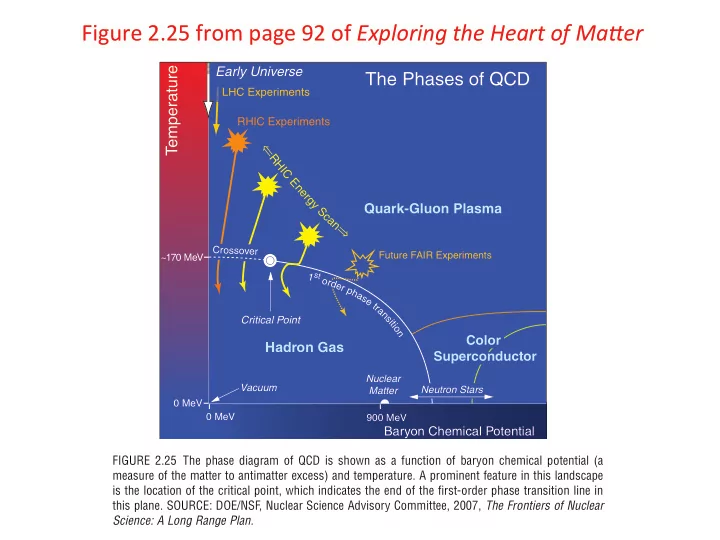
FIGURE 2.25 The phase diagram of QCD is shown as a function of baryon chemical potential (a measure of the matter to antimatter excess) and temperature. A prominent feature in this landscape is the location of the critical point, which indicates the end of the first-order phase transition line in this plane. SOURCE: DOE/NSF, Nuclear Science Advisory Committee, 2007, The Frontiers of Nuclear Science: A Long Range Plan.

slide-2
SLIDE 2

Figure ¡2.20 ¡from ¡page ¡82 ¡of ¡Exploring ¡the ¡Heart ¡of ¡Ma2er ¡

FIGURE 2.20 The ratio of the shear viscosity of a fluid to its entropy density, denoted η/s, can be thought of as the “imperfection index” of a fluid, since it measures the degree to which internal fric- tion damps out the flow of the fluid. Quantum mechanics dictates that there are no fluids with zero imperfection index. The two most perfect fluids known are the trillions-of-degrees-hot quark-gluon plasma that filled the microseconds-old universe and that today is produced in heavy ion collisions at RHIC and the LHC, and the millionths-of-degrees-cold fluid made from trapped atoms with the interaction between atoms tuned to the maximum possible. For comparison, the imperfection indices

  • f several more familiar liquids are also shown. Gases have imperfection indices in the thousands.

The imperfection index is defined as 4πη/s because it is equal to one in any of the many very strongly coupled plasmas that have a dual description via Einstein’s theory of general relativity extended to higher dimensions. Via this duality, 4πη/s =1 is related to long-established and universal properties

  • f black holes. Quark-gluon plasma is the liquid whose imperfection index comes the closest to this
  • value. SOURCE: Adapted from U.S. Department of Energy, 2009, Nuclear Physics Highlights, Oak

Ridge National Laboratory Creative Media Services. Available at http://science.energy.gov/~/media/ np/pdf/docs/nph_basicversion_std_res.pdf.
slide-3
SLIDE 3

Figure ¡2.21 ¡from ¡page ¡85 ¡of ¡Exploring ¡the ¡Heart ¡of ¡Ma2er ¡

FIGURE 2.21 When the almond-shaped initial geometry in an off-center heavy ion collision at RHIC expands as a nearly perfect fluid, it explodes with greater momentum in the direction in which the initial almond is narrowest. SOURCE: Courtesy of Brookhaven National Laboratory.

slide-4
SLIDE 4

Figure ¡2.22 ¡from ¡page ¡87 ¡of ¡Exploring ¡the ¡Heart ¡of ¡Ma2er ¡

0.1 0.2 (radians) 1

  • 1

2 3 4 5

p+p d+Au Au+Au

Jet quenching at RHIC Number of energetic particles

FIGURE 2.22 The extinction of the away-side jet. Collimated patterns of jet particles are observed at ∆Φ = π opposite a trigger particle at ∆Φ = 0 in p + p and d + Au collisions but are completely absent in Au + Au collisions. SOURCE: Adapted from DOE/NSF, Nuclear Science Advisory Committee, 2007, The Frontiers of Nuclear Science: A Long Range Plan.

slide-5
SLIDE 5

Figure ¡2.22 ¡from ¡page ¡87 ¡of ¡Exploring ¡the ¡Heart ¡of ¡Ma2er ¡

0.1 0.2 (radians) 1

  • 1

2 3 4 5

p+p d+Au Au+Au

Jet quenching at RHIC Number of energetic particles

FIGURE 2.22 The extinction of the away-side jet. Collimated patterns of jet particles are observed at ∆Φ = π opposite a trigger particle at ∆Φ = 0 in p + p and d + Au collisions but are completely absent in Au + Au collisions. SOURCE: Adapted from DOE/NSF, Nuclear Science Advisory Committee, 2007, The Frontiers of Nuclear Science: A Long Range Plan.

slide-6
SLIDE 6

Figure ¡2.23 ¡from ¡page ¡88 ¡of ¡Exploring ¡the ¡Heart ¡of ¡Ma2er ¡

1 2 3 4 5 6 7

  • 5

10

  • 4

10

  • 3

10

  • 2

10

  • 1

10

1 Photons from a Heavy Ion Collision

Thermal photons Prompt photons from initial hard collisions

Photon Yield Photon T ransverse Momentum (GeV/c)

PHENIX DA T A Sum: Thermal + Prompt FIGURE 2.23 The measured photon radiation spectrum in Au + Au collisions at RHIC is compared to the spectra expected from photons created by hard collisions in the initial stages of the collision (black curve), from thermal photons radiated by a QGP with an initial temperature (0.33 fm/c after the collision) of 370 MeV (red curve) and from the sum of these processes (blue curve). SOURCE: Courtesy of the PHENIX Collaboration.

slide-7
SLIDE 7

Figure ¡2.24 ¡from ¡page ¡90 ¡of ¡Exploring ¡the ¡Heart ¡of ¡Ma2er ¡

0.05 0.10 0.5 1 1.5 1

KET (GeV) KET/nq(GeV) v2 v2/nq

0.1 0.2 0.3 1 2 3

(PHENIX) K (PHENIX) (STAR) K0

s

p (PHENIX)

(STAR) (STAR)

RHIC Au+Au √sNN = 200 GeV

Baryons (nq=3) Mesons (nq=2)

FIGURE 2.24 The strength of the elliptic flow (v2) is plotted as a function of the transverse kinetic energy KET for various particle species including mesons (pions and kaons) and baryons (protons, Lambdas, and Xi’s) produced in heavy-ion collisions at RHIC (left-hand panel). The right-hand panel shows that the differences between mesons and baryons are eliminated when these quantities are computed on a per-quark basis, strongly suggesting that the flow pattern is determined in the QGP

  • phase. SOURCE: DOE/NSF Nuclear Science Advisory Committee, 2007, The Frontiers of Nuclear Sci-

ence: A Long Range Plan.