Figure 2.14 from page 63 of Exploring the Heart of Ma2er - - PowerPoint PPT Presentation

figure 2 14 from page 63 of exploring the heart of ma2er
SMART_READER_LITE
LIVE PREVIEW

Figure 2.14 from page 63 of Exploring the Heart of Ma2er - - PowerPoint PPT Presentation

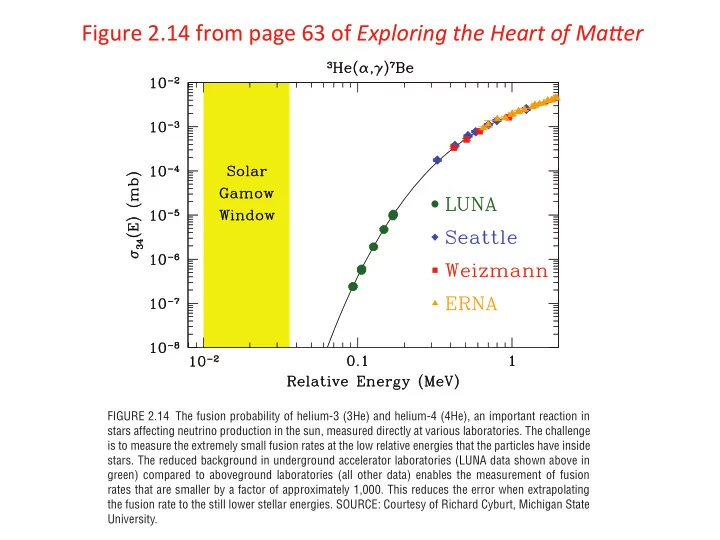
Figure 2.14 from page 63 of Exploring the Heart of Ma2er FIGURE 2.14 The fusion probability of helium-3 (3He) and helium-4 (4He), an important reaction in stars affecting neutrino production in the


slide-1
SLIDE 1

Figure ¡2.14 ¡from ¡page ¡63 ¡of ¡Exploring ¡the ¡Heart ¡of ¡Ma2er ¡

FIGURE 2.14 The fusion probability of helium-3 (3He) and helium-4 (4He), an important reaction in stars affecting neutrino production in the sun, measured directly at various laboratories. The challenge is to measure the extremely small fusion rates at the low relative energies that the particles have inside

  • stars. The reduced background in underground accelerator laboratories (LUNA data shown above in

green) compared to aboveground laboratories (all other data) enables the measurement of fusion rates that are smaller by a factor of approximately 1,000. This reduces the error when extrapolating the fusion rate to the still lower stellar energies. SOURCE: Courtesy of Richard Cyburt, Michigan State University.

slide-2
SLIDE 2
slide-3
SLIDE 3

P = χ III

2

χ I

2 ∝exp −2

k(r)dr

r

1

r

2

$ % & & ' ( ) )

In the case of the Coulomb barrier, the above integral can be evaluated exactly.

logT = a + b Qα

Geiger-Nuttall law of alpha decay 1911

For the Coulomb barrier above, derive the Geiger-Nuttal law. Assume that the energy of an alpha particle is E=Qα, and that the outer turning point is much greater than the potential radius.

T ∝ 1 P

slide-4
SLIDE 4

For a given relative velocity v with projectile number density np

Reaction Rate Definition Reaction Rate Definition

[ ] [ ]

1 1 − −

⋅ ⋅ ⋅ ⋅ = ⋅ ⋅ = s V n v n R s v n

T p p

σ σ λ

reaction/target particle reaction rate in volume V

energy/temperature dependent decay constant λ

slide-5
SLIDE 5

Reaction Rate in Stellar Environment Reaction Rate in Stellar Environment

v n n r

T p

⋅ ⋅ ⋅ = σ

reaction rate per second and cm3:

⋅ Φ ⋅ ⋅ ⋅ ⋅ + = dv v v n n r

T p pT

) ( 1 1 σ δ

Reaction rate for particles with velocity distribution Φ(v)

Accounting for reactions Between identical particles

slide-6
SLIDE 6

In stellar material of temperature T particles follow ideal gas law

kT 2 v 2 2 / 3

2

e 2 4 ) (

m

v kT m v

⎟ ⎟ ⎠ ⎞ ⎜ ⎜ ⎝ ⎛ = Φ π π

= Φ 1 ) ( dv v

with

20 40 60 80 energy (keV) 1 2 3 4 arbitrary units

example: in terms

  • f energy

E=1/2 m v2 max at E=kT

Maxwell Boltzmann Distribution Maxwell Boltzmann Distribution

slide-7
SLIDE 7

Temperature in Stars Temperature in Stars

slide-8
SLIDE 8

> < + = v Y Y r

p T pT

σ ρ δ

2 A 2 N

1 1

> < + = v Yp

pT

σ ρ δ λ

A

N 1 1

reactions per s and cm3 reactions per s & Target nucleus

this is usually referred to as the stellar reaction rate stellar reaction rate units of stellar reaction rate NA<sv>: usually cm3/s/mole

Stellar reaction rates Stellar reaction rates

T A T T A T

Y N A X N n ⋅ ⋅ = ⋅ ⋅ = ρ ρ

XT; mass fraction YT: abundance

slide-9
SLIDE 9

σ: cross section ωγ: res. strength ER: res. energy

Stellar Energy Range -- Gamow Window

  • - Resonance Width

σ

exp ( - E / kT )

N

R

A < σv > ∝ T ωγ

  • 3/2

∝ exp ( - E / kT ) GAMOW PEAK σ ∝ exp ( - b / √E ) ∝ exp ( - E / kT ) RESONANCE σ ∝ Γ2 ( E - E )2

2

+ (Γ / 2)

A

N < σ v > ∝ T

  • 3/2

σ E

exp ( - E / kT ) d E

Nonresonant Reaction Contributions Resonant Reaction Rate

Gamow Gamow-

  • Range & Reaction Rate

Range & Reaction Rate

slide-10
SLIDE 10

The Gamow window or the range of relevant cross section for “non-resonant” processes is calculated:

( )

MeV 122 . 2

3 / 2 9 3 / 1 2 2 2 1 2 / 3

T A Z Z bkT E ⋅ = ⎟ ⎠ ⎞ ⎜ ⎝ ⎛ =

( )

MeV 2368 . 3 4

6 / 5 9 6 / 1 2 2 2 1

T A Z Z kT E E ⋅ = = Δ

with A “reduced mass number” and T9 the temperature in GK

The Gamow Range of Stellar Burning The Gamow Range of Stellar Burning

Check derivation in book

slide-11
SLIDE 11

Note: kT=2.5 keV !

The Gamow peak for The Gamow peak for 12

12C(p,

C(p,γ γ) )13

13N

N

slide-12
SLIDE 12

Examples of Gamow window energies Examples of Gamow window energies

0.01 0.10 1.00 10.00 0.0 0.1 1.0 10.0 temperature [GK] EG amow [M eV]

p+p 12C+p 12C+a 12C+12C

strong dependence

  • n Z & temperature