Fertility Strategies for Lean Current soil test is four years old or - - PowerPoint PPT Presentation

fertility strategies for lean
SMART_READER_LITE
LIVE PREVIEW

Fertility Strategies for Lean Current soil test is four years old or - - PowerPoint PPT Presentation

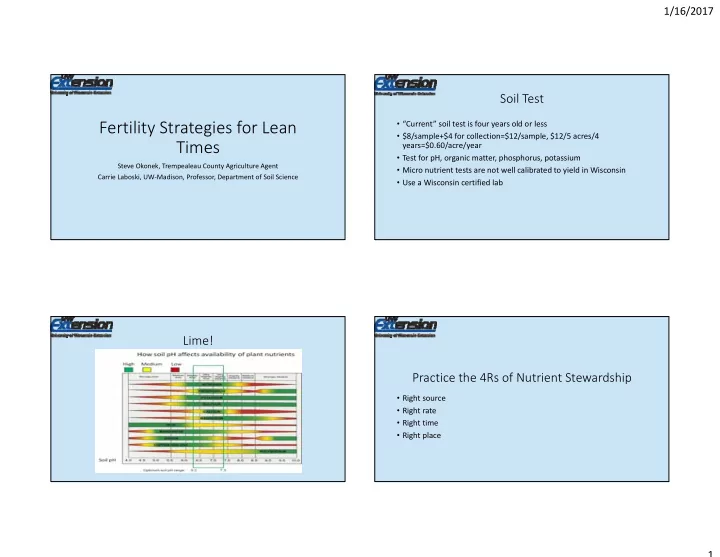
1/16/2017 Soil Test Fertility Strategies for Lean Current soil test is four years old or less $8/sample+$4 for collection=$12/sample, $12/5 acres/4 Times years=$0.60/acre/year Test for pH, organic matter, phosphorus, potassium


slide-1
SLIDE 1

1/16/2017 1

Fertility Strategies for Lean Times

Steve Okonek, Trempealeau County Agriculture Agent Carrie Laboski, UW‐Madison, Professor, Department of Soil Science

Soil Test

  • “Current” soil test is four years old or less
  • $8/sample+$4 for collection=$12/sample, $12/5 acres/4

years=$0.60/acre/year

  • Test for pH, organic matter, phosphorus, potassium
  • Micro nutrient tests are not well calibrated to yield in Wisconsin
  • Use a Wisconsin certified lab

Lime! Practice the 4Rs of Nutrient Stewardship

  • Right source
  • Right rate
  • Right time
  • Right place
slide-2
SLIDE 2

1/16/2017 2

Maximum Return to Nitrogen calculator (MRTN)

  • http://cnrc.agron.iastate.edu/nRate.aspx website for nitrogen rate

calculator

  • Correct nitrogen rate is very difficult to predict
  • Nitrogen mineralization is affected by soil moisture
  • Corn yield is affected by the “Too’s”: too hot, too cold, too wet, too

dry, too early, too late,…

  • Nitrogen rate does not equal corn grain yield
  • MRTN uses many years of plot data to get an economical optimum

nitrogen rate

State: Wisconsin Soil Type: HYP Soils Number of sites: 51 Rotation: Corn Following Soybean

Nitrogen Price ($/lb): 0.31 Corn Price ($/bu): 3.25 Price Ratio: 0.10 MRTN Rate (lb N/acre): 121 Profitable N Rate Range (lb N/acre): 104 ‐ 136 Net Return to N at MRTN Rate ($/acre): $130.77 Percent of Maximum Yield at MRTN Rate: 98% Anhydrous Ammonia (82% N) at MRTN Rate (lb product/acre): 147 Anhydrous Ammonia (82% N) Cost at MRTN Rate ($/acre): $37.51

slide-3
SLIDE 3

1/16/2017 3

Cut back on P & K applications

  • Always fertilize according to a current soil test
  • Probability of response to P is very low if soils are optimum to high
  • P is vital for growth and development, used as a catalyst
  • Response to K is more probable
  • Use limited dollars to supply K

Evaluate necessity of starter

  • Wisconsin research shows no response to starter if P tests optimum
  • r higher
  • Starter response is not affected by placement
  • 2x2 less risk of injury
  • Fields with manure applications very low probability of response to

starter

  • Soybean does not respond to traditional starter
slide-4
SLIDE 4

1/16/2017 4

Sulfur

  • Use sulfur on low organic matter, sands
  • Manure supplies more than enough sulfur
  • Use sulfate forms, elemental very slow release
  • 150 bushel corn requires 9 lbs. sulfur

Micronutrients

  • Micronutrients are seldom deficient in Wisconsin
  • Do not add micros just because a pass is being made across a field
  • Manure is great source of micros
  • Corn and soybean never show boron deficiency in Wisconsin
  • Tissue sampling is calibrated to specific growth stages of each crop

Manure is awesome stuff!

  • Credit what you spread
  • Target manure to fields that have shown sulfur deficiency
  • Light applications across many acres could be beneficial over heavy
  • n a few acres
  • Be mindful of slope, frozen ground, distance to streams, etc.

Tissue testing

  • Tissue testing calibrated to specific crop growth stage
  • Corn, ear leaf before silks brown, most mature leaf below whorl, or entire

above ground plant <12” tall

  • Soybean, last fully expanded trifoliate leaf at R1, do not sample when pods

begin to fill

  • Alfalfa, top six inches at pre‐flower
  • Testing outside of the calibrated stage is not reliable
  • Tissue and micro‐nutrient testing does not have to be state certified
  • Tissue testing best used to diagnose problem areas compared to good

areas

slide-5
SLIDE 5

1/16/2017 5

Summary

  • Using evidence based inputs yields best chance for success
  • Avoid the temptation to add “only a few dollars per acre”
  • Use labs and procedures certified by Wisconsin
  • Procedures and recommendations calibrated for Wisconsin climate and soils
  • Be sure pH is correct first
  • Micros seldom deficient
  • Use MRTN for nitrogen rates!