Determining Swine Manure Nutrient Determining Swine Manure Nutrient - - PowerPoint PPT Presentation

determining swine manure nutrient determining swine
SMART_READER_LITE
LIVE PREVIEW

Determining Swine Manure Nutrient Determining Swine Manure Nutrient - - PowerPoint PPT Presentation

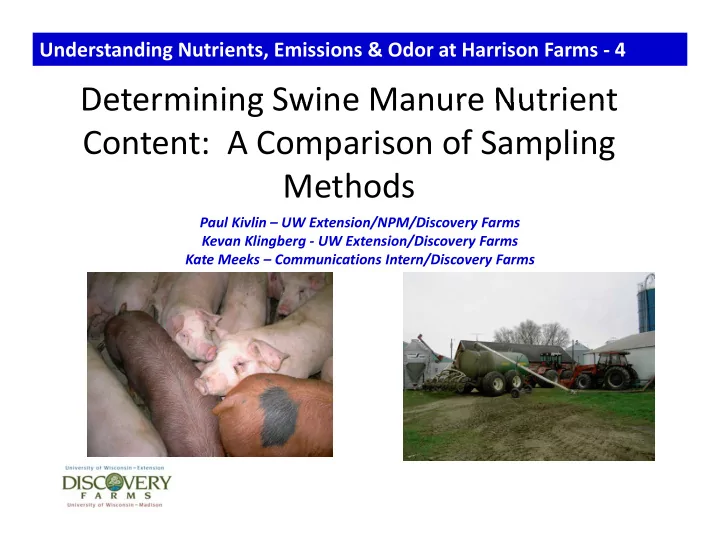
Understanding Nutrients, Emissions & Odor at Harrison Farms 4 Determining Swine Manure Nutrient Determining Swine Manure Nutrient Content: A Comparison of Sampling Methods Paul Kivlin UW Extension/NPM/Discovery Farms Kevan Klingberg


slide-1
SLIDE 1

Determining Swine Manure Nutrient

Understanding Nutrients, Emissions & Odor at Harrison Farms ‐ 4

Determining Swine Manure Nutrient Content: A Comparison of Sampling Methods

Paul Kivlin – UW Extension/NPM/Discovery Farms Kevan Klingberg ‐ UW Extension/Discovery Farms Kevan Klingberg UW Extension/Discovery Farms Kate Meeks – Communications Intern/Discovery Farms

slide-2
SLIDE 2

Introduction Introduction

  • Manure is an excellent source of nitrogen,

g , phosphorus, and potassium as well as organic matter, sulfur, and a number of micronutrients.

  • To properly utilize manure’s nutrients as a

fertilizer for crop production, producers must fertilizer for crop production, producers must know two key values:

– Application Rate, – Manure Nutrient Content – Manure Nutrient Content.

slide-3
SLIDE 3

Introduction Application Rate? Nutrient Content? Nutrient Content?

slide-4
SLIDE 4

Introduction

Manure application rate

  • Knowing how much manure is applied to a

g pp field is critical for nutrient crediting.

  • To determine manure application rates, you

need to know two factors:

– tons or gallons of manure in the spreader, g p , and – amount of land covered with a load.

slide-5
SLIDE 5

Introduction

Manure application rate

  • One way to calibrate a spreader is to weigh the

spreader when it is full and again when it is empty: spreader when it is full and again when it is empty:

Full wt – empty wt = amount of manure applied.

  • Then, measure the area where the manure was

applied: pp

L (ft) x W (ft) divided by 43,560 = acres.

  • Amount of manure applied divided by acres

= tons or gallons per acre. to s o ga o s pe ac e

slide-6
SLIDE 6

Introduction

Manure nutrient content

  • Varies by animal species,
  • Influenced by animal diet, type of housing, and type of

manure handling equipment.

  • To properly utilize manure nutrients, producers need to

know how many pounds of nitrogen, phosphorus, and potassium are in a given volume or weight of manure.

– Expressed as pounds of nutrient per 1000 gallons for liquid manure, and pounds of nutrient per ton for solid manure.

  • To determine these numbers a producer can:

– use “book values” or, – have a manure analysis performed by a laboratory.

slide-7
SLIDE 7

EXAMPLE

slide-8
SLIDE 8

Introduction

  • Book values are derived by compiling the results of many years of

sample analysis conducted at certified laboratories.

– Book values are available for most livestock species and are a good starting point for nutrient crediting.

  • Many producers want to know if the manure produced on their

farm is different from the average. Need manure analysis:

– Collect a representative sample and have a laboratory test the nutrient content. G d t d i i f f ith t – Good management decision for farms with manure storage. – Differences in manure system design and handling practices can cause significant variation from “average” manure nutrient content values. significant variation from average manure nutrient content values.

slide-9
SLIDE 9

Introduction

  • Typically, manure samples are taken as the

storage system is agitated, just prior to land application application.

– Agitation helps provide a uniform sample Agitation helps provide a uniform sample. – Since pit agitation and manure application occur ithi l ti l h t ti l b l i lt within a relatively short time span, lab analysis results are often received long after manure has been spread. – This can result in an incorrect (or at least unknown) level of nutrients applied to fields.

slide-10
SLIDE 10

Application rate A copy of the factsheet “Know H M h Y H l” b How Much You Haul” can be downloaded to help calculate spreading rates: http://ipcm.wisc.edu/LinkClick. aspx?fileticket=f99JuJSjYdg%3D &tabid=114&mid=669 &tabid=114&mid=669 Page 1 of Know How Much You Haul, UEWX Nutrient and Pest Management Program Program.

slide-11
SLIDE 11

Page 2 of Know How Much You Haul, UEWX Nutrient and Pest Management Program.

slide-12
SLIDE 12

Project

  • E & L Harrison Enterprises, Inc. asked Discovery Farms to help with

a study to develop a sampling protocol for swine operations with under floor liquid manure storage pits.

  • The goal was to provide a more timely manure analysis so that

proper application rates could be determined prior to spreading.

  • The project’s purpose was to determine whether manure samples

which were collected and analyzed prior to agitation, accurately represented the concentration of nutrients in manure after it is represented the concentration of nutrients in manure after it is agitated and applied to the field?

  • This project sampled and analyzed manure nutrient content from

p j p y the whole pit profile depth approximately two weeks before agitating and emptying the manure pit.

slide-13
SLIDE 13

Project Methods

  • Swine manure was sampled from concrete pits, beneath

confinement feeding floors from four finishing barns during:

spring 2002 – spring 2002, – fall 2002, – spring 2003.

  • During the study period the samples were collected from each pit

using two different methods:

– Vertical pit profile sample, – Load sample.

slide-14
SLIDE 14

Project Methods

Vertical pit profile sample

  • Sample taken to capture a profile of the full pit depth, two weeks

prior to agitation using a sampling tube prior to agitation, using a sampling tube.

– Tube was a homemade, 10‐ft. long x 1‐in. diameter PVC pipe with a simple rope and ball stopper. – Tube is pushed vertically into the manure as close to the bottom as possible (tube length should represent depth of the pit). – Once in place and filled, the ball is pulled up to seal the tube. – Profile sample is taken from the entire depth of the pit – Profile sample is taken from the entire depth of the pit.

  • The nutrient concentration information for this sampling method is

referred to as “profile” in Figure 1. p g

slide-15
SLIDE 15

Project Methods

Picture from: Coffey, R., G. Parker, K. Laurent, and D. Overhults. 2000. Sampling Animal Manure.

  • Pub. ID‐148. University of Kentucky Cooperative Extension Service. Lexington, KY.
slide-16
SLIDE 16

Project Methods

Load sample

  • This technique takes three samples, gathered while the pit is

q p , g p being agitated, and tankers were being filled.

– This is the more common method of sampling This is the more common method of sampling .

  • Samples were taken from:
  • Samples were taken from:

– first load (top of the manure pit), – middle load (middle of the manure pit), l t l d (b tt f th it) – last load (bottom of the manure pit).

  • This sampling method is referred to as “agitated” in Figure 1.
slide-17
SLIDE 17

Project Methods

  • Manure samples were analyzed for nutrient

content at the UW‐Soil and Forage Analysis content at the UW Soil and Forage Analysis Laboratory, Marshfield, WI.

slide-18
SLIDE 18

Project Results

  • Over the three season sample period, nine

sets of “agitated” liquid manure samples were collected and analyzed. N=9.

  • During the same sample period seven
  • During the same sample period, seven

“profile” liquid manure samples were collected and analyzed N=7 collected and analyzed. N=7.

slide-19
SLIDE 19

Project Results

Figure 1: Liquid Swine Manure Nutrient Contents

40 i d

Figure 1: Liquid Swine Manure Nutrient Contents

30 35 39 37 33 al. Agitated Profile UW‐Book 15 20 25 27 21 29 19 25 24 Lbs./1000 ga 5 10 N P205 K20

Manure Nutrients

The “agitated samples” were two pounds higher in N and K2O than the “profile samples” and two pounds lower in P2O5.

slide-20
SLIDE 20

Project Results

  • Figure 1 shows the average manure analysis for the 2 sampling methods,

– Also shows the book values for liquid swine manure (University of Wisconsin).

  • The 2 sampling methods produced results which are remarkably similar,

– “Agitated samples” were two pounds higher in N and K2O than the “profile samples” and two pounds lower in P2O5.

  • Sample set was not large enough to draw statistical conclusions, yet:

– For producers who want some guidance in determining acceptable application rates, the profile sampling technique used in this project provided a representative sample representative sample.

  • On this operation ‐ during this sampling period, for analyzed manure,

regardless of sampling method:

– Nitrogen and phosphorus levels were both higher than UWEX book value, while the potassium concentrations were lower than book value.
slide-21
SLIDE 21

Project Conclusion

  • These results indicate that on confinement swine
  • perations, sampling a below barn manure pit, using the

“profile” technique two weeks prior to agitation and hauling provided reasonable nutrient concentrations for nutrient crediting.

  • Profile sampling produced nutrient content results similar

to those achieved from sampling during pit agitation and hauling.

  • The profile manure sampling method returned lab results

The profile manure sampling method returned lab results in a timely manner, allowing for more accurate nutrient crediting of manure applied for crop production.

slide-22
SLIDE 22

Information Available

  • This presentation is the fourth in a series of four

developed to provide the data and information ll d E & L H i E i I collected at E & L Harrison Enterprises, Inc.

  • There are 4 factsheets 4 briefs and 4 presentations

There are 4 factsheets, 4 briefs and 4 presentations associated with this project. ll f h b f d l bl

  • All factsheets, briefs and presentations are available on

the UW ‐ Discovery Farms website.

  • http://www.uwdiscoveryfarms.org
slide-23
SLIDE 23

Acknowledgement Thank you to the Wisconsin Pork Thank you to the Wisconsin Pork Association for their interest and support of this project.

slide-24
SLIDE 24

For Additional Information http://www.uwdiscoveryfarms.org

UW Discovery Farms 40195 Winsand Drive PO Box 429 Pigeon Falls, WI 54760 1‐715‐983‐5668

jgoplin@wisc.edu kevan.klingberg@ces.uwex.edu g g@