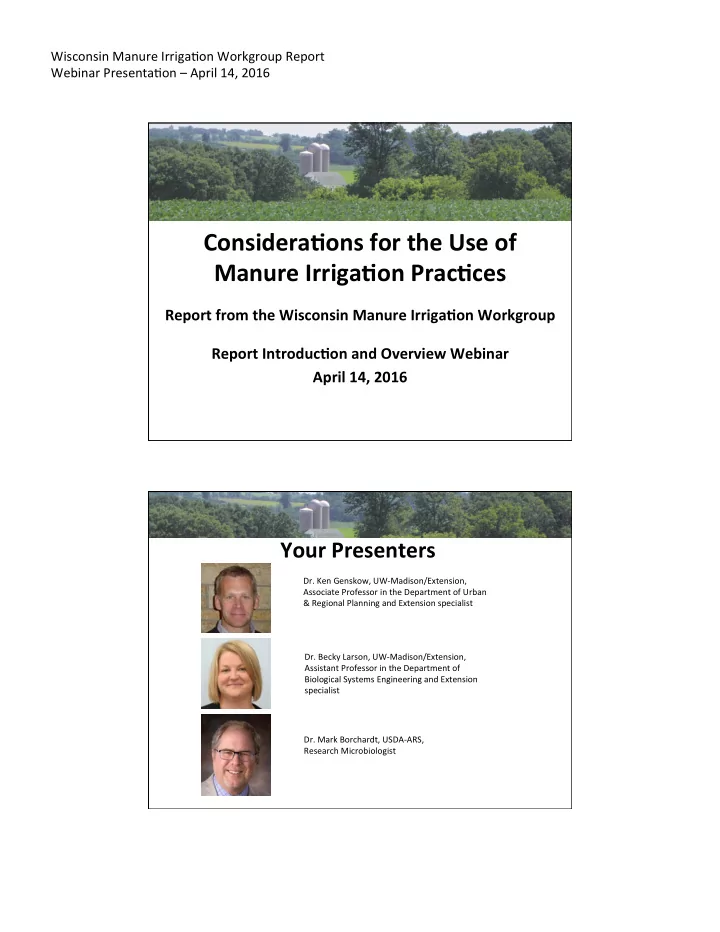
Considera*ons for the Use of Manure Irriga*on Prac*ces Report from - - PDF document

considera ons for the use of manure irriga on prac ces
SMART_READER_LITE
LIVE PREVIEW

Considera*ons for the Use of Manure Irriga*on Prac*ces Report from - - PDF document

Wisconsin Manure Irriga/on Workgroup Report Webinar Presenta/on April 14, 2016 Considera*ons for the Use of Manure Irriga*on Prac*ces Report from the Wisconsin Manure Irriga*on Workgroup Report Introduc*on and Overview Webinar April 14,


slide-1
SLIDE 1

Wisconsin Manure Irriga/on Workgroup Report Webinar Presenta/on – April 14, 2016

Considera*ons for the Use of Manure Irriga*on Prac*ces

Report from the Wisconsin Manure Irriga*on Workgroup Report Introduc*on and Overview Webinar April 14, 2016

Your Presenters

  • Dr. Ken Genskow, UW-Madison/Extension,

Associate Professor in the Department of Urban & Regional Planning and Extension specialist

  • Dr. Mark Borchardt, USDA-ARS,

Research Microbiologist

  • Dr. Becky Larson, UW-Madison/Extension,

Assistant Professor in the Department of Biological Systems Engineering and Extension specialist

slide-2
SLIDE 2

Wisconsin Manure Irriga/on Workgroup Report Webinar Presenta/on – April 14, 2016

You may submit ques/ons at any /me

Desktop Applica/on

web browser

slide-3
SLIDE 3

Wisconsin Manure Irriga/on Workgroup Report Webinar Presenta/on – April 14, 2016

ios Android

Look for the “?”

Today

Overview of Manure Irriga/on Workgroup and Report Outline

– Ken Genskow, UW-Madison/Extension

Review or manure irriga/on prac/ces and issues

– Becky Larson, UW-Madison/Extension

Summary of airborne pathogen driY study

– Mark Borchardt, USDA-ARS

Overview of workgroup recommenda/ons

– Ken Genskow, UW-Madison/Extension

Ques/ons: ~ 30 minutes

slide-4
SLIDE 4

Wisconsin Manure Irriga/on Workgroup Report Webinar Presenta/on – April 14, 2016

Manure Irriga/on Workgroup

Purpose: Review issues and develop guidance on the prac/ces of applying livestock manure or process wastewater through irriga/on equipment Audience:

  • State and local agencies and officials
  • Interested/concerned stakeholders
  • Producers interested in the prac/ces

Manure Irriga/on Workgroup

  • Scope of review:

– benefits, – concerns, – remaining ques/ons

  • Decisions: Consensus seeking
  • Product: guidance and recommenda/ons for stakeholders and

those interested in establishing policy – local and state officials.

  • Workgroup had no formal authority to establish policy

hap://fyi.uwex.edu/manureirriga/on/

slide-5
SLIDE 5

Wisconsin Manure Irriga/on Workgroup Report Webinar Presenta/on – April 14, 2016

Manure Irriga/on Workgroup

Composi*on: UW-Madison/Extension (3) USDA-ARS (1) USDA-NRCS (1) WDNR (2) WDATCP (1) WDHS (2)

Public Forums May 2013 Workgroup mee/ngs: July 2013 – September 2015 (16 mee/ngs) Concurrent pathogen driY study by USDA-ARS & UW-Madison: 2013-2015

County Health Departments (2) Dairy Farmers (3) Professional agronomist (1) Nutrient applicator (1) Organic Farmer/concerned ci/zen (1) Wisconsin Land+Water Assoc (1)

Iden/fied for Workgroup

Benefits

  • Timing of manure

applica/on

  • Road safety and reduced

road damage

  • Farm management and

economic benefits Concerns

  • Public health risk from

airborne pathogens and

  • ther contaminants
  • DriY
  • Odor and other quality of

life concerns

  • Surface water quality
  • Groundwater
  • Implementa/on and

compliance

slide-6
SLIDE 6

Wisconsin Manure Irriga/on Workgroup Report Webinar Presenta/on – April 14, 2016

Workgroup Report

  • 1. Introduc/on
  • 2. Manure content, management, and current regula/ons
  • 3. Considera/ons for manure irriga/on prac/ce
  • a. Droplet driY
  • b. Odor
  • c. Water quality
  • d. Air quality
  • e. Airborne pathogens
  • f. Timing
  • g. Other management issues
  • 4. Scenarios
  • 5. Response & recommenda/ons

Appendices – including pathogen driY study expanded summary

12

Manure Systems

slide-7
SLIDE 7

Wisconsin Manure Irriga/on Workgroup Report Webinar Presenta/on – April 14, 2016

13

Manure Application Methods

14

Traveling Gun

slide-8
SLIDE 8

Wisconsin Manure Irriga/on Workgroup Report Webinar Presenta/on – April 14, 2016

15 16

Center Pivot

slide-9
SLIDE 9

Wisconsin Manure Irriga/on Workgroup Report Webinar Presenta/on – April 14, 2016

17 18

slide-10
SLIDE 10

Wisconsin Manure Irriga/on Workgroup Report Webinar Presenta/on – April 14, 2016

19 20

slide-11
SLIDE 11

Wisconsin Manure Irriga/on Workgroup Report Webinar Presenta/on – April 14, 2016

21

Operation

Can control many pieces on the system:

  • Speed of travel
  • Pressure
  • Nozzle type
  • End gun shut off
  • Computerized systems which detect wind speed, etc.
  • More specialized application

22

http://cropmetrics.com/features/variable-rate-irrigation/

slide-12
SLIDE 12

Wisconsin Manure Irriga/on Workgroup Report Webinar Presenta/on – April 14, 2016

23

Considerations for Practice

24

Drift

  • Aerial movement of liquid
  • utside the intended application

area

  • Different than overspray
  • Concerns for surface waters,

residences, public areas, other crops, etc.

  • No regulations for other manure

application methods

  • Drift from manure irrigation can

be minimized by:

§ Maximizing droplet size § Minimizing release height (e.g. drop nozzles) § Minimizing wind speeds § Using barriers (e.g. tree lines)

slide-13
SLIDE 13

Wisconsin Manure Irriga/on Workgroup Report Webinar Presenta/on – April 14, 2016

25

Odor

  • Odor perception is variable
  • Manure odors can be from 300+

compounds

  • Great citizen concern for odors

produced

  • Odor will be generally be greater for

manure irrigation systems compared to other application methods

  • Odor mitigation

§ Dispersion (winds greater than 5mph) § Edge of field barriers § Consideration of neighbors § Proximity to receptors § Manure processing § Large droplets

26

Water Quality

  • Concerns for runoff and

impact to groundwater

  • May decrease runoff and

leaching due reduced volume applied for each application period

  • Need to apply to current

regulations including NRCS CPS 590

  • Issues with compliance/

monitoring and enforcement

http://passel.unl.edu/pages/ informationmodule.php? idinformationmodule=1088801071&topicor der=14&maxto=16

slide-14
SLIDE 14

Wisconsin Manure Irriga/on Workgroup Report Webinar Presenta/on – April 14, 2016

27

Air Quality

  • Issues of concern include

§ Particulate matter § Greenhouse gas emissions § Hazardous air pollutants (including ammonia and hydrogen sulfide)

  • OSHA Occupational Standards and Wisconsin Ambient

Air Standards

  • Field concentrations of many hazardous air pollutants are

below standards (more of a concern at the farmstead near the manure storage)

  • Mitigation techniques

§ Edge of field barriers § Large droplets § Low release height

28

Application Timing

slide-15
SLIDE 15

Wisconsin Manure Irriga/on Workgroup Report Webinar Presenta/on – April 14, 2016

29

Quan*ta*ve Microbial Risk Assessment for Es*ma*ng Setback Distance from Aerial Irriga*on of Dairy Manure

Mark Borchardt, Tucker Burch, Susan Spencer,

USDA – Agricultural Research Service

Joel Stokdyk and Aaron Firnstahl

US Geological Survey Wisconsin Water Science Center

Becky Larson, Dept Biological Systems Engineering UW-Madison Burney Kieke, Marshfield Clinic Research FoundaIon Ana Rule, Bloomberg School of Public Health, Johns Hopkins University

slide-16
SLIDE 16

Wisconsin Manure Irriga/on Workgroup Report Webinar Presenta/on – April 14, 2016

Project Objectives

  • 1. Iden/fy the risk of acute gastrointes/nal illness

from airborne pathogens during manure irriga/on. Relate risk levels to distance from irrigated manure.

  • 2. Iden/fy other variables (e.g., weather condi/ons)

most important for airborne pathogen transport during manure irriga/on Conceptual Model

InacIvaIon IrrigaIon

Inhala*on Fomite deposi*on Garden/Food

Exposure

Vector

Aerosols and Droplets

slide-17
SLIDE 17

Wisconsin Manure Irriga/on Workgroup Report Webinar Presenta/on – April 14, 2016

Research Approach

Field Data Modeling Risk Assessment

  • 25 field trials

– 15 traveling gun, 8 center pivot, 2 tanker

  • Measured microbe concentra/ons in manure

and at mul/ple distances for each trial

– qPCR and culture

  • Collected weather data for each trial

Research Approach

Field Data Modeling Risk Assessment

slide-18
SLIDE 18

Wisconsin Manure Irriga/on Workgroup Report Webinar Presenta/on – April 14, 2016

Mean temperature (°F) Max wind speed (MPH) Mean wind speed (MPH) Mean solar irradiance (W/m2) Mean rela/ve humidity (%)

Weather Conditions during Manure Irrigation Trials

Gram-Negative Bacteria in Air During Travelling Gun Manure Irrigation

May 22, 2014; 11 mph wind; 530 W/m2 solar irradiance; 50% relative humidity; 68 °F temp

Notes

  • MacConkey agar in

Anderson samplers

  • Air sample volume was 540

liters

  • Downwind distances were

perpendicular to gun movement

  • Manure diluted 1:100

before plating 100 µl

slide-19
SLIDE 19

Wisconsin Manure Irriga/on Workgroup Report Webinar Presenta/on – April 14, 2016

Research Approach

Field Data Modeling Risk Assessment

  • Sta/s/cal modeling (i.e., regression)
  • 2 objec/ves:

– Predict air concentra/ons for risk assessment – Relate air concentra/ons to weather condi/ons and microbe concentra/ons in manure

Research Approach

Field Data Modeling Risk Assessment

  • Sta/s/cally most important variables:

– Distance from irrigated manure – Wind speed – Pathogen concentra/ons in manure

slide-20
SLIDE 20

Wisconsin Manure Irriga/on Workgroup Report Webinar Presenta/on – April 14, 2016

Research Approach

Field Data Modeling Risk Assessment

  • Quan/ta/ve microbial risk assessment

– Predic/ve alterna/ve to epidemiology – Relies on dose-response models

  • Inputs: pathogen prevalence, distance, age,

inhala/on rate, /me spent outdoors

  • 2 pathogen surrogates: bovine Bacteroides

and gram nega/ve bacteria Risk vs. Distance Median of the Risk Distribution

AGI: acute gastrointes/nal illness, GN: gram nega/ve bacteria, BB: bovine Bacteroides

slide-21
SLIDE 21

Wisconsin Manure Irriga/on Workgroup Report Webinar Presenta/on – April 14, 2016

Risk vs. Distance 75th Percentile of the Risk Distribution

AGI: acute gastrointes/nal illness, GN: gram nega/ve bacteria, BB: bovine Bacteroides

Previous Risk Assessments

slide-22
SLIDE 22

Wisconsin Manure Irriga/on Workgroup Report Webinar Presenta/on – April 14, 2016

This Study’s Risk Es/mates Rela/ve to Previous Risk Assessments

Risk = 1 in 100,000 Risk = 1 in 100

Summary

  • At 500 feet downwind from dairy manure irrigation

illness risk is on the order of 1/100,000 to 1/100 per irrigation event

  • Risk depends on pathogen type, pathogen

prevalence, downwind distance, and the number of irrigation events

  • Pathogen air concentrations downwind from manure

irrigation depend on wind speed, pathogen concentrations in manure, and distance

  • This study is unique for using field data and state-of-

the-art statistical modeling and risk assessment methods

slide-23
SLIDE 23

Wisconsin Manure Irriga/on Workgroup Report Webinar Presenta/on – April 14, 2016

Acknowledgements

  • We thank …
  • Jan Altmann, Jordan Gonnering, Hana Millen and

Zach Zopp for field and laboratory work

  • John Panuska for contribu/ons to the study

design

  • Scoa Fischer and owners and staff of

par/cipa/ng dairy farms

  • Philip Schmidt, Peter Teunis, and Norval Strachan

for dose-response parameter distribu/ons

  • This study was funded in part by the Wisconsin

Department of Natural Resources

Workgroup Recommenda/ons

  • Mul/ple mee/ngs
  • Consensus seeking

Consensus: unanimous agreement – could “live with” Near consensus: high level of agreement (all but 1 or 2) Close to near consensus: a few not in agreement No agreement: broader disagreement

slide-24
SLIDE 24

Wisconsin Manure Irriga/on Workgroup Report Webinar Presenta/on – April 14, 2016

Consensus Baseline Recommenda/ons

If using manure irriga/on, in all cases must:

  • Follow all exis/ng laws for animal waste and nutrient

management

  • Have and follow 590-standard Nutrient Management Plan
  • Take appropriate steps to minimize driY
  • Ensure no overspray of irrigated manure
  • Have suitable means of supervising/controlling equipment
  • Have suitable means of determining relevant weather info
  • Have means of preven/ng backflow if connected to water
  • Ensure no human waste or septage is processed with manure

Consensus Recommenda/ons (con/nued)

  • Determine wind speed as 15-minute mean at field
  • Drop nozzles if center pivot
  • Nozzles and pressures for “coarse” or larger droplet sizes
  • All applica/ons and setbacks in accordance with 590-NMP
  • No more than 8 irrigated applica/ons to any 1 field per season

(with poten/al for more if treated with acceptable technology)

slide-25
SLIDE 25

Wisconsin Manure Irriga/on Workgroup Report Webinar Presenta/on – April 14, 2016

Weaed Perimeter

Minimum distance from weaed perimeter

Setback Distance

slide-26
SLIDE 26

Wisconsin Manure Irriga/on Workgroup Report Webinar Presenta/on – April 14, 2016

Setback – Road Right-of-Way

0 feet: Near consensus, all types of roads and highways 0 feet: Consensus, public forests with no recrea/onal access 0 feet: Near consensus, private forests

Setback – Forests

slide-27
SLIDE 27

Wisconsin Manure Irriga/on Workgroup Report Webinar Presenta/on – April 14, 2016

Setback – Adjacent Ag Proper/es

0 feet: Near consensus – pasture and crops that are not

  • rganic or raw consumed

0 – 50 feet: Close to near consensus – regardless of crop

Setback - Dwelling

500 – 750 feet: Near consensus, under various condi/ons for wind speed and direc/on 250 feet: Close to near consensus, for some situa/ons; no agreement for others

slide-28
SLIDE 28

Wisconsin Manure Irriga/on Workgroup Report Webinar Presenta/on – April 14, 2016 100 feet: Near consensus, IF wind-speed ≤ 10 mph AND parallel or away from property line Other distances: No agreement

Setback– Property Line for Public Recrea/on Area, School, Playground

Night-/me Applica/on

Consensus: NOT for raw/untreated Near consensus: same as daylight IF manure treated AND wind- speed ≥ 2 mph but ≤ 10 mph AND wind is parallel

  • r away from building or property line
slide-29
SLIDE 29

Wisconsin Manure Irriga/on Workgroup Report Webinar Presenta/on – April 14, 2016

Next Steps

Short term:

  • Next 30 minutes: Ques/ons from today’s presenta/ons
  • Next 4-5 weeks: Ques/ons/comments submiaed via the

manure irriga/on workgroup website

  • Week of May 16: Webinar #2 – Responding to ques/ons
  • FAQ document

Beyond:

  • Poten/al for shared website with links to new research
  • Local discussions and decisions around these prac/ces
  • Poten/al future forum

Thank You

Report available soon aYer the webinar ends at: hap://fyi.uwex.edu/manureirriga/on/