Fast microwave assisted synthesis of p -methoxyphenyltellurium - - PDF document

fast microwave assisted synthesis of p
SMART_READER_LITE
LIVE PREVIEW

Fast microwave assisted synthesis of p -methoxyphenyltellurium - - PDF document

[d003] Fast microwave assisted synthesis of p -methoxyphenyltellurium trichloride Julio A. Seijas,* M. Pilar Vzquez-Tato,* Alberto Mena-Menndez Departamento de Qumica Orgnica. Facultade de Ciencias. Universidade de Santiago de Compostela.


slide-1
SLIDE 1

Fast microwave assisted synthesis of p-methoxyphenyltellurium trichloride

Julio A. Seijas,* M. Pilar Vázquez-Tato,* Alberto Mena-Menéndez

Departamento de Química Orgánica. Facultade de Ciencias. Universidade de Santiago de

  • Compostela. Campus de Lugo. Alfonso X el Sabio, 27002-Lugo. Spain

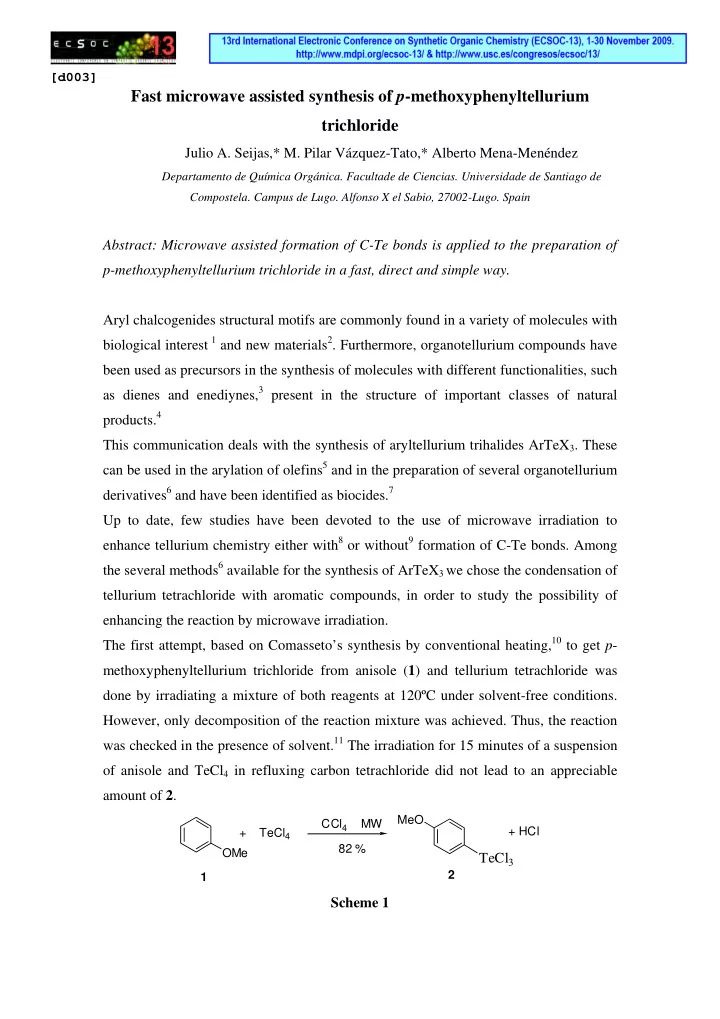
Abstract: Microwave assisted formation of C-Te bonds is applied to the preparation of p-methoxyphenyltellurium trichloride in a fast, direct and simple way. Aryl chalcogenides structural motifs are commonly found in a variety of molecules with biological interest 1 and new materials2. Furthermore, organotellurium compounds have been used as precursors in the synthesis of molecules with different functionalities, such as dienes and enediynes,3 present in the structure of important classes of natural products.4 This communication deals with the synthesis of aryltellurium trihalides ArTeX3. These can be used in the arylation of olefins5 and in the preparation of several organotellurium derivatives6 and have been identified as biocides.7 Up to date, few studies have been devoted to the use of microwave irradiation to enhance tellurium chemistry either with8 or without9 formation of C-Te bonds. Among the several methods6 available for the synthesis of ArTeX3 we chose the condensation of tellurium tetrachloride with aromatic compounds, in order to study the possibility of enhancing the reaction by microwave irradiation. The first attempt, based on Comasseto’s synthesis by conventional heating,10 to get p- methoxyphenyltellurium trichloride from anisole (1) and tellurium tetrachloride was done by irradiating a mixture of both reagents at 120ºC under solvent-free conditions. However, only decomposition of the reaction mixture was achieved. Thus, the reaction was checked in the presence of solvent.11 The irradiation for 15 minutes of a suspension

  • f anisole and TeCl4 in refluxing carbon tetrachloride did not lead to an appreciable

amount of 2.

OMe + TeCl4

TeCl3

MeO 82 % + HCl CCl4 MW 1 2

Scheme 1

[d003]

slide-2
SLIDE 2

With the purpose of using higher temperatures the irradiation was carried out in a sealed

  • vessel. Hence, a 1:1 ratio of anisole and TeCl4 was irradiated for 10 minutes with the

maximum temperature control set at 120ºC and irradiation power 80W, yielding a 73%

  • f p-methoxyphenyltellurium trichloride (2). Raising the irradiation power to 100W in

the same reaction time the yield reached 82%, higher irradiation powers (200W, 250W) did not increase the yield. In summary, here is reported the first microwave-assisted formation of aryltellurides. This proves that microwaves are a valuable tool for the formation of Ar-C bonds,

  • pening a new facet in the field of organochalcogenide chemistry.

Acknowledgements XUNTA DE GALICIA for financial support: PGIDIT05PXIB26201PR. Experimental procedure Anisole (540 mg, 5 mmol ), TeCl4 (135 mg, 0,5 mmol) and CCl4 are mixed in a sealed

  • vessel. Reaction mixture was irradiated in a CEM Discover monomode oven for 10

minutes at 120ºC (100W). On cooling the reaction mixture, a yellow crystalline solid crystallizes out, this was filtered and vacuum dried. The solid (139 mg, 82%) was identified as p-methoxyphenyltellurium trichloride (2). IR(Golden-Gate): 3013, 1566, 1485, 1256, 1180, 1046, 817 cm-1. 1H NMR (CDCl3) δ 3.81 (s, 3H, OCH3), 6.99 (d, 2H, J=9Hz.), 8.31 (d, 2H, J= 9Hz.). 13C NMR (CDCl3) δ 56.16, 114.06, 114.64, 134.59, 135.93. MS m/z (%) 344 (M++4, 39), 342 (M++2, 36), 340 (M+ [3xCl35, Te128], 23), 307 (19), 305 (15), 303 (8), 272 (85), 270 (73), 268 (40), 237 (65), 235 (60), 233 (37), 214 (100), 199 (87), 142 (90).

1 Kaldor, S. W.; Kalish, V. J.;Davies II, J. F.; Shetty, B. V.; Fritz, J. E.; Appelt, K.; Burgess, J. A.;

Campanale, K. M.; Chirgadze, N. Y.; Clawson, D. K.; Dressman, B. A.; Hatch, S. D.; Khalil, D. A.; Kosa, M. B.; Lubbehusen, P. P.; Muesing, M. A.; Patick, A. K.; Reich, S. H.; Su, K. S.; Tatlock, J. H. J.

  • Med. Chem. 1997, 40, 3979. Liu, G.; Huth, J. R.; Olejniczak, E. T.; Mendoza, R.; DeVries, P.; Leitza, S.;

Reilly, E. B.; Okasinski, G. F.; Fesik, S. W.; von Geldern, T. W. J. Med. Chem. 2001, 44, 1202. Liu, L.; Stelmach, J. E.; Natarajan, S. R.; Chen, M.-H.; Singh, S. B.; Schwartz, C. D.; Fitzgerald, C. E.; O'Keefe,

  • S. J.; Zaller, D. M.; Schmatz, D. M.; Doherty, J. B. Bioorg. Med. Chem. Lett. 2003, 13, 3979. Parnham,
  • M. J.; Graf, E. Prog. Drug Res. 1991, 36, 9. Goudgaon, N. M.; Naguib, F. N. M.; el Kouni, M. H.;

Schinazi, F. J. Med. Chem. 1993, 36, 4250. Mugesh, G.; du Mont, W.-W.; Sies, H. Chem. ReV. 2001, 101, 2125. Zhang, S.-J.; Dong, J.-Q.;Wang, Y.-G. Synth. Commun. 2003, 33, 1891.

slide-3
SLIDE 3

2 Okamoto, Y., in Patai, S., Rappoport, Z., Eds. The Chemistry of Organic Selenium and Tellurium

Compounds; Wiley: Chichester, U.K., 1986; Vol. 1, Chapter 10. Hellberg, J.; Remonen, T.; Johansson, M.; InganaÈs, O.; Theander, M.; Engman, L.; Eriksson, P. Synth. Met. 1997, 84, 251. Ando, T.; Kwon, T. S.; Kitagawa, A.; Tanemura, T.; Kondo, S.; Kunisada, H.; Yuki, Y. Macromol. Chem. Phys. 1996, 197,

  • 2803. Takagi, K.; Nishikawa, Y.; Kwon, T. S.; Kunisada, H.; Yuki, Y. Polym. J. 2000, 32, 970. Stuhr-

Hansen, N.; Beckers, E. H. A.; Engman, L.; Janssen, R. A. J. Heteroat. Chem. 2005, 16, 656.

3 Araujo, M.; Comasseto, J.V., Synlett 1995, 1145. Zeni, G.; Comasseto, J. V. Tetrahedron Lett. 1999, 40,

  • 4619. Araujo, M.; Raminelli, C.; Comasseto, J. V.; Braz, J. Chem. Soc. 2004, 15, 358. Zeni, G.; Perin,

G.; Cella, R.; Jacob, R. G.; Braga, A. L.; Silveira, C. C.; Stefani, H. A. Synlett 2002, 975. Vieira, M. L.; Zinn, F. K.; Comasseto, J. V.; Braz. J. Chem. Soc. 2001, 12, 586; Zeni, G.; Braga, A. L.; Stefani, H. A.

  • Acc. Chem. Res. 2003, 36, 731.

4 Nicolaou, K. C.; Dai, W.-M. Angew. Chem., Int. Ed. 1991, 30 , 1387. 5 Uemura, S.; Wakasugi, M.; Okano, M. J. Organomet. Chem., 1980, 194, 277. Comasseto, J. V.;

Stefani, H. A.; Chieffi , A.; Zukerman-Schpector J. Organometallics 1991, 10, 845-846.

6 “Tellurium in Organic Synthesis” 2nd edition N. Petragnani, H. A. Stefani. Academic Press 2007. 7 Cezar de Almeida, P.; dos Santos Tersariol, I. L.; Cezar de Oliveira, W. R.; Oliveira Rodrigues Cunha,

  • R. L. Braz. Pat. BR 2005005808, 2007, CAN 148:231842, 2008

8 Lenardaõ, E. J.; Silva, M. S.; Mendes, S. R.; de Azambuja, F.; Jacob, R. G.; dos Santos, P. C. S. Perin,

G.; Braz. J. Chem. Soc., 2007, 18, 943-950. Perin, G.; Jacob, R. G.; Azambuja, F.; Botteselle, G. V.; Siqueira, G. M.; Freitaga, R. A.; Lenardaõ, E. J. Tetrahedron Lett. 2005, 46, 1679–1682. Perin, G.; Mendes, S. R.; Silva, M. S.; Lenardaõ, E. J.; Jacob, R. G.; dos Santos, P. C. Synth. Commun.2006, 36: 2587–2595. Kumar, S.; Engman, L. J. Org. Chem. 2006, 71, 5400-5403. Šibor, J.; Pazdera, P. Molecules 1996, 1, 157–162.

9 Singh, K.; McWhinnie, W. R.; Chen, H. L.; Sun, M.; Hamor, T. A. J. Chem. Soc., Dalton Trans., 1996,

1545–1549. Ming Zheng', M.; Wang, L.; Shao, J.; Zhong, Q. Synth. Commun. 1997, 27, 351-354. Ericsson, C.; Engman, L. J. Org. Chem. 2004, 69, 5143-5146.

10 Cunha, R. L. O. R.; Omori, A. T.; Castelani, P.; Toledo, F. T.; Comasseto, J. V. J. Organometallic

  • Chem. 2004, 689, 3631–3636.

11 Reichel, L.; Kirschbaum, E. Liebigs Ann. Chem. 1936, 523, 211.