SLIDE 1
Microwave assisted synthesis of tripodal triazines from 1,3,5-tris(2- hydroxyethyl)-1,3,5-triazinane-2,4,6-trione and fatty acids
José Crecente-Campo, Silvia Fernández-Sánchez, Julio A. Seijas,* M. Pilar Vázquez- Tato* Departamento de Química Orgánica. Facultad de Ciencias. Universidad de Santiago de Compostela, Campus de Lugo. Aptdo. 280. 27080-Lugo. Spain. Abstract: A new fast and direct synthesis for tripodal fatty acid esters of tris-hydroxyethyl
isocyanurate 1 under microwave irradiation is developed. The method is valid for saturated and unsaturated acids, but the last produced a mixture of esters cis and trans.
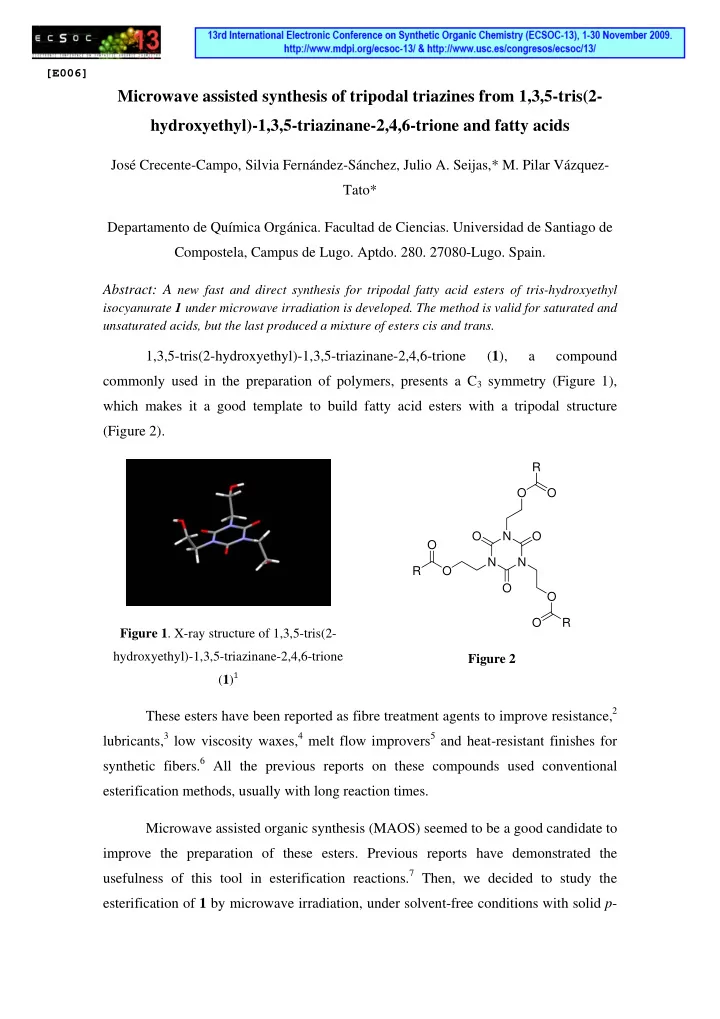
1,3,5-tris(2-hydroxyethyl)-1,3,5-triazinane-2,4,6-trione (1), a compound commonly used in the preparation of polymers, presents a C3 symmetry (Figure 1), which makes it a good template to build fatty acid esters with a tripodal structure (Figure 2).
Figure 1. X-ray structure of 1,3,5-tris(2- hydroxyethyl)-1,3,5-triazinane-2,4,6-trione (1)1
N N N O O O O O O O O O R R R
Figure 2
These esters have been reported as fibre treatment agents to improve resistance,2 lubricants,3 low viscosity waxes,4 melt flow improvers5 and heat-resistant finishes for synthetic fibers.6 All the previous reports on these compounds used conventional esterification methods, usually with long reaction times. Microwave assisted organic synthesis (MAOS) seemed to be a good candidate to improve the preparation of these esters. Previous reports have demonstrated the usefulness of this tool in esterification reactions.7 Then, we decided to study the esterification of 1 by microwave irradiation, under solvent-free conditions with solid p-
[E006]
SLIDE 2
toluenesulfonic acid as catalyst. Thus, a 1:3 mixture of 1 and decanoic acid together with a catalytic amount of TsOH (1.67 mol%) were heated to 160ºC for 10 minutes yielding 2,2',2''-(2,4,6-trioxo-1,3,5-triazinane-1,3,5-triyl)tris(ethane-2,1-diyl) tris(decanoate) (2) in 85%. (Scheme 1).
N N N OH OH HO O O O OH O N N N O O O O O O O O O + p-TsOH, 1.67 mol% 160ºC, MW 2, n=7, 85% 3, n=15, 52% 1 n n n n n= 7, T= 160ºC n=15, T= 110ºC
Scheme 1
Under the same reaction conditions stearic acid suffered pyrolysis. Thus, temperature was decreased in steps of 10 degrees, finding that at 110ºC there was no carbonization yielding, after 20 minutes, a 52% of 2,2',2''-(2,4,6-trioxo-1,3,5-triazinane- 1,3,5-triyl)tris(ethane-2,1-diyl) tristearate (3) (Scheme 1). In order to check the stability of double bonds oleic acid ((9Z)-Octadec-9-enoic acid) was studied. Irradiation for 30 minutes at 160ºC yielded 68% of a mixed triester of elaidic (trans) and oleic (cis) acids as detected by 1H NMR (Figure 3), in an approximated ratio of 2:1, which could correspond to (9E,9'E)-2,2'-(5-(2-((Z)-nonadec- 9-enoyloxy)ethyl)-2,4,6-trioxo-1,3,5-triazinane-1,3-diyl)bis(ethane-2,1-diyl) dioctadec- 9-enoate where 1 is esterified with two molecules of elaidic acid and one of oleic acid.
SLIDE 3 N N N O O O OH OH HO + COOH N N N O O O O O O O O O p-TsOH, 5% mol 160ºC, MW
4
6 6 6 6 6 6
Scheme 2
5.5 5.4 5.3 5.2 Chemical Shift (ppm)
H H
2.1 2.0 1.9 1.8 Chemical Shift (ppm)
H H H H H H
Figure 3 In summary, we developed a new fast and direct synthesis for tripodal fatty acid esters of tris- hydroxyethyl isocyanurate 1. This allows easy access to this kind of compounds in order to study their properties as lipid analogues (Figure 4).
SLIDE 4 Trigliceride C18 Compound 4 Figure 4. Molecular lipophilic potential8 Acknowledgements XUNTA DE GALICIA for financial support: PGIDIT05PXIB26201PR and USC for a predoctoral fellowship to JCC.
General experimental procedure
Compound 1 (0.199 g, 0.76 mmol) thoroughly mixed with decanoic acid (0.408 g, 2.28 mmol) and p-TsOH (7.3 mg), was irradiated in a CEM Discover monomode oven for 10 minutes (200W, 160ºC). The crude reaction was dissolved in CH2Cl2 and washed with NaOHaq (10%) and water. After evaporation the residue was purified by chromatography on silica column, yielding 2 (0.473 g, 85%) as a thick oil.
1 Chong, S. Y.; Seaton, C. C.; Kariuki, B. M.; Tremayne M. Acta Crystallogr. ,Sect. B: Struct. Sc. 2006, 62, 864.
2 Yamakita, H.; Ito, Y. Japan Patent JP2008163489, 2008, Scifinder CAN 149:202523, 2008. 3 Gan, X.; Qiu, S.; Lu, X.; Zhang, Z.; Wang, G.; Hu, Z.; Zhang, D.; Xing, Y. China Patent CN 1583985,
2005, Scifinder CAN 144:54123, 2005.
4 Kitamura, T.; Doi, K. Japan Patent 1992 JP 04246589, Scifinder CAN 118:149815 1993
SLIDE 5 5Nakayama, Y. Japan Patent JP 04248867 1992, Scifinder CAN 118:170302 1993 6 Kitamura, K.; Hosomi, H. Japan Patent JP 62125079, 1987, Scifinder CAN 107:238521, 1987.
Minagawa, M.; Nakahara, Y. Japan Patent JP 48071444, 1973, Scifinder CAN 80:60580, 1974.
7 “Microwaves in organic synthesis” 2nd edition, A. Loupy ed. Wiley-VCH, 2006. Sivan Velmathi,
Nagahata, R.; Sugiyama, J.; Takeuchi K. Macromol. Rapid Commun. 2005, 26, 1163–1167.
8 Surface calculated with software VEGA ZZ. Pedretti, A.; Villa, L.; Vistoli, G. J. Comp.-Aid. Mol.
Design., 2004, 18, 167-173. Pedretti, A.; Villa, L.; Vistoli, G. J. Mol. Graph., 2002, 21, 47-49. Pedretti, A.; Villa, L.; VistoliTheor G. Chem. Acc., 2003, 109, 229-32. http://www.ddl.unimi.it. The Molecular Lipophilicity Potential (MLP) is calculated projecting the Broto-Moreau lipophilicity atomic constants on the molecular surface (Gaillard, P.; Carrupt, P.A.; Testa, B.; Boudon, A. J. Comp.-Aid. Mol. Design., 1994, 8, 83).