FAR Subcontractor Flowdown Requirements Negotiation Strategies for - - PowerPoint PPT Presentation

far subcontractor flowdown requirements
SMART_READER_LITE
LIVE PREVIEW

FAR Subcontractor Flowdown Requirements Negotiation Strategies for - - PowerPoint PPT Presentation

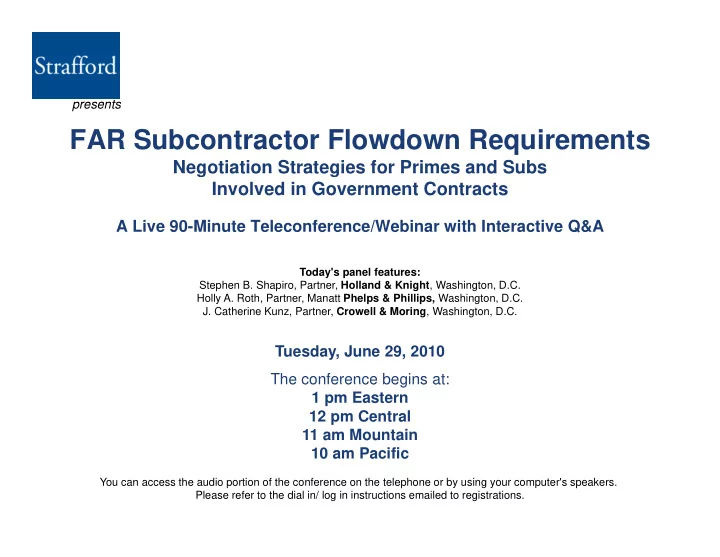
presents presents FAR Subcontractor Flowdown Requirements Negotiation Strategies for Primes and Subs Negotiation Strategies for Primes and Subs Involved in Government Contracts A Live 90-Minute Teleconference/Webinar with Interactive Q&A


slide-1
SLIDE 1

presents

FAR Subcontractor Flowdown Requirements

Negotiation Strategies for Primes and Subs

presents

Negotiation Strategies for Primes and Subs Involved in Government Contracts

A Live 90-Minute Teleconference/Webinar with Interactive Q&A

Today's panel features: Stephen B. Shapiro, Partner, Holland & Knight, Washington, D.C. Holly A. Roth, Partner, Manatt Phelps & Phillips, Washington, D.C. J Catherine Kunz Partner Crowell & Moring Washington D C

  • J. Catherine Kunz, Partner, Crowell & Moring, Washington, D.C.

Tuesday, June 29, 2010 The conference begins at: The conference begins at: 1 pm Eastern 12 pm Central 11 am Mountain 10 am Pacific 10 am Pacific

You can access the audio portion of the conference on the telephone or by using your computer's speakers. Please refer to the dial in/ log in instructions emailed to registrations.

slide-2
SLIDE 2

For CLE purposes, please let us know how many people are listening at your location by y

  • closing the notification box
  • and typing in the chat box your
  • and typing in the chat box your

company name and the number of attendees attendees.

  • Then click the blue icon beside the box

to send to send.

For live event only

slide-3
SLIDE 3
  • If the sound quality is not satisfactory
  • If the sound quality is not satisfactory

and you are listening via your computer speakers please dial 1-866-869-6667 speakers, please dial 1 866 869 6667 and enter your PIN when prompted. Otherwise, please send us a chat or e- , p mail sound@straffordpub.com immediately so we can address the problem.

  • If you dialed in and have any difficulties

during the call, press *0 for assistance.

slide-4
SLIDE 4

Subcontractor Flowdown R i t i G t Requirements in Government Contracts

June 29, 2010

S h B Sh i E H ll R th E J C th i K E

Stephen Shapiro Holly Roth

  • J. Catherine Kunz

Stephen B. Shapiro, Esq. Holland & Knight LLP 2099 Pennsylvania Avenue, N.W. Suite 100 Washington, DC 20006 Phone: (202) 457-7032 Holly Roth, Esq. Partner Government & Regulatory Policy Manatt Phelps & Phillips, LLP 700 12th Street, N.W. Suite 1100 Washington, DC 20005

  • J. Catherine Kunz, Esq.

Crowell & Moring LP 1001 Pennsylvania Ave., N.W. Washington, DC 20004 Phone: (202) 624-2957 Fax: (202) 628-5116

4

  • e: (

) 7 7 Fax: (202) 955-5564 New York: (212) 513-3451 stephen.shapiro@hklaw.com g , Phone: (202) 585-6558 Fax: (202) 637-1528 HRoth@manatt.com ( ) ckunz@crowell.com

slide-5
SLIDE 5

Government Subcontracts Overview Government Subcontracts - Overview

Stephen B. Shapiro Partner Holland & Knight LLP g 2099 Pennsylvania Avenue, N.W. Suite 100 Washington, DC 20006 Phone: (202) 457-7032 Fax: (202) 955-5564 New York: (212) 513 3451 New York: (212) 513-3451 stephen.shapiro@hklaw.com

5

slide-6
SLIDE 6

Overview

 I. What is a Flowdown Provision?  II. Types of Subcontracts

yp

– Considerations when deciding which type of

contract to enter

 III. The Christian Doctrine

6

slide-7
SLIDE 7

What is a Flowdown Provision? What is a Flowdown Provision?

 Clauses from a Prime Contractor’s contract

with the Government which are included in the subcontract.

– Included either by reference or in-text

h d f

 Methods of incorporation: FAR 52.102

– Clauses requiring verbatim incorporation

Cl th t t b i t d i b t

– Clauses that must be incorporated in substance – Clauses that are silent on incorporation

7

slide-8
SLIDE 8

Types of Contracts Types of Contracts

 Fixed Price  Cost Reimbursement  Cost-Plus-Fixed-Fee  Time & Materials

e & ate a s

 Commercial Item  GSA Schedule  GSA Schedule

8

slide-9
SLIDE 9

Fixed Price Contracts FAR 16 202 Fixed Price Contracts – FAR 16.202

 Contract provides a firm price for the goods

  • r services to be delivered.

 Price will not be adjusted except in the case

  • f certain events anticipated by contract.

– i.e. change in the scope of work to be performed

 Typically used for tasks with a great deal of

t t i t b ti i t cost certainty, because contingencies must be included in bid.

9

slide-10
SLIDE 10

Fixed Price Contracts: Considerations

 Considerations for the Prime Contractor:

– Provides cost certainty – Helps limit risk – Allows for price competition

ll d f d f k

– Requires a well-defined scope of work – Limits flexibility

10

slide-11
SLIDE 11

Fixed Price Contracts: Considerations

 Considerations for the Subcontractor:

– Requires accurate cost estimate – No profit ceiling; subcontractor keeps all profit

beyond the cost of performance Fewer administrative costs

– Fewer administrative costs – May not require disclosure of cost figures to the

Prime or Government

– Subcontractor assumes all unexpected costs

11

slide-12
SLIDE 12

Cost Reimbursement Contracts – FAR 16.301

 Subcontractor is reimbursed for all allowable

costs, as defined by contract.

 Includes a total cost estimate and ceiling

figure.

 Typically used for contracts where

specifications are incomplete or the scope of th k t b il d fi d the work cannot be easily defined.

– i.e. Research & Development Contracts

12

slide-13
SLIDE 13

Cost Reimbursement Contracts: Considerations

 Considerations for the Prime Contractor:

– Provides flexibility and mitigates transaction costs in

contracts where frequent changes are anticipated contracts where frequent changes are anticipated

– May be difficult to determine potential costs – Subcontractor bears risk of exceeding the cost ceiling

 Considerations for the Subcontractor:

– Less risk in connection with cost overruns – Increased accounting requirements

Increased accounting requirements

– Added compliance issues

13

slide-14
SLIDE 14

Cost-Plus-Fixed-Fee Contracts – FAR 16.306

 A variant of a Cost Reimbursement

Contract.

 Contract provides for the payment of cost of

performance, plus a pre-determined profit.

– Profit will not be reduced even if the actual cost

  • f performance is less than anticipated

Often used for contracts where the level of

 Often used for contracts where the level of

effort required is not yet known.

– Contracts for research or preliminary exploration

14

Contracts for research or preliminary exploration

slide-15
SLIDE 15

Cost-Plus-Fixed-Fee Contracts: Considerations

 Considerations for the Prime Contractor:

– Fee certainty; will not swell with cost of performance – More efficiency incentive than cost reimbursement

contract, but still must supervise sub

 Considerations for the Subcontractor:  Considerations for the Subcontractor:

– Typically low profit, but guaranteed; little risk of loss – High administrative costs – Heightened audit risk

15

slide-16
SLIDE 16

Time & Materials Contract – FAR 16.601

 Labor paid at fixed hourly rates

– Reflecting wages, overhead and administrative

costs, and sometimes profit

 Materials reimbursed at actual cost.  Typically used when anticipating the time or

extent of work required is difficult to quantify quantify.

– Allows work to begin immediately with

reassessment at a later point

16

reassessment at a later point

slide-17
SLIDE 17

Time & Materials Contract: Considerations

 Considerations for the Prime Contractor:

– Most of the performance risk is on the Prime – Must obligate Sub to extensive compliance requirements – Allows work of an uncertain duration or nature to begin

quickly

 Considerations for the Subcontractor:

– Prime contractor has most of the performance risk

G t d fit i l d d i t

– Guaranteed profit included in rate – Potentially high administration costs

17

slide-18
SLIDE 18

Commercial I tem Contract – FAR Part 12; FAR 44.400

 A contract to purchase an item which is

commonly used by non-governmental agencies.

– “item” includes the installation, repair, and

support of a commercial item support of a commercial item

18

slide-19
SLIDE 19

Commercial I tem Contract: Considerations

 Considerations for the Prime Contractor:

– Fewer administrative costs – Requires more detailed consideration before including

non-required clauses

 Considerations for the Subcontractor:

Considerations for the Subcontractor:

– Simplified acquisition process

 Many flowdown provisions are dispensed with

Sli fit i

– Slim profit margin – Other helpful procurement provisions removed

 i.e. the notice and cure period for a Termination for

19

Default

slide-20
SLIDE 20

GSA Schedule Contract GSA Schedule Contract

 Typically, an un-funded long-term contract

listing the price the Government will pay for i i l i i certain commercial items or services.

– An order does not occur until an agency signs it

 Can be renewed up to 3 times for a 20-year  Can be renewed up to 3 times, for a 20-year

total.

 Involves a long negotiation process. Once

  • a o g

go a o p o O approved, a supplier is placed on a list from which an agency may choose to order items or i

20

services.

slide-21
SLIDE 21

GSA Schedule Contract: Considerations

 Considerations for the Prime Contractor:

– Large contract and profit potential – Fewer transactional costs than several individual contracts

 Considerations for the Subcontractor:

Extensive application and negotiation process

– Extensive application and negotiation process – Uncertainty

 Will an agency order?  How much will the agency order?

– Need to flow down pricing obligations

21

slide-22
SLIDE 22

The Christian Doctrine The Christian Doctrine

 A mandatory contract clause that expresses

a significant tenant of public procurement policy is considered to be included in the contract by operation of law. G.L. Christian & Assoc v United States 312 F 2d 418 (Ct & Assoc. v. United States, 312 F.2d 418 (Ct.

  • Cl. 1963).

 Only clauses that are both mandatory and  Only clauses that are both mandatory and

speak to public procurement policy are covered by the doctrine.

22

covered by the doctrine.

slide-23
SLIDE 23

The Christian Doctrine: Examples of Mandatory Provisions for Prime Mandatory Provisions for Prime Contractors

 Termination for Convenience – FAR

52.249(1)-(7)

 Termination for Default – FAR 49.401  The Changes Clause – FAR 52.243(4)  The Payment Clause – FAR 52.232(1)-(7)  The Buy-American Act – FAR 52.225(1)-(4)

y ( ) ( )

 Equal Opportunity and Affirmative Action

Clauses

23

slide-24
SLIDE 24

Examples of Non-Mandatory p y Provisions for Prime Contractors

 Clauses often required by contract but not

mandatory:

– The Government Property Clause – FAR 52.245 – Fast Payment Procedure – FAR 14.301

P Af A d FAR 52 233 3

– Protest After Award – FAR 52.233-3 – Excusable Delay – FAR 52.249-14

24

slide-25
SLIDE 25

The Christian Doctrine and Subcontracts: Considerations

Don’t assume that a mandatory provision will flowdown automatically.

– The Christian Doctrine does not apply to subcontracts

The Christian Doctrine does not apply to subcontracts

– Exceptions for social policy:

 Notice of Requirement for Affirmative Action To Ensure Equal

Employment Opportunity for Construction- FAR 52.222-23 p y pp y

 Affirmative Action Compliance Requirements for

Construction- FAR 52.222-27

 Equal Opportunity for Special Disabled Veterans, Veterans of

the Vietnam Era, and Other Eligible Veterans- FAR 52.222-35

 Affirmative Action for Workers With Disabilities- FAR 52.249-

36

25

slide-26
SLIDE 26

“Mandatory vs Discretionary” “Mandatory vs. Discretionary”

Holly Roth Partner Government & Regulatory Policy g y y Manatt Phelps & Phillips, LLP 700 12th Street, N.W. Suite 1100 Washington, D.C. 20005 Phone: (202) 585-6558 Fax: (202) 637-1528 ( ) HRoth@manatt.com

26

slide-27
SLIDE 27

“Flowdown” Clauses “Flowdown” Clauses

 Clauses prescribed by the government that

a Prime Contractor incorporates into subcontracts.

– Subcontract clauses "flow down" responsibilities

  • f the prime contractor to the subcontractor
  • f the prime contractor to the subcontractor.

– Subcontract clauses frequently triggered by

subcontract dollar value threshold.

– Some, but not all, flowdown clauses are

negotiable.

27

slide-28
SLIDE 28

Mandatory Flowdown Clauses Mandatory Flowdown Clauses

 Prime contract clauses that specifically

require the inclusion of all or substantially all

  • f their text in all subcontracts entered into

in support of the prime contract.

“Th C t t h ll i l d th b t f

– “The Contractor shall include the substance of

this clause ... in all subcontracts with subcontractors... ”

– Mandatory flowdown clauses are not negotiable.

28

slide-29
SLIDE 29

Mandatory Flowdowns I mposed by y p y Executive Order

 All subcontracts

– E.O. 11246, Equal Opportunity (MAR 2007)

(52.222-26).

 Initial trigger threshold $10,000.  Department of Labor audits compliance  Department of Labor audits compliance

 All large scale construction subcontracts

– E.O. 13502, Project Labor Agreement (MAY

, j g ( 2010) (52.222-34).

29

slide-30
SLIDE 30

Mandatory Flowdowns I mposed by Statute (Commercial I tems) Threshold Statute (Commercial I tems) – Threshold Mandatory Flowdown Requirement.

 Commercial Items (FAR 2.201) – in general

– Any item, other than real property, that is of a type

customarily used by the general public or by non- customarily used by the general public or by non- governmental entities for purposes other than governmental purposes, and— (i) Has been sold leased or licensed to the general public;

– (i) Has been sold, leased, or licensed to the general public;

  • r

– (ii) Has been offered for sale, lease, or license to the

general public general public.

30

slide-31
SLIDE 31

Mandatory Flowdowns I mposed by y p y Statute (Commercial I tems)

 FAR 52.212-5, Contract Terms and Conditions

Required to Implement Statutes or Executive Orders Commercial Items Orders—Commercial Items

– (e)(1) Notwithstanding the requirements of the clauses in

paragraphs (a), (b), (c), and (d) of this clause, the Contractor is not required to flow down any FAR clause other than those in not required to flow down any FAR clause, other than those in paragraphs (e) (1) of this paragraph in a subcontract for commercial items. Unless otherwise indicated below, the extent

  • f the flow down shall be as required by the clause—

– (e) (2) While not required, the contractor May include in its

subcontracts for commercial items a minimal number of additional clauses necessary to satisfy its contractual obligations

31

slide-32
SLIDE 32

Mandatory Flowdowns I mposed by y p y Statute (Commercial I tems)

FAR 52.244-6, Subcontracts for Commercial Items (APR 2010)

– Clauses used in prime contracts for other than

“commercial items ” commercial items.

– Requires contractors and subcontractors to incorporate,

and require subcontractors at all tiers to incorporate, commercial items or nondevelopmental items as commercial items or nondevelopmental items as components of items to be supplied under this contract.

32

slide-33
SLIDE 33

Mandatory Flowdowns I mposed by y p y Statute (Commercial I tems)

Contractor Code of Business Ethics and Conduct (APR 2010) (Pub. L. 110-252, Title VI, Chapter 1 (41 U.S.C. 251 note)), (52.203-13). ( )

– Threshold: $5,000,000 and 120 performance

Utilization of Small Business Concerns (MAY 2004) (15 U.S.C. 637(d)(2) and (3)) 637(d)(2) and (3)).

– 52.219-9 threshold: $550,000 or $1,000,000 for construction of

any public facility with further subcontracting possibilities.

Equal Opportunity for Special Disabled Veterans, Veterans of the Vietnam Era, and Other Eligible Veterans (SEP 2006)(38 U.S.C. 4212), (52.222-35).

33

), ( )

– Threshold: $100,000 – Compliance audited by DOL.

slide-34
SLIDE 34

Mandatory Flowdowns I mposed by y p y Statute (Commercial I tems), cont.

– Affirmative Action for Workers with Disabilities (JUN 1998)

(29 U.S.C. 793), (52.222-36).

 Threshold: $10 000  Threshold: $10,000

– Service Contract Act of 1965 (NOV 2007 ) (41 U.S.C. 351,

et seq.), (52.222-41).

– Combating Trafficking in Persons (FEB 2009) (22 U.S.C.

7104(g)) (52.222-50).

34

slide-35
SLIDE 35

Mandatory Flowdowns I mposed by y p y Statute (Commercial I tems), cont.

– Exemption from Application of the Service

Contract Act to Contracts for Maintenance, Calibration or Repair of Certain Equipment Calibration, or Repair of Certain Equipment— Requirements "(Nov 2007)" (41 U.S.C. 351, et seq.) (52.222-51).

– Exemption from Application of the Service

Contract Act to Contracts for Certain Services— Requirements (FEB 2009) (41 U S C 351 et Requirements (FEB 2009) (41 U.S.C. 351, et seq.) (52.222-53).

– Employment Eligibility Verification (JAN 2009)

35

(52.222-54).

 Not applicable to contracts for COTS items.

slide-36
SLIDE 36

Mandatory Flowdowns I mposed by y p y Statute (Commercial I tems), cont.

– Promoting Excess Food Donation to Nonprofit

  • Organizations. (MAR 2009) (Pub L. 110-247).

Flow down required in accordance with Flow down required in accordance with paragraph (e) of FAR clause 52.226-6. (52.226- 6).

– Preference for Privately Owned U.S.-Flag

Commercial Vessels (FEB 2006) (46 U S C Appx Commercial Vessels (FEB 2006) (46 U.S.C. Appx 1241(b) and 10 U.S.C. 2631). Flow down required in accordance with paragraph (d) of

36

FAR clause 52.247-64. (52.247-64).

slide-37
SLIDE 37

Mandatory Flowdowns y (Noncommercial I tems) – Examples

– Anti-Kickback Procedures, The Anti-Kickback Act

  • f 1986 (41 U.S.C. 51-58), (52.203-7).

– Limitation on Payments to Influence Certain

Federal Transactions (52.203-12). Federal Transactions (52.203 12).

– Audit and Records— Negotiation, (10 U.S.C.

2313, 41 U.S.C. 254d, and OMB Circular No. A-133), 52.215-2.

37

slide-38
SLIDE 38

Mandatory Flowdowns: The American Recovery and American Recovery and Reinvestment Act

 Whistleblower Protections (Section 1553 of

  • Pub. L. 111-5), (52.203-15).

38

slide-39
SLIDE 39

Non Mandatory Flowdown Clauses Non-Mandatory Flowdown Clauses

 Prime contract clauses that should be

flowed down in a subcontract to ensure that the subcontractor will provide adequate assistance or cooperation to enable the prime contractor to meet its contractual prime contractor to meet its contractual requirements with the government.

39

slide-40
SLIDE 40

Non-Mandatory Flowdown Clauses: y Examples

 Acquisition of Supplies

– The Buy American Act (41 U.S.C. 10a - 10d)

(52.225-1).

– Buy American Act—Free Trade Agreements—

Israeli Trade Act (JUN 2009) (52 225-3) Israeli Trade Act (JUN 2009) (52.225-3).

– Trade Agreements (19 U.S.C. 2501, et seq.)

(52.225-5).

– Restrictions on Certain Foreign Purchases

(52.225-13).

40

slide-41
SLIDE 41

Non-Mandatory Flowdown Clauses: y Examples

 Acquisition of Commercial items

– FAR 52.212-2, Contract Terms and Conditions –

Commercial Items

 Acquisition of Commercial Services (T&M or Labor

Hour)

– FAR 52.212-2, Contract Terms and Conditions –

Commercial Items (ALT I) (OCT 2008) Commercial Items (ALT I) (OCT 2008)

 Audits of subcontractor records permitted.  Inspection and acceptance at subcontractor site required.

 Termination Clauses for Other Than Commercial  Termination Clauses for Other Than Commercial

Items

– 52.249-8, 9 and 10, Termination for Default – 52.249-1 through 6, Termination for Convenience

41

g ,

slide-42
SLIDE 42

Offeror Representations and p Certifications

– Submitted online (www.orca.bpn.gov) and with

proposal submission as required by prime contractor contractor.

– Requires disclosure of information during the

solicitation phase that the government will use p g to determine the fitness and integrity of a potential contractor. Failure to accurately and completely answer any

– Failure to accurately and completely answer any

representation and certification could have unforeseen and potentially negative

42

consequences.

slide-43
SLIDE 43

Offeror Representations and Certifications Commercial Certifications Commercial I tems – 52.212-3 (sample clauses)

– General. The offeror represents that either— – (A) It [ ] is, [ ] is not certified by the Small Business

Administration as a small disadvantaged business concern Administration as a small disadvantaged business concern and identified, on the date of this representation, as a certified small disadvantaged business concern in the database maintained by the Small Business Administration (PRO-Net), and that no material change in disadvantaged

  • wnership and control has occurred since its certification,

and, where the concern is owned by one or more d d l l d d d h h f individuals claiming disadvantaged status, the net worth of each individual upon whom the certification is based does not exceed $750,000 after taking into account the applicable exclusions set forth at 13 CFR 124 104(c)(2); or

43

applicable exclusions set forth at 13 CFR 124.104(c)(2); or

slide-44
SLIDE 44

Offeror Representations and Certifications Commercial Certifications Commercial I tems – 52.212-3 (sample clauses)

– (B) It [ ] has, [ ] has not submitted a completed

application to the Small Business Administration

  • r a Private Certifier to be certified as a small
  • r a Private Certifier to be certified as a small

disadvantaged business concern in accordance with 13 CFR 124, Subpart B, and a decision on that application is pending, and that no material change in disadvantaged ownership and control has occurred since its application was submitted. pp

44

slide-45
SLIDE 45

Offeror Representations and Certifications Commercial Certifications Commercial I tems – 52.212-3 (sample clauses)

– (f) Buy American Act Certificate. (Applies only if

the clause at Federal Acquisition Regulation (FAR) 52 225 1 Buy American Act Supplies is (FAR) 52.225-1, Buy American Act—Supplies, is included in this solicitation.)

45

slide-46
SLIDE 46

Offeror Representations and Certifications Commercial Certifications Commercial I tems – 52.212-3 (sample clauses)

– (1) The offeror certifies that each end product, except those

listed in paragraph (f)(2) of this provision, is a domestic end product and that for other than COTS items, the offeror has id d t f k i i t h b i d considered components of unknown origin to have been mined, produced, or manufactured outside the United States. The

  • fferor shall list as foreign end products those end products

manufactured in the United States that do not qualify as q y domestic end products, i.e., an end product that is not a COTS item and does not meet the component test in paragraph (2) of the definition of "domestic end product." The terms "commercially available off the shelf (COTS) item " "component " commercially available off-the-shelf (COTS) item, component, "domestic end product," "end product," "foreign end product," and "United States" are defined in the clause of this solicitation entitled "Buy American Act—Supplies."

46

slide-47
SLIDE 47

Offeror Representations and Certifications Commercial Certifications Commercial I tems – 52.212-3 (sample clauses)

– (h) Certification Regarding Responsibility Matters

(Executive Order 12689). (Applies only if the contract value is expected to exceed the contract value is expected to exceed the simplified acquisition threshold.) The offeror certifies, to the best of its knowledge and belief, that the offeror and/or any of its principals—

– (1) [ ] Are, [ ] are not presently debarred,

suspended proposed for debarment or declared suspended, proposed for debarment, or declared ineligible for the award of contracts by any Federal agency;

47

slide-48
SLIDE 48

Offeror Representations and Certifications Commercial Certifications Commercial I tems – 52.212-3 (sample clauses)

– (2) [ ] Have, [ ] have not, within a three-year period

preceding this offer, been convicted of or had a civil judgment rendered against them for: Commission of fraud j g g

  • r a criminal offense in connection with obtaining,

attempting to obtain, or performing a Federal, state or local government contract or subcontract; violation of d l l h Federal or state antitrust statutes relating to the submission of offers; or Commission of embezzlement, theft, forgery, bribery, falsification or destruction of records making false statements tax evasion violating records, making false statements, tax evasion, violating Federal criminal tax laws, or receiving stolen property;

48

slide-49
SLIDE 49

Offeror Representations and Certifications Commercial Certifications Commercial I tems – 52.212-3 (sample clauses)

– (3) [ ] Are, [ ] are not presently indicted for, or

  • therwise criminally or civilly charged by a

Government entity with commission of any of Government entity with, commission of any of these offenses enumerated in paragraph (h) (2)

  • f this clause;

– (4) [ ] Have, [ ] have not, within a three-year

period preceding this offer, been notified of any delinquent Federal taxes in an amount that delinquent Federal taxes in an amount that exceeds $3,000 for which the liability remains unsatisfied.

49

slide-50
SLIDE 50

Flowdown Clause Obligations from the Prime g Contractor’s Perspective

  • J. Catherine Kunz, Esq.

Crowell & Moring LP 1001 Pennsylvania Ave., NW Washington, DC 20004 Phone: (202) 624-2957 Fax: (202) 628-5116 k @ ll ckunz@crowell.com

50

slide-51
SLIDE 51

Analysis for Flowdown Clause y Compliance

 Multi-step analysis

– What is considered a subcontract? – Which clauses are required to be flowed down? – When must required clauses be flowed down?

h l l l d d h

– Is the commercial item clause included in the

prime contract, and does the subcontract involve the purchase of a commercial item? p

– Which clauses should a prime consider flowing

down, in addition to mandatory clauses?

51

slide-52
SLIDE 52

What Qualifies as a Subcontract? What Qualifies as a Subcontract?

 Necessary to the performance of one or

more government contracts. E.g.,

– specifically required by the prime contract – substantially or directly related to performance

  • f the prime contract
  • f the prime contract

– directly charged to the prime contract

52

slide-53
SLIDE 53

What Qualifies as a Subcontract? What Qualifies as a Subcontract?

 Typically not a government subcontract:

– Purchases of goods and services necessary for

the management and administration of the company as a whole

 E.g., general usage supplies or services (paper,  E.g., general usage supplies or services (paper,

computer toner, telephone service, etc.).

– Purchases of standard inventory items

E t d d t d i ll f th

 E.g., standard parts used in many or all of the

company’s products, for both government and commercial projects.

53

slide-54
SLIDE 54

What Qualifies as a Subcontract? What Qualifies as a Subcontract?

 Likely a government subcontract:

– Purchases of goods and services substantially or

directly related to the performance of the government contract

 Products or services unique to the end product  Products or services unique to the end product  Products or services customized for inclusion in the

end product

54

slide-55
SLIDE 55

Which Clauses are Required to be q Flowed Down?

 Is the clause required to be flowed down to

subcontracts?

 Generally, this is not a difficult

determination

 Requires substantive review of each clause

incorporated into the prime contract

55

slide-56
SLIDE 56

Which Clauses are Required to be q Flowed Down?

Example: FAR 52.225-13 Restrictions on Certain Foreign P h Purchases “. . . (c) The Contractor shall insert this clause, including this paragraph (c), in all subcontracts.” including this paragraph (c), in all subcontracts.

56

slide-57
SLIDE 57

When must Required Clauses be q Flowed Down?

 Not all clauses with flowdown language

must be flowed down in every instance Th f h l ill i di h h

 The text of the clause will indicate when the

clause is required to be flowed down to a subcontract subcontract

 Sometimes the prime contractor’s best

judgment will need to be applied

– projected value of the subcontract – whether the subcontract will involve certain

activities

57

activities

slide-58
SLIDE 58

When must Required Clauses be q Flowed Down?

Example:

FAR 52.203-6 Restrictions on Subcontractor Sales to the Government “(c) The Contractor agrees to incorporate the substance of this clause, including this paragraph (c), in all subcontracts under this contract which exceed the simplified contract which exceed the simplified acquisition threshold [$100,000].”

58

slide-59
SLIDE 59

When must Required Clauses be q Flowed Down?

Example:

FAR 52.219-9 Small Business Subcontracting Plan “. . . the offeror will include [FAR 52.218 Utilization of Small Business Concerns] in all subcontracts that offer further subcontracting opportunities ” subcontracting opportunities . . . .

59

slide-60
SLIDE 60

Does the Subcontract I nvolve the Purchase of a Commercial I tem?

 Does the prime contract include a clause

limiting the number of clauses to be flowed down to a subcontract for commercial items?

R i d fl d l f i l it

– Required flowdown clauses for commercial item

subcontracts are largely socio-economic clauses with which most companies already comply p y p y

 Minimizes the compliance burden placed on the

subcontractor

60

slide-61
SLIDE 61

Does the Subcontract I nvolve the Purchase of a Commercial I tem?

 Look for:

– FAR 52.212-5 (“. . . The Contractor is not

required to flow down any FAR clause, other than those in paragraphs (e)(1) of this paragraph in a subcontract for commercial paragraph in a subcontract for commercial items.”)

– FAR 52.244-6 (“The Contractor shall insert the

f ll i l i b t t f i l following clauses in subcontracts for commercial items . . . .”)

– or similar language

61

  • r similar language
slide-62
SLIDE 62

Does the Subcontract I nvolve the Purchase of a Commercial I tem?

Definition of Commercial I tem (FAR 2.101):

(1) Any item that is of a type customarily used by the general public or by non-governmental entities for purposes other than governmental purposes and has been sold, leased, or licensed or offered for sale, lease, or license to the general public. (2) Any item evolved from (1) through advances in technology

  • r performance and that is not yet available in the commercial

marketplace, but will be available in time to satisfy the delivery requirements under a government solicitation.

62

slide-63
SLIDE 63

Definition of Commercial I tem Definition of Commercial I tem

Definition of Commercial I tem, cont’d:

(3) Any item meeting the criterion of (1) or (2) but for difi ti f t t il il bl i th modifications of a type customarily available in the commercial marketplace, or minor modifications of a type not customarily available in the commercial marketplace made to meet federal government requirements. meet federal government requirements. (4) Any combination of items meeting the requirements of (1), (2), or (3) that are of a type customarily combined and sold in combination to the general public. (5) A nondevelopmental item, if the procuring agency determines the item was developed exclusively at private expense and sold in substantial quantities, on a competitive basis to multiple state and local governments

63

basis, to multiple state and local governments.

slide-64
SLIDE 64

Definition of Commercial I tem Definition of Commercial I tem

Definition of Commercial I tem, cont’d:

(6) Installation maintenance repair training and other (6) Installation, maintenance, repair, training, and other services if such services are procured for support of an item referenced in (1) through (4) above and the source of such services provides similar services contemporaneously to the l bli d t d diti i il t th general public under terms and conditions similar to those

  • ffered to the federal government.

(7) Services of a type offered and sold competitively in substantial quantities in the commercial marketplace based on substantial quantities in the commercial marketplace based on established catalog or market prices for specific tasks performed or specific outcomes to be achieved and under standard commercial terms and conditions.

64

slide-65
SLIDE 65

Clauses to Consider Flowing Down Clauses to Consider Flowing Down

For the prime contractor’s protection, the following clauses can be flowed down

– Termination for convenience clause

 Will provide the prime the ability to terminate the

subcontractor should the Government terminate the prime

– Changes clause

Will provide the prime the ability to make changes of the

 Will provide the prime the ability to make changes of the

subcontractor’s requirements should the Government make changes to the prime’s requirements

– Definitions clause

 Will ensure a standard set of definitions is applicable

65

slide-66
SLIDE 66

Clauses to Consider Flowing Down Clauses to Consider Flowing Down

 For the prime contractor’s protection, the

following clauses can be flowed down

– Protest After Award clause

 Will allow the prime to issue a stop work order to the

subcontractor

– Disputes clause

 Will put the sub on notice of the disputes process,

including the requirement to submit a certification of a including the requirement to submit a certification of a claim

– Other clauses

66

 Specific to the nature of the prime contract

slide-67
SLIDE 67

I mplementing Flowdown p g Obligations

 Approaches to meet flowdown clause

  • bligations

C aft a niq e doc ment that inco po ates the applicable

– Craft a unique document that incorporates the applicable

flowdown clauses for each subcontracting opportunity

– Attach an addendum with applicable flowdown clauses to

a standard purchase order or commercial subcontract form

– For commercial item purchases, include a provision in

standard purchase order or commercial subcontract form p requiring compliance with flowdown clauses when applicable

67

slide-68
SLIDE 68

Challenging I ssues Regarding Flowdown g g g g Clauses

 Assertion from prime that clause is “self-deleting”  Refusal from sub to accept required flowdown

l ( ) clause(s)

 Incorporation of entire prime contract into

subcontract subcontract

 Implementation of process by new government

contractors to identify which vendors qualify as b d fl d f l subcontractors and ensure flowdown of clauses

68

slide-69
SLIDE 69

Subcontractor Flowdown Requirements in Government Requirements in Government Contracts

June 29, 2010

S h B Sh i E H ll R th E J C th i K E

Stephen Shapiro Holly Roth

  • J. Catherine Kunz

Stephen B. Shapiro, Esq. Holland & Knight LLP 2099 Pennsylvania Avenue, N.W. Suite 100 Washington, DC 20006 Phone: (202) 457-7032 Holly Roth, Esq. Partner Government & Regulatory Policy Manatt Phelps & Phillips, LLP 700 12th Street, N.W. Suite 1100 Washington, DC 20005

  • J. Catherine Kunz, Esq.

Crowell & Moring LP 1001 Pennsylvania Ave., N.W. Washington, DC 20004 Phone: (202) 624-2957 Fax: (202) 628-5116

69

  • e: (

) 7 7 Fax: (202) 955-5564 New York: (212) 513-3451 stephen.shapiro@hklaw.com g , Phone: (202) 585-6558 Fax: (202) 637-1528 HRoth@manatt.com ( ) ckunz@crowell.com