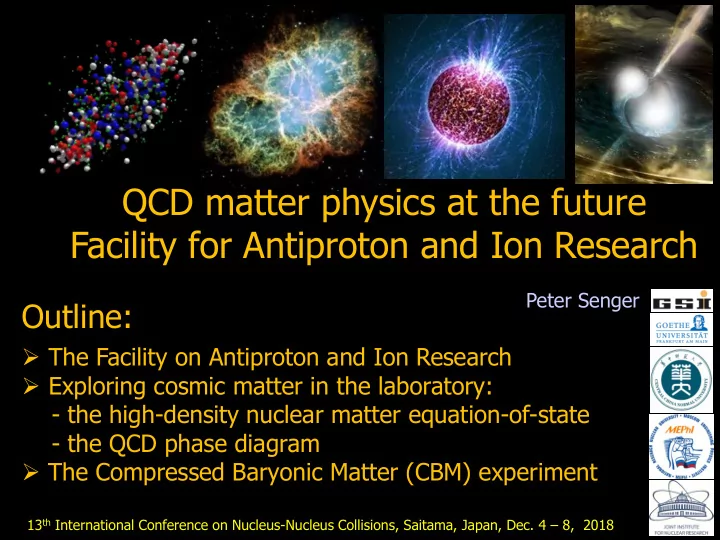
Facility for Antiproton and Ion Research Peter Senger Outline: The - - PowerPoint PPT Presentation

facility for antiproton and ion research
SMART_READER_LITE
LIVE PREVIEW

Facility for Antiproton and Ion Research Peter Senger Outline: The - - PowerPoint PPT Presentation

neutron QCD matter physics at the future matter Facility for Antiproton and Ion Research Peter Senger Outline: The Facility on Antiproton and Ion Research Exploring cosmic matter in the laboratory: - the high-density nuclear matter


slide-1
SLIDE 1

neutron matter

  • The Facility on Antiproton and Ion Research
  • Exploring cosmic matter in the laboratory:
  • the high-density nuclear matter equation-of-state
  • the QCD phase diagram
  • The Compressed Baryonic Matter (CBM) experiment

Outline:

QCD matter physics at the future Facility for Antiproton and Ion Research

Peter Senger

13th International Conference on Nucleus-Nucleus Collisions, Saitama, Japan, Dec. 4 – 8, 2018

slide-2
SLIDE 2

Facility for Antiproton & Ion Research

SIS18 HESR CR Compressed Baryonic Matter Super Fragment-Separator: Nuclear Structure and Astrophysics Anti-Proton Physics p-Linac

  • 1012/s; 1.5 GeV/u; 238U28+
  • 1010/s 238U92+ up to 11 (35) GeV/u
  • 3x10¹³/s 30 (90) GeV protons
  • radioactive beams up to

1.5 - 2 GeV/u;

  • 1011 antiprotons 1.5 - 15 GeV/c

Primary Beams Secondary Beams Technical Challenges

  • rapid cycling superconducting magnets
  • dynamical vacuum

100 m

FAIR phase 1 FAIR phase 2

SIS100/300 2

slide-3
SLIDE 3

Facility for Antiproton & Ion Research

SIS100/300 SIS18 HESR CR Anti-Proton Physics p-Linac 100 m

FAIR phase 1 FAIR phase 2 NUSTAR: Rare Isotope beams

Compressed Baryonic Matter Super Fragment- Separator: Nuclear Structure and Astrophysics 3

Experimental programs

slide-4
SLIDE 4

4

Nuclear astrophysics: The origin of elements

rp-, p- process: Synthesis of nuclei with masses close to and beyond the proton dripline in binary systems of a sun and a neutron star r- (rapid) process: Synthesis of very neutron-rich instable nuclei via rapid capture

  • f neutrons in neutron star

mergers

X-ray binary

s- (slow) process: Synthesis of heavy nuclei via slow neutron capture in very massive stars

Measurements in the laboratory: Mass, lifetime, decay channels, structure of very rare instable (neutron or proton rich) nuclei

slide-5
SLIDE 5

Facility for Antiproton & Ion Research

SIS100/300 SIS18 HESR CR Anti-Proton Physics p-Linac 100 m

FAIR phase 1 FAIR phase 2 PANDA: Antiproton-proton collisions

Compressed Baryonic Matter Super Fragment- Separator: Nuclear Structure and Astrophysics

Experimental programs

5

slide-6
SLIDE 6

Hadron Physics with antiprotons at FAIR

D

  • 50 MeV

D D

+

p K

25 MeV 100 MeV

K

+

K

  • p
  • p

+

Gluonic excitations: Hybrids, glueballs Charmonium states: Precision spectroscopy Time-like form factors, nucleon structure In medium mass modifications: Extension to the charm sector Extension of nuclear chart: Double hypernuclei

slide-7
SLIDE 7

Facility for Antiproton & Ion Research

SIS100/300 SIS18 HESR CR Anti-Proton Physics p-Linac 100 m

FAIR phase 1 FAIR phase 2 Atomic Physics Plasma & Applied Sciences

Super Fragment- Separator: Nuclear Structure and Astrophysics 7

Experimental programs

slide-8
SLIDE 8

Atomic Physics, Plasma and Applied Sciences

  • Highest Charge States: Extreme Static Fields
  • Relativistic Energies: Extreme Dynamical Fields and Ultrashort Pulses
  • High Intensities: Very High Energy Densities and Pressures
  • High Charge at Low Velocity: Large Energy Deposition
  • Low-Energy Anti-Protons: Antimatter Research

planetary interiors

... states of matter common in astrophysical objects

extreme conditions

... radiation hardness and modification of materials

Plasma Bio

aerospace engineering

... radiation shielding of cosmic radiation

Materials

anti-matter

... matter / anti- matter asymmetry

strong field research

... probing of fundamental laws

  • f physics

Atomic Physics

SPARC FLAIR HEDgeHOB/WDM MAT/BIOMAT BIO/BIOMAT

slide-9
SLIDE 9

Facility for Antiproton & Ion Research

SIS100/300 SIS18 HESR CR Anti-Proton Physics p-Linac 100 m

FAIR phase 1 FAIR phase 2 Compressed Baryonic Matter: Nucleus-nucleus collisions

Super Fragment- Separator: Nuclear Structure and Astrophysics 9

Experimental programs

Compressed Baryonic Matter

slide-10
SLIDE 10

10

P=P(E,T,ρ,I)

QCD matter physics

slide-11
SLIDE 11

11

Neutron star mergers and heavy-ion collisions

  • M. Hanauske et al.,
  • J. Phys.: Conf. Ser.

878 012031

n-star merger Au +Au 1.5A GeV

density temperature

EOS

slide-12
SLIDE 12

12

The nuclear matter equation of state (EOS) describes the relation between density, pressure, temperature, energy, and isospin asymmetry

P = dE/dVT=const V = A/ρ dV/ dρ = - A/ρ2 P = ρ2 d(E/A)/dρT=const

Neutron matter Symmetric matter

Esym

E/A

The nuclear matter equation-of-state

EA(ρ,δ) = EA(ρ,0)+Esym(ρ)·δ2 with δ= (ρn–ρp)/ρ

  • Ch. Fuchs and H.H. Wolter, EPJA 30 (2006) 5
slide-13
SLIDE 13

The EOS of (symmetric) nuclear matter

Knm = 200 MeV: "soft" EOS

  • C. Fuchs, Prog. Part. Nucl. Phys. 56 (2006) 1

T=0: E/A = 1/ρ  U (ρ)dρ Effective NN-potential:

U(r)=ar+brg

EA(ρ,δ) = EA(ρ,0) + Esym(ρ)·δ2 + O(δ4)

  • E/A(ρo) = -16 MeV
  • slope d(E/A)(ρo)/dρ = 0
  • curvature Knm = 9ρ2 d2(E/A)/dρ2

(nuclear incompressibility) Measurements at GSI SIS18:

  • elliptic flow of light fragments
  • subthreshold kaon production

Knm = 380 MeV: "stiff" EOS Knm = 220  40 MeV: "soft" EOS

  • A. Le Fevre et al., Nucl. Phys. A945 (2016) 112
  • C. Sturm et al., (KaoS Collaboration) Phys. Rev. Lett. 86 (2001) 39
  • Ch. Fuchs et al., Phys. Rev. Lett. 86 (2001) 1974
slide-14
SLIDE 14

Esym (MeV) slope curvature

The nuclear symmetry energy

EA(ρ,δ) = EA(ρ,0)+Esym(ρ)·δ2

Empirical value Esym(ρ0) ≈ 30 MeV theoretical value L(ρ0) ≈ 60 MeV theoretical value Ksym = -700 to 470 MeV

  • P. Russotto et al., Phys. Rev. C 94, 034608 (2016)

elliptic flow n/ch

B.A. Li and X. Han, Phys. Lett. B 727 (2013) 276

  • Ch. Fuchs and H.H. Wolter, EPJA30 (2006) 5
slide-15
SLIDE 15
  • T. Klaehn et al., Phys. Rev. C74: 035802, 2006

3 ρ0 5 ρ0 8 ρ0

PSR J1614-2230 M = 1.970.04 Msun

  • P. Demorest et al.,

Nature 467, 1081 (2010)

PSR J0348+0432 M = 2.010.04 Msun

  • J. Antoniadis et al.,

Science 340, 6131 (2013)

Mass-density relation of neutron stars for different EOS

slide-16
SLIDE 16

16

Neutron matter Symmetric matter

Esym

E/A

The high-density nuclear matter equation-of-state

3.0 3.5 4.0 4.5 5.0

Symmetry energy Esym ? Symmetric matter EOS ?

3 – 5 ρ0

slide-17
SLIDE 17

Baryon densities in central Au+Au collisions

I.C. Arsene et al., Phys. Rev. C 75, 24902 (2007)

5 A GeV 10 A GeV

8 ρ0 5 ρ0

17

 2 ρ0  5 ρ0

courtesy Toru Kojo (CCNU)

slide-18
SLIDE 18

CBM physics case and observables

The QCD matter equation-of-state at neutron star core densities

  • collective flow of identified particles (π,K,p,Λ,Ξ,Ω,...)

driven by the pressure gradient in the early fireball

  • P. Danielewicz, R. Lacey, W.G. Lynch, Science 298 (2002) 1592

EOS of symmetric matter extracted from proton flow in Au+Au collisions measured at AGS for beam energies from 2 to 11A GeV.

Azimuthal angle distribution: dN/dφ = C (1 + v1 cos(φ) + v2 cos(2φ) + ...) hard EoS soft EoS K+ prod.

slide-19
SLIDE 19

CBM physics case and observables

Direct multi-strange hyperon production: pp  - K+K+p (Ethr = 3.7 GeV) pp  - K+K+K0p (Ethr = 7.0 GeV) pp  Λ0Λ0 pp (Ethr = 7.1 GeV) pp  + - pp (Ethr = 9.0 GeV) pp  + - pp (Ethr = 12.7 GeV Hyperon production via multiple collisions

  • 1. pp  K+Λ0p,

pp  K+K-pp,

  • 2. pΛ0 K+ - p, πΛ0 K+ - π,

Λ0Λ0 - p, Λ0K-  - p0 3 . Λ0 -  - n, -K-  - p- Antihyperons

  • 1. Λ0 K+  +p0 ,
  • 2. + K+  + p+.

The QCD matter equation-of-state at neutron star core densities

  • particle production at (sub)threshold energies via multi-step processes

(multi-strange hyperons, charm)

Λ0Λ0 - p pp  K+pΛ0 pp  K+pΛ0 pp  K+pΛ0 Λ0 -  - n pp  K+pΛ0 pp  K+pΛ0 pp  ppK+K- Λ0Λ0 - p K- -  - p- pp  K+pΛ0 p pp  K+pΛ0 Λ0p K+ - p Λ0 -  - n

 Hyperon yield  multi-step collisions  density  EOS

slide-20
SLIDE 20

Ω- production in 4A GeV Au+Au

HYPQGSM calculations, K. Gudima, Y. Murin et al. , priv. comm.

CBM physics case and observables

The QCD matter equation-of-state at neutron star core densities

  • particle production at (sub)threshold energies via multi-step processes

(multi-strange hyperons, charm)

slide-21
SLIDE 21

CBM physics case and observables

Hyperon yield in 4A GeV Au+Au: soft EOS (K=240 MeV) / hard EOS (K=350) MeV

PHQMD calculations , V. Kireyeu et al., priv. comm.

Ω- Λ Ξ- Λ Ξ+ Ω+

The QCD matter equation-of-state at neutron star core densities

  • particle production at (sub)threshold energies via multi-step processes

(multi-strange hyperons, charm)

slide-22
SLIDE 22

CBM physics case and observables

FAIR

The QCD matter equation-of-state at neutron star core densities

  • particle production at (sub)threshold energies via multi-step processes

(multi-strange hyperons, charm)

Simulations using the UrQMD event generator for central Au+Au collisions 10A GeV based

  • n realistic detector responses
slide-23
SLIDE 23

The symmetry energy Esym at high density

  • Elliptic flow neutrons/protons (upgrade option)
  • Particles with opposite isospin

I3 particle production Ethr GeV decay +1 Σ+(uus) pp  Σ+K+n pp  Σ+K0p pn  Σ+K0n 1.8 Σ+  pπ0 Σ+ nπ+

  • 1

Σ-(dds) pn  Σ-K+p nn  Σ-K+n 1.8 Σ-  nπ-

W.-M. Guo et al., Phys. Lett. B738 (2014) 397

π-/π+

n/p flow n/p flow

Au+Au 400A MeV

π-/π+ π-/π+

CBM physics case and observables

Missing mass method

slide-24
SLIDE 24

Quark matter in massive neutron stars?

  • M. Orsaria, H. Rodrigues, F. Weber, G.A. Contrera, arXiv:1308.1657
  • Phys. Rev. C 89, 015806, 2014

QCD phase diagram

slide-25
SLIDE 25

Exploring the QCD phase diagram

NUPECC Long Range Plan 2017

slide-26
SLIDE 26

At very high temperature:

  • N of baryons  N of antibaryons, situation similar to early universe
  • L-QCD finds crossover transition between hadronic matter and Quark-Gluon Plasma
  • Experiments: ALICE, ATLAS, CMS at LHC, STAR, PHENIX at RHIC

Exploring the QCD phase diagram

slide-27
SLIDE 27

Exploring the QCD phase diagram

At high baryon density:

  • N of baryons  N of antibaryons , densities like in neutron star cores
  • L-QCD not (yet) applicable, models predict phase transitions and exotic phases
  • Experiments:

BES at RHIC, NA61 at CERN SPS, CBM at FAIR, MPD/BM@N at NICA, CEE at HIAF

slide-28
SLIDE 28

Particle density:

Linking hadron production in heavy-ion collisions to the QCD phase diagram: Statistical Hadronization Model

  • A. Andronic et al., Jour. Phys. G38 (2011)

Ni: number of particles i V: volume T: temperature Zi: partition function : chemical potential gi = (2Ji + 1): spin degeneracy factor Ei = (p2 + mi

2): total energy

Assumptions:

  • chemical equilibrium
  • simultaneous freeze-out
  • f all particles
slide-29
SLIDE 29

Particle density:

  • G. Agakishiev et al., arXiv:1512.07070

Cross-over transition at B  0 with pseudo-critical temperature of Tc = 156.51.5 MeV

Linking hadron production in heavy-ion collisions to the QCD phase diagram: Statistical Hadronization Model

Ni: number of particles i V: volume T: temperature Zi: partition function : chemical potential gi = (2Ji + 1): spin degeneracy factor Ei = (p2 + mi

2): total energy

Assumptions:

  • chemical equilibrium
  • simultaneous freeze-out
  • f all particles
slide-30
SLIDE 30

M < 1 GeV/c2: radial flow generated in the late hadronic phase M > 1 GeV/c2: messengers from the early partonic phase ?

Slope of transverse mass distributions

  • f particles and lepton pairs

In+In 158A GeV Nu Xu priv. comm.

Minv (GeV/c2)

  • R. Arnaldi et. al., NA60 Collaboration
  • Phys. Rev. Lett. 100, 022302 (2008)
slide-31
SLIDE 31

CBM physics case and observables

Phase transitions from partonic to hadronic matter

  • excitation function of yields and slope parameters of hadrons (from p to Ω)

and of lepton pairs (from Minv= 0.2 to ~ 3 GeV)  separation of radial flow generated in late hadronic phase and early partonic phase

slide-32
SLIDE 32

CBM physics case and observables

Phase coexistence

  • excitation function (invariant mass) of lepton pairs:

thermal radiation from QGP, caloric curve

Slope of dilepton invariant mass spectrum 1 GeV/c2 < Minv < 2.5 GeV/c2 Invariant mass distribution of lepton pairs

  • T. Ablyasimov et al., (CBM Collaboration)
  • Eur. Phys. J. A 53 (2017) 60

Phase transitions from partonic to hadronic matter

  • excitation function of yields and slope parameters of hadrons (from p to Ω)

and of lepton pairs (from Minv= 0.2 to ~ 3 GeV)  separation of radial flow generated in late hadronic phase and early partonic phase

slide-33
SLIDE 33

CBM physics case and observables

Jan Steinheimer, Jorgen Randrup

  • Phys. Rev. C 87, 054903 (2013)
  • Eur. Phys. J. A (2016) 52: 239
  • C. Herold, M. Nahrgang, I. Mishustin, M.Bleicher

Nuclear Physics A 925 (2014) 14

Phase coexistence

  • excitation function (invariant mass) of lepton pairs:

thermal radiation from QGP, caloric curve

  • anisotropic azimuthal angle distributions: “spinodal decomposition”

Phase transitions from partonic to hadronic matter

  • excitation function of yields and slope parameters of hadrons (from p to Ω)

and of lepton pairs (from Minv= 0.2 to ~ 3 GeV)  separation of radial flow generated in late hadronic phase and early partonic phase

Spinodal decomposition of the mixed phase: net baryon number density fluctuations

slide-34
SLIDE 34

CBM physics case and observables

Phase coexistence

  • excitation function (invariant mass) of lepton pairs:

thermal radiation from QGP, caloric curve

  • anisotropic azimuthal angle distributions: “spinodal decomposition”

Critical point

  • event-by-event fluctuations of conserved quantities (B,S,Q)

“critical opalescence” Phase transitions from partonic to hadronic matter

  • excitation function of yields and slope parameters of hadrons (from p to Ω)

and of lepton pairs (from Minv= 0.2 to ~ 3 GeV)  separation of radial flow generated in late hadronic phase and early partonic phase

4th moment of net-proton multiplicity distribution: critical fluctuations

slide-35
SLIDE 35

CBM physics case and observables

Onset of chiral symmetry restoration at high rB

  • in-medium modifications of hadrons: r,, e+e-(μ+μ-)
  • dileptons at intermediate invariant masses: 4 π  ρ-a1 chiral mixing

Origin of quark masses Orange region: Chiral condensate QCD mass generation by spontaneous/dynamical Chiral Symmetry breaking: Hadrons acquire mass by coupling to the virtual quark-antiquark pairs of the chiral condensate

slide-36
SLIDE 36

CBM physics case and observables

N-Λ, Λ-Λ interaction, strange matter?

  • (double-) lambda hypernuclei
  • meta-stable objects (e.g. strange dibaryons)
  • A. Andronic et al., Phys. Lett. B697 (2011) 203

SIS100

Central Au+Au collisions at 10 A GeV: Multiplicity Yield in 1 week

ΛΛ 5H

5  10-6 3000

ΛΛ 6He

1  10-7 60 Reaction Rate 1 MHz, BR 10%, efficiency 1% p e

ΛΛ 6He

slide-37
SLIDE 37

37

  • 

6He reconstruction in CBM detector

6 He

p p

5 He

p t Nagara event Micro Vertex Detector (4 layers of Monolithic Active Pixel Sensors) Silicon Tracking System (8 layers of double-sided micro-strip sensors)

slide-38
SLIDE 38

Particle yields in central Au+Au 4 A GeV AGS

Statistical model, A. Andronic, priv. com.

Experimental challenges

e+e- μ+μ- extremely high interaction rates required !

38

slide-39
SLIDE 39

Experiments exploring dense QCD matter

high net-baryon densities

39

  • T. Ablyasimov et al.,

(CBM Collaboration)

  • Eur. Phys. J. A 53 (2017) 60
slide-40
SLIDE 40
  • 105 - 107 Au+Au reactions/sec
  • determination of displaced vertices (σ  50 m)
  • identification of leptons and hadrons
  • fast and radiation hard detectors and FEE
  • free-streaming readout electronics
  • high speed data acquisition and high performance

computer farm for online event selection

  • 4-D event reconstruction

Experimental requirements

40

40

slide-41
SLIDE 41

The Compressed Baryonic Matter Experiment

HADES

p+p, p+A A+A (low mult.) SC Dipol Magnet Micro Vertex Detector Silicon Tracking System Ring Imaging Cherenkov Transition Radiation Detector Time of Flight Detector Projectile Spectator Detector Muon Detector DAQ/FLES HPC cluster

41

slide-42
SLIDE 42

CBM DAQ and online event selection

GSI Green IT Cube

Novel readout system:

  • no hardware trigger on events
  • detector hits with time stamps
  • full online 4-D track and event

reconstruction.

42

First-level Event Selector

high rack storage, 100,000 cores

  • nly 5% of total energy

consumption needed for cooling

Hit and track time distribution for Au+Au 10A GeV collisions at 10 MHz (UrQMD)

1 TByte/s Total Input Data rate

full event reconstr. 107 events/s

slide-43
SLIDE 43

Event generators UrQMD 3.3 Transport code GEANT3, FLUKA Realistic detector geometries, material budget and detector response

  • min. bias Au+Au 25 A GeV

Track reconstruction efficiency

reconstruction

Simulation and reconstruction

slide-44
SLIDE 44

Online particle identification in CBM: The KF Particle Finder

successfully used online in the STAR experiment at RHIC

slide-45
SLIDE 45

For further reading ...

“Challenges in QCD Matter Physics – the scientific programme of the Compressed Baryonic Matter Experiment at FAIR”

  • T. Ablyazimov, et al. Eur. Phys. J. A (2017) 53

The CBM Physics Book

Foreword by Frank Wilczek Springer Series: Lecture Notes in Physics, Vol. 814 1st Edition., 2011, 960 p.,

Electronic Authors version: http://www.gsi.de/documents/DOC-2009-Sep-120-1.pdf

slide-46
SLIDE 46

FAIR phase 0 experiments on dense QCD matter

  • 1. Install, commission and use 430 out of 1100

CBM RICH multi-anode photo-multipliers (MAPMT) in HADES RICH photon detector

  • 2. Install, commission and use

10% of the CBM TOF modules including read-out chain at STAR/RHIC (BES II 2019/2020)

  • 3. Install, commission and use 4 Silicon Tracking

Stations and the Project Spectator Detector in the BM@N experiment at the Nuclotron in JINR/Dubna (start 2019 with Au-beams up to 4.5 A GeV)

46

  • 4. Build miniCBM at GSI/SIS18

for a full system test with high-rate nucleus-nucleus collisions from 2018 - 2021

slide-47
SLIDE 47

The CBM Collaboration: 56 institutions, > 460 members

China:

CCNU Wuhan Tsinghua Univ. USTC Hefei CTGU Yichang Chongqing Univ.

Czech Republic:

CAS, Rez

  • Techn. Univ. Prague

France:

IPHC Strasbourg

Hungary:

KFKI Budapest Eötvös Univ.

Germany:

Darmstadt TU FAIR Frankfurt Univ. IKF Frankfurt Univ. FIAS Frankfurt Univ. ICS GSI Darmstadt Giessen Univ. Heidelberg Univ. P.I. Heidelberg Univ. ZITI HZ Dresden-Rossendorf KIT Karlsruhe Münster Univ. Tübingen Univ. Wuppertal Univ. ZIB Berlin

India:

Aligarh Muslim Univ. Bose Inst. Kolkata Panjab Univ. Rajasthan Univ.

  • Univ. of Jammu
  • Univ. of Kashmir
  • Univ. of Calcutta

B.H. Univ. Varanasi VECC Kolkata IOP Bhubaneswar IIT Kharagpur IIT Indore Gauhati Univ.

Korea:

Pusan Nat. Univ.

Poland:

AGH Krakow

  • Jag. Univ. Krakow

Warsaw Univ. Warsaw Univ. Tech.

Romania:

NIPNE Bucharest

  • Univ. Bucharest

Russia:

IHEP Protvino INR Troitzk ITEP Moscow Kurchatov Inst., Moscow VBLHEP, JINR Dubna LIT, JINR Dubna MEPHI Moscow PNPI Gatchina SINP MSU, Moscow

Ukraine:

  • T. Shevchenko Univ. Kiev

Kiev Inst. Nucl. Research 47

CBM Scientists

30th CBM Collaboration meeting 24-28 Sept. 2017, CCNU, Wuhan, China

?

slide-48
SLIDE 48

FAIR GmbH | GSI GmbH

FAIR Project Status 2018

  • Comprehensive civil construction plan:

completion of all buildings by 2022

  • Full integrated planning for

construction and commissioning

  • f the entire project: Completion of

the full FAIR facility by 2025.

  • Civil construction as well as

procurement of accelerators and realization of experiments are progressing well.

Ground breaking - 4 July 2017 2014: 1350 pillars 60 m deep

48

slide-49
SLIDE 49
slide-50
SLIDE 50

Spin Period (ms) Distance (pc) Mass (M☉) NICER Rate (photons/ks) PSR J0437−4715 5.76 156.79±0.25 1.44±0.07 1319 PSR J0030+0451 4.87 325±9

  • 314

PSR J1231−1411 3.68 440 ? 210 PSR J1614−2230 3.15 700 1.928±0.017 18 PSR J2124−3358 4.93 410-70+90

  • 100

NICER Target List for M-R Constraints

Independent, accurate mass measurements possible from radio timing  tighter constraint on RNS

First results in several months!

FAIR tunnel excavation August 2018

slide-51
SLIDE 51

FAIR civil construction status Sept. 2018

slide-52
SLIDE 52

FAIR Collaboration Members by Country

slide-53
SLIDE 53

Instead of a summary: NuPECC recommendation

Key Summary Recommendation of the NuPECC Long Range Plan 2017 presented in Brussels on Nov 27th : Complete urgently the construction of the ESFRI* flagship FAIR and develop and bring into operation the experimental program of its four scientific pillars APPA, CBM, NUSTAR and PANDA. FAIR is a European flagship facility for the coming

  • decades. Worldwide unique it will allow for a large

variety of unprecedented fore-front research in physics and applied science. It focuses on the structure and evolution of matter. Its multi- faceted research opens a new era in our understanding of the fundamental building blocks of matter and the forces as well as of the evolution of our Universe: the new possibilities for research in Darmstadt are unique and are expected to produce ground breaking new insights for nuclear research.

*European Strategy Forum on Research Infrastructures 53