
SLIDE 1
Particle Identification at the PANDA/FAIR experiment using DIRC and RICH detectors
- A. Hayrapetyan on behalf of the PANDA Cherenkov Group
Particle Identification at the PANDA/FAIR experiment using DIRC and - - PowerPoint PPT Presentation
Particle Identification at the PANDA/FAIR experiment using DIRC and RICH detectors A. Hayrapetyan on behalf of the PANDA Cherenkov Group Facility for Antiproton and Ion Research FAIR http://www.fair- center.eu/ Facility for Antiproton and
http://www.fair- center.eu/
Spectroscopy Narrow XYZ states Exact measurement of their widths Nucleon structure Transition Distribution Amplitudes Drell Yan Process Time-like form factors Hypernuclear physics Double Λ hypernuclei Hadrons in nuclei Charm and strangeness In the medium Strange Baryons Spectroscopy, Polarisation Detector γ, e , μ , π, k γ, e , μ , π γ, π, k, p γ, π, k, p
Spectroscopy Narrow XYZ states Exact measurement of their widths Nucleon structure Transverse Distribution Amplitudes Drell Yan Process Time-like form factors Hypernuclear physics Double Λ hypernuclei Hadrons in nuclei Charm and strangeness In the medium Strange Baryons Spectroscopy, Polarisation In all cases practically one needs to have PID For all species ( γ, e, μ, π, k, p) As the kaon identification is the most challenging , here their anticipated phase space P=3.5 GeV/c P= 15.0 GeV/c
Spectroscopy Narrow XYZ states Exact measurement of their widths Nucleon structure Transverse Distribution Amplitudes Drell Yan Process Time-like form factors Hypernuclear physics Double Λ hypernuclei Hadrons in nuclei Charm and strangeness In the medium Strange Baryons Spectroscopy, Polarisation In all cases practically one needs to have PID For all species ( γ, e, μ, π, k, p) As the kaon identification is the mos challenging , here their anticipated phase space from PANDA benchmark reaction channels
arXiv:0903.3905v1 [hep-ex]
Details see here
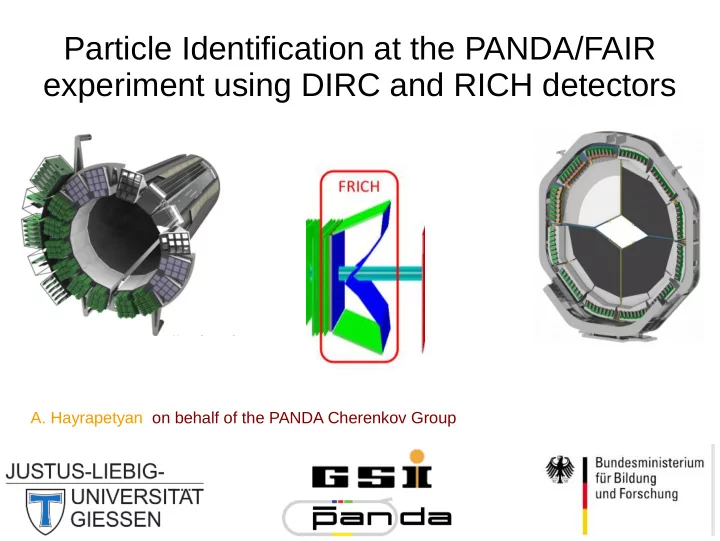
Endcap Disc DIRC Barrel DIRC FRICH
Barrel DIRC FRICH Endcap Disc DIRC(EDD) Polar Angles 22-140 0-5(10) 5(10)-22 degree Goal 3 s.d. p/K separation 3 s.d.π/K 2÷10 GeV/c 3s.d. p/K Up to 3.5 GeV/C μ/π possible till ~2.0 GeV/C up to 4.0 GeV/C
T.Iijima et al., NIM A548 (2005)383 A.Yu.Barnyakov et al., NIMA553(2005)70
NIMA v. 433. Issues 1-2 (1999) 98-103 A few layer of Aerogel, Mirrors and Photon detector area outside of acceptance See A. Barnyakov talk next for more The principle as predecessor, 20 years ago in our HERMES Experiment
Photon detector , Philips Digital Photon Counting (PDPC) https://www.digitalphotoncounting.com Aerogel produced at BIC SB RAS in cooperation with BINP Novosibirsk
Ring 2D distribution for P=6 GeV/C(left) and ring radius distribution for P= 1 GeV/C Momentum beam measured by FRICH prototype at CERN T9 test beam
http://www.uni-giessen.de/dueren
θc
Quartz γ γ θp
X One can calculate the Cherenkov angle analytically, hence EDD could be a part of online trigger at any level
One can see that by enough hits the misidentification is then negligible
missidentification Number of Photons Number of Photons missidentification
Pion, muon,electron
Proton
One sees that Protons are more happy than Pions&Co PMT Number ----> PMT Number ----> Pixel Number ---->
Pion, muon,electron
Proton
Readout FEE FPGA based channels (256 single edge, 192 with ToT) TRB3 TOFPET ASIC compact design 8X128=1024 channels Radiator Borofloat Glass ---- fused Silica Photon Detector MaPMT(16 channels)---MCP-PMT (>=300 channels) FEL Plexiglas Quartz with prism With optic bonding
λ um In Silica produced Cherenkov Photons Number Against wavelength –> Pions Kaons Protons Cherenkov angle against momentum
Full Weight ~ 450 kg For 1 Quadrant ~ 85 kg Quadrants 4 ROMs 96 = 4X3X8 (Readout Modul) Photon detection area ~600cm2 FELs 288 = 4X3X8X3 (Focusing Element) Readout Channels ~30k free running readout system Wavelength Filters ~ 100 or New “green” photocatode MCP We are waiting ~22 detected hits (per track) We promise >3 s.d. for π/K separation till 4 GeV/c momentum
In design or in Prototype(in 3d printed housing)
Finalizing the specifications , algorithms, TDR for a EDD Quadrant readiness for Phase1, 2018 new Testbeam at T9 The complete design in CAD
Barrel DIRC 2018 component procurement 2019-2021 bar box and readout module Assembly 2022-2023 installation in PANDA Hall 2023-2024 commissioning with cosmic and beam TDR approved(arXiv:1710.00684) EDD 2018 R&D fine tuning 2018-2021 1st Quadrant production 2022-2023 Installation of First Quadrant 2023-2024 commissioning 2025 completion of remaining 3 Quadrants FRICH 2018 TDR expected Mirror layout optimization in 2D MC simulation PANDAROOT Aerogel Optimization Photon detector investigation