
SLIDE 1
Technical Design Report for the: PANDA Data Acquisition and Event Filtring
(AntiProton Annihilations at Darmstadt)
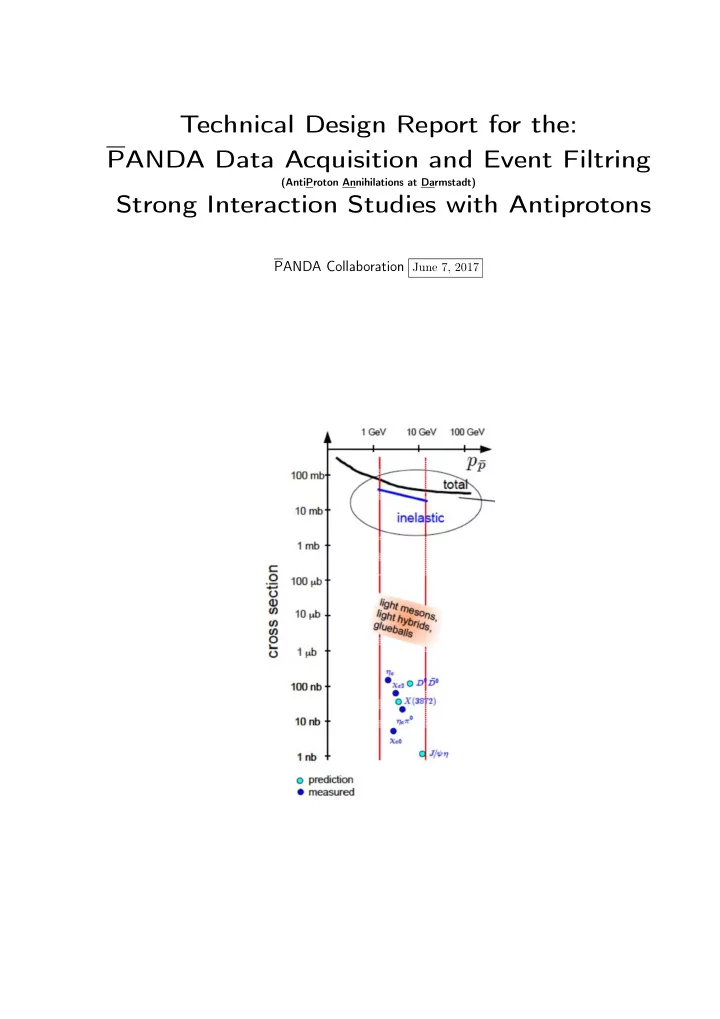
Technical Design Report for the: PANDA Data Acquisition and Event - - PDF document
Technical Design Report for the: PANDA Data Acquisition and Event Filtring (AntiProton Annihilations at Darmstadt) Strong Interaction Studies with Antiprotons PANDA Collaboration June 7, 2017 ii The PANDA Collaboration 2016-02-01 03:15:06
(AntiProton Annihilations at Darmstadt)
ii
2016-02-01 03:15:06 Aligarth Muslim University, Physics Department, Aligarth, India
Universität Basel, Basel, Switzerland
Institute of High Energy Physics, Chinese Academy of Sciences, Beijing, China
Universität Bochum, Institut für Experimentalphysik I, Bochum, Germany
Rheinische Friedrich-Wilhelms-Universität Bonn, Bonn, Germany
Università di Brescia, Brescia, Italy
Institutul National de C&D pentru Fizica si Inginerie Nucleara "Horia Hulubei", Bukarest-Magurele, Romania
P.D. Patel Institute of Applied Science, Department of Physical Sciences, Changa, India
University of Technology, Institute of Applied Informatics, Cracow, Poland
IFJ, Institute of Nuclear Physics PAN, Cracow, Poland
AGH, University of Science and Technology, Cracow, Poland
Instytut Fizyki, Uniwersytet Jagiellonski, Cracow, Poland
FAIR, Facility for Antiproton and Ion Research in Europe, Darmstadt, Germany
GSI Helmholtzzentrum für Schwerionenforschung GmbH, Darmstadt, Germany
Veksler-Baldin Laboratory of High Energies (VBLHE), Joint Institute for Nuclear Research, Dubna, Russia
iii
University of Edinburgh, Edinburgh, United Kingdom
Friedrich Alexander Universität Erlangen-Nürnberg, Erlangen, Germany
Northwestern University, Evanston, U.S.A.
Università di Ferrara and INFN Sezione di Ferrara, Ferrara, Italy
Frankfurt Institute for Advanced Studies, Frankfurt, Germany
INFN Laboratori Nazionali di Frascati, Frascati, Italy
INFN Sezione di Genova, Genova, Italy
Justus Liebig-Universität Gießen II. Physikalisches Institut, Gießen, Germany
University of Glasgow, Glasgow, United Kingdom
Birla Institute of Technology and Science - Pilani , K.K. Birla Goa Campus, Goa, India P.N. Deepak, A. Kulkarni KVI-Center for Advanced Radiation Technology (CART), University of Groningen, Groningen, Netherlands
Gauhati University, Physics Department, Guwahati, India
Indian Institute of Technology Indore, School of Science, Indore, India
Fachhochschule Südwestfalen, Iserlohn, Germany
Forschungszentrum Jülich, Institut für Kernphysik, Jülich, Germany
Chinese Academy of Science, Institute of Modern Physics, Lanzhou, China
INFN Laboratori Nazionali di Legnaro, Legnaro, Italy
Lunds Universitet, Department of Physics, Lund, Sweden
iv Johannes Gutenberg-Universität, Institut für Kernphysik, Mainz, Germany
Helmholtz-Institut Mainz, Mainz, Germany
Research Institute for Nuclear Problems, Belarus State University, Minsk, Belarus
Moscow Power Engineering Institute, Moscow, Russia
Institute for Theoretical and Experimental Physics, Moscow, Russia
Nuclear Physics Division, Bhabha Atomic Research Centre, Mumbai, India
Indian Institute of Technology Bombay, Department of Physics, Mumbai, India
Westfälische Wilhelms-Universität Münster, Münster, Germany
Suranaree University of Technology, Nakhon Ratchasima, Thailand
Budker Institute of Nuclear Physics, Novosibirsk, Russia
Institut de Physique Nucléaire, CNRS-IN2P3, Univ. Paris-Sud, Université Paris-Saclay, 91406, Orsay cedex, France
Dipartimento di Fisica, Università di Pavia, INFN Sezione di Pavia, Pavia, Italy
Institute for High Energy Physics, Protvino, Russia
IRFU,SPHN, CEA Saclay, Saclay, France
Sikaha-Bhavana, Visva-Bharati, WB, Santiniketan, India
University of Sidney, School of Physics, Sidney, Australia
National Research Centre "Kurchatov Institute" B.P.KONSTANTINOV PETERSBURG NUCLEAR PHYSICS INSTITUTE, Gatchina, St. Petersburg, Russia
Petersburg Nuclear Physics Institute of Russian Academy of Science, Gatchina, St. Petersburg, Russia
v Stockholms Universitet, Stockholm, Sweden
Kungliga Tekniska Högskolan, Stockholm, Sweden
Sardar Vallabhbhai National Institute of Technology, Applied Physics Department, Surat, India
Veer Narmad South Gujarat University, Department of Physics, Surat, India
INFN Sezione di Torino, Torino, Italy
Università di Torino and INFN Sezione di Torino, Torino, Italy
Politecnico di Torino and INFN Sezione di Torino, Torino, Italy
Università di Trieste and INFN Sezione di Trieste, Trieste, Italy
Uppsala Universitet, Institutionen för fysik och astronomi, Uppsala, Sweden
The Svedberg Laboratory, Uppsala, Sweden
Instituto de Física Corpuscular, Universidad de Valencia-CSIC, Valencia, Spain
Sardar Patel University, Physics Department, Vallabh Vidynagar, India
National Centre for Nuclear Research, Warsaw, Poland
Österreichische Akademie der Wissenschaften, Stefan Meyer Institut für Subatomare Physik, Wien, Austria
vi Editors: Wolfgang K"u hn Email: w.kuehn@physik.uni-giessen.de Myroslav Kavatsyuk Email: m.kavatsyuk@rug.nl N.N .... Technical Coordinator: Lars Schmitt Email: l.schmitt@gsi.de Deputy: Anastasios Belias Email: a.belias@gsi.de Spokesperson: Klaus Peters Email: klaus.peters@gsi.de Deputy: Tord Johansson Email: tord.johansson@tsl.uu.se
vii
viii The use of registered names, trademarks, etc. in this publication does not imply, even in the absence of specific statement, that such names are exempt from the relevant laws and regulations and therefore free for general use.
ix
Preface vii 1 Executive Summary 1 2 The PANDA Experiment 3 2.1 The PANDA Experiment . . . . . . . 3 2.1.1 The Scientific Program . . . . . . 3 2.1.2 High-Energy Storage Ring . . . . 3 2.1.3 Targets . . . . . . . . . . . . . . . 3 2.1.4 Luminosity Considerations . . . . 3 2.2 The PANDA Detector . . . . . . . . . 4 2.2.1 Target Spectrometer . . . . . . . 5 2.2.2 Forward Spectrometer . . . . . . . 5 2.2.3 The Particle Identification System 6 2.2.4 Data Acquisition . . . . . . . . . . 6 2.2.5 Infrastructure . . . . . . . . . . . 6 3 Requirements 11 3.1 Event rates for Phase 1 Physics . . . 11 3.2 Pile-up situation . . . . . . . . . . . . 11 3.3 On-line storage and requirements for event filtering . . . . . . . . . . . . . 11 3.4 DAQ partioning and running modes . 11 4 System Architecture 13 4.1 Basic building blocks of the system . 13 4.2 Data formats, interfaces and data flow 13 4.3 Event filtering and partitioning of al- gorithms . . . . . . . . . . . . . . . . 13 4.4 Run Control, error handling and data quality monitoring . . . . . . . . . . . 13 5 Performance 15 5.1 Simulations . . . . . . . . . . . . . . 15 5.1.1 Framework . . . . . . . . . . . . . 15 5.1.2 Results . . . . . . . . . . . . . . . 15 5.2 Measurements with prototype com- ponents . . . . . . . . . . . . . . . . . 15 5.2.1 Setup . . . . . . . . . . . . . . . . 15 5.2.2 Results . . . . . . . . . . . . . . . 15 6 Project managements and ressources 17 6.1 Responsibilities . . . . . . . . . . . . 17 6.2 Schedule and Milestones . . . . . . . 17 6.3 Cost . . . . . . . . . . . . . . . . . . 17 7 Acknowledgements 19
x
1
The PANDA Experiment PANDA [1] will be one of the four flagship experi- ments at the new international accelerator complex FAIR (Facility for Antiproton and Ion Research) in Darmstadt, Germany. With the PANDA detec-
5
tor unique experiments will be performed using the high-quality antiproton beam within a momentum range from 1.5 GeV/c to 15 GeV/c, stored in the HESR (High Energy Storage Ring) [2]. The explo- ration of fundamental questions of hadron physics
10
in the charm and multi-strange hadron sectors will deliver essential contributions to many open ques- tions of QCD. The scientific program of PANDA [3] includes hadron spectroscopy, properties of hadrons in matter, nucleon structure, hypernuclei and much
15
more like the exotic bound quark states with or without gluonic degrees of freedom. The cooled antiproton beam colliding with a fixed proton or nuclear target will allow hadron production and formation experiments with a luminosity of up to
20
2 × 1032 cm−2s−1 in the fully completed version of the facility. In the Modular Start Version (MSV) the luminosity will be 1 × 1031 cm−2s−1. Excellent Particle Identification (PID) is mandatory for the success of the PANDA physics program, in which
25
the Barrel TOF will play a crucial role. PANDA Overview: Data Acquisition The PANDA experiment adopts a free-running data acquisition concept in order to allow as much flex- ibility as possible which the complex and diverse
30
physics objectives of the experiment require, and also to fully exploit the high interaction rate of up to 2 × 10⁷ events/s. Each sub-detector system runs autonomously in a self-triggering mode, yet syn- chronised with a high-precision time distribution
35
system, SODANET. Zero-suppressed and physi- cally relevant signals are transmitted to a high- bandwidth computing network implementing a soft- ware trigger. Without a selection of data the whole data rate could be as high as 200 GB/s. The data
40
acquisition system aims for an online data reduction
[1] PANDA Collaboration. Technical Progress Re- port, FAIR-ESAC/Pbar. 2005.
45
[2] D. Prasuhn. Status HESR. PANDA meeting, June 2014. [3] PANDA Collaboration. Physics Performance Report for PANDA: Strong Interaction Studies with Antiprotons. arxiv:0903.3905, 2009.
5
2 BIBLIOGRAPHY
3
The PANDA (anti-Proton ANnihilation at DArm- stadt) collaboration [1] envisages a physics core pro- gram [2] that comprises
5
surements of mass, width, and decay branches;
have more exotic configurations like multiquark states, charmed hybrids, and glueballs;
10
search for medium modifications
charmed hadrons in nuclear matter;
ticular double Λ states. In the charmonium and open-charm regions, many
15
new states have been observed in the last years, that do not match the patterns predicted in those regimes [3]. There are even several states unam- biguously being of exotic nature, raising the ques- tion about the underlying mechanism to form such
20
kind of states [4]. The production of charmonium and open-charm states in e+e− interactions are restricted to ini- tial spin-parities of JP C = 1−−. This limits the possibility to precisely scan and investigate these
25
resonances in formation reactions. The use of ¯ pp annihilation does not suffer from this limitation. Combined with the excellent energy resolution of down to about 25 keV, this kind of reactions offer unique opportunity to perform hadron and charmo-
30
nium spectroscopy in the accessible energy range. Since the decay of charm quarks predominantly pro- ceeds via strangeness production, the identification
the signal events from the huge pionic background.
35
The combination of HESR and PANDA are situ- ated at FAIR facility (Fig. 2.1). The experiment aims at both high reaction rates and high resolu- tion in order to be able to study rare production
40
processes and small branching ratios. With a design value of 1011 stored antiprotons for beam momenta from 1.5 GeV/c to 15 GeV/c and high density inter- nal targets the anticipated antiproton production rate of 2·107 s−1 governs the experiment interaction rate in the order of cycle-averaged 1·107 s−1. The
5
stored antiprotons are freely coasting except for a 10% to 20% bunch structure allocated to a barrier bucket for compensation of energy losses. Two complementary operating modes are planned, named high luminosity and high resolution mode,
10
respectively. The high luminosity mode with ∆p/p = 10−4, stochastic cooling and a target thick- ness of 4·1015 cm−2 will have an average luminosity
lution mode ∆p/p = 5 · 10−5 will be achieved with
15
electron cooling for momenta up to p = 8.9 GeV/c. Operation will mainly be in conjunction with a clus- ter jet target which will not impose a time structure
is expected to be L = 2 · 1031 cm−2s−1.
20
The PANDA Target Spectrometer is designed to al- low the installation of different targets. For hydro- gen as target material both a Cluster-Jet target and a Pellet target are being prepared. One technical
25
challenge is the distance of 2.1 m between the injec- tion nozzle and the Interaction point, plus the same distance until the target particles are dumped in an efficient catcher keeping the whole target line under high vacuum.
30
The Cluster-Jet target is homogenous in space and time whereas a Pellet target with average inter- pellet spacing of 3 mm exhibits large density varia- tions on the 10–100 µs timescale. An extension of the targets to heavier gases such as
35
deuterium, nitrogen, or argon is planned for com- plementary studies with nuclear targets.
The luminosity is directly linked to the number of stored antiprotons. The maximum luminosity de-
40
pends on the antiproton production rate. The cycle- averaged antiproton production rate and reaction rate must be equal in the consumption limit. Due to injection losses and possible dumping of beam parti-
4 2 THE PANDA EXPERIMENT
Figure 2.1: Schematic of the future FAIR layout incorporating the current GSI facilities on the left; on the right the future installations, the SIS 100 synchrotron the storage and cooler ring complex including CR and HESR and the Super FRS experiment being some of the new parts. PANDA is positioned right in the center of the image inside the HESR.
cles at the end of a cycle the time-averaged reaction rate will be lower. In Figure 2.2 the beam prepara- tion periods with target off and data taking periods with target on are drawn. The red curve showing the luminosity at constant target thickness is pro-
5
portional to the decreasing number of antiprotons during data taking. In order to provide a constant luminosity, compensation by adjusting the target thickness is studied. In the case of a Pellet target, variations of the in-
10
stantaneous luminosity will occur. These are de- pending on the antiproton beam profile, pellet size, pellet trajectories and the spacing between pellets. In the case of an uncontrolled pellet sequence tar- get thickness fluctuations with up to 2–3 pellets in
15
beam do occur during timescales of the pellet tran- sit time which is 10–100 µs, . The pellet high lumi- nosity mode (PHL mode) features smaller droplet size, lower spread in pellet relative velocity and smaller average pellet distance. The latter being
20
much smaller than the beam size, hence the thick- ness fluctuations would be much reduced. However, this pellet target mode is currently being developed.
Figure 2.2: [5] Time dependent macroscopic luminos- ity profile L(t) in one operation cycle for constant (solid red) and increasing (green dotted) target density ρtarget. Different measures for beam preparation are indicated. Pre-cooling is performed at 3.8 GeV/c. A maximum ramp of 25 mT/s is specified for acceleration and decel- eration of the beam.
Figure 2.3 shows the PANDA detector viewed with partial cut-outs. As a fixed target experiment, it is asymmetric having two parts, the Target Spectrom- eter (TS) and the Forward Spectrometer (FS). The
5
antiproton beam is scattered off a pellet or cluster-
2.2 The PANDA Detector 5 jet target (left side in Fig. 2.3). PANDA will mea- sure ¯ pp reactions comprehensively and exclusively, which requires simultaneous measurements of lep- tons and photons as well as charged and neutral hadrons, with high multiplicities.
5
The physics requirements for the detectors are:
particles,
products, and
10
momenta of the reaction products.
Figure 2.4 shows a side view of the PANDA target
15
sealed to avoid solid angle gaps and which provides little spare space inside, consists of a superconduct- ing solenoid magnet with a field of 2 T and a set
tral and charged particles as well as for the track-
20
ing and PID for charged tracks housed within the
closely abuts the beam pipe surrounding the target area and provides secondary vertex sensitivity for particles with decay lengths on the order of 100 µm.
25
The main tracker is a straw tube tracker (STT). There will be several gas electron multiplier (GEM) tracking stations in the forward direction. The tracking detectors like MVD and STT also provide information on the specific energy loss in their data
30
stream. Two Internally Reflected Cherenkov light (DIRC) detectors are to be located within the TS. Com- pared to other types of Ring Imaging Cherenkov (RICH) counters the possibility of using thin ra-
35
diators and placing the readout elements outside the acceptance favors the use of DIRC designs as Cherenkov imaging detectors for PID. The Barrel DIRC covers the polar angles θ from 22◦ to 140◦ in- side the PANDA TS. The Endcap Disc DIRC (EDD)
40
covers the polar angles θ from 10◦ to 22◦ in the hor- izontal plane and 5◦ to 22◦in the vertical plane. For the analysis of the DIRC data the tracking informa- tion is needed, as the Cherenkov angle is measured between the Cherenkov photon direction and the
45
momentum vector of the radiating particle. The Barrel TOF detector, which is the topic of this document, serves as precise (< 100 ps) timing detec- tor cylindrically surrounding the target. It consists
multipliers (SiPMs) and is attached to the support frame outside of the Barrel DIRC providing rea- sonable π-K separation below 1 GeV/c (see chap- ter ??).
5
The lead tungstate (PWO) crystals of the electro- magnetic calorimeters (EMC) are read out with Avalanche Photo Diodes (APD) or vacuum pen- todes. Both, the light output and the APD per- formance improve with lower temperature. Thus
10
the plan is, to operate the EMC detectors at T = −25◦C. The EMC is subdivided into backward end- cap, barrel and forward endcap, all housed within the solenoid magnet return yoke. Besides the detection of photons, the EMC is also
15
the most powerful detector for the identification of
this particle species will play an essential role for the physics program of PANDA. The return yoke for the solenoid magnet in the
20
PANDA TS is laminated to accommodate layers of drift tubes (Iarocci-type detectors) for the muon de-
muon layer being able to detect low energy muons and the cumulated iron layer thickness in front of
25
the outer layers providing enough hadronic material to stop the high energy pions produced in PANDA. A similar lamination and instrumentation of the iron is foreseen in the downstream door of the yoke augmented by the addition of a muon filter located
30
in between the TS and the FS.
Figure 2.5 shows a side view of the PANDA for- ward spectrometer. The FS angular acceptance has an ellipsoidal form with a maximum angular accep-
35
tance of ±10 degrees horizontally and ±5 degrees vertically w.r.t. the beam direction. The tracking section of the FS is incorporated into the large gap of a dipole magnet providing bending power of 2 Tm with a B-field perpendicular to the
40
forward tracks. The other parts are placed further downstream outside the dipole magnet. An aerogel RICH detector will be located right be- hind the dipole magnet followed by a the Forward Time-of-Flight wall (FTOF) which also covers the
45
detection of slow particles below the Cherenkov light threshold. The energy is measured in the Shashlyk type electromagnetic calorimeter consist- ing of 1404 modules of 55 × 55 mm2 cell size cov- ering 2.97 × 1.43 m2.
50
For the determination of the luminosity a detec-
6 BIBLIOGRAPHY tor based on four layers of monolithic active pixel sensors will be installed close to the beam pipe de- tecting scattered antiprotons under small angles.
5
The charged particle identification (PID) will com- bine the information from the time-of-flight, track- ing, dE/dx and calorimetry information with the
cus on positive identification of kaons.
10
The individual PANDA subsystems contributing to the PID and the combination of their data into a global PID information have been reviewed in the PID-TAG-report [6], a performance plot regarding the π-K separation power is shown in chapter ??.
15
The data flow and processing is spatially separated into the Front End Electronics (FEE) part located
quisition (DAQ), located off-detector in the count-
20
ing room. The FEE comprises analog electronics, digitization, low level pre-processing and optical data transmis- sion to the DAQ system. While each sub-detector implements detector spe-
25
cific FEE systems the DAQ features a common ar- chitecture and hardware for the complete PANDA detector. Operating the PANDA detector at interaction rates
30
data rates of ∼ 200 GB/second. The PANDA DAQ [1] design does not use fixed hardware based triggers but features a continuously sampling system where the various subsystems are synchronized with a precision time stamp distribu-
35
tion system. Event selection is based on real-time feature extrac- tion, filtering and high level correlations. The main elements of the PANDA DAQ are the data concentrators, the compute nodes and high
40
speed interconnecting networks. The data concen- trators aggregate data via point-to-point links from the FEE and the compute nodes provide feature extraction, event building and physics driven event selection.
45
A data rate reduction of about 1000 is envisaged in
storage. Peak rates above the mean data rate
∼ 200 GB/second and increased pile-up may
target thickness fluctuations (in case of pellet
5
target) and luminosity variations during the HESR
Therefore, FPGA based compute nodes serve as ba- sic building blocks for the PANDA DAQ system exploiting parallel and pipelined processing to im-
10
plement the various real-time tasks, while multiple high speed interconnects provide flexible scalability to meet the rate demands.
The PANDA detector is located below ground in
15
an experimental hall, encased in smaller tunnel-like concrete structure, partially fixed, partially made
Most subsystems connect their FEE-components via cables and tubes placed in movable cable ducts to the installations in the
20
counting house, where three levels are foreseen to accommodate cooling, gas supplies, power supplies, electronics, and work space.
[1] PANDA Collaboration. Technical Progress Re-
25
port, FAIR-ESAC/Pbar. 2005. [2] PANDA Collaboration. Physics Performance Report for PANDA: Strong Interaction Studies with Antiprotons. arxiv:0903.3905, 2009. [3] X. Liu. An overview of XYZ new particles.
30
arXiv:1312.7408v2 [hep-ph], 2014. [4] Yu. S. Kalashnikova et al. Quark and Meson De- grees of Freedom in the X(3872) Charmonium.
[5] PANDA Collaboration. Straw Tube Tracker
35
Technical Design Report. 2012. [6] G. Schepers et al. Particle Identification at
BIBLIOGRAPHY 7
Figure 2.3: Aerial view of PANDA with the Target Spectrometer (TS) on the left side, and the Forward Spec- trometer (FS) starting with the dipole magnet on the right. The antiproton beam enters from the left.
8 BIBLIOGRAPHY
Figure 2.4: Side view of PANDA with the Target Spectrometer (TS). The antiproton beam enters from the left.
BIBLIOGRAPHY 9
Figure 2.5: Side view of PANDA forward Spectrometer (FS). The antiproton beam enters from the left.
10 BIBLIOGRAPHY
11
Section 3.1 describes the expected event rates for phase 1 physics Section 3.2 discusses the pileup sit- uation Section 3.3 discusses the available capacity for on-line storage and the resulting requirements
5
tioning of DAQ and DAQ running modes
10
15
12 BIBLIOGRAPHY
13
Section 4.1 describes the basic building blocks of the system (SODAnet, data concentrators, data transport, FPGA based compute nodes, CPU/GPU farm) Section 4.2 describes data formats, interfaces and data flow Section 4.3 describes the event filter-
5
ing system and its partitioning into FPGA based and CPU/GPU based algorithms Section 4.4 dis- cusses run control (RC), error handling and data quality monitoring (DQM)
10
15
14 BIBLIOGRAPHY
15
Section 5.1 describes discrete event simulations demonstrating the performance of the data acquisi- tion system Section 5.2 describes measurements with prototype components of the data acquisition system
5
10
16 BIBLIOGRAPHY
17
18 BIBLIOGRAPHY
19
We acknowledge financial support from ...
20 7 ACKNOWLEDGEMENTS
21
2.1 Schematic of the future FAIR layout incorporating the current GSI facili- ties on the left; on the right the fu- ture installations, the SIS 100 syn- chrotron the storage and cooler ring
5
complex including CR and HESR and the Super FRS experiment be- ing some of the new parts. PANDA is positioned right in the center of the image inside the HESR. . . . . . . . 4
10
2.2 [5] Time dependent macroscopic lu- minosity profile L(t) in one opera- tion cycle for constant (solid red) and increasing (green dotted) tar- get density ρtarget. Different mea-
15
sures for beam preparation are indi- cated. Pre-cooling is performed at 3.8 GeV/c. A maximum ramp of 25 mT/s is specified for acceleration and deceleration of the beam. . . . 4
20
2.3 Aerial view of PANDA with the Tar- get Spectrometer (TS) on the left side, and the Forward Spectrometer (FS) starting with the dipole magnet
25
enters from the left. . . . . . . . . . 7 2.4 Side view of PANDA with the Target Spectrometer (TS). The antiproton beam enters from the left. . . . . . . 8 2.5 Side view of PANDA forward Spec-
30
trometer (FS). The antiproton beam enters from the left. . . . . . . . . . 9
22