
SLIDE 1
F r o m Q u a r k s t o Q u a s a r s
- Dr. Peter Skands
CERN Theoretical Physics Dept
Start Here (Particle Physics) End Here (Cosmology) Outline:
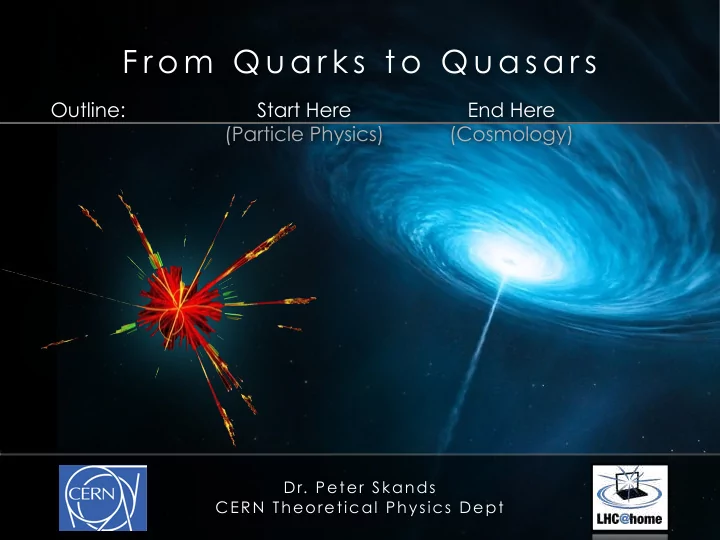
F r o m Q u a r k s t o Q u a s a r s Outline: Start Here End - - PowerPoint PPT Presentation
F r o m Q u a r k s t o Q u a s a r s Outline: Start Here End Here (Particle Physics) (Cosmology) Dr. Peter Skands CERN Theoretical Physics Dept Hvem er jeg? Lste fysik-astronomi p KU (cand scient: 5 r) Lunds Universitet:
CERN Theoretical Physics Dept
Start Here (Particle Physics) End Here (Cosmology) Outline:
2
Læste fysik-astronomi på KU (cand scient: 5 år) → Lunds Universitet: teoretisk fysik (PhD: 3 år)
3
Læste fysik-astronomi på KU (cand scient: 5 år) → Lunds Universitet: teoretisk fysik (PhD: 3 år) → Fermilab (Chicago) “Post Doc”: 2 år “Scientist”: 3 år Nu: CERN …
4
~ 10 000 scientists work at CERN.
20 European Member States and around 60 other countries
Flags of CERN’s Member States
27Yearly budget ~ 1 billion CHF ~ 6 mia DKR
What goes on at CERN
Theory Experiment
→ Science
VINCIA PYTHIA …
Simulation Codes
→ Simulated Particle Collisions
Experimental Data
→ Published Data Points
“Events” “Histograms”
Teorien om den stærke kernekraft: Kvante-Chromodynamik (QCD)
Kvarker og Gluoner
Bremsstrahlung
Når du sparker en kvark, stråler den gluoner (Jvf elektriske ladninger, der stråler fotoner)
Hadronisering
Når kvarker og gluoner bliver ‘kolde’ bindes de i hadroner Der opstår ‘gluon-strenge’ mellem dem, som bryder op Den process forsøger vi at modellere og forstå
“Monte Carlo event generators”
→ tilfældige begivenheder, som i eksperimentet ~ en ‘virtuel accelerator’
Not a computer scientist. But the numerical calculations I (want to) do require a lot of power → distributed computing: farms / GRID / clouds.
8
+ Hadroner = bundne tilstande af kvarker (og antikvarker)
Mesoner (kvark-antikvark): pioner, kaoner, ρ mesoner, … Baryoner (triple-kvark): protoner, neutroner, hyperoner, …
~ 1fm = “1 fermi”
Te s t 4 T h e o r y - A V i r t u a l A t o m S m a s h e r
O v e r 1 0 0 0 b i l l i o n s i m u l a t e d c o l l i s i o n e v e n t s
p p
LHC Physics Center at CERN
10
New Users/Day
May June July Aug Sep
July 4th 2012
The ¡LHC@home ¡2.0 ¡project ¡Test4Theory ¡allows ¡users ¡to ¡par:cipate ¡in ¡running ¡ simula:ons ¡of ¡high-‑energy ¡par:cle ¡physics ¡using ¡their ¡home ¡computers. The ¡results ¡are ¡submiAed ¡to ¡a ¡database ¡which ¡is ¡used ¡as ¡a ¡common ¡resource ¡by ¡both ¡ experimental ¡and ¡theore:cal ¡scien:sts ¡working ¡on ¡the ¡Large ¡Hadron ¡Collider ¡at ¡CERN.
New: ¡Ci#zen ¡Cyberlab ¡(funds ¡from ¡EU)
Develop ¡an ¡app ¡that ¡lets ¡ci8zen ¡scien8sts ¡ learn ¡about, ¡interact ¡with, ¡and ¡op2mize ¡ high-‑energy ¡physics ¡simula2ons, ¡by ¡ comparing ¡them ¡to ¡real ¡data
http://lhcathome.cern.ch/test4theory
P . Skands From Quarks to Quasars 11
… we re m a d e i n s t a r s …
t h e b u i l d i n g b l o c k s o f L i f e
T h e C a r b o n i n o u r b o d i e s T h e O x y g e n t h a t we b re a t h e T h e N i t ro g e n
So perhaps we are the eyes through which the universe beholds itself ?
All I know for sure: Nature is a Fantastic Work of Art Where did it come from? What is it? Where is it going? It inspires us to think beyond ourselves
P . Skands From Quarks to Quasars
12
Stockholm, 1922
“The present state of atomic theory is characterised by the fact that we not only believe the existence of atoms to be proved beyond a doubt, but also we even believe that we have an intimate knowledge of the constituents of the individual atoms ...”
Niels Bohr (1885-1962)
P . Skands From Quarks to Quasars 13
Today, we even believe that we have an intimate knowledge of the constituents of
nothing
http://www.physics.adelaide.edu.au/theory/staff/leinweber/VisualQCD/Nobel 1 Femtometer = 1fm = 10-15m ~ Size of a proton
Gluon action density: 2.4x2.4x3.6 fm, Supercomputer “Lattice simulation” from D. B. Leinweber, hep-lat/0004025
P . Skands From Quarks to Quasars
The true nature of the strong nuclear force is revealed at distances below about 10-15m (= 10-6 nm) To “see” something that small: need high energies (wavelength inversely proportional to energy): kick an electron with 1 billion Volts = 1 Giga-electron-Volt (GeV) The energy of the Large Hadron Collider at CERN : 8 TeV In computer simulations, we try to recreate the collisions happening in the LHC in as much detail as mother nature. The clarity of our vision of the Terascale depends on their accuracy. You can help → LHC@home 2.0
“the Terascale” !
14
Short wavelength More Energy Long wavelength Low Energy E = h f
P . Skands From Quarks to Quasars 15
the real Accelerators
1932: Cockroft & Walton built a system that could fire protons, like bullets, into metal targets: p + LiF → Be, He, O, …
(Nobel 1951) “Transmutation of atomic nuclei by artificially accelerated atomic particles”
Early Van de Graaff Generator
Early van-de-Graaf, ca 1937 Cavendish laboratory, UK, ca. 1932 Fermi Laboratory, Chicago, USA,
Modern van-de-Graaf
P . Skands From Quarks to Quasars
The goal: Accelerators ¡are ¡‘op8cal’ ¡systems, ¡with ¡
Light ¡ ¡charged ¡par:cles Lenses ¡ ¡magnets Wave ¡length ¡shortening ¡ ¡par:cle ¡accelera:on
E = mc2
16
P . Skands From Quarks to Quasars
Relative to combustion of 1 kg of octane molecules (gasoline) :
100m Waterfall : 0.000 025 Burning wood : 0.3 Burning sugar (metabolism) : 0.5 Burning ethanol or coal : 0.75 Burning Beryllium : 1.5
17
P . Skands From Quarks to Quasars
Relative to combustion of 1 kg of octane molecules (gasoline) :
100m Waterfall : 0.000 025 Burning wood : 0.3 Burning sugar (metabolism) : 0.5 Burning ethanol or coal : 0.75 Burning Beryllium : 1.5 Uranium-235 Fission : 2 000 000 Deuterium-Tritium Fusion : 10 000 000
18
P . Skands From Quarks to Quasars
Relative to combustion of 1 kg of octane molecules (gasoline) :
100m Waterfall : 0.000 025 Burning wood : 0.3 Burning sugar (metabolism) : 0.5 Burning ethanol or coal : 0.75 Burning Beryllium : 1.5 Uranium-235 Fission : 2 000 000 Deuterium-Tritium Fusion : 10 000 000 Matter-Antimatter Annihilation : 2 000 000 000
19
P . Skands From Quarks to Quasars
Relative to combustion of 1 kg of octane molecules (gasoline) :
100m Waterfall : 0.000 025 Burning wood : 0.3 Burning sugar (metabolism) : 0.5 Burning ethanol or coal : 0.75 Burning Beryllium : 1.5 Uranium-235 Fission : 2 000 000 Deuterium-Tritium Fusion : 10 000 000 Matter-Antimatter Annihilation : 2 000 000 000 Tevatron collisions : 2 000 000 000 000 LHC collisions: 8 000 000 000 000
Still, Dan Brown exaggerated a bit in “Angels & Demons” …
“If all of the antimatter ever produced at Fermilab had been collected, we would have a couple of nanogrammes …” Dave Vandermeulen, antimatter expert, Fermilab
20
July 4th 2012: “Higgs-like” particle seen at CERN
Fabiola Gianotti
Spokeswoman of ATLAS
(+ over 500 other published physics papers from LHC so far)
P . Skands From Quarks to Quasars
Consider a ‘field’ distributed evenly across the Universe,
Suppose that different particles experience this ‘field’ as being more or less transparent
To a photon (light), the field is completely “translucent” But an electron (or a proton), will interact with it
Suppose that this field condenses around the particles which couple to it, causing an increased energy density around those particles. Looks like mass (E=mc2). We call this field the “H” (or Higgs) Field If correct, it should be possible to create waves in the Higgs field itself (though that may require a lot of energy)
22
P . Skands From Quarks to Quasars
If correct, the Higgs mechanism makes one spectacular prediction: it should be possible to excite a wave in the Higgs field itself Made out of pure ‘Higgs’ stuff, in particle form this wave is known as the ‘Higgs particle’ or ‘Higgs boson’ This particle would quickly dissolve (decay) into other particles, but should be detectable via its decay products The discovery of a particle consistent with these properties was announced at CERN on July 4, 2012 The coming years will see a huge activity trying to determine all the quantum properties of this new “H particle”
23
P . Skands From Quarks to Quasars
the Last Piece of the puzzle?
24
Atoms Neutrinos Exo8c ¡maCer An8maCer Electromagne8sm The ¡nuclear ¡forces + ¡Gravity ¡(Einstein) + ¡Mass
Like: ¡Quantum ¡Gravity? ¡Higgs ¡Origins? ¡Grand ¡Unifica8on? ¡Extra ¡Dimensions? ¡… ¡
P . Skands From Quarks to Quasars
25
What ¡we ¡ know Some ¡new ¡ “dark” ¡type ¡of ¡ maAer
(maybe) (mostly ¡quarks)
Stuff ¡that ¡makes ¡ space ¡expand
(really ¡no ¡clue)
P . Skands From Quarks to Quasars
26 1) Rigid Body Speed [m/s] versus distance from origin 2) Keplerian Motion (Solar System) 3) Spiral Galaxies Mercury: 48 km/s Earth: 30 km/s Neptune: 5 km/s R o t a t i o n C u r ve s M33 Triangulum Galaxy
P . Skands From Quarks to Quasars
(and of Galaxy Clusters)
27 50,000 ¡light ¡years
~ ¡ ¡0.5 ¡× ¡1018 ¡km
~ ¡3 ¡billion ¡:mes ¡Earth-‑Sun ¡distance
Something ¡unknown ¡is ¡making ¡galaxies ¡spin ¡like ¡crazy
M33 Triangulum Galaxy
21 ¡cm: p+
e-
spin-‑flip
(wait ¡10 ¡Myr)
P . Skands From Quarks to Quasars
28
August ¡2006: ¡Clowe ¡et ¡al.: ¡“A ¡direct ¡empirical ¡proof ¡of ¡ the ¡existence ¡of ¡dark ¡maAer”
Astrophysical ¡Journal ¡648 ¡L109-‑L113 ¡(2006) ¡
But ¡we ¡s8ll ¡don’t ¡know ¡what ¡“it” ¡is Maybe ¡we ¡can ¡make ¡it ¡in ¡the ¡LHC ¡? Or ¡“see” ¡it ¡in ¡space ¡or ¡on ¡Earth? ¡ Stay ¡tuned…
P . Skands From Quarks to Quasars
29
What ¡we ¡ know Some ¡new ¡ “dark” ¡type ¡of ¡ maAer
(maybe) (mostly ¡quarks)
Stuff ¡that ¡makes ¡ space ¡expand
(really ¡no ¡clue)
P . Skands From Quarks to Quasars
30
Extremely far away → appear point-like
(“Quasi-Stellar” → Quasar)
The most luminous
→ we can see them even when they’re very, very far away (~ 10 billion
light years) …
… when the Universe was younger
P . Skands From Quarks to Quasars
31
Gravity slows down expansion of Universe Very distant quasars show that was essentially true in the very early Universe
(Nov 12, 2012, BOSS)
P . Skands From Quarks to Quasars
Gravity slows down expansion of Universe Very distant quasars show that was essentially true in the very early Universe
(Nov 12, 2012, BOSS)
32
So: what is causing this?
Note: not (yet) claiming Einstein was wrong. His equations have room for a “Cosmological Constant” that could do exactly this. But even so, what is it? Where did it come from?
P . Skands From Quarks to Quasars
What are Dark Matter and Dark Energy? Are they new “stuff” that obeys
known laws, or are they new laws unto themselves? Or both?
How well can you solve Quantum Field Theory? Without assuming
things that aren’t true? Fluctuations within fluctuations within fluctuations within fluctuations ...
Is 4 dimensions all there is? If more, how do they look? Is holography relevant? Where did the Higgs potential come from? How is it stable? What
determines how particles couple to it? Is it fundamental? Are there more Higgs fields?
Why does normal matter have heavier ‘exotic’ cousins? I.e., the
Why 4 fundamental forces? Are there more? Or are they really one? Why is there a bit more matter than antimatter around? (e.g., us) Also, what is quantum gravity? Superstrings? Or something else? Ideas are not enough. How to test! How to calculate!
33