f 1 , a concomitantly lower ultimate strength. the curve - - PDF document

f 1
SMART_READER_LITE
LIVE PREVIEW

f 1 , a concomitantly lower ultimate strength. the curve - - PDF document

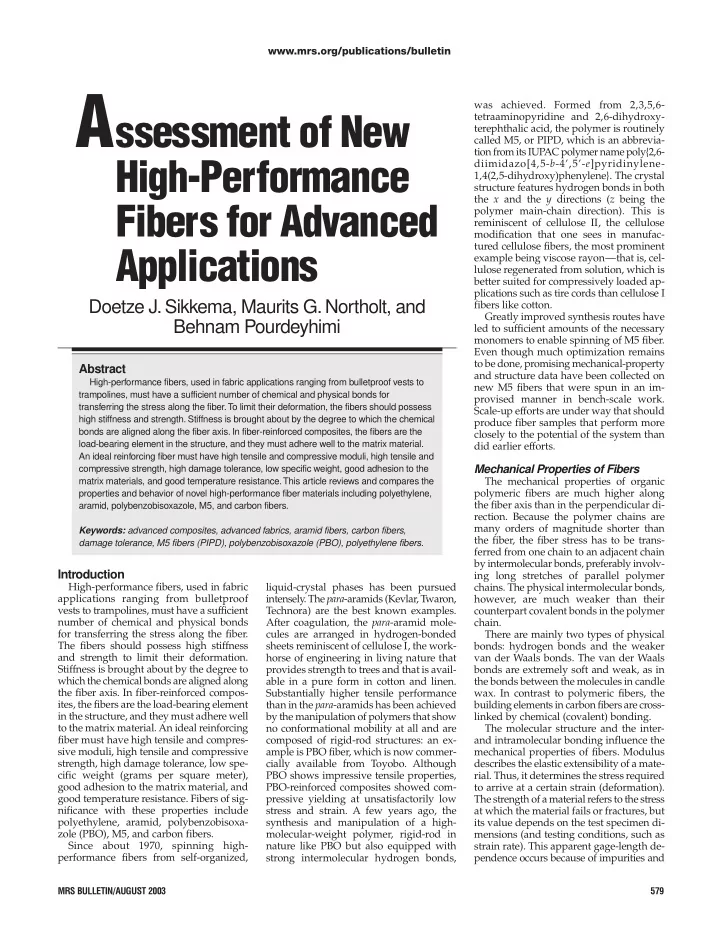
www.mrs.org/publications/bulletin A ssessment of New was achieved. Formed from 2,3,5,6- tetraaminopyridine and 2,6-dihydroxy- terephthalic acid, the polymer is routinely called M5, or PIPD, which is an abbrevia- tion from its IUPAC polymer name


slide-1
SLIDE 1

Introduction

High-performance fibers, used in fabric applications ranging from bulletproof vests to trampolines, must have a sufficient number of chemical and physical bonds for transferring the stress along the fiber. The fibers should possess high stiffness and strength to limit their deformation. Stiffness is brought about by the degree to which the chemical bonds are aligned along the fiber axis. In fiber-reinforced compos- ites, the fibers are the load-bearing element in the structure, and they must adhere well to the matrix material. An ideal reinforcing fiber must have high tensile and compres- sive moduli, high tensile and compressive strength, high damage tolerance, low spe- cific weight (grams per square meter), good adhesion to the matrix material, and good temperature resistance. Fibers of sig- nificance with these properties include polyethylene, aramid, polybenzobisoxa- zole (PBO), M5, and carbon fibers. Since about 1970, spinning high- performance fibers from self-organized, liquid-crystal phases has been pursued

  • intensely. The para-aramids (Kevlar, Twaron,

Technora) are the best known examples. After coagulation, the para-aramid mole- cules are arranged in hydrogen-bonded sheets reminiscent of cellulose I, the work- horse of engineering in living nature that provides strength to trees and that is avail- able in a pure form in cotton and linen. Substantially higher tensile performance than in the para-aramids has been achieved by the manipulation of polymers that show no conformational mobility at all and are composed of rigid-rod structures: an ex- ample is PBO fiber, which is now commer- cially available from Toyobo. Although PBO shows impressive tensile properties, PBO-reinforced composites showed com- pressive yielding at unsatisfactorily low stress and strain. A few years ago, the synthesis and manipulation of a high- molecular-weight polymer, rigid-rod in nature like PBO but also equipped with strong intermolecular hydrogen bonds, was achieved. Formed from 2,3,5,6- tetraaminopyridine and 2,6-dihydroxy- terephthalic acid, the polymer is routinely called M5, or PIPD, which is an abbrevia- tion from its IUPAC polymer name poly{2,6- diimidazo[4,5-b-4’,5’-e]pyridinylene- 1,4(2,5-dihydroxy)phenylene}. The crystal structure features hydrogen bonds in both the x and the y directions (z being the polymer main-chain direction). This is reminiscent of cellulose II, the cellulose modification that one sees in manufac- tured cellulose fibers, the most prominent example being viscose rayon—that is, cel- lulose regenerated from solution, which is better suited for compressively loaded ap- plications such as tire cords than cellulose I fibers like cotton. Greatly improved synthesis routes have led to sufficient amounts of the necessary monomers to enable spinning of M5 fiber. Even though much optimization remains to be done, promising mechanical-property and structure data have been collected on new M5 fibers that were spun in an im- provised manner in bench-scale work. Scale-up efforts are under way that should produce fiber samples that perform more closely to the potential of the system than did earlier efforts.

Mechanical Properties of Fibers

The mechanical properties of organic polymeric fibers are much higher along the fiber axis than in the perpendicular di-

  • rection. Because the polymer chains are

many orders of magnitude shorter than the fiber, the fiber stress has to be trans- ferred from one chain to an adjacent chain by intermolecular bonds, preferably involv- ing long stretches of parallel polymer

  • chains. The physical intermolecular bonds,

however, are much weaker than their counterpart covalent bonds in the polymer chain. There are mainly two types of physical bonds: hydrogen bonds and the weaker van der Waals bonds. The van der Waals bonds are extremely soft and weak, as in the bonds between the molecules in candle

  • wax. In contrast to polymeric fibers, the

building elements in carbon fibers are cross- linked by chemical (covalent) bonding. The molecular structure and the inter- and intramolecular bonding influence the mechanical properties of fibers. Modulus describes the elastic extensibility of a mate-

  • rial. Thus, it determines the stress required

to arrive at a certain strain (deformation). The strength of a material refers to the stress at which the material fails or fractures, but its value depends on the test specimen di- mensions (and testing conditions, such as strain rate). This apparent gage-length de- pendence occurs because of impurities and

MRS BULLETIN/AUGUST 2003 579

Assessment of New

High-Performance Fibers for Advanced Applications

Doetze J.Sikkema, Maurits G.Northolt, and Behnam Pourdeyhimi

Abstract

High-performance fibers, used in fabric applications ranging from bulletproof vests to trampolines, must have a sufficient number of chemical and physical bonds for transferring the stress along the fiber.To limit their deformation, the fibers should possess high stiffness and strength. Stiffness is brought about by the degree to which the chemical bonds are aligned along the fiber axis. In fiber-reinforced composites, the fibers are the load-bearing element in the structure, and they must adhere well to the matrix material. An ideal reinforcing fiber must have high tensile and compressive moduli, high tensile and compressive strength, high damage tolerance, low specific weight, good adhesion to the matrix materials, and good temperature resistance.This article reviews and compares the properties and behavior of novel high-performance fiber materials including polyethylene, aramid, polybenzobisoxazole, M5, and carbon fibers. Keywords: advanced composites, advanced fabrics, aramid fibers, carbon fibers, damage tolerance, M5 fibers (PIPD), polybenzobisoxazole (PBO), polyethylene fibers.

www.mrs.org/publications/bulletin

slide-2
SLIDE 2
  • ther flaws present in the structure, leading

to stress concentrations that result in cata- strophic failure of the material. Naturally, the probability of the presence of impuri- ties is higher in a larger test specimen with a concomitantly lower ultimate strength. Figure 1 shows a typical stress–strain curve for a polymer fiber. In this figure, positive values indicate that the material is subjected to tensile forces, while negative values indicate that the material is subjected to compressive forces. The stress range in which the fiber behaves as a purely elastic material lies between the compressive yield stress, or compressive strength (c), and the tensile yield stress (y), which have approxi- mately the same absolute value. Between the yield stress and the failure stress (f), nonlinear elastic and plastic behavior oc-

  • curs. When the fiber is subjected to a com-

pressional load, failure is caused by shear-yielding of adjacent chains, the same process that accounts for the yield point (y) in the tensile curve. The most signifi- cant difference between polymer fibers and carbon fibers is that carbon fibers do not show yielding behavior and remain truly elastic up to fracture. The slope of the curve is Young’s modulus, E. When a polymer fiber is loaded along the fiber axis, elongation is brought about by the elastic extension of the chain and by the elastic and nonelastic rotation of the chain axis toward the fiber axis due to the shear deformation of the fibrils. The ex- tension of the chain is determined by the stiff covalent bonds, while the shear de- formation is governed by the much weaker interchain bonds. A good measure for the chain tensile stiffness is the chain modulus, which can vary from 90 GPa for the regenerated-cellulose chain of cellu- lose II to 550 GPa for the new M5 fiber, as compared with 200 GPa for steel. The modulus for shear between adjacent chains, which determines the amount of elastic shear deformation, reflects the attraction between the chains, and is usually two or- ders of magnitude smaller than the cova- lent bond strength. Thus, the shear failure

  • f the interchain bonds, not the fracture of

the covalent bonds in the chain, is the lim- iting factor for the strength of these fibers. The tensile properties of the fibers arise from the chain and shear moduli, together with the shape and width of the chain ori- entation distribution.1 Hence, a stiff and slender chain, strong interchain bonds, and a narrow orientation distribution of the chains will be expected to result in a higher

  • modulus. To achieve high strength, one

also needs chains long enough to ensure sufficient overlap between the chains so that the loading stress is transferred from

  • ne chain to the next.

Gage-Length Effects

Studies by Weibull on the strength of materials have shown that the random size, spacing, and orientation defects in a brittle material are a function of the amount of stressed volume and the mag- nitude of the local stresses. The cumula- tive probability-of-failure function of the Weibull distribution can be expressed as: (1) where , the scale parameter, is related to the mean of the distribution; , the shape parameter, is related to the coefficient of variation; l, the origin of the distribution, is the location parameter and represents a level below which no failure can occur; and f is the fiber tensile strength. If one sets the location parameter to zero, the Weibull distribution can be used as a function to F

  • f 1
  • f
  • l
  • ,

describe the hazard rate, and one will ob- tain a reliable safety factor for design con-

  • siderations. The common two-parameter

form of the Weibull distribution is then (2) According to Pierce’s weakest-link theory, fibers tend to show a decrease in strength as the gage length increases.2 If the follow- ing assumptions are correct,

  • 1. a long length of fiber is made up of

many shorter lengths (n) connected to each other in series,

  • 2. the strengths of these shorter lengths

are independent,

  • 3. they are randomly distributed, and
  • 4. they follow a distribution function F(),

then the distribution of the strength, Fn, for a long fiber can be expressed as (3) This indicates that when the scale para- meter is plotted against gage length on a log–log scale, the relationship should be linear, with a slope of –1/.2 In polymer fibers, the failure strength decreases with increasing gage length be- cause of the imperfections present in the

  • structure. M5 fibers, however, are less sen-

sitive to gage-length effects than their aramid counterparts.3

Natural-Cellulose and Regenerated- Cellulose Fibers

The chain in cellulose in many plant fibers such as cotton, ramie, flax, jute, kenaf, manila, and sisal is composed of linked glucose residues. In their native form (cel- lulose I), there are two intramolecular hydrogen bonds between the glucose residues, resulting in a chain modulus of 140 GPa. This rather stiff chain, together with the sheet-like hydrogen bonding be- tween the chains, is responsible for the high tensile modulus (up to 90 GPa) in, for example, sisal fibers. However, dissolving native cellulose and regenerating it through wet spinning, such as in the manufacture

  • f viscose rayon, always results in fibers in

which the cellulose II has a conformation characterized by a single intramolecular hydrogen bond, resulting in a chain modu- lus of only 88 GPa.4

Synthetic Fibers

The alignment of the polymer chains is achieved by super-drawing (i.e., a drawing ratio of more than 10) of precursor fibers in the solid state and manipulating rigid-rod- like molecules in solution, typically via the F

n
  • f 1 exp

n

  • f
  • ,
  • f 0.

F

  • f 1
  • f
  • ,
  • f 0.

580 MRS BULLETIN/AUGUST 2003

Assessment of New High-Performance Fibers for Advanced Applications

Figure 1.T ypical stress–strain curve for a high-performance polymer fiber.Positive values indicate that the material is subjected to tensile forces; negative values indicate that the material is subjected to compressive forces.The stress range in which the fiber behaves as a purely elastic material lies between the compressive yield stress, or compressive strength (c), and the tensile yield stress (y), which have approximately the same absolute value. Between the yield stress and the failure stress (f), nonlinear elastic and plastic behavior occurs.When the fiber is subjected to a compressional load, failure is caused by shear-yielding of adjacent chains, the same process that accounts for the yield point (y) in the tensile curve. E is Y

  • ung’s modulus.
slide-3
SLIDE 3

liquid-crystalline or ordered solution state. The first approach is used in the well- known polyethylene fibers Dyneema and Spectra, which are used for ballistic protec- tion, fishing lines, and mooring cables. The high solid-state drawability in Dyneema/ Spectra polyethylene fibers depends to a large extent on the ability of the polyethyl- ene molecules to slip along each other eas-

  • ily. This process yields fibers with a tensile

modulus of about 100 GPa and strength of 6 GPa. However, because of the rather weak chain-to-chain attractional van der Waals forces, polyethylene fibers undergo creep and display poor compressive load-bearing

  • behavior. These issues, combined with the

poor adhesion of polyethylene, make these high-strength fibers unsuitable as reinforc- ing fibers. These fibers perform well only for short durations or for impact loading. Figure 2 shows the arrangement of the polyethylene chains in a fiber of this type.

Spinning of Liquid-Crystalline Solutions and PpPTA

PpPTA (poly-p-phenylene terephthala- mide) or aramid (Twaron and Kevlar) fibers are produced by the second approach to aligning the polymer chains—manipulat- ing rigid-rod-like molecules in solution, typically via the liquid-crystalline or ordered solution state. The polymer is prepared from the monomers in a complex solvent. Subsequently, the polymer is isolated, washed, dried, and redissolved in highly concentrated sulfuric acid to make the spin- ning solution, which is then extruded while in the liquid-crystalline state. Typically, the liquid-crystalline solution consists of do- mains in which the chains are more or less

  • riented parallel to a common director. Ini-

tial alignment of the domains is achieved by the shear-flow field existing inside the spinneret, which is an array of spinning ori- fices in the spinning plate. As a result of an external force applied on the spin line (the freshly formed filament that has not yet solidified), further orientation of the do- mains is induced by an elongational flow when the spin line is stretched (the spin- stretch phase). Higher draw ratios yield a higher degree of orientation of the do- mains in the solution, but the ultimate de- gree of orientation of the chains in the fiber is limited by the internal degree of orien- tation within the domains. This internal

  • rder is determined by the concentration,

the temperature, and the stiffness and length of the polymer chain. If the relax- ation time of the oriented spinning solu- tion is long enough, the chain orientation at the end of the spin-stretch stage can be preserved by solidification in the spinning bath containing the coagulant liquid. Chemical modeling shows the aramid crystal structure along the chain direction (Figure 3). In this projection, the dashed lines indicate the hydrogen bonds. The picture clearly shows that the chains are linked by these hydrogen bonds in a single direction. Between these planes formed by hydrogen-bonded chains there are the van der Waals bonds (not shown). The empty space in the chemical structure symbolizes the cleavage planes.

Polybenzobisoxazole

In the 1980s, the U.S. Air Force initiated work directed at developing polymers with a much stronger rod-like character than the aramids, culminating in the polybenzo- bisoxazole (PBO) fiber. The PBO chain has no freedom to adopt folded conformations by rotation about any chain bonds, and the rings are forced into a true overall rigid- rod shape. The PBO molecule is a highly conjugated molecule, which implies that the interatomic bonding is much stronger than the single covalent bonding found, for example, in the polyethylene chain. Dilute- solution measurements prove that polymer chains like PBO indeed have an extremely elongated shape. Yet, despite impressive tensile properties, the compression per- formance of PBO remains disappointing. The low compressive strength of PBO lim- its its use. We attribute this disappointing property to the weak intermolecular inter- action, which has only a van der Waals

  • character. Compressive yielding of fibers
  • riginates in shear yielding, and it is the in-

termolecular bonds that can counteract that.

M5 Fibers

Scientists at Akzo Nobel created a poly- mer chain as rigid-rod-like as PBO, having strong intermolecular hydrogen bonds. This fiber is known as M5. The monomers required were not commercially available, and routes for their preparation had to be

  • developed. The chemical structure of M5 is

shown in Structure 1. Note that in the M5 repeating unit, O–H and N–H groups are

  • present. It was established by x-ray diffrac-

tion techniques that the M5 molecules in fact form a hydrogen-bond network, span- ning both dimensions perpendicular to the main-chain direction, rather than the sheet- type hydrogen-bonding pattern found in aramids (compare Figures 3 and 4). Figure 4 shows the crystal structure of M5 along the chain axis. Note the bidirectional hydrogen- bonded network between the chains, re- sembling a honeycomb and reinforcing the

Assessment of New High-Performance Fibers for Advanced Applications

MRS BULLETIN/AUGUST 2003 581 Figure 2. Fully oriented polyethylene. The polymer chains interact only by weak van der Waals forces. Figure 3.The crystal structure of aramid (Twaron and Kevlar) fibers, seen along the chain

  • axis. In one direction, the chains are linked by hydrogen bonds (dashed lines). Between

these hydrogen-bonded sheets are the weaker van der Waals bonds. Red atoms are

  • xygen, blue are nitrogen, white are hydrogen, and gray are carbon.
slide-4
SLIDE 4

lateral chain–chain interaction. This bidi- rectional hydrogen-bonding network leads to high compressive and shear properties. The shear modulus of M5 is 6 GPa, as compared with 2 GPa for PBO and aramid

  • fibers. We speculate that the honeycomb-

like structure of M5 may be responsible for the impact- and damage-tolerance properties of M5-reinforced advanced composite products (e.g., side-impact- protection beams for automobiles).

Comparing Properties of Aramid, M5, and Carbon Fibers

Compared with high-performance poly- ethylene fibers, aramid, PBO, and M5 fibers show better creep resistance and temp- erature resistance. The formation of a hydrogen-bonded sheet-like structure in aramids contributes to their compressive strength in conjunction with plastic defor- mation under overload and ultimately to fibrillation at severe overload. When aramid fibers fail in tension or compres- sion, this is caused by the weak van der Waals bonds between these sheets, which break apart relatively easily. The compres- sive strength of aramid fibers is not more than 0.6 GPa, and their tensile strength is limited to about 4 GPa. Compared with carbon fibers, the aramids show lower compressive strain and substantially lower compressive stress (coupled to their much lower stiff- ness). An important difference between

  • rganic polymer fibers and carbon fibers

is the ductility of the former, contrasted with the extreme brittleness of the latter. Carbon fibers consist of extended graphite planes (carbon atoms bonded in a hexagonal planar network) that are ori- ented more or less parallel to the fiber axis. These graphite planes are rather stiff and their size is about 5–100 nm, depending

  • n the kind of carbon fiber. The tensile

modulus of this graphitic plane can reach 1000 GPa. The stress on the carbon fiber has to be transferred from one graphite plane to the adjacent graphite plane by cross-links that consist of carbon–carbon covalent bonds between these planes. However, the major disadvantage of these covalent cross-links is that, once broken, they do not reform after the stress has been

  • removed. They are purely elastic bonds

and do not show any yielding behavior. In a carbon fiber under an increasing tensile stress, any flaw acts as a stress concentrator, and the local stress will increase far more rapidly than the stress on the fiber until this local stress breaks the covalent bonds. This generates an avalanche of bond breakage, and the carbon fiber fails in a brittle mode. Thus, by their nature, carbon fibers do not have any damage tolerance. Yet, the ad- vantage of the covalent cross-link bonds is that they give the carbon fiber its high compressive strength (2 GPa). In contrast, the bonding between the chains in polymer fibers is established by van der Waals and hydrogen bonds. These bonds show elastic behavior up to the yield strain in the tensile curve of the fiber. For larger strains, some loosening or yielding

  • f the interchain bonding occurs, resulting

in the nonelastic (plastic) behavior of the

  • fiber. This “softening” of interchain bond-

ing allows stress relaxation by some local movement of the chains around flaws and impurities without severely deteriorating the creep behavior of the fibers. After un- loading of the fiber before breakage, all interchain bonds are restored to their orig- inal strength. The crystal structure of M5 features hy- drogen bonds in both the x and y directions in a hydrogen-bonded network (z being the polymer main-chain direction),5 lead- ing to moduli of over 300 GPa and strength values that are at a par with or higher than aramids, at well over 2 N/tex (3.4 GPa). The first composite bars that were tested for axial compressive strength confirmed the high compressive proper- ties of the new fiber in composite form, with the onset of plastic deformation oc- curring at stress levels of up to 1.7 GPa in three- and four-point bending tests. A unique aspect of M5/epoxy composites is the fact that under compressive overload conditions, the test specimens continue to bear a significant (compressive) load, in contrast to carbon-fiber-reinforced speci- mens that shatter and aramid composite bars that are crushed into a form of fibrillar blanket rather than a beam. Figure 5 shows failed test bars of a carbon fiber and an M5 fiber composite. These are textbook examples illustrating the difference be-

582 MRS BULLETIN/AUGUST 2003

Assessment of New High-Performance Fibers for Advanced Applications

Figure 4.The crystal structure of M5 fiber along the chain axis. Red atoms are oxygen, blue are nitrogen, white are hydrogen, and gray are carbon.Dashed lines are hydrogen bonds. Figure 5. Failed compression-test bars

  • f (a) carbon fiber and (b) M5 fiber

composite. Structure 1. Poly{2,6-diimidazo[4,5-b- 4’,5’-e]pyridinylene-1,4(2,5-dihydroxy) phenylene}, known as PIPD or M5.

slide-5
SLIDE 5

tween brittle and ductile failure. It is tempting to speculate on the molecular mechanism(s) responsible for the damage tolerance that M5-reinforced composites show in these exploratory tests. The net- work of hydrogen bonds in the fiber, arranged in a pattern reminiscent of the cell structure of balsa wood (a well-known damage-tolerant material) seems a likely mechanism.

Molecular Properties of Aramid, M5, and Carbon Fibers

Table I gives the fundamental polymer (crystal) properties that determine the me- chanical properties of the fibers discussed. Listed are the elastic modulus of the build- ing element, ec, the modulus for shear be- tween the elements (chain or graphite plane), g, and the kind of major inter- element bonds. Fiber modulus is related to these constants through the chain orien- tation angle by (4) where E is Young’s modulus.

Applications and Outlook

The mechanical properties of the new M5 fiber make it competitive with carbon 1 E 1 ec sin2

  • 2g

,

Assessment of New High-Performance Fibers for Advanced Applications

MRS BULLETIN/AUGUST 2003 583

Table I: Basic Elastic Constants of Organic Fibers.

Modulus of Building Shear Modulus between Fiber Type Element, (GPa) Elements, g (GPa) Type of Bond Ultrahigh-molecular-weight polyethylene 300 0.7–0.9 van der Waals Cellulose II 90 2.0–5.0a Bidirectional hydrogen Cellulose I 140 1.5 Unidirectional hydrogen/van der Waals Poly(p-phenylene terephthalamide) (PpPTA) 240 1.5–2.7 Unidirectional hydrogen/van der Waals Polybenzobisoxazole (PBO) 500 1.0 van der Waals Poly{2,6-diimidazo[4,5-b- ,5 -e]pyridinylene- 550 6.0 Bidirectional hydrogen 1,4(2,5-dihydroxy) phenylene} (PIPD, or M5) Polyacrylonitrile (PAN)-based carbon 900–1100 14–30b Covalent (many)

aDepending on water content. bDepending on degree of graphitization.
  • 4

ec

Table II: Mechanical and Physical Properties of High-Performance Fibers.

Carbon Fiber,a PBOb Fiber, M5 Fiber (exper.), Property Aramid Fiber, High E High Strength High E High E Tenacity (specific strength) (GPa) 3.2 3.5 5.5 5.0 Elongation (%) 2.0 1.5 2.5 1.5 Elastic modulus (GPa) 115 230 280 330 Compressive strength (GPa) 0.58 2.10 0.40 1.70 Compressive strain (%)c 0.50 0.90 0.15 0.50 Density (g/mL) 1.45 1.80 1.56 1.70 Water regaind (%) 3.5 0.0 0.6 2.0 Limiting oxygen index 29 … 68 59 (LOI)e (% O2) Onset of thermal degradation, air (C) 450 800 550 530 E Y

  • ung’s modulus.
a Mechanical properties of carbon fiber are evaluated in resin-impregnated strands to protect the material against premature brittle failure in the tensile

testing machine.The organic fibers are tested as such; averages of 10 filament measurements (10 cm gauge length) are given for the tensile data.

b PBO polybenzobisoxazole;Toyobo data. c Measured in unidirectional composite test bars, three-point bending test, onset of deflection for the organic-fiber-reinforced composites; catastrophic

failure for the carbon composites. M5 composites proved to be able to carry much higher loads than the load at onset of deflection and to absorb more energy at high compressive strains in a mode analogous to the flow behavior in steel being damaged.

d Fibers are first dried in an oven, then exposed to 65% relative humidity at 23C for 24 h. e Percentage of oxygen in the atmosphere that will sustain burning of the material.

fiber for most applications in which car- bon fiber is currently used. An enhanced level of performance, especially deriving from the impact-resistance and damage- tolerance of M5, will lead to applications in aerospace, automotive, and sporting

  • equipment. The high electrical resistance
  • f the new (insulating) fiber would enable

it to perform in areas where (conductive) carbon fiber presents problems (e.g., cor- rosion in metal contacts). The high polarity of M5 as compared with PBO, polyethylene, or aramids, aids in easy adhesion to a variety of matrix ma- terials, judging by bundle pull-out tests performed with various epoxy, unsaturated

slide-6
SLIDE 6

polyester, and vinyl ester resins, in which it outperformed aramids. The ballistic protection mechanism of safety vests is based on an extremely rapid distribution of the impact energy of a projec- tile over as large an area of the vest as possi- ble without fracture of the fiber. The square

  • f the speed of the deformation pulse, which

transmits the impact deformation over the whole vest, is proportional to the ratio of the tensile modulus and the specific weight. This implies that fibers such as M5 and PBO will find applications for ballistics. The important properties of several high-performance fibers are listed in Table II. Molecular engineering of the chemical and physical bonds, further reductions in flaws, and improving the uniformity of the fiber structure will yield further significant advances in high-performance fiber prop-

  • erties. Additional improvements in M5

fibers are expected once pilot facilities are

  • established. Magellan Systems Interna-

tional, for example, is initiating scale up in collaboration with industrial and univer- sity partners, including North Carolina State University and groups at several

  • ther universities.

References

  • 1. J.J.M. Baltussen and M.G. Northolt, Polym.
  • Bull. 36 (1996) p. 125; M.G. Northolt, J.J.M. Bal-

tussen, and B. Schaffers-Korff, Polymer 36 (1995)

  • p. 3485.
  • 2. H.D. Wagner, P. Schwartz, and L. Phoenix,

Textile Res. J. 55 (1984).

  • 3. B. Pourdeyhimi, report submitted to

NATICK.

  • 4. L.M.J. Kroon-Batenburg and J. Kroon, Carbo-
  • hydr. Eur. 12 (1995) p. 15.
  • 5. B. Kalb and A.J. Pennings, Polym. Bull. 1

(1979) p. 871. ■ 584 MRS BULLETIN/AUGUST 2003

Assessment of New High-Performance Fibers for Advanced Applications

Preregistration Deadline: September 15, 2003

Workshop Chair: Dr. Cole W. Litton, Air Force Research Laboratory The Nitride Workshop is the 8th in a series that began in St. Louis in 1992. Participation of the entire GaN materials and device communities is encouraged, with subject areas including: The program will include short (15 minute) oral presentations; poster sessions are also expected. Generous time for questions will be scheduled and no parallel sessions are planned. Preregistration Rate ..........................................$370 must be received by 4PM ET, September 15, 2003 On-Site Registration Rate ....................................$440 AFTER 4PM ET, September 15, 2003

September 29–October 1, 2003 • Omni Richmond Hotel • Richmond, Virginia, USA

REGISTER NOW TO SAVE!

  • GaN substrate development
  • III-nitride epitaxial growth
  • properties and applications of narrow-gap III-nitrides
  • structural characterization of III-nitrides
  • optical and electrical characterization of III-nitrides
  • defects, doping and compensation of III-nitrides
  • polarity and polarization field in Wurtizitic GaN and

related III-nitrides

  • compositional stability of III-nitride alloys and

heterostructures

  • III-nitride nanostructures
  • advances in dry and wet-etch processing of III-nitrides
  • UV optical sources and detectors
  • III-nitride optoelectronic devices
  • III-nitride electronic devices

8th Wide-Bandgap III-Nitride Workshop

For the most up-to-date information on this workshop, as well as other meetings and events from the Materials Research Society, visit

www.mrs.org/meetings/

Materials Research Society • 506 Keystone Drive, Warrendale, PA USA • Tel: 724-779-3003 • Fax: 724-779-8313 • E-mail: info@mrs.org www.mrs.org/publications/bulletin