Experience Turkeys Largest Gallinaceous species Toms: 17- 21lbs, 40 - - PowerPoint PPT Presentation

experience turkeys
SMART_READER_LITE
LIVE PREVIEW

Experience Turkeys Largest Gallinaceous species Toms: 17- 21lbs, 40 - - PowerPoint PPT Presentation

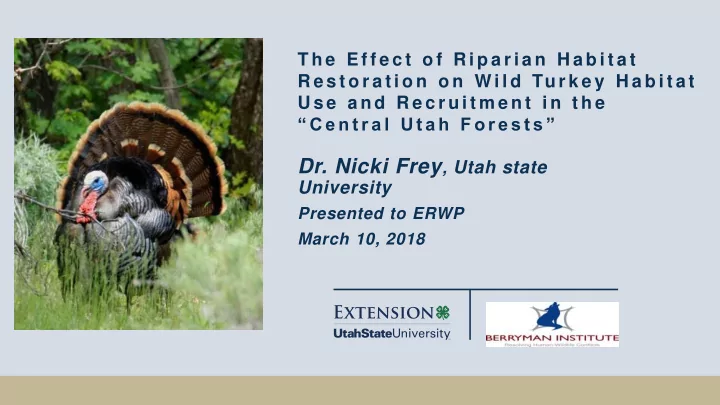
T h e E f f e c t o f R i p a r i a n H a b i t a t R e s t o r a t i o n o n W i l d Tu r k e y H a b i t a t U s e a n d R e c r u i t m e n t i n t h e C e n t r a l U t a h F o r e s t s Dr. Nicki Frey , Utah state


slide-1
SLIDE 1
  • Dr. Nicki Frey, Utah state

University

Presented to ERWP March 10, 2018

T h e E f f e c t o f R i p a r i a n H a b i t a t R e s t o r a t i o n o n W i l d Tu r k e y H a b i t a t U s e a n d R e c r u i t m e n t i n t h e “ C e n t r a l U t a h F o r e s t s ”

slide-2
SLIDE 2

Experience

slide-3
SLIDE 3

Turkeys

Largest Gallinaceous species Toms: 17-21lbs, 40” Females: 8-11lbs, 30”

slide-4
SLIDE 4

Study Background

  • Co-existed with native Americans in Utah but extirpated
  • Translocations began in the 1920s with farm-raised stock; didn’t end well
  • 1950s wild Merriam’s from CO and AZ into Garfield County (i.e. Escalante)
  • 1989 began transplanting Rios from Western states into southern Utah
  • Used successful transplants to build populations throughout Uah
  • Important and Popular Game species in Utah
  • $430,000 from permits in 2016
slide-5
SLIDE 5

Study Background

  • Still, statewide there are

concerns

  • high-quality winter habitat
  • lack of ecology research a
  • In Utah, Russian olive

believed to be the primary food source and shelter

  • Thus, your restoration project

has attracted some attention

Wild turkeys in ag field in winter

slide-6
SLIDE 6

Ecology Nesting Needs

  • On the ground
  • Merriams nest in higher alt

woods

  • Rios in cottonwood galleries
  • Heavy herbaceous cover,

logs

  • Rios: ¼ mile from water
  • Rios: Grass 18”
  • Insects for poults
slide-7
SLIDE 7

Ecology Habitat Needs for Merriam’s

Merriam Habitat Needs

  • Gambel’s Oak/Pondo

forests for nesting

  • Juniper, Pinyon, and

Gambel’s oak for forage

slide-8
SLIDE 8

Ecology Habitat Needs for Rio’s

  • Layered vegetative cover
  • Bushes around 4’ tall/wide
  • Roost trees (cottonwoods)
  • Prefer open areas under the

roost trees

  • Grass, insects, mast, forbs
slide-9
SLIDE 9

Riparian Restoration

slide-10
SLIDE 10

Riparian Restoration

2010 2015

slide-11
SLIDE 11

Objectives -

  • Evaluate the general habitat use and movement patterns
  • Monitor the nesting and recruitment success
  • Compare the nesting success and vegetation components
  • Empirical study?
  • Compare the over-winter survival
  • Empirical study?
slide-12
SLIDE 12

What We can Determine

  • How often and when turkeys use treated riparian areas
  • What habitat turkeys prefer in each season
  • Where the turkeys go
  • If females nest in different areas, we can compare nesting success

among these areas

  • If turkeys over-winter in different areas, we can compare survival of

these turkeys among different areas

slide-13
SLIDE 13

What We Can’t Determine

  • If turkeys use treated riparian areas differently than before
  • If recruitment is different than before
  • If turkey movements are different than before
  • Empirical data from other states to compare to what they do now
slide-14
SLIDE 14

Study Design

  • GPS and VHF Telemetry
  • Treated and Untreated

Drainages?

  • Winters: Escalante
  • Summer: Boulder Mtns and

GSENM

slide-15
SLIDE 15

Objective 1: Habitat Use and Movements

  • 32 transmitters
  • Mostly females
  • GPS and VHF
  • 3-4 daily locations GPS
  • Once weekly VHF
  • Seasonal habitat use?
  • Movement patterns?
slide-16
SLIDE 16

Objective 2: Nesting Success and Recruitment

  • GPS to identify nesting
  • VHF visited twice weekly
  • During incubation
  • Post-hatch nest analysis
  • Brood-rearing habitat analysis
  • What does nesting habitat look

like?

  • What does brood rearing habitat

look like?

  • Do hens use treated areas?
slide-17
SLIDE 17

Objectives 3 and 4: Comparisons

  • Is use different than other

areas in US?

  • Does habitat use correlate

to nesting success?

  • How long after treatment

does it take

  • Breeding and non-breeding

females

  • Toms and jakes
slide-18
SLIDE 18

Partners

  • Utah State University Extension
  • USFWS Partners for Fish and Wildlife
  • Utah Division of Wildlife Resources
  • Bureau of Land Management
  • Grand Staircase-Escalante National

Monument

  • NWTF-Utah
slide-19
SLIDE 19

Started Last Week

  • Terry Tolbert, BLM
  • Sue Fearon, ERWP
  • Clint Wirick, FWS
  • Me – Nicki – USU

Extension

Putting on a transmitter

slide-20
SLIDE 20

Example of Data

slide-21
SLIDE 21

Timeline

Activity Months Years Trapping Jan - April 2018, 2019, 2020 Telemetry January 2018 August 2020 Nest-Brood Data Collection May - July 2018 - 2020 Data Analysis and Reporting August 2018 October 2020 Final Report December 2020 Thesis June 2021

slide-22
SLIDE 22

Outputs

  • Increased knowledge of turkeys in general
  • Increased knowledge of response
  • Ability to manage so as to support wild

turkeys

  • Fact sheets, thesis, news releases
  • Youth education
slide-23
SLIDE 23

Thanks for Your Interest and Support