
SLIDE 1
Global Health Scholarship: Fulbright Experience in Nigeria
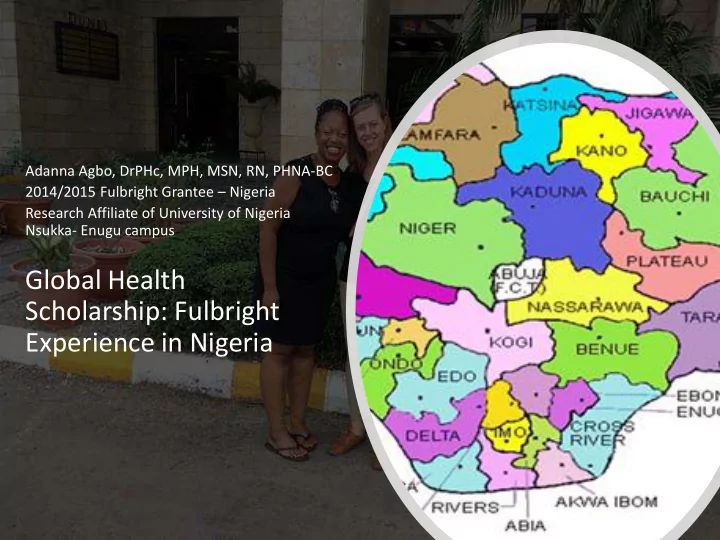
Adanna Agbo, DrPHc, MPH, MSN, RN, PHNA-BC 2014/2015 Fulbright Grantee – Nigeria Research Affiliate of University of Nigeria Nsukka- Enugu campus
Experience in Nigeria What is a Fulbright Student Grantee? Senator - - PowerPoint PPT Presentation
Adanna Agbo, DrPHc, MPH, MSN, RN, PHNA-BC 2014/2015 Fulbright Grantee Nigeria Research Affiliate of University of Nigeria Nsukka- Enugu campus Global Health Scholarship: Fulbright Experience in Nigeria What is a Fulbright Student Grantee?
Adanna Agbo, DrPHc, MPH, MSN, RN, PHNA-BC 2014/2015 Fulbright Grantee – Nigeria Research Affiliate of University of Nigeria Nsukka- Enugu campus
Senator J. William Fulbright
called for the use of surplus war property to fund the 'promotion of international good will through the exchange of students in the fields of education, culture, and science.
program offering opportunities for students and young professionals to undertake international graduate study, advanced research, university teaching, and primary and secondary school teaching worldwide. https://us.fulbrightonline.org/
applicants:
– Recent graduates - Graduating seniors and recent bachelor’s-degree recipients – Master's and doctoral candidates – Young professionals, including writers, creative and performing artists, journalists, and those in law, business, and other professional fields
maternal health in Nigeria
major global health problem
mortality is described as the death of a woman that occurs as a result of pregnancy and childbirth related complications; before, during or immediately after childbirth; or in the case of spontaneous or elective abortion, within 42 days following pregnancy termination (World Health Organization, 2013).
According to WHO reports, the number of maternal deaths that occurred worldwide in 1990 was 523 000, in 2008 the number was 358 000, and in 2013, there were 289 000 maternal deaths (World Health Organization, 2013). “For each woman who dies, approximately 20
consequences” (The Center for innovation & Technology in Public Health, n.d.). The United Nations Population Fund (UNFPA) report that in 2008, half of all maternal deaths
the Democratic Republic of Congo, Pakistan, Afghanistan and India (UNFPA, 2012). The WHO further adds that as of 2013, 1/3 of all global maternal deaths occurred in only 2 countries, Nigeria (40,000 deaths annually) and India (50,000 deaths annually) (WHO, 2014).
Outcomes and Health Seeking Behaviors in Southeastern Nigeria: A Rural Community-based Study
– What is the prevalence of maternal deaths in the communities? – What are the cultural practices related to pregnancy, giving birth and after delivery? – What are the delay factors that affect the decision to seek & receive services? – What are the behavioral factors that affect intention & behavior to seek services? – What are similarities and differences between the women that seek maternal health services and those who do not? – What can be done to improve the situation?
Interviews with community members-Focus groups.
Local Government Area (LGA) in Enugu State (rural)
participants
Igwes, The Chairman of the LGA, Religious Leaders, Women Leaders
places
Centers
for today’s presentation
Pregnant Women in 2nd phase
Drugs, Hours)
participants reside
and is open 9am – 5pm on weekdays
some women it is far, for others it is close by
nurses in the HCs, then there are also non-professionally trained nurses – referred to by the participants as Private nurse/Auxiliary nurse/Chemist nurse, “Quack” nurse
are more reachable & accessible compared to HC
the road, larger health facilities (hospitals)
(Affordability, Care)
Auxiliary nurse delivery cost in the same community N5,000
N4,000 for boys & N3,000 for girls, Auxiliary nurse delivery cost in the same community N4,000 for boys and girls
community (with N150 for registration)
razor, baby items, etc., cost about N5,000
even the TBA than at the HC
sites
sites
Signs & Family Planning
ceremony for the Nursing Department
students
Day organized by nursing students
Department at UNEC
BLOWING, EXCITING, REWARDING, ONCE IN A LIFETIME EXPERIENCE FOR ME
Program, the US Department
International Education, University of Nigeria Nsukka, and Morgan State University