Exoplanet Atmospheres and Giant Telescopes Ian Crossfield Sagan - - PowerPoint PPT Presentation

exoplanet atmospheres and giant telescopes
SMART_READER_LITE
LIVE PREVIEW

Exoplanet Atmospheres and Giant Telescopes Ian Crossfield Sagan - - PowerPoint PPT Presentation

Exoplanet Atmospheres and Giant Telescopes Ian Crossfield Sagan Fellow, UA/LPL 2015/10/08 What's in a name? E-ELT TMT GMT R~10 5 , MIR, slit METIS NIRES-R GMTNIRS R~10 5 , NIR, slit NIRES-B HIRES R~10 5 , optical, fiber HROS G-CLEF


slide-1
SLIDE 1

Exoplanet Atmospheres and Giant Telescopes

Ian Crossfield

Sagan Fellow, UA/LPL 2015/10/08
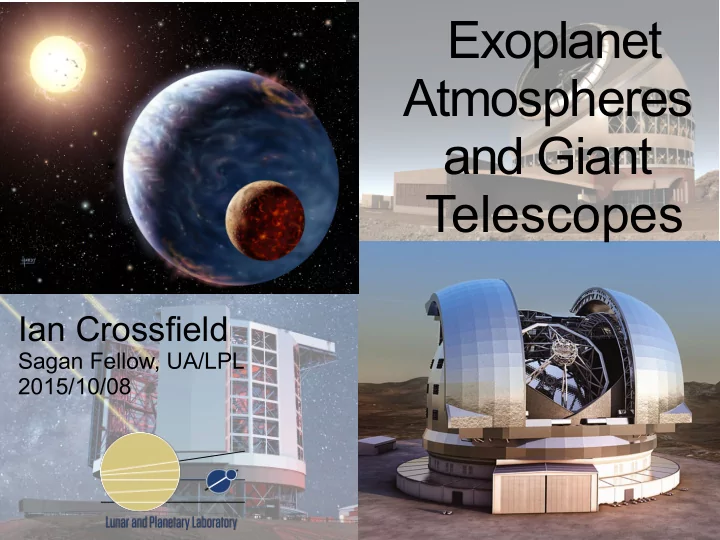
slide-2
SLIDE 2

What's in a name?

E-ELT TMT GMT R~105, MIR, slit METIS NIRES-R GMTNIRS R~105, NIR, slit HIRES NIRES-B R~105, optical, fiber HROS G-CLEF R~3000, NIR, IFU HARMONI IRIS GMTIFS High-contrast imager EPICS PSI TIGER * first-light

slide-3
SLIDE 3

Young, Hot Giant Planets

Irradiated Gas Giants

Mature, Cold Gas Giants Small Planets & Habitability

slide-4
SLIDE 4

Young, Hot Gas Giants

slide-5
SLIDE 5

HARMONI, EPICS: find & characterize many planets during formation.

Star/planet separation (arcsec) Star/planet flux ratio (@ 1.6 µm)

Macintosh+2006

Taurus planets (still accreting)

slide-6
SLIDE 6

HARMONI, EPICS: find & characterize many planets during formation.

Macintosh+2006

~2 Myr protoplanet?

Kraus+Ireland 2011

Star/planet separation (arcsec) Star/planet flux ratio (@ 1.6 µm)

Taurus planets (still accreting)

slide-7
SLIDE 7

CO H2O

HARMONI: λ/∆λ~4000 spectroscopy

  • f young, bright gas giants:

Konopacky+2013, Barman+2015

HR 8799b,c: Teff ~1100 K M ~ 5-10 MJup t ~ 30 Myr CO & H2O

slide-8
SLIDE 8

HARMONI: λ/∆λ~4000 spectroscopy

  • f young, bright gas giants:

Konopacky+2013, Barman+2015

CO H2O

HR 8799b,c: Teff ~1100 K M ~ 5-10 MJup t ~ 30 Myr CO & H2O

GJ 504b: ~500 K ~ 4 MJup 200 Myr CH4; H2O? CO?

Kuzuhara+2013, Janson+2013

slide-9
SLIDE 9

Snellen+2014

Measure planetary spin in NIR, at R>104:

beta Pic b: v sin i ~ 25 km/s

slide-10
SLIDE 10

Measure planetary spin in NIR, at R>104:

Snellen+2014, Schwartz (in prep) GQ Lup

slide-11
SLIDE 11

Global Extrasolar Weather Patterns:

Zhang+Showman 2014

slide-12
SLIDE 12

Global Extrasolar Weather Patterns: Doppler Imaging of Exoplanets and Brown Dwarfs

Zhang+Showman 2014 Crossfield+2014a

VLT/CRIRES: Brown dwarf Luhman 16B

slide-13
SLIDE 13

Global Extrasolar Weather Patterns: Doppler Imaging of Exoplanets and Brown Dwarfs

Crossfield+2014a Crossfield 2014b

slide-14
SLIDE 14

Mature, Irradiated Gas Giants

slide-15
SLIDE 15

15

λ1 λ2

RP Flux Time

Transmission spectroscopy probes exoplanetary atmospheric composition:

slide-16
SLIDE 16

16

Transmission spectroscopy probes exoplanetary atmospheric composition:

λ1 λ2

RP Flux Time

Bean+2010,2011

slide-17
SLIDE 17

HIRES will probe composition and atmospheric dynamics

Snellen+2010

VLT/CRIRES:

Transit of hot Jupiter HD 209458b. CO detected. Global wind? 2 ± 1 km/s

slide-18
SLIDE 18

HIRES will probe composition and atmospheric dynamics

Snellen+2010 Showman+2013, Rauscher+Kempton 2014

slide-19
SLIDE 19

HD209458b: (1.4 RJup) K=6.3, D=8m, ∆λ=0.15 µm, σTr~0.05%

K2-3b: (2.1 REarth)

K=8.6, D=30m, ∆λ=1.5 µm, σTr~0.03%

HIRES will extend these studies from hot Jupiters to cool sub-Neptunes:

Snellen+2010 Crossfield+2015

slide-20
SLIDE 20

HIRES: probe composition and thermal structure of non-transiting planets

VLT/CRIRES:

Non-transiting hot Jupiter 51 Peg b: H2O, CO; no thermal inversion.

Birkby+2014

slide-21
SLIDE 21

HIRES: probe composition and thermal structure of non-transiting planets as a function of longitude

Brogi+2013, 2014, Birkby+2014, de Kok+2013, Rodler+2013a, b, Schwartz+2015

slide-22
SLIDE 22

HIRES: probe composition and thermal structure of non-transiting planets as a function of longitude

Brogi+2013, 2014, Birkby+2014, de Kok+2013, Rodler+2013a, b, Schwartz+2015

Optical albedos will complement thermal measurements

(cf. Martins et al. 2015)

slide-23
SLIDE 23

Mature, cold Gas Giants

slide-24
SLIDE 24

EPICS: would study 10-15 sub- Jovians around nearby stars:

<T> ~ 250 K <R> ~ 3 REarth

Crossfield 2013; Quanz, Crossfield+2015

Not a blind search: Radial velocity surveys will find these systems!

Equilibrium Temperature [K]

Earth Radii

slide-25
SLIDE 25

METIS-IFU: High-dispersion, high- contrast exoplanet science.

Snellen+2015

slide-26
SLIDE 26

Small & Rocky Planets

slide-27
SLIDE 27

Small, rocky planets should be detectable around many stars in NIR:

current capabilities

future capabilities

Need a giant telescope's angular resolution & sensitivity to see these planets.

Assumed: one rocky, temperate planet per nearby star; NIR.

M K G F

slide-28
SLIDE 28

Small, rocky planets should be detectable around many stars in NIR:

future capabilities?

Need a giant telescope's angular resolution & sensitivity to see these planets.

Assumed: one rocky, temperate planet per nearby star; 10 µm

… and in mid-IR

M K G F

slide-29
SLIDE 29

Can ELTs detect extrasolar biosignature gases?

slide-30
SLIDE 30

HARMONI, EPICS: Detecting O2 in planets orbiting nearby M dwarfs?

Kawahara+2012

slide-31
SLIDE 31

HIRES: Detecting O2 with high- dispersion Doppler transit spectroscopy.

Schneider 1994; Webb & Wormleaton 2001; Snellen+2013; Rodler+Lopez-Morales 2014

slide-32
SLIDE 32

HIRES: Detecting O2 with high- dispersion Doppler transit spectroscopy.

Schneider 1994; Webb & Wormleaton 2001; Snellen+2013; Rodler+Lopez-Morales 2014 Rodler+Lopez-Morales 2014

slide-33
SLIDE 33

Could study planetary spectra vs. planet age:

3.9 Gyr ago 2.4 Gyr ago 0.8 Gyr ago Kaltenegger+2007 Wavelength (µm) Spectrum of earth:

slide-34
SLIDE 34

HIRES: Alternative biosignature gases?

Seager+2013

slide-35
SLIDE 35

Young, Hot Giant Planets

  • HARMONI spectroscopy:
  • Atmospheric abundances
  • Thermal structure
  • EPICS:
  • Location, frequency, accretion

luminosity of forming planets

  • HIRES:
  • Global weather monitoring of

planets & brown dwarfs

slide-36
SLIDE 36

Young, Hot Giant Planets

  • HARMONI spectroscopy:
  • Atmospheric abundances
  • Thermal structure
  • EPICS:
  • Location, frequency, accretion

luminosity of forming planets

  • HIRES:
  • Global weather monitoring of

planets & brown dwarfs

slide-37
SLIDE 37

Irradiated Gas Giants

  • NIRES, METIS:
  • Composition and dynamics of

transiting planet atmospheres; from H.J.'s to sub-Jovians

  • Global composition & thermal

structure of non-transiters

slide-38
SLIDE 38

Young, Hot Giant Planets

Irradiated Gas Giants

  • HARMONI spectroscopy:
  • Atmospheric abundances
  • Thermal structure
  • EPICS:
  • Location, frequency, accretion

luminosity of forming planets

  • HIRES:
  • Global weather monitoring of

planets & brown dwarfs

  • NIRES, METIS:
  • Composition and dynamics of

transiting planet atmospheres; from H.J.'s to sub-Jovians

  • Global composition & thermal

structure of non-transiters

slide-39
SLIDE 39

Mature, cold Gas Giants

  • EPICS, METIS:
  • Albedo, IR emission of

known RV+GAIA planets

  • New planet searches
slide-40
SLIDE 40

Young, Hot Giant Planets

Irradiated Gas Giants

Mature, Cold Gas Giants

  • HARMONI spectroscopy:
  • Atmospheric abundances
  • Thermal structure
  • EPICS:
  • Location, frequency, accretion

luminosity of forming planets

  • HIRES:
  • Global weather monitoring of

planets & brown dwarfs

  • NIRES, METIS:
  • Composition and dynamics of

transiting planet atmospheres; from H.J.'s to sub-Jovians

  • Global composition & thermal

structure of non-transiters

  • EPICS, METIS:
  • Albedo, IR emission of

known RV+GAIA planets

  • New planet searches
slide-41
SLIDE 41

Small Planets & Habitability

  • MOS:
  • Transit followup of

K2/Plato systems

  • Compositions of H2-

dominated atmospheres

  • HIRES, EPICS:
  • Detecting O2 or other

biosignature gases!

slide-42
SLIDE 42

Young, Hot Giant Planets

Irradiated Gas Giants

Mature, Cold Gas Giants Small Planets & Habitability

HARMONI spectroscopy:

  • Atmospheric abundances
  • Thermal structure

EPICS:

  • Location, frequency, accretion

luminosity of forming planets HIRES:

  • Global weather monitoring of

planets & brown dwarfs

  • HIRES, METIS:
  • Composition and dynamics of

transiting planet atmospheres; from H.J.'s to sub-Jovians

  • Global composition & thermal

structure of non-transiters

  • EPICS, METIS:
  • Albedo, IR emission
  • f known RV+GAIA

planets

  • New planet searches
  • MOS:
  • Transit followup of

K2/Plato systems

  • Compositions of H2-

dominated atmospheres

  • HIRES, EPICS:
  • Detecting O2 or other

biosignature gases!

slide-43
SLIDE 43

Recommendation:

  • To study exoplanet atmospheres, our

highest priority should be an

adaptive-optics, infrared, high-dispersion spectrograph

for the ELTs.

slide-44
SLIDE 44

EPICS: Will study albedo properties of known planets:

Crossfield 2013

slide-45
SLIDE 45

MOS: Transit followup of planets from Kepler2 and PLATO

slide-46
SLIDE 46

MOS: Transit followup of planets from Kepler2 and PLATO

slide-47
SLIDE 47

Keck/MOSFIRE: Kepler:

Ground-based studies of sub-Earth-sized planets:

Crossfield et al. in prep Muirhead et al. (2012)

slide-48
SLIDE 48

Keck/MOSFIRE:

Ground-based studies of sub-Earth-sized planets:

Crossfield et al. in prep