
SLIDE 1
Transiting Exoplanet Survey Satellite
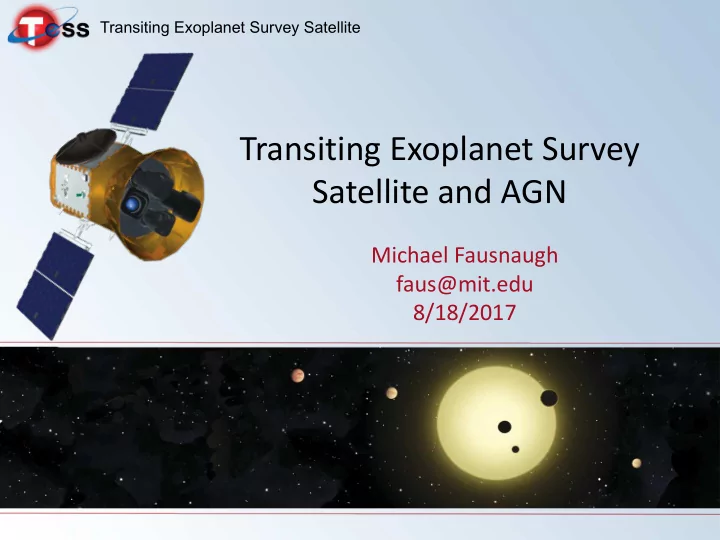
Transiting Exoplanet Survey Satellite and AGN Michael Fausnaugh - - PowerPoint PPT Presentation
Transiting Exoplanet Survey Satellite Transiting Exoplanet Survey Satellite and AGN Michael Fausnaugh faus@mit.edu 8/18/2017 u Level 1 Science requirement: Masses for 50 planets with radius < 4R_Earth u Search many bright stars
Transiting Exoplanet Survey Satellite
u Level 1 Science requirement:
§ Masses for 50 planets with radius < 4R_Earth
u Search many bright stars
§ Discovery by transits § Masses by follow-up (RV)
u Transits require:
§
§ high precision (earth around sun is ~100 ppm)
u Challenges for extra-galactic astronomy, but….
§ Unique cadence/precision for variability studies § Many objects (nearly whole sky)
2
3
4
150 120 906030 0 30 60 90 120 150 Ecliptic Longitude 75 60 45 30 15 15 30 45 60 75 Ecliptic Latitude Milky Way
5
6
u
10.5 cm aperture
u
24x24 degree FOV (x4)
§
2300 square degrees per pointing
u
Four 2048 x 2048 CCDs (x4)
u
~21 arcseconds/pixel
u
0.6 to 1.0 microns (like I_c)
u
Targeted pixels
§
2 minute cadence
u
Full Frame Images (FFIs)
§
30 minute cadence
u
No propriety period
7
u Possible Science Cases? u Variability Catalog
§ RM campaigns have been inefficient (50% ”success”) § Identify variable ones (high amplitude) for future planning
§ No need to trace past null results (though long baseline is great!)
§ Find odd behavior (flares, changing-look, non-stationary states….) § Why are some variable and others aren’t?**
8
2 4 6 8 10 12 Number of Sectors 100 101 102 103 104 Number of AGN
9
0.5 1.0 1.5 2.0 2.5 3.0 Redshift 101 102 103 Number ∼1 month ∼1 year
10
11
45 46 47 48 49 logLBol 101 102 103 Number ∼1 month ∼1 year
u Possible Science Cases? u Structure functions/PSD estimation
§ Hours to days have been examined for only ~20 objects (Kepler [?]) § Will (still) have systematics
§ baseline is generally short § Not independent of noise (and therefore mag)
12
u Possible Science Cases? u Individual Targets
§ TESS images/light curves are free and public! § Light curves will (probably) be excellent
§ Easy to point: where is the sun? § Very red pass-band (dust emission my contaminate) § Pixels are large (crowded/blended photometry)
13
u Possible Science Cases? u Discovery
§ A small fraction of AGN that exist are known, esp. in the Southern
§ Variability selection (follow-up to confirm) § Needs rapid variability (so, low mass/luminosity….) § Or maybe fill out the south ecliptic pole in advance with traditional
14
150 120 906030 0 30 60 90 120 150 Ecliptic Longitude 75 60 45 30 15 15 30 45 60 75 Ecliptic Latitude Milky Way
15
u Guest Investigator Program u Due Sept. 29, 2017 u Nominal awards of $50k -- $200k to use TESS data for aux.
u Can propose new 2-minute targets or use FFIs u Some grey areas:
§ E.g., early access to data?
u Technical questions: Patricia Boyd patricia.t.boyd@nasa.gov. u NASA point of contact: Martin Still martin.still@nasa.gov.
16