Flexible & robust inference of the exoplanet population - - PowerPoint PPT Presentation

flexible robust inference of the exoplanet population
SMART_READER_LITE
LIVE PREVIEW

Flexible & robust inference of the exoplanet population - - PowerPoint PPT Presentation

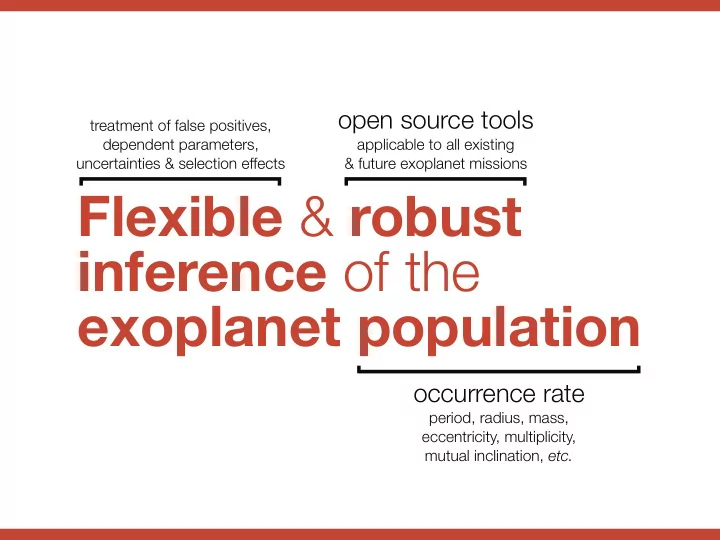
open source tools treatment of false positives, dependent parameters, applicable to all existing uncertainties & selection effects & future exoplanet missions Flexible & robust inference of the exoplanet population occurrence rate


slide-1
SLIDE 1

treatment of false positives, dependent parameters, uncertainties & selection effects

  • pen source tools

applicable to all existing & future exoplanet missions

  • ccurrence rate

period, radius, mass, eccentricity, multiplicity, mutual inclination, etc.

Flexible & robust inference of the exoplanet population

slide-2
SLIDE 2

systems k surveys n θ Sn wk xn,k

"true" physical parameters selection effects population noisy

  • bservations

Probabilistic modeling can be used to combine surveys, take uncertainties into account, and measure the effects of false positives

slide-3
SLIDE 3

−2 −1 1 2 time since transit [days] −2 −1

  • rel. flux [ppt]

100 1000 period [days] p(log period)

Single transits and long-period radial velocity measurements

  • nly place weak constraints on the parameters of the planets

but, with probabilistic modeling, this can be taken into account & these can still be used for population inference. Think how useful this will be for K2 and TESS!

slide-4
SLIDE 4

1 2 3 4 5 6 7

  • bserved number of planets per star

500 1000 1500 2000 2500 3000 number of stars the observed KOI multiplicity distribution

don't forget about zero!

For systems with multiple planets, the parameters are no longer independent. Other methods of population inference—approximate Bayesian computation or likelihood-free inference—might be necessary!