Excess Soil Management Regulatory Proposal Summary Note : Deck - - PowerPoint PPT Presentation

excess soil management regulatory proposal summary
SMART_READER_LITE
LIVE PREVIEW

Excess Soil Management Regulatory Proposal Summary Note : Deck - - PowerPoint PPT Presentation

Excess Soil Management Regulatory Proposal Summary Note : Deck paraphrases the proposal documents posted on the environmental registry. Please also refer to those documents. Confidential: For Discussion Only 1 Ministry of the Environment and


slide-1
SLIDE 1

Ministry of the Environment and Climate Change

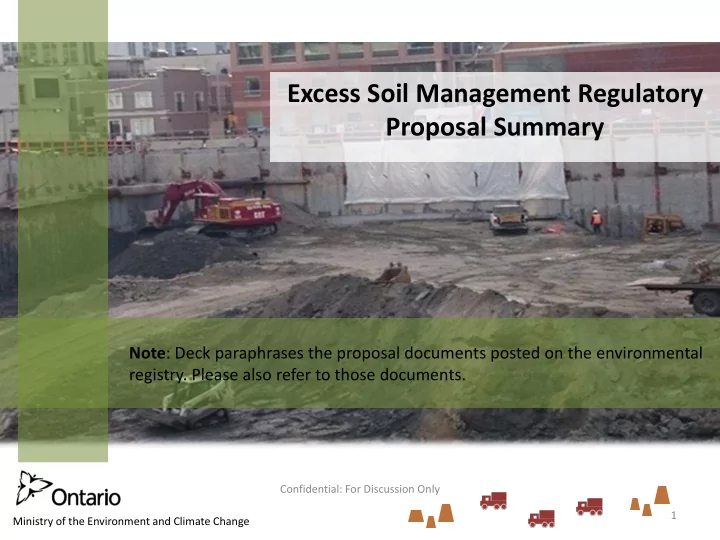
Excess Soil Management Regulatory Proposal Summary

Confidential: For Discussion Only 1

Note: Deck paraphrases the proposal documents posted on the environmental

  • registry. Please also refer to those documents.
slide-2
SLIDE 2

Overview

  • A Reminder: Overview of 2017 Proposed Excess Soil Reuse Regulatory Package
  • New Regulatory Proposal

– A new proposed On-Site and Excess Soil Management Regulation (Legal Wording); – Complementary amendments to O. Reg. 347; and – Amendments to O. Reg. 153/04. – A proposed document to be adopted by reference titled “Rules for Onsite and Excess Soil Management” – The proposed “Beneficial Reuse Assessment Tool” (BRAT) Note: Deck paraphrases the proposal documents posted on the environmental registry. Please also refer to those documents. Excess soil is soil that has been dug up, typically during construction activities, which cannot be reused at the development site and must be moved to another location.

Confidential: For Discussion Only

slide-3
SLIDE 3

A Reminder – Overview of 2017 Proposed Regulatory Package

In April 2017, the ministry released a plain-language regulatory proposal on the Environmental Registry for comment, including:

  • A new excess soil regulation under the Environmental Protection Act -

including, provisions related to reuse of excess soil, excess soil management plan requirements, and registration of soil movements to a new soil registry

  • Complementary amendments to existing regulations e.g., Waste (Reg. 347),

Brownfields (Reg. 153/04) and amendments to the Building Code

  • New standards and sampling direction for excess soil

Current legal draft regulatory proposal has similar components, with revisions based

  • n input.

3 3 Confidential: For Discussion Only

slide-4
SLIDE 4
  • 110 submissions received and 35+ meetings took place. Comments and input received

indicated general support for the proposed regulatory package.

  • Some of the key changes made to the proposal include:

– Revised approach to waste designation

  • Excess soil directly reused in accordance with the proposed regulation is not waste
  • Rebranded “receiving sites” as “reuse sites”
  • Waste Designation would not be applied beyond a period after reuse project is

completed – Revised waste approvals requirements

  • Excess soil could be hauled without an approval, rules in the regulation for

transport of dry and liquid soil

  • Certain types of on-site processing of soil is permitted without an approval

– Reduced regulatory burden

  • Increase quantitative trigger to 2000m

3 for ESMP

  • Reduce frequency of registry updates from 28 to 60 days

Recap on Input Received and Key Revisions

Confidential: For Discussion Only 4

slide-5
SLIDE 5

– Further flexibility for reuse through new reuse standards and a new Beneficial Reuse Assessment Tool (BRAT)

  • Two size tables (brownfields and infinite; Tables added for stratified, near

water, shallow soil)

  • Expand attainment rules to be applicable to Tables 1-9
  • Greater ability to reflect more site-specific land use characteristics with the

BRAT (e.g. depth to groundwater and distance to water bodies) – Phased in transition time for key regulatory requirements

  • Modernization of Brownfields amendments would come into effect Jan 1, 2019
  • Reuse standards, clarifying waste designation and approvals would come into

effect Jan 1, 2020

  • ESMP and registry requirements would come into effect Jan 1, 2021

5

Recap on Input Received and Key Revisions

Confidential: For Discussion Only

slide-6
SLIDE 6

This current proposal builds on the earlier proposal, with some revisions to respond to input received. It includes:

  • Proposed regulations (legal wording)

– A new proposed On-Site and Excess Soil Management Regulation; – Complementary amendments to O. Reg. 347; and – Amendments to O. Reg. 153/04.

  • A proposed document to be adopted by reference titled “Rules for Onsite and Excess

Soil Management” – It includes ESMP contents, excess soil characterization and a destination assessment and identification, requirements for excess soil tracking systems and applicable soil quality standards and related rules

  • The proposed “Beneficial Reuse Assessment Tool” (BRAT)
  • An additional supporting document titled “Rationale Document for Reuse of Excess

Soil at Reuse Sites” which outlines the scientific rationale for the proposed standards

New Regulatory Proposal

Confidential: For Discussion Only 6

slide-7
SLIDE 7

Confidential: For Discussion Only 7

slide-8
SLIDE 8

Confidential: For Discussion Only

Excess Soil Waste Designation

Reuse Site

  • Not a waste if

conditions in the Regulation and the site-specific instrument (if applicable) at the reuse site are met

Waste While At Temporary Sites

Landfill Project Area

  • Generally soil

being reused on- site is not a waste

  • Soil being

processed on- site is waste except for certain types of processing

Soil Processing Site

(dry or liquid soil)

Soil Bank Storage Site

(dry soil)

Temporary Excess Soil Storage

(dry soil)

Excess Soil Is A Waste

Dry Excess Soil Is Not A Waste

Dry Excess Soil Is Not A Waste Regulation does not apply to hazardous waste Dry or Liquid Excess Soil Is A Waste

slide-9
SLIDE 9
  • Excess soil leaving a project area would not be designated waste provided:

1) The excess soil is being directly transported to a reuse site for final placement 2) The operator of the reuse site has consented in writing to the deposit of the excess soil 3) The excess soil is dry and remains dry until it is finally placed 4) Additional conditions, depending on whether or not a site specific instrument is in place If the Reuse Site is Governed by a Site Specific Instrument – The excess soil governed by a site specific instrument complies with the quality and quantity requirements in that instrument – Where the instrument does not contain quality requirements, the Soil Rules apply – Where the instrument does not contain quantity requirements, the quantity of excess soil brought the reuse site must be consistent with the identified beneficial purpose Site specific instrument or by-law includes, for example, a site alteration permit under the Municipal Act, a license under the Aggregate Resources Act, or any other site-specific instrument under an Act of Ontario or Canada that may regulate the quality or quantity of excess soil to be finally placed at a reuse site

Proposed Excess Soil Reuse Rules

Confidential: For Discussion Only 9

slide-10
SLIDE 10

If the Reuse Site is Not Governed by a Site Specific Instrument – There is a beneficial purpose connected to an undertaking – The quantity of excess soil brought to the reuse site must be consistent with the identified beneficial purpose – The quality of excess soil brought to the reuse site must comply with the Soil Rules – The reuse site is not being utilized primarily for depositing excess soil – The excess soil would not be designated a waste if 5 years have passed since the undertaking has been completed

  • The excess soil must be finally placed at the reuse site within one year of its deposit,

except for undertakings related to infrastructure or unless an extension has been granted (up to 2 years)

10

Proposed Excess Soil Reuse Rules

Confidential: For Discussion Only

slide-11
SLIDE 11

The proposed regulation would clarify when waste Environmental Compliance Approvals (ECAs) are not required. Haulers Transporting Excess Soil

  • Excess soil haulers would be exempt from waste approvals
  • Haulers would be subject to rules in the proposed regulation, including soil handling and vehicle

maintenance requirements

  • Excess soil hauling record would be required for all soil movements, and would be available with

the truck during transportation (could be electronic or paper), providing information on quantity, source site, reuse site, time and date leaving and being deposited, and contacts for the sites

On Site Processing and Temporary Storage Sites

  • Soil that is excavated in a project area and is subject to processing is a waste, except in relation to

certain types of processing, including passive aeration, passive drainage, soil turning, size based sorting

  • Temporary soil storage sites would not require waste approvals, but would be subject to rules in

the proposed regulation and related Rules for Onsite and Excess Soil Management document

Processors and Soil Bank Storage Sites

  • Soil banks storage sites and offsite soil processors continue to require a waste approval

Proposed Excess Soil Reuse and Waste Approvals

11 Confidential: For Discussion Only

slide-12
SLIDE 12

Proposed Excess Soil Management Plans

  • An excess soil management plan (ESMP) would be required to be prepared and

implemented for specific projects before any excess soil leaves the project area, unless: a) less than 2,000m3 of excess soil is leaving the project area or the project area was not in a settlement area, and the project area was not an area with an industrial use, certain commercial uses or a remediation project; b) less than 100m3 of excess soil is leaving the project area and the soil is taken directly to a waste disposal site; c) the excess soil must be removed for emergency purposes or to respond to an

  • rder;

d) the excavation of excess soil is necessary for the maintenance of infrastructure;

  • r

e) the excess soil is top soil and is being moved to another project for reuse as top soil and the project area was not an area with an industrial use, certain commercial uses or a remediation project.

12 Confidential: For Discussion Only

slide-13
SLIDE 13
  • ESMPs would be prepared and certified by a Qualified Person

– Professional Engineers and Professional Geoscientists, as defined in O. Reg. 153/04

  • ESMPs would be required to be implemented by the project leader; a record of

implementation would be maintained, including quality and quantity of excess soil moved to actual receiving sites

  • A QP would be required to amend the ESMP within 30 days after awareness of any new

circumstances by the project leader (e.g. new area of potential environmental concern, additional testing, new reuse site not identified in the plan)

  • Proposed contents of an ESMP include, generally
  • 1. Description of the project and project area, including soil management

approaches and estimated quantity and quality of excess soil to be removed

  • 2. Persons involved in the project (e.g. project leader, qualified person)
  • 3. Assessment of past uses, sampling and analysis plan and soil characterization

report

  • 4. Tracking system and procedures, and description of records being kept
  • 5. Excess soil reuse locations, ownership and property information (destination

assessment)

  • 6. Project leader and QP declarations

13

Proposed Excess Soil Management Plans

Confidential: For Discussion Only

slide-14
SLIDE 14

Proposed ESMP Tracking

Tracking System

  • The project leader must ensure that a soil tracking system is developed and

implemented, as part of their Excess Soil Management Plan.

  • The Soil Rules would set out the requirements to be met. This includes:

– Ensuring excavated excess soil is segregation and stored in stockpiles at the project area according to soil quality – Tracking each load from when it is loaded, during transportation and until final placement or at a soil bank, soil processing site or landfill, and any transportation to and from a temporary soil storage site – Producing a hauling record (paper or electronic) – Weekly updates – Record to be produced upon request, including soil characterization and assessment results, soil volume, location of reuse sites and soil quality and quantity sent to each reuse site, soil bank, processor or landfill as applicable – Auditing procedures for periodic testing to ensure the system is operating as described

14 Confidential: For Discussion Only

slide-15
SLIDE 15

Registration

  • Registration to a new online registry is proposed, once an Excess Soil Management

Plan has been prepared, then every 60 days during movement and at completion

  • Key information would be registered, not the full plan e.g., quantity and quality

moved and to where, information on key parties involved (e.g., source site, reuse sites, TESSS, processors, haulers, etc.)

  • Excess soil quality registered would be by category (e.g., applicable generic standard

table) Record Retention

  • A project leader and an operator of a temporary soil storage site, a soil bank storage

site, a soil processing site, a landfill or a reuse site shall retain records related to excess soil movements created or acquired under this Regulation for a period of at least seven years

  • A person transporting excess soil shall retain a record required under section 15 in

respect of excess soil for a period of at least seven years

15

Proposed ESMP Record Keeping Requirements

Confidential: For Discussion Only

slide-16
SLIDE 16
  • Assessment and characterization requirements would be applicable to

sites for which an Excess Soil Management Plan is required, as well as for storm water pond cleanouts

  • Sampling is also mandatory in areas with an industrial use, certain

commercial uses, a potentially contaminating activity is identified, or where evidence of contamination is discovered during excavations

  • Key elements to be carried out in accordance with the Soil Rules:
  • 1. Up-front assessment, renamed “Assessment of Past Uses”
  • 2. Sampling and analysis plan
  • 3. Excess soil characterization report

16

Source Site Sampling Highlights

Confidential: For Discussion Only

slide-17
SLIDE 17
  • The assessment of past uses is meant to achieve the following objectives:

– Develop a preliminary determination of the likelihood that one or more contaminants have affected soil in a location where soil is to be excavated at the project area – Identify any areas of potential environmental concern within the project area and to determine if any location where soil is to be excavated could have been affected by a potentially contaminating activity – If any areas of potential environmental concern are identified, to identify the contaminants of potential concern for the purpose of determining the focus of the sampling and analysis plan

  • Key components include

– Records review – Interviews – Site reconnaissance – Review and evaluation of results – Conceptual site model – Assessment of past uses report

17

Assessment of Past Uses

Confidential: For Discussion Only

slide-18
SLIDE 18

Soil Characterization Requirements:

– Either in situ sampling and stockpile sampling are permitted; however, in situ sampling is the preferred method – Minimum sampling frequencies set out for in situ sampling and sampling from stockpiles – Minimum parameters to be tested are defined (e.g. petroleum hydrocarbons, BTEX, metals) as well as leachate analyses requirements – Rules for in situ sampling have been simplified to a volume-based frequency – Composite sampling rules from O. Reg. 153/04 were adopted – Field screening is permitted for soil that is subject to sampling and analysis and is to be segregated into stockpiles; how it is done is left to the discretion of the qualified person – Sampling frequencies and analytical parameters for soil destined for a landfill or a soil processor at the discretion of the qualified person

  • Number of samples should be sufficient to distinguish soil that cannot be reused
  • With multiple parameters of concern, the qualified person may be able to focus on a

single parameter group as an indicator

Sampling and Analysis Plan

18 Confidential: For Discussion Only

slide-19
SLIDE 19
  • For soil being brought to a RSC property, it must be sampled as part of an

ESMP and meet the soil quality standard for the intended use of the RSC property

  • If soil was not sampled as part of an ESMP, it must be sampled in accordance

with frequencies specified in O. Reg. 153/04 before being brought to a RSC property

  • Attainment rules apply only to soil being brought to a RSC property
  • If soil was sampled as part of an ESMP before it is brought to an RSC property,

the Qualified Person at the RSC property may confirm the ESMP sampling is adequate, to meet sampling requirements in O. Reg. 153/04

Soil Being Brought to a RSC Property

19 Confidential: For Discussion Only

slide-20
SLIDE 20

Proposed Excess Soil Standards & Beneficial Reuse Assessment Tool

  • New excess soil standards framework was derived to support the excess soil management

regulatory proposal to address the uncertainty related to excess soil quality with a goal of promoting greater reuse of excess soils

  • Standards framework is detailed in Part IV of “Rules for On-Site and Excess Soil

Management” and allows for 3 options regarding use of soil standards: – Generic excess soil standards (included in a series of look up Tables) – Site-specific standards developed using the Beneficial Reuse Assessment Tool (BRAT) - NEW – Site-specific standards developed using full Risk Assessment

  • Additional rules/special circumstances (e.g., environmentally sensitive areas, salt impacted

soil, local background/naturally occurring)

  • Attainment rules for meeting standards (i.e., single point compliance and statistical

compliance), attainment rules expanded to available for use in Tables 1-9

  • Simpler approach to generics - two size tables (brownfields and infinite)

Confidential: For Discussion Only

slide-21
SLIDE 21

Table Description Small Volume (up to 350 m3) (or up to 1000 m3 with rationale provided by a qualified person) Volume Independent Full Depth Background Table 1 Table 1 Full Depth, Potable Table 2 Table 2.1 Full Depth, Non-Potable Table 3 Table 3.1 Stratified, Potable Table 4 Table 4.1 Stratified, Non-Potable Table 5 Table 5.1 Full Depth, Shallow Soil, Potable Table 6 Table 6.1 Full Depth, Shallow Soil, Non-Potable Table 7 Table 7.1 Full Depth, Within 30 m of a Water Body, Potable Table 8 Table 8.1 Full Depth, Within 30 m of a Water body, Non-Potable Table 9 Table 9.1 21

Soil Standards Tables

The following provides a summary of the excess soil standards tables available for use under the soil regulation

Confidential: For Discussion Only
slide-22
SLIDE 22
  • Generic soil standards follow a similar approach as the Brownfields standards and have been

developed for 2 volume categories: – Small volume (up to 350 m3 or up to 1000 m3 w/ additional supporting Qualified Person rationale). Small volume standards are same as Brownfields standards. – Volume independent - developed new standards using Brownfields approach, to better account for leaching and vapour intrusion concerns associated with large volumes (“Soil Rules”, Appendix 1). Must also meet leachate screening levels in specific circumstances (“Soil Rules”, Appendix 2).

  • Additional Tables of volume independent standards developed, for consistency with Brownfields

regime (e.g., volume independent now include Tables 2.1, 3.1, 4.1, 5.1, 6.1, 7.1, 8.1 and 9.1).

  • Once volume determined, rules for selecting applicable Table of excess soil standards are generally

the same as Brownfields rules. Rules are documented in Part IV of “Soil Rules” and account for the following: Environmentally Sensitive Areas, groundwater potability, stratified approach, shallow soils, sites within 30m of a water body.

  • Ministry’s approach to deriving excess soil standards (specifically volume independent) fully

documented in updated Rationale document (posted to EBR with regulatory proposal).

Proposed Generics Soil Standards

Confidential: For Discussion Only

slide-23
SLIDE 23
  • Site-specific standards can also be developed using the new Beneficial Reuse Assessment Tool

(BRAT) – EBR posting includes a draft version of BRAT (which includes a user guide) – Rules for use of BRAT are specified in Part IV of the “Soil Rules” document

  • Key Highlights:

– BRAT must be completed by QPESA or QPRA (recommended that Qualified Person have experience with RA or work with team that has experience in RA) – Qualified Person enters site specific inputs (e.g., depth to water table, soil type, distance to nearest water body, etc.). Rules and user interface are very similar to “Approved Model” currently used under O. Reg. 153/04. – Can account for Site Use Characteristics (similar to Risk Management Measures under O. Reg. 153/04), however when selected:

  • Increased oversight required
  • Site Use Characteristics selected by Qualified Person need to be consistent with current

and intended use at reuse property; for site use characteristics that are built, needs to already be built or included in approved planning or development permits (e.g., site plan approvals) or other legal instruments; for building prohibition, same concept… – Includes Qualified Person certification statements specific to completion of BRAT – Not designed for standalone use at Table 1 sites (but can be a useful tool when undertaking full risk assessment, see next slide)

New Beneficial Reuse Assessment Tool (BRAT)

Confidential: For Discussion Only

slide-24
SLIDE 24
  • Site-specific standards can also be developed using full Risk Assessment

– Rules are specified in Part IV of the “Soil Rules” – Oversight by public body is needed – Site-specific instrument is needed

  • Risk Assessment requirements:

– Must be completed by QPRA – Must identify applicable generic excess standards that apply to the reuse site (Table and property use) – Must list all contaminants of concern (COC screening) – Must include assessment of both human health risk and ecological risk – Must consider and address leaching pathway – Must specify a property specific standard for each contaminant of concern

  • Additional guidance on Risk Assessments expected to follow

Risk Assessment

Confidential: For Discussion Only

slide-25
SLIDE 25
  • Additional rules/special circumstances included in Part IV of “Soil Rules”:

– Environmentally Sensitive Areas (use Table 1) – Soils used for growing crops and pasture (protect topsoil & use Table 1) – Local background concentrations (reuse ok if rationale can be provided) – Salt impacted excess soil (reuse ok under very specific circumstances) – Excess soil blended with compost materials

  • Attainment and meeting standards, proposing 2 options:

– Single point compliance (same rules as Brownfields/O. Reg. 153/04); and – Statistical compliance (new option)

  • Relies on larger sampling data sets (minimum 20 samples), which encourages better

decision making

  • Equivalent level of protection
  • Rules specified in “Soil Rules”
  • Additional compliance option for proponents, use is not mandatory (can still use single

point compliance)

  • Can be used for all tables (including small volume and volume independent) and has also

been built into BRAT as an option when developing site-specific standards

Additional Rules and Attainment

Confidential: For Discussion Only

slide-26
SLIDE 26

Modernization of Brownfields O. Reg. 153/04 Amendments - Overview

26

  • The ministry presented a plain language document outlining proposed amendments to O.
  • Reg. 153/04 through the April 2017 Excess Soil Management regulatory proposal on the

environmental registry.

  • There were 41 submissions received during the 60 day comment period relating to the

proposed amendments to O. Reg. 153/04. Comments were generally supportive.

  • The ministry considered the comments in developing the proposed draft regulation (legal

wording) that has been posted for public comment as of April 16, 2018.

  • The ministry is also proposing minor housekeeping amendments to O. Reg. 153/04.
  • If approved, it is proposed that these amendments would come into effect on

January 1, 2019.

Confidential: For Discussion Only

slide-27
SLIDE 27

Proposed Amendments to O. Reg. 153/04

27

Relief from Delineating to Applicable Site Condition Standards for Certain Risk Assessment Properties

  • Currently, O. Reg. 153/04 requires delineation of contaminants of concern to

applicable site condition standards as part of a Phase Two Environmental Site Assessment (ESA).

  • Stakeholders have indicated that meeting these delineation requirements can, at

some properties undergoing Risk Assessment (RA), pose practical challenges. Proposed Amendment

  • An exemption would provide relief from the requirement to delineate to

applicable site condition standards. The use of this “non-standard delineation” would be communicated through the related RA submission, and would be stated in the phase one and phase two ESA reports and in the RSC.

  • The exemption would be conditional on the Phase 2 property having been

appropriately characterized and the extent of contamination being well understood, among other things.

Confidential: For Discussion Only

slide-28
SLIDE 28

Proposed Amendments to O. Reg. 153/04

28

Substances Related to Safety Under Conditions of Snow and Ice

  • Activities undertaken to satisfy regulatory requirements to submit RSCs for filing,

for properties with exceedances above applicable site condition standards of parameters such as EC/SAR, may not lead to significant environmental or human health benefits and may make some brownfield redevelopment projects less viable. Proposed Amendment

  • Expand the exemption that is currently limited to exceedances due to application
  • f substances to highways under conditions of snow/ice. The new exemption

would deem the applicable site condition standard to be met if a Qualified Person determines that a substance has been used for vehicle or pedestrian safety under conditions of snow/ice.

  • Qualified Person could determine that the exemption applies at either the Phase
  • ne or Phase two ESA stage (i.e. determine through Phase one ESA that salt was

applied to roads, walkway, parking lot, etc.)

Confidential: For Discussion Only

slide-29
SLIDE 29

Proposed Amendments to O. Reg. 153/04

29

Removal of RSC Triggers for Lower Risk Undertakings

  • The requirement that an RSC be filed prior to converting low-rise commercial buildings

to mixed-use (residential and/or institutional with commercial on the main floor), temporary roads in construction areas to residential, and indoor places of worship to residential are unnecessary barriers to redevelopment. Proposed Amendment

  • Remove the RSC trigger for these lower risk undertakings so proponents can obtain

municipal building permits without the cost and delays associated with submitting an RSC for filing.

  • Ministry proposing a one year transition for a new RSC requirement when changing the

use of property from commercial/community/industrial to indoor place of worship.

Confidential: For Discussion Only

slide-30
SLIDE 30

Proposed Amendments to O. Reg. 153/04

30

Treated Drinking Water and Naturally Elevated Substances

  • Leaking municipal water mains or large scale purges of municipally treated drinking water, and

movement of local fill that contains naturally occurring elevated concentrations, can lead to exceedances of certain substances. Proposed Amendment

  • New exemptions that would deem the relevant applicable site condition standard to be met if:
  • Based on a phase one or phase two ESA, a Qualified Person determines that there has

been a discharge of treated drinking water;

  • Based on a phase two ESA, a Qualified Person determines that fill was used at the

property that contains a contaminant that exceeds the applicable site condition standard, but does not exceed the naturally occurring range of concentrations typically found in the area. Daycare Definition

  • O. Reg. 153/04 uses the term “day-care centre”, but does not define it.

Proposed Amendment

  • Update term and define it as it is defined in the Child Care and Early Years Act, 2014.

Confidential: For Discussion Only

slide-31
SLIDE 31

Proposed Amendments to O. Reg. 153/04

31

Horizontally Severed Properties

  • When an ESA is prepared in respect of a property that is stratified/horizontally severed, it is not

always clear to Qualified Persons and property owners that O. Reg. 153/04 requires the ESA to take into account the full column of property. Proposed Amendment

  • A new provision would clarify that phase one and phase two ESAs must take into account every

property at or below the ground surface that is above or below the phase one or phase two

  • property. RSCs would also need to indicate the Property Identification Numbers of any

properties at or below the ground surface that are above or below the RSC property. Certificate of Status

  • Requirement to provide a firm’s Certificate of Status (CofS) is an administrative burden for the

Qualified Person and the ministry. Proposed Amendment

  • Revoke requirement for Qualified Person to provide a CofS to reduce administrative burden and

cost. Housekeeping

  • Several small amendments are proposed that would remove obsolete transition provisions,

improve clarity and consistency, and fix grammatical errors.

Confidential: For Discussion Only

slide-32
SLIDE 32

Please Provide Comments

32

Environmental Registry regulatory proposal posting closes June 15, 2018 Please respond through the Environmental Registry (ERO # 013-2774)

  • r send comments to: MOECC.LandPolicy@ontario.ca

If you have questions on the proposed excess soil regulatory proposal please contact Laura Blease at laura.blease@ontario.ca or by phone at 416-325- 8275.