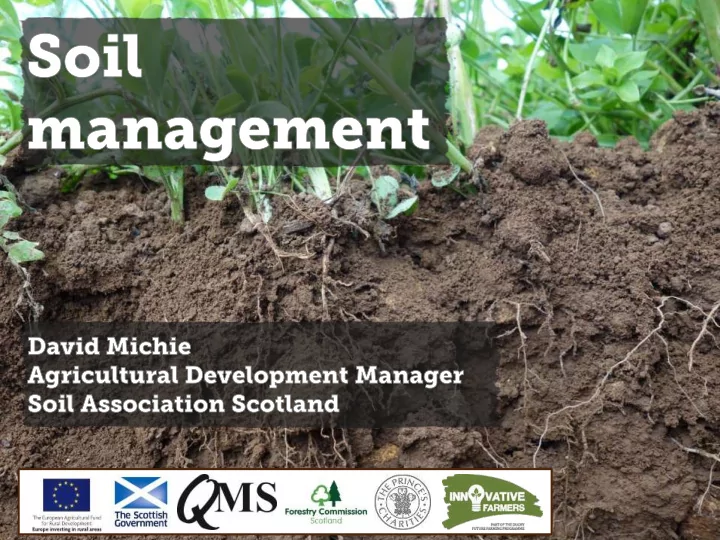
soil? Bi ologi cal Soil Physi cal M i n eral (nutri ents) - - PowerPoint PPT Presentation

soil
SMART_READER_LITE
LIVE PREVIEW

soil? Bi ologi cal Soil Physi cal M i n eral (nutri ents) - - PowerPoint PPT Presentation

What i s soil? Bi ologi cal Soil Physi cal M i n eral (nutri ents) (structure) Bi ology Soil is a living environm ent A handful of soil contains billions of organism s They need air to breathe Essential for soils to function


slide-1
SLIDE 1
slide-2
SLIDE 2

What i s soil?

slide-3
SLIDE 3

Soil

Bi ologi cal M i n eral

(nutri ents)

Physi cal

(structure)

slide-4
SLIDE 4

Bi ology

  • Soil is a living environm ent
  • A handful of soil contains billions of
  • rganism s
  • They need air to breathe
  • Essential for soils to function
  • Com plex web of soil ecology that

turns dead plant and anim al m aterial into plant available nutrients, and m ix up the m ineral with the organic

slide-5
SLIDE 5

M ites Earthworm s Nem atodes Bacteri a Collem bola Fungi Acti n omycetes

slide-6
SLIDE 6

Earthw orm s

  • Healthy soil indicator
  • Soil drainage
  • Casts are a good

source of available nutrients

  • Can survive in

subm erged soils for 120 days

  • pH >5.5
slide-7
SLIDE 7

Tardi grades

slide-8
SLIDE 8

Tardi grades

  • Can survive extrem es:
  • Tem perature

– Just above absolute zero to >100°C

  • Pressure

– 6x greater than in the deepest ocean trenches

  • Ionizing radiation

– 100s x higher than a lethal hum an dose

  • Vacuum of outer

– go without food or water for >10 years!

slide-9
SLIDE 9

Organ i c m atter

  • Soil organic

m atter is a m ix of stuff that is:

– Alive – Dead – Very dead

slide-10
SLIDE 10

Soil organ i c pools

Fraction Am oun t (t/ ha) Am oun t (%) Turn over tim e (years) Microbial biom ass

0.3 (<1%) 2.4

Readily decom posed plant m aterial (crop residues, livestock m anure)

0.1 (<1%) 0.2

Resistant plant m aterial

0.6 (2%) 3.3

Physically protected organic m atter

13.6 (47%) 71

Chem ically stabilized organic m atter (hum us)

14.6 (50%) 2,900

Jen ki n son (1981)

slide-11
SLIDE 11

Organ i c m atter

  • A good indicator of quality soils
  • Very im portant!

– Fuels biological activity – Drainage – Structural stability – Water holding capacity – Drought resistance

slide-12
SLIDE 12

Soil organ i c m atter

  • Can be lost by

– Erosion –

  • Can be preserved with

– Ley periods – Bulky organic m anure application – Deep rooting crops – Good nutrient budgeting – Reducing tillage

slide-13
SLIDE 13

Soil organ i c m atter

  • Soil texture can indicate organic

m atter levels

  • Sandy soils can be down to ~2%
  • Organic/peat soils are >20%
  • Influences heavy m etal toxicity and

trace elem ent availability

– So affects target pH

slide-14
SLIDE 14

Soil pH

  • The pow er of Hydrogen (H +)
  • A m easure of acidity or alkalinity
  • Very im portant, because it affects:

– Nutrient availability – Biology – Even has an effect on soil structure (Ca:Mg ratio)

  • nutrient deficiencies
slide-15
SLIDE 15

Soil pH

  • Influences plant growth
  • Nutrient availability

– Particularly phosphate

  • Trace elem ents / potentially toxic ions

– Essential m anganese (Mn) is deficient at a higher pH – Toxic alum inium (Al) is available at a lower pH

slide-16
SLIDE 16

Target pH for soils

  • Depends on soil type and croppin g
  • Mineral soils

– Target pH 6.2 (rotational ground) – Target pH 5.9 (perm anent grass)

  • Peaty soils

– Target pH 5.1 (perm anent grass)

  • Based on old fashioned W sam pling
slide-17
SLIDE 17

Soil texture

  • pH will drop at

different rates in different soils

– Managem ent – Soil texture

  • Sandy soils little

and often

  • Clay soils less

frequently

slide-18
SLIDE 18

W sam pli n g

slide-19
SLIDE 19
  • Maintaining optim um pH in the

topsoil is im portant for

– Optim um yields – Consistent crop quality – Good root developm ent

  • Maxim ise nutrient uptake
  • Minim ise nutrient losses

– To air and water

Opti m um pH

slide-20
SLIDE 20
slide-21
SLIDE 21

Soil an alysi s

  • Every 4 or 5 years; keep an eye on:

– pH – Phosphate (P) – Potash (K) – Magnesium (Mg)

  • Lim e little and often
  • Aim for Moderate P and K status
  • Replace what you take off

– Silage takes off m ore than grazing

slide-22
SLIDE 22

Soil sam pli n g

  • Get your soils sam pled an d an alysed!
  • Soil sam pling

– Take lots of subsam ples – W form ation – 15 cm deep – Bulk them together

slide-23
SLIDE 23
slide-24
SLIDE 24
slide-25
SLIDE 25

Soil an alysi s

  • Can test for other things:

– Sulphur (S) – Cobalt (Co) – Copper (Cu) – Organic m atter (LOI)

  • the soil has been lim ed

– Lim e is CaCO3

slide-26
SLIDE 26

Nutri ent m an agem ent

  • Replace what you take off

– Silage takes off m ore than grazing, and can rem ove lots of potash that needs replaced – Grazed perm anent grass takes very little

  • ff each year som e phosphate and

potash

  • Target bulky organic m anures to

silage fields

slide-27
SLIDE 27

Nutri ent values

Man ure type Application rate Available N* N* (kg / ha) Total P2O5 (kg / ha) Total K2O (kg / ha)

15:15:20 600 kg/ha 90 90 120 Cattle FYM 20 t /ha 24 64 160 Cattle slurry 30 m 3 /ha 36 36 96 Values:

  • 15:15:20

£165 /ha

  • Cattle FYM

£xxx /ha

  • Cattle slurry

£XXX/ha *N availability will depend

  • n application tim ing and

m ethod of incorporation

slide-28
SLIDE 28

Organ i c m anures N

  • 1. Readily available nitrogen

– Im m ediate uptake, am ounts vary with application tim ing and incorporation

  • 2. Crop available N

– For the following crop

  • 3. Potentially available N

– Broken down slowly, available over several years – Bulky organic m anures, i.e. m uck

slide-29
SLIDE 29
slide-30
SLIDE 30

Nutri ents P & K

  • Get your soils sam pled an d an alysed!
  • Target organic m anures (i.e. m uck) to

fields with low K and/or P status

  • Take organic m anures into account,

especially if you always apply to the sam e fields

slide-31
SLIDE 31

Nutri ents N

  • Muck will also provide som e N, and

sm all but significant quantities of trace elem ents

  • Take clover into account

– Craibstone cam pus) the average rate of N fixation was 112 kg N /ha /year (~90 units /acre) – This could be higher on the west coast (m ilder and wetter clim ate)

slide-32
SLIDE 32

DI Y soil assessm ents

  • How easy is it to dig?

– Soil structure

  • Earthworm s

– Num ber – Diversity

  • Sm ell
  • Colour
  • Wetness
  • Root growth
slide-33
SLIDE 33
slide-34
SLIDE 34

Soil structure

  • Com paction of the upper soil layers:

– Lim its root developm ent – Restricts nutrient uptake – Reduces growth potential – Reduces yield

  • Com paction is associated with

denitrification (loss of NOx) a particularly bad GHG

slide-35
SLIDE 35

Poor structure: causes

  • Livestock

– Overgrazing – Poaching

  • Heavy m achinery

– Over-cultivation – Working in wet conditions

slide-36
SLIDE 36

Prabost average m onthly rai n fall (m m ), 1981 2010

50 100 150 200 250

Prabost Edin burgh

slide-37
SLIDE 37

Aerators & subsoilers

  • Soils need air to

breathe

  • Soil life

– Nitrogen fixation – Nutrient cycling

  • Drainage
  • Rooting
slide-38
SLIDE 38

Topsoil tri al: results

Sw ard li fter Aerator No treatm ent

slide-39
SLIDE 39

Roots

  • Deep roots can open up

the soil

– Red clover – Chicory – Cocksfoot – Mustard

  • Also

– Provide organic m atter – Bring up trace elem ents

slide-40
SLIDE 40

Messages

  • Keep an eye on your soil
  • Carry out soil sam pling and analysis
  • Keep the soil in the right pH range
  • Replace the nutrients you take off
  • Check your soil structure
slide-41
SLIDE 41