Mineral nutrition Minerals and supplementation Macro-minerals (%) - - PDF document

mineral nutrition
SMART_READER_LITE
LIVE PREVIEW

Mineral nutrition Minerals and supplementation Macro-minerals (%) - - PDF document

Mary Drewnoski, University of Nebraska 11/28/2017 Mineral nutrition Minerals and supplementation Macro-minerals (%) Micro-minerals (ppm) Calcium Cobalt * * Magnesium Copper * Mary Drewnoski, Beef Systems Specialist


slide-1
SLIDE 1

Mary Drewnoski, University of Nebraska 11/28/2017 2017 Range Beef Cow Symposium, Cheyenne, Wyo. 1

Mineral nutrition and supplementation

Mary Drewnoski, Beef Systems Specialist

No mineral is an island

Minerals

  • Macro-minerals (%)

– Calcium – Magnesium – Phosphorus – Potassium – Sodium – Sulfur

  • These have limited storage

in the body and require constant supply

  • Micro-minerals (ppm)

– Cobalt – Copper – Iodine – Iron – Manganese – Selenium – Zinc

  • These can be stored in the

body and thus do not require constant intake * * * * *

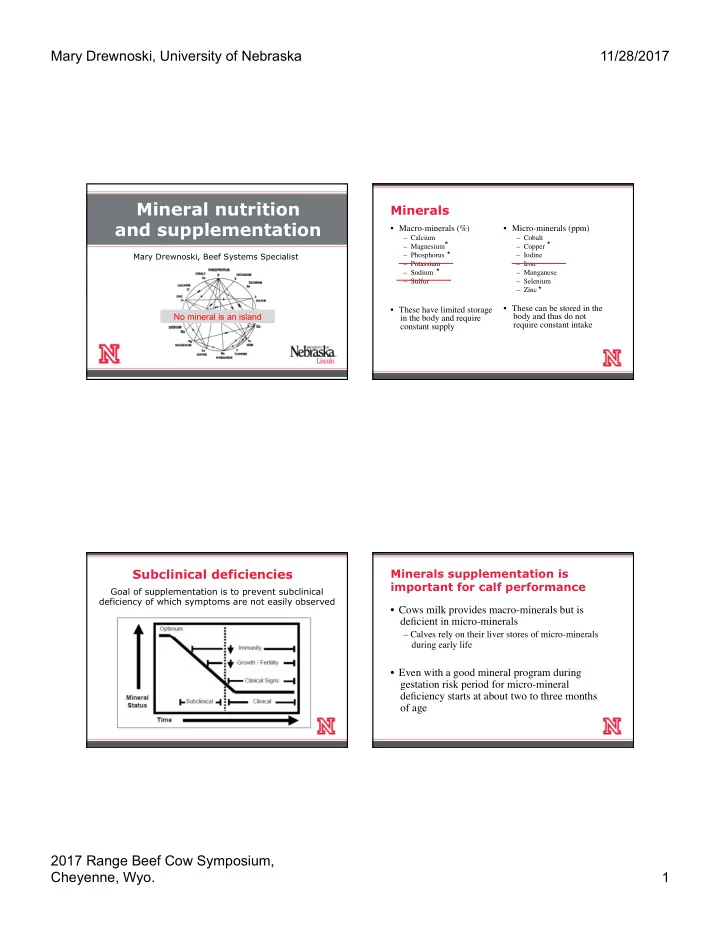
Subclinical deficiencies

Goal of supplementation is to prevent subclinical deficiency of which symptoms are not easily observed

Minerals supplementation is important for calf performance

  • Cows milk provides macro-minerals but is

deficient in micro-minerals

– Calves rely on their liver stores of micro-minerals during early life

  • Even with a good mineral program during

gestation risk period for micro-mineral deficiency starts at about two to three months

  • f age
slide-2
SLIDE 2

Mary Drewnoski, University of Nebraska 11/28/2017 2017 Range Beef Cow Symposium, Cheyenne, Wyo. 2

  • Nutrients are not in the

body until absorbed

– bioavailability

  • Antagonists

– An element which inhibits the absorption or transport

  • f another element

– Can often cause what is called a secondary deficiency

Concentration ≠availability

Grass tetany (Mg)

  • Concentration of a mineral in the diet

does not always guarantee adequate status

  • Little storage of Mg in body

– Magnesium homeostasis depends on a continual absorption of magnesium from the gut

  • Lush cool-season grasses
  • Increased K and N interferes with Mg

absorption

  • Want K:Mg of 10:1 or less

Mineral Composition of Subirrigated Meadow Hay

Gudmundsen Sandhills Laboratory, 1999-2015 Mineral June Harvest July Harvest

  • Oct. 1st

Regrowth Mineral Requirement Macro Mineral, % Calcium 0.37 0.63 1.09 0.16 - 0.40 Phosphorus 0.18 0.13 0.17 0.13 - 0.23 Potassium 2.39 1.84 1.76 0.60 - 0.70 Sulfur 0.18 0.17 0.25 0.15 Magnesium 0.20 0.19 0.24 0.12 - 0.20 Sodium 0.09 0.06 0.08 0.07 - 0.10 Trace Mineral, ppm Iron 111 85 114 50 Manganese 33 35 37 40 Zinc 17 13 16 30 Copper 6 5 6 10

Variability of minerals

  • Variability of mineral content of forage is great

– Therefore take averages with a grain of salt – Will vary even within a geographical location

  • 1) plant species, 2) soil characteristics, 3) soil fertility, 4)

stage of plant maturity, and 5) climatic conditions

  • Testing your own forages to develop

supplementation program can be cost effective

slide-3
SLIDE 3

Mary Drewnoski, University of Nebraska 11/28/2017 2017 Range Beef Cow Symposium, Cheyenne, Wyo. 3

Nutritional Wisdom of Cattle?

  • Cattle do not have the capability to balance their
  • wn diets.
  • Mammals exhibit little nutritional wisdom

– animals will select a palatable but poor quality diet in preference to an unpalatable, nutritious diet, even to the point of death (McDowell, 1995).

  • Palatability, and not metabolic demand, is the

factor controlling mineral consumption by beef cattle (Marston, 1999).

– For most free choice minerals salt is the intake driver

Sodium

  • Forage Na is often below animal requirements and

supplementation is essential

  • Cattle crave salt and will consume it in excess when it is

provided free-choice

Phosphorus (and Calcium)

  • Forage often sufficient in Ca but not always P
  • Ca and P supplementation should be considered

simultaneously

  • Want a Ca:P ratio of no less than 1:1

Sources of minerals

  • Bioavailability to the animal

– How much will be absorbed and used

  • Less available

– Most oxide based minerals

  • Ex. Copper Oxide

– Exceptions: Magnesium and Zinc

  • More available

– Sulfate, carbonate

  • Ex. Zinc Sulfate
slide-4
SLIDE 4

Mary Drewnoski, University of Nebraska 11/28/2017 2017 Range Beef Cow Symposium, Cheyenne, Wyo. 4

Recommendations for level of mineral in free choice supplements1

Amount on tag Mineral Cow requirement Will supply to total diet2 4 oz intake 2 oz intake Selenium, ppm 0.1 0.1 to 0.2 13 to 26 26 to 52 Copper, ppm 10 10 to 15 1300 to 2500 2600 to 5000 Zinc, ppm 30 15 to 22 2000 to 3000 4000 to 6000 Manganese, ppm 40 10 to 20 1300 to 2600 1300 to 5200 Iodine, ppm 0.2 0.2 26 52 Cobalt, ppm 0.1 0.1 13 26 Magnesium, % 0.12-0.20 0.03 to 0.10 3 to 13 6 to 26 Calcium, % 0.16-0.40 0 to 0.10 0 to 13 0 to 26 Phosphorus, % 0.13-0.23 0 to 0.10 0 to 13 0 to 26

1 Assumes a relatively available source of mineral is used 2 Assume 1300 lb cow consuming 2.5% BW

Question?

Beef.unl.edu