Examples of UNDPs work in Examples of UNDPs work in Conservation, - - PowerPoint PPT Presentation

examples of undp s work in examples of undp s work in
SMART_READER_LITE
LIVE PREVIEW

Examples of UNDPs work in Examples of UNDPs work in Conservation, - - PowerPoint PPT Presentation

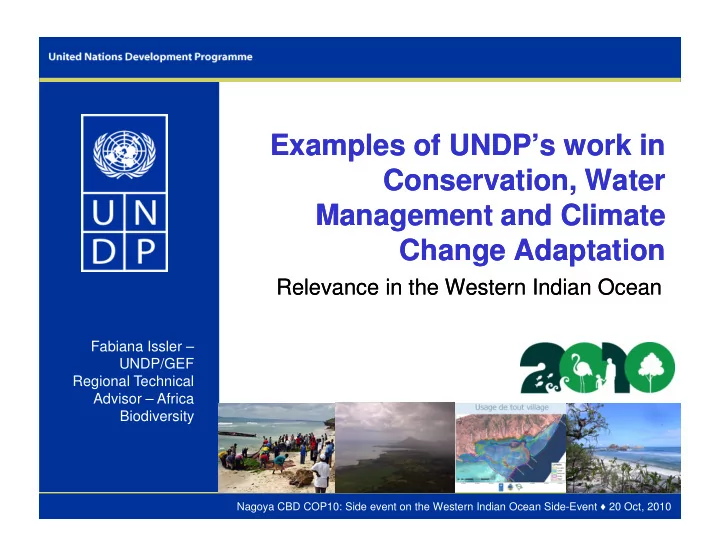
Examples of UNDPs work in Examples of UNDPs work in Conservation, Water Conservation, Water Management and Climate Management and Climate Change Adaptation Change Adaptation Relevance in the Western Indian Ocean Relevance in the


slide-1
SLIDE 1

Examples of UNDP’s work in Examples of UNDP’s work in Conservation, Water Conservation, Water Management and Climate Management and Climate Change Adaptation Change Adaptation

Relevance in the Western Indian Ocean Relevance in the Western Indian Ocean

Nagoya CBD COP10: Side event on the Western Indian Ocean Side-Event 20 Oct, 2010

Fabiana Issler – UNDP/GEF Regional Technical Advisor – Africa Biodiversity

slide-2
SLIDE 2

UNDP’s Strategy

VISION: Fostering Sustainable Human Development in a changing climate

KEY SERVICES STRATEGY: Develop the capacity of countries to prepare, finance, implement and report on low carbon & climate resilient development strategies.

  • UNDP’s Biodiversity Objective:

to assist developing countries and countries in transition to develop their own capacity to manage biodiversity so as to sustain the delivery of the ecosystem goods and services on which human development depends

KEY SERVICES

Environmental Finance: Identify, access and combine sources of environmental finance to attract and drive much larger private sector investment flows towards low carbon, climate resilient and ecosystem friendly development Mainstreaming / Policy Frameworks: Assist countries to develop low carbon & climate resilient strategies including strategies to maintain economic growth and resilience

slide-3
SLIDE 3

UNDP’s Biodiversity Programme

Objective:

to assist developing countries and countries in transition to develop their own capacity to manage biodiversity so as to sustain the delivery of the ecosystem goods and services on which human

  • PROTECTED

AREAS MAINSTREAMING

+ ECOSYSTEM-BASED ADAPTATION

goods and services on which human development depends

+ECOSYSTEM APPROACH TO WATER MGT

slide-4
SLIDE 4

The Western Indian Ocean Region Where are we “making it happen”? What are the results

  • and perspectives thus

far? How can we strengthen an existing sustainable Alliance?

slide-5
SLIDE 5

The Western Indian Ocean Region This presentation:

How UNDP assists countries develop capacity and key results of its several programmes

  • and key results of its several programmes

The ASCLME: An example of sustained partnership building centered around common goals and the formation of an Alliance

slide-6
SLIDE 6

The Western Indian Ocean Region

Combining and sequencing funds

E.g. UNDP’s own funds, GEF-biodiversity, GEF-

How UNDP assists countries “make it happen” – i.e. developing capacity:

  • E.g. UNDP’s own funds, GEF-biodiversity, GEF-

International Waters, GEF land-deg, climate funding, including adaptation, carbon… then levering significant amounts of government and private sector finance and forming partnerships

  • Biodiversity
  • International Waters
  • Climate change adaptation
slide-7
SLIDE 7

A Key International Waters’ Regional Intervention

ASCLME ASCLME -

  • Agulhas and Somali

Agulhas and Somali Current Large Marine Ecosystems Current Large Marine Ecosystems Project (2007 Project (2007-2013) 2013)

  • Gather new and important information

Gather new and important information about ocean currents and how they interact about ocean currents and how they interact with and influence the climate, biodiversity with and influence the climate, biodiversity and economies of the western Indian Ocean and economies of the western Indian Ocean

$12.2 M $12.2 M in GEF in GEF $21 M $21 M in co in co-funding funding

  • and economies of the western Indian Ocean

and economies of the western Indian Ocean region region

  • Transboundary Diagnostic Analysis (TDA)

Transboundary Diagnostic Analysis (TDA)

  • Strategic Action Programme (SAP)

Strategic Action Programme (SAP)

  • Strengthen scientific and management

Strengthen scientific and management expertise, with a view to introducing an expertise, with a view to introducing an ecosystem approach to managing the living ecosystem approach to managing the living marine resources of the western Indian marine resources of the western Indian Ocean region Ocean region

Developed of an Alliance for effective management and governance of the WIO LME

slide-8
SLIDE 8

ASCLME

www.asclme.org

Catch of the Day:

  • An estimated 56 million people who

live on the coast in the western Indian Ocean region depend for their survival on what they can harvest from the sea.

slide-9
SLIDE 9

Seychelles: Biodiversity Programme

  • Mainstreaming BD into

Mainstreaming BD into Tourism & Fisheries (2008 Tourism & Fisheries (2008- 2014) 2014)

  • Control Measures for Invasive

Control Measures for Invasive Alien Species (2008 Alien Species (2008-2014) 2014)

  • Pipeline Project: Strengthen

Pipeline Project: Strengthen

$7.7 M in GEF $7.7 M in GEF $16.9 M in co $16.9 M in co-funding funding

  • Pipeline Project: Strengthen

Pipeline Project: Strengthen PA System through NGO PA System through NGO management modalities (2011 management modalities (2011- 2014) 2014)

  • Possible new intervention:

Conservation Finance?

Development of a strategic agenda for conserving, safeguarding and sustainably using biodiversity in Seychelles

slide-10
SLIDE 10

Seychelles

www.pcusey.sc www.env.gov.sc/bdmainstream http://un.intnet.mu

  • Island naiveté: White tern (Gygis

alba) nesting on a branch on Cousin Island

slide-11
SLIDE 11

Mauritius: BD & CC Adaptation Programme

  • Establishment of SEMPA on Rodrigues

Establishment of SEMPA on Rodrigues

  • Is. & of a national MPA
  • Is. & of a national MPA programme

programme for for the Republic of Mauritius (2004 the Republic of Mauritius (2004-2013) 2013)

  • PAN Project (2011

PAN Project (2011-2015): 2015): 7,904 ha of

7,904 ha of forests protected, of which 1,258 ha are coastal forests protected, of which 1,258 ha are coastal

$5.0 M in GEF BD $5.0 M in GEF BD $14 M in co $14 M in co-funding funding $11 M in $11 M in new new adaptation adaptation finance finance

  • Development of a strategic agenda for

conserving and sustainably managing forests, coastal and marine areas in Mauritius now – and in the face of climate change

  • Japan

Japan-

  • Africa Adaptation Programme:

Africa Adaptation Programme: Country Project Mauritius (2009 Country Project Mauritius (2009-2011) 2011)

  • New Adaptation Fund Project: Adapting

New Adaptation Fund Project: Adapting Coastal Zone Management to Address the Coastal Zone Management to Address the Impacts of Climate Change (2011 Impacts of Climate Change (2011-2015) 2015)

slide-12
SLIDE 12

Rodrigues, Mauritius Republic

www.sempa-rodrigues.com http://un.intnet.mu

  • Zoning for the establishment of

SEMPA or “South East Marine Protected Area”

slide-13
SLIDE 13

Mauritius

http://un.intnet.mu

  • Protected area priority setting

exercise for Mauritius Island in connection with the establishing the “PAN” the Protected Area Network, which will also includes private lands

slide-14
SLIDE 14

Madagascar: A priority country

Environment Programme #3 Environment Programme #3 (since 2004): (since 2004):

− UNDP/GEF “EP3”project (2005 UNDP/GEF “EP3”project (2005-2012): 2012): conservation compatible land uses based on conservation compatible land uses based on community sustainable natural resource use in community sustainable natural resource use in the Protected Area Support Zones (PASZ) the Protected Area Support Zones (PASZ) – WB/GEF “EP3” project protects core PAs WB/GEF “EP3” project protects core PAs − 3 (out of 4) pilot sites are coastal: 3 (out of 4) pilot sites are coastal: Sahamalaza Sahamalaza; ;

$10.5 M in GEF $10.5 M in GEF $21.4 M in co $21.4 M in co-funding funding

3 (out of 4) pilot sites are coastal: 3 (out of 4) pilot sites are coastal: Sahamalaza Sahamalaza; ; Lokobe Lokobe/Nosy Nosy Tanikely Tanikely; ; Toliara Toliara Nosy Nosy-Ve Ve (core (core PAs = 116,465 ha) + PAs = 116,465 ha) + Mikea Mikea Forests (184,630 ha) Forests (184,630 ha)

Managed Resources Protected Managed Resources Protected Areas MRPAs (2011 Areas MRPAs (2011-2015) 2015)

− Add five MRPAs with 1.5 million ha to the Add five MRPAs with 1.5 million ha to the national PA register and facilitate a further national PA register and facilitate a further 1.2 million ha through partner interventions. 1.2 million ha through partner interventions.

Established working models of sustainable NRM in PASZ + Will consolidate “new” models for sustainable use category PAs

slide-15
SLIDE 15

Madagascar

www.snu.mg/pnud/

Two key lessons on PA management sustainability from EP3: ensure…

  • from EP3: ensure…
  • Improved households

revenue to local community

  • Functional mechanisms for

communication, multi- stakeholder consultation and NRM conflict management

slide-16
SLIDE 16

Coastal Forests of Kenya and Tanzania

T anzania Coastal Forests (2010 T anzania Coastal Forests (2010-2014): 2014):

− 1.3 million hectares of coastal forests and 1.3 million hectares of coastal forests and coastal woodlands and mangrove forests coastal woodlands and mangrove forests under improved management by responsible under improved management by responsible government institutions (monitoring and government institutions (monitoring and enforcement and improved revenue enforcement and improved revenue generation schemes). generation schemes). − Focus on Zanzibar sites, plus Focus on Zanzibar sites, plus Matumbi Matumbi, , Kilwa Kilwa and and Lindi Lindi landscapes landscapes

$4.3 M in GEF $4.3 M in GEF $9.3 M in co $9.3 M in co-funding funding

  • and

and Lindi Lindi landscapes landscapes − Partnerships involving national and local Partnerships involving national and local government, WWF and UNDP government, WWF and UNDP

Kenya Coastal Forests (2007 Kenya Coastal Forests (2007-2012): 2012):

− 620,000 ha of protected coastal forests and 620,000 ha of protected coastal forests and productive landscapes (including 12 PAs of productive landscapes (including 12 PAs of several categories several categories - − Focus on Focus on Kwale Kwale District Forest Landscape District Forest Landscape and Joint Forest Management systems and Joint Forest Management systems

Provide protection to a highly endangered and biodiverse ecosystems

slide-17
SLIDE 17

Coastal Forests of East Africa

www.ke.undp.org/projects/50 www.tz.undp.org/

Eastern Africa Coastal Forests Eco-region :

IN TANZANIA:

Tanzania

  • 16

IN TANZANIA: A landscape-wide approach (see map) has been

  • adopted. It includes effective management of

existing PAs, fast-track gazettal of new areas and support sustainable activities contributing to poverty alleviation and economic development. IN KENYA: Categories managed under Joint Forest Management systems include: National Reserve, several Forest Reserves, National Monuments/ Community Sacred Groves or Kayas a privately

  • wned forest, but also ungazetted Kaya forests.
slide-18
SLIDE 18

Mozambique and Comoros

Mozambique’s Conservation Finance Mozambique’s Conservation Finance Project (2011 Project (2011-2015) 2015)

− Sustainable Financing of the Protected Area System in Sustainable Financing of the Protected Area System in Mozambique benefitting some 13.6 million ha of PAs / Mozambique benefitting some 13.6 million ha of PAs / MPAs MPAs − Partnerships with Carr Foundation / Partnerships with Carr Foundation / Gorongosa Gorongosa Restoration Project Restoration Project

$4.9 M in GEF BD $4.9 M in GEF BD $2.9 M in $2.9 M in new new adaptation finance adaptation finance $18.9 M in co $18.9 M in co-funding funding

  • Will create the basis for a more

appropriately funded conservation programme in Mozambique and deal with pressing coastal zone management problems in the face of climate change Comoros: Least Development Countries’ Comoros: Least Development Countries’ Fund for Climate Change Adaptation Fund for Climate Change Adaptation

− Adapting water resource management in Comoros to Adapting water resource management in Comoros to increase capacity to cope with climate change increase capacity to cope with climate change − Watershed & water supply Watershed & water supply − Implement priority #1 as defined in the UNFCCC NAPA Implement priority #1 as defined in the UNFCCC NAPA

slide-19
SLIDE 19

South Africa: Cape Region and Wild Coast

Wild Coast (2007 Wild Coast (2007-2013) 2013)

− Establish a representative PA estate on communally Establish a representative PA estate on communally-

  • wned land along the Wild Coast of the Eastern Cape
  • wned land along the Wild Coast of the Eastern Cape

Province: managing some 226,496 ha of threatened Province: managing some 226,496 ha of threatened habitats habitats

C.A.P.E. UNDP/GEF Project (2004 C.A.P.E. UNDP/GEF Project (2004-2010) 2010)

− Cape Action for People and Environment (C.A.P.E.): Cape Action for People and Environment (C.A.P.E.): Highly successful in supporting the conservation of the Highly successful in supporting the conservation of the Cape Floristic Region (CFR) and adjacent marine Cape Floristic Region (CFR) and adjacent marine

C.A.P.E. Additional C.A.P.E. Additional

$20.9 M in GEF BD $20.9 M in GEF BD $121.8 M in co $121.8 M in co-funding funding $4m in $4m in new new ecosystem ecosystem- based based adaptation & adaptation & mitigation finance mitigation finance

  • Cape Floristic Region (CFR) and adjacent marine

Cape Floristic Region (CFR) and adjacent marine environment by laying a sound foundation for scaling up environment by laying a sound foundation for scaling up and replicating successful project outcomes. and replicating successful project outcomes.

ABI ABI -Agulhas Biodiversity Initiative (2004 Agulhas Biodiversity Initiative (2004- 2010) 2010)

− New management measures and institutional New management measures and institutional arrangements for conservation at a sub arrangements for conservation at a sub-regional level, tied regional level, tied closely to the activities of the productive sectors and closely to the activities of the productive sectors and rooted in decentralised governance frameworks. rooted in decentralised governance frameworks.

Adaptation & Mitigation Adaptation & Mitigation funding from Germany’s funding from Germany’s ICI ICI - International Climate

International Climate Initiative ( Initiative (2009 2009-2010 2010) ) − Reduce the carbon footprint Reduce the carbon footprint and adaptively manage and adaptively manage landscapes by increasing landscapes by increasing resilience resilience

Development of a strategic agenda for conserving endangered and biodiverse coastal and marine ecosystems now – and in the face of climate change
slide-20
SLIDE 20

South Africa

www.capeaction.org.za

Biodiversity Conservation in the Cape Region

Part of a larger 20 year programme to stem biodiversity loss in the Cape Floristic Region

  • loss in the Cape Floristic Region

Major strides in strengthening governance, introducing larger policy reforms in the conservation sector. The UNDP projects UNDP/GEF C.A.P.E. and ABI have been uniquely positioned to shape the policy agenda through their active stakeholder constituency. SANBI has worked with UNDP and the World Bank—with funding sourced by UNDP to prepare a knowledge primer documenting the decision making tools and management innovations that have been developed in South Africa. The CAPE programme has made a major contribution in terms of management innovation—good practices have been distilled in the publication.

slide-21
SLIDE 21

Totals, Summary Goals and Key Outcome

  • $68 M

$68 M in GEF

in GEF Biodiversity & Biodiversity & International International Waters Waters

  • $20 M

$20 M in new

in new

Supporting international water governance Supporting international water governance through an ecosystem approach through an ecosystem approach Conserving and sustainably using Conserving and sustainably using biodiversity while maintaining ecosystem biodiversity while maintaining ecosystem resilience and service provision resilience and service provision

  • Developing the capacity of Western Indian

Ocean countries to prepare, finance and implement low carbon & climate resilient development strategies.

ecosystem ecosystem-based based adaptation & adaptation & mitigation finance mitigation finance

  • $224 M

$224 M in co

in co- funding funding

resilience and service provision resilience and service provision Adapting to climate change by addressing Adapting to climate change by addressing additional risks posed by it and additional risks posed by it and vulnerabilities vulnerabilities

slide-22
SLIDE 22

The Western Indian Ocean Region

An example of sustained partnership building centered around common goals and

  • common goals and

the formation of an Alliance

slide-23
SLIDE 23

Formal Partnerships in WIO region adopted by ASCLME

NOAA: Comprehensive Agreement adopted as Annex to Project Document IRD (French Institute for Research and Development): Formal MoU signed WWF: Formal MoU signed FAO: Formal Agreement signed with EAF Nansen Project IUCN: Formal Partnership signed and defined in ‘Seamounts’ Project Document UNEP: Through respective WIO LME Project Documents World Bank: Through respective WIO LME Project Documents

  • World Bank: Through respective WIO LME Project Documents

Nairobi Convention: Formal Partnership defined in Project Document. Member of ASCLME Steering Committee NEPAD: Formal Partnership defined in Project Document. Member of ASCLME Steering Committee WIOMSA: Observer on ASCLME Steering Committee African Coelacanth Ecosystem Programme (ACEP): Formal MoU and Member of ASCLME Steering Committee University of Cape Town: Several contracts/MoUs for oceanographic assistance and training

slide-24
SLIDE 24

Partnerships under development/negotiation currently with ASCLME

IMO: Agreement for Cooperation in Steering Committee Minutes. MoU under preparation EU-ReCoMaP: Agreement for Cooperation in Steering Committee Minutes. Adopted onto Steering Committee as Observer Royal Dutch Marine Institute (NIOZ): Agreement for Cooperation on Long-term Ocean-Climate Observation mooring deployment adopted in Steering Committee

  • Minutes. MoU under preparation
  • Minutes. MoU under preparation

University of British Columbia: Contract finalised for provision of Cost Benefit Analysis of marine resources and EBM University of Royal Holloway: Agreement for Cooperation on population genetics

  • f marine resources adopted in Steering Committee Minutes. MoU under

preparation Rhodes University: MoU currently under final preparation for Rhodes to act as a hub for CB&T for sub-saharan International Waters projects and LMEs

slide-25
SLIDE 25

A Regional Alliance

The GEF Western Indian Ocean Stock-Taking Meeting in Nairobi in March 2010 considered the various initiatives that are active in the region, particularly through GEF, but also through other agencies and efforts It also took careful note of existing institutions in the region – i.e. Nairobi Convention, South Western Indian Ocean Fisheries (SWIOF)

  • Nairobi Convention, South Western Indian Ocean Fisheries (SWIOF)

Commission, Western Indian Ocean Marine Science association (WIOMSA) – and appreciated that much of the governance structure for the LMEs is already captured within the mandates of such bodies This meeting of high-level government persons endorsed the need for developing a Western Indian Ocean Sustainable Ecosystem Alliance based on the principles of ecosystem-based management, which will ensure that the efforts and inputs of all stakeholders are captured and evolved into a focused and effective regional management and governance system for the WIO LMEs

slide-26
SLIDE 26

A Regional Alliance through Global Support

This request for a Regional Alliance was further discussed at the recent Steering Committee Meeting of the Agulhas and Somali Current LME Project (Dar es Salaam, September 2010) The Steering Committee noted that the WIO is important globally as well as regionally and its well-being is a responsibility that extends beyond the region, especially in terms of marine resources (e.g.

  • beyond the region, especially in terms of marine resources (e.g.

Distant Water Fishing Fleets) and climate change (The Agulhas Current has a direct impact on ocean-atmosphere exchanges throughout the entire Atlantic Ocean) Therefore, the countries of the WIO should not shoulder this responsibility alone. As part of this Alliance for the future, global partners and global support will be a continuous and growing necessity

slide-27
SLIDE 27

WIO-SEA – Further Actions

The Participating Countries congratulated the ASCLME Project on the growing partnerships in the region which it had catalysed and requested the following Actions by the Project:

  • That ASCLME should continue to expand on its successful partnerships

and formal agreements for cooperation, and expand its communication and coordination function with other projects and programmes

  • In view of the guidance given by the governments (in Nairobi in April

2010) to work toward an Alliance for effective management and governance of the WIO Large Marine Ecosystems, that ASCLME should further pursue the concept of a regional/global alliance that would bring together appropriate institutions and efforts to pool and coordinate their expertise, resources and objectives under the

  • wnership of the countries
slide-28
SLIDE 28

Next Steps

On the basis of this Call for Action by the countries, ASCLME is reviewing its further activities to align them even more precisely with this requirement for development of a WIO Sustainable Ecosystem Alliance ASCLME is now proposing, through its Mid-Term Review process, to focus more specifically on Western Indian Ocean Sustainable Ecosystem

Alliance, before delivery of a fully integrated Strategic Action Programme

  • Alliance, before delivery of a fully integrated Strategic Action Programme

for a WIO Large Marine Ecosystem approach, to ensure a firm foundation

  • f sustainability for the SAP when it is implemented

As requested by the countries, ASCLME now aims to develop and consolidate an Alliance of partnerships within the WIO under the guidance and ownership of its participating countries In doing so, ASCLME will be pleased to coordinate with all other parties who may share and support this same vision