Evaluation of Health & Behavior of Birds of the Order - - PowerPoint PPT Presentation

evaluation of health amp behavior of birds of the order
SMART_READER_LITE
LIVE PREVIEW

Evaluation of Health & Behavior of Birds of the Order - - PowerPoint PPT Presentation

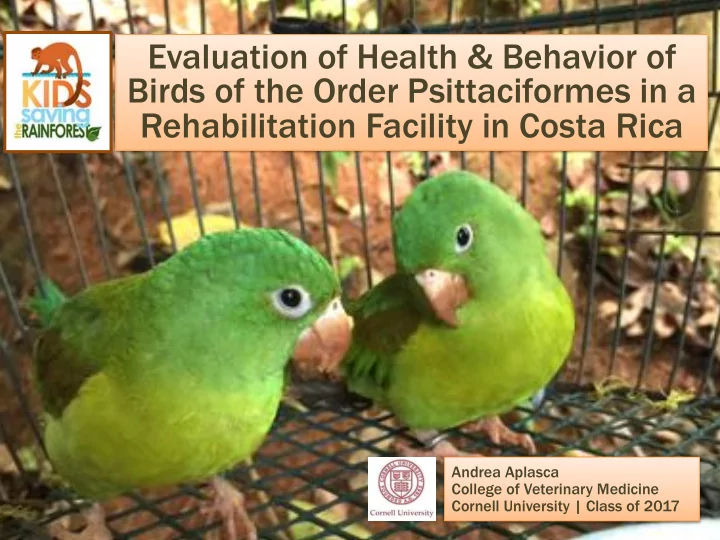
Evaluation of Health & Behavior of Birds of the Order Psittaciformes in a Rehabilitation Facility in Costa Rica Andrea Aplasca College of Veterinary Medicine Cornell University | Class of 2017 Outline Introduction & Background

slide-1
SLIDE 1

Evaluation of Health & Behavior of Birds of the Order Psittaciformes in a Rehabilitation Facility in Costa Rica

Andrea Aplasca College of Veterinary Medicine Cornell University | Class of 2017

slide-2
SLIDE 2

Outline

  • Introduction & Background
  • Objectives & Hypotheses
  • Methods
  • Results
  • Conclusions

Health PE Hematology Fecal Analysis Behavior Foraging Flight Social

slide-3
SLIDE 3

Introduction & Background

  • Order Psittaciformes

– 3 Superfamilies:

  • Psittacoidea, Cacatuoidea, Strigopoidea
  • 350+ species
  • Threatened or Endangered: 95
slide-4
SLIDE 4

Major Threats

  • Habitat Loss
  • Poaching and pet trade
  • 1990-1994

~2 million parrots moved internationally

slide-5
SLIDE 5

Confiscated animals Rehabilitation Facilities Stress, Transport, Dense Multi-species Groups

! Increased Risk of Disease

  • A lot of unknowns!
  • History
  • Location of origin
  • Prior movements
  • Disease exposure
slide-6
SLIDE 6

Why study parrots?

  • Improve welfare and rehabilitation of individual

birds

  • Ensure safety of wild populations upon release
  • Increase general knowledge about each species
  • Individual animal health

= Marker for population health

slide-7
SLIDE 7

Objectives

  • 1. Develop and implement disease

surveillance program for birds in facility

  • 2. Evaluate behavior to identify animals

suitable for release into the wild

slide-8
SLIDE 8

Hypotheses

  • 1. Parrots in a rehabilitation facility exhibit

higher prevalence of hemoparasites than free ranging birds in the neotropics

  • 2. Animals with higher parasite loads (type

and quantity) exhibit more clinical signs associated with decreased body condition

  • r other signs of disease
slide-9
SLIDE 9

Methods: Location

  • Kids Saving the

Rainforest

– Costa Rica, Pacific coast – 501 (c)(3) non-profit

  • rganization

– ~ 7km from Manuel Antonio National Park

slide-10
SLIDE 10

Methods: Species

  • Enclosure 1

– 7 Red Lored Parrots – 5 Crimson Fronted Parakeets – 1 Yellow Naped Amazon (Vulnerable) – 1 Mealy Amazon (Near Threatened)

slide-11
SLIDE 11

Methods: Species

  • Enclosure 2

– 9 Orange Chinned Parakeets

  • 2 reside within closed cage

– 1 White Crowned Parrot – 1 Brown Hooded Parrot – 1 Olive Throated Parakeet – 1 Orange Fronted Parakeet (currently in clinic)

slide-12
SLIDE 12

Methods: Species

  • Clinic Animals

– 1 White Crowned Parrot – 1 Scarlet Macaw

slide-13
SLIDE 13

Methods: Health Evaluation

  • Physical Exam
slide-14
SLIDE 14

Methods: Health Evaluation

  • Venipuncture
  • Jugular vein, basilic vein
  • 25 or 27 gauge needle
  • 1 cc heparinized syringes
  • Heparinized blood tubes
  • Complete Blood Count
  • WBC Count

– Estimated & Leukopet

  • Packed Cell Volume
  • Total Solids
slide-15
SLIDE 15

Methods: Health Evaluation

  • Fecal Analysis

– Direct – Float (passive)

  • Sodium nitrate solution (SG ~ 1.25-1.27)

– Float (centrifugation) *Gold Standard*

  • Sheather’s sugar solution (SG ~ 1.27)

– Gram’s Stain

slide-16
SLIDE 16

Methods: Behavior

  • 1. Foraging Ability
  • 2. Flying Ability
  • 3. Social Behavior
slide-17
SLIDE 17

Methods: Foraging Ability

  • Ethogram

– No Int – CF: Int, Play, Eat – FF: Int, Play, Eat

Ti Time me Ac Activity Fr Fruit Pr Presen esenta tati tion

  • n Commen

Comments ts 9.00 FF - Interest papaya platform 9.02 FF - Interest papaya platform Moving food with beak 9.05 No Interest 9.10 Same-Sp Preened Biggie’s head feathers

slide-18
SLIDE 18

Methods: Foraging Ability

Week 1 Week 2 Week 3

  • 100% Chopped

Food

  • Simple Foraging

Tests

  • 75% Chopped

Food

  • Simple Foraging

Tests

  • 75% Chopped

Food

  • Difficult Foraging

Tests

  • AM – 45 minutes (after feed, tours, etc)
  • PM – 45 minutes (before feed)
slide-19
SLIDE 19

Foraging D Devices

– Bell – Basket – Table – Burrito – Leaves – Boxes

slide-20
SLIDE 20
slide-21
SLIDE 21
slide-22
SLIDE 22

Methods: Flight Ability

  • Flight Cage (White hawk cage)
  • Incidental Observations
  • Tested within Enclosure
slide-23
SLIDE 23

Methods: Social Behavior

  • Ethogram

– Vocal: Natural, Human, Other – PPL – Same Sp: N, (-), (+) – Diff Sp: N, (-), (+)

slide-24
SLIDE 24

Results!

Elmen Morrow 2014

slide-25
SLIDE 25

Results: Health Evaluation Physical Exam

  • Most birds

– No significant findings, Good body condition

Sp Spec ecies es Body W Weight ht Mean ( (g) Body C Condition S Score Mean ( (Scale 1 1-5) Red Lored Parrots (n = 7) 381 3.21 Crimson Fronted Parakeets (n = 5) 142 3 Orange Chinned Parakeets (n = 9) 61 3.67

  • Feathers trimmed
  • Dull feather condition
  • Leg band problems
  • Chronic healed wing fractures
slide-26
SLIDE 26

Results: Health Evaluation Hematology

Red Lored Parrots (n = 7)

Te Test Me Mean an Rang Range Packed Cell Volume (%) 45.9 40-51 Total Solids (g/dL) 3.51 2.7-4.1 Total White Blood Cells / uL 6099 2449-10230

slide-27
SLIDE 27

Results: Health Evaluation Hematology

Crimson Fronted Parakeets (n = 5)

Te Test Me Mean an Rang Range Packed Cell Volume (%) 49 42-52 Total Solids (g/dL) 3.44 3.1-3.8 Total White Blood Cells / uL 5659 3649-7040

slide-28
SLIDE 28

Results: Health Evaluation Hematology

Orange Chinned Parakeets (n = 9)

Te Test Me Mean an Rang Range Packed Cell Volume (%) 50 46-53 Total Solids (g/dL) 3.64 2.9-4.1 Total White Blood Cells / uL 4866 2654-9865

slide-29
SLIDE 29

Results: Health Evaluation Fecal Analysis

  • Direct
  • 0/29 = 0 %
  • Float (passive)
  • 1/29 = 3.4 %
  • Float (centrifugation)
  • 5/29 = 17.2 %
  • Mites
  • Gram’s stain
  • 22/29 = 75.9 %
  • Yeast
slide-30
SLIDE 30

Results: Health Evaluation Specific Cases

Red Lored Parrots

Example: Candida albicans?

Roger - Fecal analysis

– 1 pinworm ova

Magnum, Biggie, Gilly

Few yeast with budding

slide-31
SLIDE 31

Results: Health Evaluation Specific Cases

Crimson Fronted Parakeets

  • Cheeks & Freckles (aka Sirol & Loris)

– Moderate yeast + Budding

  • Cuckoo
slide-32
SLIDE 32

Results: Health Evaluation Specific Cases

Orange Chinned Parakeets

  • All had yeast
  • Hi Pair Normal Wing – 1 mite
  • Caged 1 – 1 ova, Hyphae, Few yeast
  • Caged 2 – 1 large larva, Few yeast
  • Olive Throated Friend + Orange Fronted

Friend

  • 1 larva
slide-33
SLIDE 33

Results: Health Evaluation Specific Cases

  • Cherry – No specific findings on lab tests
slide-34
SLIDE 34

Results: Behavioral Data

  • Total Time Observed:

– 6,624 mins = 110.4 hrs

  • Total Time per Animal:

– 276 mins = 4.6 hrs

slide-35
SLIDE 35

Results: Foraging Ability

‘FF Eat’

  • Range: 39-113 mins

[out of 276 mins]

  • 3 Weeks total Time

Ranked ( (High t h to L Low) Total T Time ( (mi mins) )

Magnum 113# Roy 96# Jagger 87# Houdini 78# Gilly 77# Cuckoo 69# Roger 69# Uno 65# Red 64# Hulk 58# Freckles 53# Bossy 53# Biggie 44# Cheeks 31#

CAGE 1

slide-36
SLIDE 36

Results: Foraging Ability

‘FF Eat’

  • Range: 39-113 mins

[out of 276 mins]

  • Green

– Increased from Wk 2 – Wk 3

  • Red

– Deceased from Wk 2 – Wk 3

Ranked ( (High t h to L Low) Total T Time ( (mi mins) )

Magnum 113# Roy 96# Jagger 87# Houdini 78# Gilly 77# Cuckoo 69# Roger 69# Uno 65# Red 64# Hulk 58# Freckles 53# Bossy 53# Biggie 44# Cheeks 31#

CAGE 1

slide-37
SLIDE 37

Results: Foraging Ability

‘FF Eat’

  • Range: 39-113 mins

[out of 276 mins]

  • Green

– Increased from Wk 2 – Wk 3

  • Red

– Deceased from Wk 2 – Wk 3

Ranked ( (High t h to L Low) Total T Time ( (mi mins) )

Magnum 113# Roy 96# Jagger 87# Houdini 78# Gilly 77# Cuckoo 69# Roger 69# Uno 65# Red 64# Hulk 58# Freckles 53# Bossy 53# Biggie 44# Cheeks 31#

Magnum Magnum! Cu Cuckoo

  • o!

RL U Uno! Wk 1 11# 18# 24# Wk 2 34# 17# 18# Wk 3 68# 34# 23# Total 113! 69! 65! CAGE 1

slide-38
SLIDE 38

Results: Foraging Ability

‘FF Eat’

  • Range: 39-113 mins

[out of 276 mins]

  • Green

– Increased from Wk 2 – Wk 3

  • Red

– Deceased from Wk 2 – Wk 3

Ranked ( (High t h to L Low) Total T Time ( (mi mins) )

Magnum 113# Roy 96# Jagger 87# Houdini 78# Gilly 77# Cuckoo 69# Roger 69# Uno 65# Red 64# Hulk 58# Freckles 53# Bossy 53# Biggie 44# Cheeks 31#

Bi Biggi ggie! Che heeks! Wk 1 8# 15# Wk 2 13# 2# Wk 3 23# 14# Total 44! 31! CAGE 1

slide-39
SLIDE 39

Results: Foraging Ability

‘FF Eat’

  • Range: 39-113 mins

[out of 276 mins]

  • Green

– Increased from Wk 2 – Wk 3

  • Red

– Deceased from Wk 2 – Wk 3

Ranked ( (High t h to L Low) Total T Time ( (mi mins) )

Magnum 113# Roy 96# Jagger 87# Houdini 78# Gilly 77# Cuckoo 69# Roger 69# Uno 65# Red 64# Hulk 58# Freckles 53# Bossy 53# Biggie 44# Cheeks 31#

Jag Jagger! Gi Gilly! Ro Roy! Wk 1 38# 27# 63# Wk 2 43# 47# 33# Wk 3 6# 3# 0# Total 87! 77! 96! CAGE 1

slide-40
SLIDE 40

Results: Foraging Ability

‘FF Eat’

  • Range: 5-69 mins

[out of 276 mins]

  • 3 Weeks Total Time

An Animal I ID Total T Time (mi mins) )

Olive!Throated! 69# Orange!Fronted!Friend! 61# Hi!Pair!Wonky! 45# Olive!Throat!Friend! 42# Lo!Pair!Normal! 29# Hi!Pair!Normal! 25# Termite!Guy! 12# Lo!Pair!Wonky! 12#

CAGE 2

slide-41
SLIDE 41

‘FF Eat’

  • Range: 5-69 mins

[out of 276 mins]

  • 3 Weeks Total Time

An Animal I ID Total T Time (mi mins) )

Olive!Throated! 69# Orange!Fronted!Friend! 61# Hi!Pair!Wonky! 45# Olive!Throat!Friend! 42# Lo!Pair!Normal! 29# Hi!Pair!Normal! 25# Termite!Guy! 12# Lo!Pair!Wonky! 12#

CAGE 2

An Animal I ID Week 3 3 T Time (mi mins) )

Orange Fronted Friend! 30# Hi Pair Normal! 21# Hi Pair Wonky! 21# Lo Pair Normal! 17# Olive Throat Friend! 15# Olive Throated! 10# Lo Pair Wonky! 9#

Total Time Week 3

slide-42
SLIDE 42

Results: Flight Ability

CAGE 1

Sp Spec ecies es An Animal I ID Seen F Flying Commen Comments ts Yellow Naped Amazon Houdini X Mealy Amazon Hulk X Very good Red Lored Parrot Roger Red Lored Parrot Roy X Red Lored Parrot Gilly X Fair (Tested) Red Lored Parrot Uno X Red Lored Parrot Magnum X Very good Red Lored Parrot Biggie X Red Lored Parrot Jagger X

slide-43
SLIDE 43

Results: Flight Ability

CAGE 2

Sp Spec ecies es An Animal I ID Seen F Flying Commen Comments ts Orange Fronted Parakeet Pip Squeak X Good, but very reluctant White Crowned Parrot Peachy X Fair, very reluctant Brown Hooded Parrot Buffy X Very good (Tested) Olive Throated Parrot Angel X Very good Orange Chinned Parakeet Olive Throat Friend X Very good Orange Chinned Parakeet Orange Front Friend X Fair Orange Chinned Parakeet Termite Guy X Very good

slide-44
SLIDE 44

Results: Social Behavior

CAGE 1

An Animal Total T Time ( (mi mins) ) Cheeks 133# Freckles 113# Uno 66# Gilly 41# Magnum 21# Jagger 21# Bossy 18# Biggie 17# Red 13# Roger 10# Roy 2# Cuckoo 0# Houdini 0# Hulk 0#

‘SS +’

  • Range: 0-133 mins

[out of 276 mins]

slide-45
SLIDE 45

Results: Social Behavior

CAGE 1

An Animal Total T Time ( (mi mins) ) Gilly 95# Red 77# Biggie 72# Houdini 47# Bossy 18# Cuckoo 17# Hulk 4# Roger 4# Roy 0# Uno 0# Magnum 0# Jagger 0# Cheeks 0# Freckles 0#

‘DS +’

  • Range: 0-95 mins

[out of 276 mins]

slide-46
SLIDE 46

Results: Social Behavior

CAGE 1

An Animal Total T Time ( (mi mins) ) Jagger 11# Mealy 7# Uno 6# Cuckoo 4# Roy 3# Cheeks 3# Roger 1# Houdini 0# Gilly 0# Magnum 0# Biggie 0# Bossy 0# Red 0# Freckles 0#

‘PPL Int’

  • Range: 0-11

[out of 276 mins]

  • Did not interact with

birds intentionally

  • May be possible future

test?

slide-47
SLIDE 47

Results: Social Behavior

CAGE 1

Vocalizations

An Animal Fr Frequency

Yellow Naped Amazon “Houdini” 11# Mealy Amazon “Hulk” 7# Red Lored Parrot “Roy” 4# Red Lored Parrot “Roger” 3# Red Lored Parrot “Jagger” 1#

slide-48
SLIDE 48

CAGE 2

Results: Social Behavior

‘SS +’

  • Range: 0-188 mins

[out of 276 mins] An Animal I ID Total T Time (mi mins) ) Lo!Pair!Normal! 188# Hi!Pair!Normal! 186# Lo!Pair!Wonky! 175# Hi!Pair!Wonky! 132# Orange!Fronted!Friend! 10# White!Crown! 0# Brown!Hood! 0# Olive!Throat! 0#

slide-49
SLIDE 49

CAGE 2

Results: Social Behavior

‘DS +’

  • Range: 0-111 mins

[out of 276 mins] An Animal I ID Total T Time (mi mins) ) Olive!Throat! 111# Olive!Throated!Friend! 110# Termite!Guy! 28# Orange!Fronted!Friend! 16# White!Crowned! 15# Brown!Hooded! 12# Hi!Pair!Non>Wonky! 0#

slide-50
SLIDE 50

CAGE 2

Results: Social Behavior

‘PPL Int’

  • Range: 0-14 mins

[out of 276 mins] An Animal I ID Total T Time (mi mins) ) Brown!Hood! 14# Org!F!Friend! 6# Hi!Pair!Non>Wonky! 2# Hi!Pair!Wonky! 2# Lo!Pair!Non>Wonky! 1# White!Crown! 0# Olive!Throat! 0# OT!Friend! 0# Termite!Guy! 0#

slide-51
SLIDE 51

General Conclusions

  • Baseline study to identify potential

individuals for release

  • Majority of animals appear clinically healthy
slide-52
SLIDE 52

General Conclusions

  • Good candidates for soft release

– Good foragers during Week 3 – Strong flying ability – Positive social behaviors with same species – Low interest in people – Clinically healthy

slide-53
SLIDE 53

Candidates for soft release: Report Card!

An Animal I ID Wk Wk 3 3 Fo Forager Good F Flyer SS + + Low P PPL Int Int Health C h Che heck Uno X X X X Magnum X X X X Yeast + Budding Biggie X X Poor X Yeast + Budding Red X X Fair X Bossy X X Fair X Freckles X X X X

CAGE 1

slide-54
SLIDE 54

Candidates for soft release: Report Card!

An Animal I ID Wk Wk 3 3 Fo Forager Good F Flyer SS + + Low P PPL Int Int Health C h Che heck Hi Pair Normal X X X X 1 Mite, Yeast + Budding Hi Pair Wonky X X X X Hi Yeast + Budding Olive T Friend X X Poor X Occ Yeast + Budding Orange F X Fair Poor X Mod Yeast +

CAGE 2

slide-55
SLIDE 55

Hypotheses

  • 1. Parrots in a rehabilitation facility exhibit

higher prevalence of hemoparasites than free ranging birds in the neotropics

  • 2. Animals with higher parasite loads (type

and quantity) exhibit more clinical signs associated with decreased body condition

  • r other signs of disease
slide-56
SLIDE 56

Hypotheses

  • 1. Parrots in a rehabilitation facility exhibit

higher prevalence of hemoparasites than free ranging birds in the neotropics

  • 2. Animals with higher parasite loads (type

and quantity) exhibit more clinical signs associated with decreased body condition

  • r other signs of disease

Not Supported

slide-57
SLIDE 57

Hypotheses

  • 1. Parrots in a rehabilitation facility exhibit

higher prevalence of hemoparasites than free ranging birds in the neotropics

  • 2. Animals with higher parasite loads (type

and quantity) exhibit more clinical signs associated with decreased body condition

  • r other signs of disease

Not Supported Not Conclusive

slide-58
SLIDE 58

Challenges: Health Evaluation

  • High stress physical exams
  • Sick bird may have “normal” blood

values

– What are the “normal” values??

  • Fecal parasites – shed intermittently

– Pooled samples?

  • Gram’s stain – very delicate process
  • No viral testing
slide-59
SLIDE 59

Challenges: Behavior

  • A LOT of animals!
  • ~4.5 hrs per animal – Enough?
  • Many observers – Inherent subjectivity
  • Social structure affects behavior
  • Less active during bad weather
slide-60
SLIDE 60

Additional Work

  • Examine effect of weather on behavior
  • Is behavior different in AM vs. PM?
  • Is behavior related to clinical findings?
  • Definitive parasite IDs
  • Soft release of identified birds
slide-61
SLIDE 61

Thank You!

  • Project Development

– Dr. Maria Pia Martin – Dr. Noha Abou-Madi – Dr. Robert P. Moore – Mandy Kain

  • Project Support

– Cornell University College of Veterinary Medicine

slide-62
SLIDE 62

Thank You!

  • Army of Volunteers for

hours & hours of:

– Observations, Observations, Observations – Keeping an eye on Hulk while wrangling parrots – Luring tiny parakeets into sunflower-filled cages

slide-63
SLIDE 63

Appendix Species Information

  • Red Lored Parrots (Amazona autumnaiis)

– Pairs, groups, large flocks – Life span 80 yrs – Least concern

  • Crimson Fronted Parakeet (Psittacara finschi)

– Single of mixed species groups – Least concern, forest edges, maybe increasing

  • Orange Chinned Parakeets

– Large groups up to 50 birds – Small groups/pairs during breeding