Reorder Buffer Method Issue Execute Write Classic 5-stage - - PowerPoint PPT Presentation

reorder buffer
SMART_READER_LITE
LIVE PREVIEW

Reorder Buffer Method Issue Execute Write Classic 5-stage - - PowerPoint PPT Presentation

Reorder Buffer Method Issue Execute Write Classic 5-stage pipeline In-order In-order In-order Multi-cycle FP pipeline In-order In-order Out-of-order Scoreboard In-order Out-of-order Out-of-order Tomasulo


slide-1
SLIDE 1

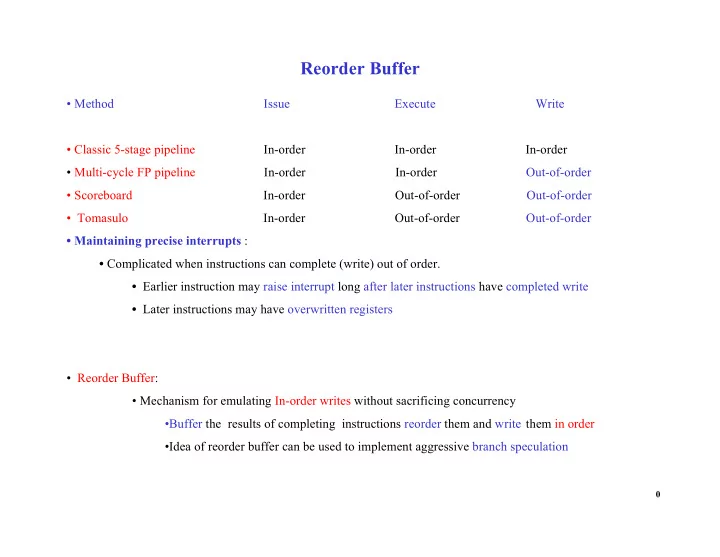
Reorder Buffer

  • Method

Issue Execute Write

  • Classic 5-stage pipeline

In-order In-order In-order

  • Multi-cycle FP pipeline

In-order In-order Out-of-order

  • Scoreboard

In-order Out-of-order Out-of-order

  • Tomasulo

In-order Out-of-order Out-of-order

  • Maintaining precise interrupts :
  • Complicated when instructions can complete (write) out of order.
  • Earlier instruction may raise interrupt long after later instructions have completed write
  • Later instructions may have overwritten registers
  • Reorder Buffer:
  • Mechanism for emulating In-order writes without sacrificing concurrency
  • Buffer the results of completing instructions reorder them and write them in order
  • Idea of reorder buffer can be used to implement aggressive branch speculation
slide-2
SLIDE 2

Speculative Execution

Block 1 A B Block 2 ? Decision Delayed

1

slide-3
SLIDE 3

Speculative Execution

Block 1 A B Block 2 ? Decision Delayed Guess future execution path

Speculatively Executed Block

Overlap Execution with Stall Delay

Speculative task: Task that is performed without assurance that it is required

2

slide-4
SLIDE 4

Speculative Execution

Block 1 A B Block 2 ? Decision Delayed Guess future execution path Speculatively Executed Block Also Speculatively Executed

3

slide-5
SLIDE 5

Speculative Execution

Block 1 A B Block 2 ? Decision Delayed Guess future execution path Speculatively Executed Block Also Speculatively Executed Decision Resolved Rollback to decision point

4

slide-6
SLIDE 6

Speculative Execution

Block 1 A B Block 2 ? Decision Delayed Guess future execution path Speculatively Executed Block Also Speculatively Executed Rollback to decision point

Speculative task: Incorporate rollback mechanism to undo consequences of the task

5

slide-7
SLIDE 7

Checkpoint Based Speculation

  • Create checkpoint immediately prior to speculation
  • At checkpoint: Take a snapshot of relevant system state
  • On rollback: Restore saved system state

Checkpoint:

  • Make copies of register contents
  • Copy-On-Write mechanism to make copies of memory locations written by speculative

instructions

  • Primarily used in software implementations of fault tolerance or for maintaining transactional

semantics

6

slide-8
SLIDE 8

Reorder Buffer for Speculation

  • Do not allow speculative instructions to update system state
  • Writes by speculative instruction are stalled till speculative status is resolved
  • Use renaming mechanisms to transfer information between speculative instructions
  • Rename source registers (a la Tomasulo)
  • On resolution
  • Mis-speculation: Squash the speculative instructions
  • Correct execution: Commit (the writes) of the speculative instructions
  • Reorder Buffer:
  • Mechanism to force In-Order Writes of Instructions
  • Buffer the results of completing instructions reorder them and writethem in order

7

slide-9
SLIDE 9

Extending Tomasulo Pipeline with Reorder Buffer

ISSUE DISPATCH EX WRITE COMMIT Head Tail

Issue Unit adds newly issued instructions to tail of Q Commit Unit removes ready to commit instructions from head of Q

RoB :

  • Storage to buffer writes until ready to commit
  • Circular queue written and released in FIFO (instruction) order
  • Each entry allocates space for 1 instruction to store its results +

identifying information

8

slide-10
SLIDE 10

Tomasulo’s Pipeline with RoB based Commit Issue

LSQ

IR

WB

RS

Dispatch

REG FILE

Common Data Bus (CDB) RoB

EX EX

COMMIT Accesses RoB and REG FILE

9

slide-11
SLIDE 11

Extending Tomasulo Pipeline with Reorder Buffer

ISSUE DISPATCH EX WRITE COMMIT Destination registers need to distinguish between 3 possible states:

  • 1. Available (A): No pending write to register. Register has its final value.
  • 2. In Flight (I): Writer instruction is in flight:

The last instruction with that destinationregister has not yet completed its wri

  • 3. Ready (R): Writer has competed write but not yet committed. The value from the

reorder buffer will be written to the register when it commits. Note: A and I are the same two register states of regular Tomasulo. The state of a register is used by an issuing instruction to find out where to get its source operand.

10

slide-12
SLIDE 12

Key Features (Tomasulo with Reorder)

Issue instruction X (ALU instruction): 1. Stall issue until

  • Free Reservation Station and Reorder Buffer slots are available
  • Let RSX and RBX denote the RS and RoB slots allocated to X.
  • Henceforth X is identified using its Reorder Buffer tag RBX
  • Reservation Station RSI fields exactly the same as regular Tomasulo
  • RBX made up of the following fields:

Destination State Value Tag: The identifier for instruction X (usually implicit index into the buffer) Destination: The destination register of instruction X State: Yes/No---- RoB entry is valid result Yes: X has completed write No: X is In flight) Value: Result of X (broadcast during write by X) Tag

11

slide-13
SLIDE 13

Example

A: MUL F4, F0, F2 B: ADD F8, F4, F6 Issue A

RSA v0 v2 MUL

F4

RSA F4 RBA v0 v2 MUL RBA F4 No

  • F4

RBA F4

STATE:

I

Tomasulo’s without RoB Tomasulo’s with RoB

12

slide-14
SLIDE 14

Example

A: MUL F4, F0, F2 B: ADD F8, F4, F6 Issue B

RSB v6 ADD

F4

RSB F8 RBB v6 MUL RBA F4 No

  • F4

RBB F8

STATE:

I RSA RBB F8 No

  • RBA

Tomasulo’s without RoB Tomasulo’s with RoB

13

slide-15
SLIDE 15

Key Features: Instruction Issue (contd …. )

3. For each source operand register S:

  • Action depends on state of source register (A, I, R)
  • A: copy value from S immediately to RSX
  • I (pending write by instruction J): tag the source field of RSX with RBJ
  • R (pending update from RBJ ): read value from RBJ and copy to RSI

F0

RBJ

STATE:

I

F0 F0

RBJ

STATE:

R

STATE:

A

RSX

ADDD F2, F0, F4

RSX

RoB[RBA]

RoB entry RSX

RBJ

14

slide-16
SLIDE 16

Key Features: Instruction Issue (contd …. )

  • 4. For destination register D
  • Make X the writer of D
  • Set the state of D to I (Implicitly cancels the previous write if any).

15