Migratory Birds Preventing Heronries in Residential Areas Fort - - PowerPoint PPT Presentation

migratory birds
SMART_READER_LITE
LIVE PREVIEW

Migratory Birds Preventing Heronries in Residential Areas Fort - - PowerPoint PPT Presentation

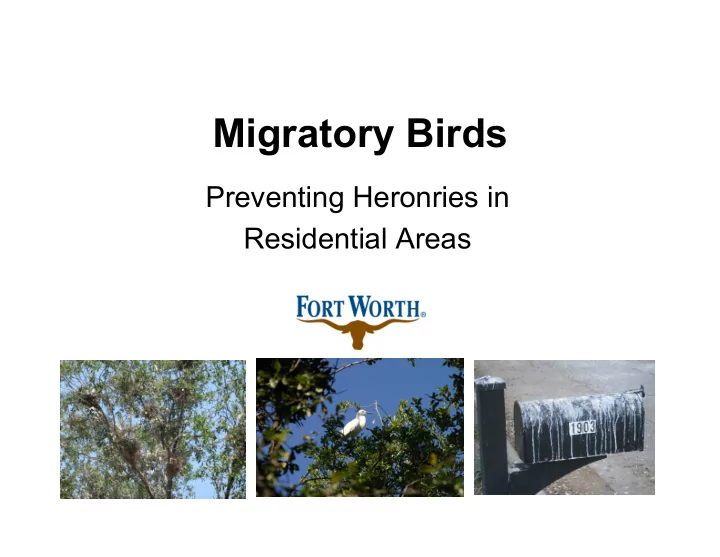
Migratory Birds Preventing Heronries in Residential Areas Fort Worth 2012 Birds arrived in spring; stayed until September Three homes had nests; entire block affected Property owners working to remove old nests, trim trees, prevent


slide-1
SLIDE 1

Migratory Birds

Preventing Heronries in Residential Areas

slide-2
SLIDE 2

Fort Worth 2012

  • Birds arrived in spring; stayed until

September

  • Three homes had nests; entire block

affected

  • Property owners working to remove old

nests, trim trees, prevent new nesting

  • Birds are “programmed” to return; even

greater numbers likely in spring 2013

  • Where will the birds go?
slide-3
SLIDE 3

The Problem

slide-4
SLIDE 4

Limitations

  • Protected status under Migratory Bird Treaty Act
  • f 1918 prevents nest destruction when eggs of

any species (egrets, herons, etc.) are present.

  • No City tax funds may be spent on private
  • property. City has helped with:

– Dead/injured bird pickup – Education

slide-5
SLIDE 5

Case Study - Carrollton

  • Carrollton 2011

– 1201 Nests – 4,804 Adult birds – 7,206 Chicks – 7,206 Eggs

  • If allowed to return

– 10,568 Adult birds – 42,272 Eggs – 21,326 Chicks – Total birds in the rookery would have been 31,704

slide-6
SLIDE 6

The Plan

  • Education
  • Communication
  • Action Steps
slide-7
SLIDE 7

Education is Key

  • Learn the warning signs

– Previous nesting activity – Dense tree canopy – Scout or sentry birds

  • Know what you can legally do

– Harassment methods – Nest removal

  • Get organized

– Communicate with neighbors – Determine who will help and how

slide-8
SLIDE 8

Action Steps

  • Fall

– Remove old nests – Trim your trees – Get organized

  • February

– Watch for sentry birds – Report sentry bird sightings to neighbors

  • Pre-Nesting

– Make noise – Hang visual deterrents in trees – Use water hoses – Remove the start of any nest

slide-9
SLIDE 9
  • Air horns
  • Scare-eye balloons
  • Streamers
  • Water guns (toys)
  • Lights
  • Nest removal hook
  • Radios

Effective Tools

slide-10
SLIDE 10

Celebrate Success!

slide-11
SLIDE 11

What’s the difference between roosting and nesting?

“B “Bir irds ds don' don't typically pically sit it on

  • n a

a nes nest when hen roos

  • osting

ing out

  • utside

ide the he nes nesting ing seas eason.

  • n. Any

nything hing can can be be done done to

  • dr

driv ive e them hem aw away ay when hen they hey ar are e

  • nly
  • nly roos
  • osting.”

ing.”

USFW Wildlife Biologist

slide-12
SLIDE 12

“Act ctiv ive e or

  • r Par

artiall ially Act ctiv ive e Colonies

  • lonies. Once egg

laying has commenced by any of those birds, all nest destruction must cease. Destruction of empty nests in an active or partially active colony will likely threaten surrounding nests that contain eggs or nestlings; therefore it will not be allowed except

  • n a case-by-case basis as

determined by the Migratory Bird Permits Office.”

Interim Empty Nest Policy of the U. S. Fish and Wildlife Service, Region 2