Blood
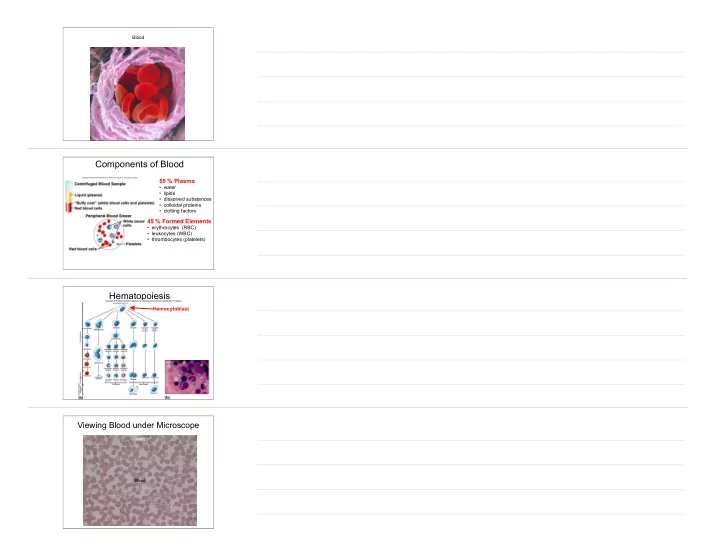
Components of Blood
55 % Plasma
- water
- lipids
- dissolved substances
- colloidal proteins
- clotting factors
45 % Formed Elements
- erythrocytes (RBC)
- leukocytes (WBC)
- thrombocytes (platelets)
Hematopoiesis
Hemocytoblast
Components of Blood 55 % Plasma water lipids dissolved - - PowerPoint PPT Presentation
Blood Components of Blood 55 % Plasma water lipids dissolved substances colloidal proteins clotting factors 45 % Formed Elements erythrocytes (RBC) leukocytes (WBC) thrombocytes (platelets)
Blood
Hemocytoblast
Their cytoplasm is rich in granules which stain typical colors that help with their recognition. The nucleus is condensed in a little masses or lobes. Because these cells appear to be lacking in granules, they are named
nucleus and a transparent cytoplasm
– Make up the majority of WBCs (60 – 70%) – Nucleus with 3 – 5 lobes – Fine reddish to violet granules in cytoplasm
– Make up 2 – 4% of WBC – Nucleus has two large lobes connected by a thin strand – Large orange-pink granules in cytoplasm
– Make up 25-33% of WBC – Large round nucleus, dark violet in color – Small lymphocytes: nucleus occupies much of cell – Large lymphocytes have more cytoplasm
– Make up 3 - 8%
– Large kidney- shaped nucleus, light to dark violet in color – Abundant cytoplasm with fine granules
No antibodies
18
Rh positive
Rh positive
Rh negative
– the diagnosis of anemia and polycythemia – the monitoring of treatment for anemia, – recovery from dehydration, and – monitoring of ongoing bleeding to check its severity.
– Adult males: 42-52% – Adult women: 37-48%