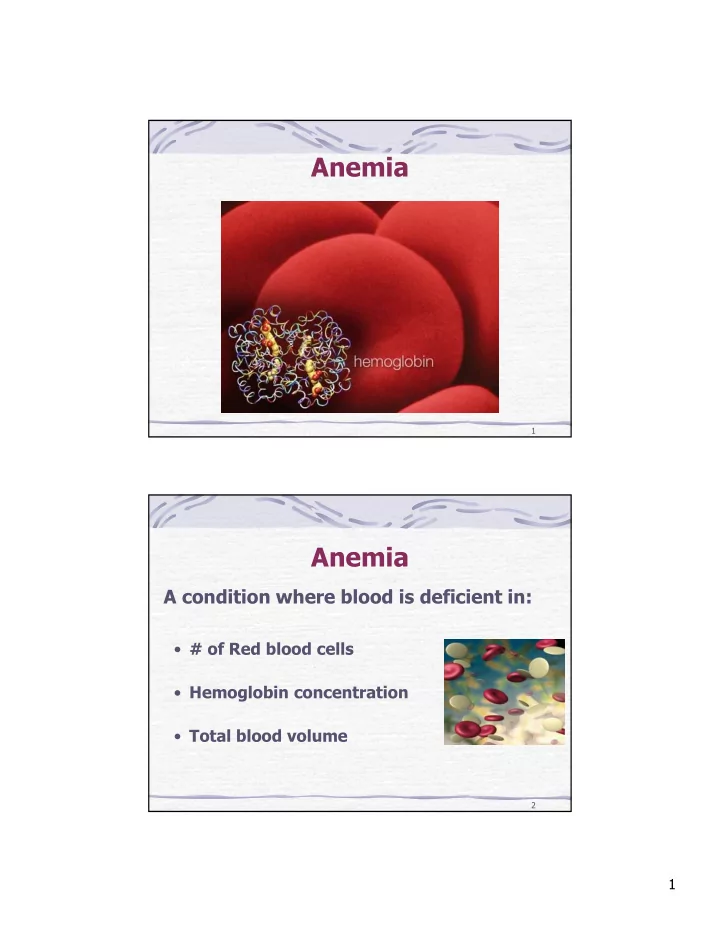
Anemia 1 Anemia A condition where blood is deficient in: # of Red - - PDF document

anemia
SMART_READER_LITE
LIVE PREVIEW

Anemia 1 Anemia A condition where blood is deficient in: # of Red - - PDF document

Anemia 1 Anemia A condition where blood is deficient in: # of Red blood cells Hemoglobin concentration Total blood volume 2 1 Anemia Definition Hemoglobin [Hgb] concentration is 2 {std} deviations below the mean [Hgb] for a


slide-1
SLIDE 1

1

Anemia

1 2

Anemia

A condition where blood is deficient in:

  • # of Red blood cells
  • Hemoglobin concentration
  • Total blood volume
slide-2
SLIDE 2

2

Anemia Definition

Hemoglobin [Hgb] concentration is 2 {std} deviations below the mean [Hgb] for a normal population for the same gender and age range.

3 4

Hemoglobin (Hgb) Function

  • Transports O2 from the lungs to the tissues
  • Transports CO2 back to the lungs & exhaled
slide-3
SLIDE 3

3

5

Hemoglobin (Hgb)

  • Influenced by age, sex, altitude, & smoking
  • Normal ranges:
  • New born babies:

17- 22 gm/dL

  • Children:

11-13 gm/dL

  • Adult women:

12-16 gm/dL

6

Causes of Anemia

  • Blood cell loss from the body
  • surgery, hemorrhage, Menstruation
  • Decreased lifespan of the red blood cell
  • Hemolytic anemia i.e., sickle cell anemia
  • Growth spurts
  • Pregnancy:
  • Inability of mom to keep up with

red blood cell production for the growing fetus (should get 30mg of iron per day.)

slide-4
SLIDE 4

4

Other Causes of Anemia

  • Chronic illness or infection can cause

the body to make fewer red blood cells

  • Some drugs & medical treatments
  • Aplastic anemia: the inability for bone

marrow to produce enough RBC (could be side effect of chemo, etc.)

  • Renal Disease, cancer

7 8

Most Common Cause

  • f Anemia

Iron Deficiency

slide-5
SLIDE 5

5

9

  • Infants: not receiving adequate iron in their diet
  • Children: rapid growth spurts where iron available

cannot keep up with RBC production

  • Women: blood loss during menstruation
  • Pregnant women: growing fetus has a high

demand for iron

Populations at Risk for IronDeficiency

10

  • Not receiving adequate iron in their diet

(watered down formula)

  • Infants at 6 months require dietary iron

(iron stores have become depleted from birth)

  • Premature infants may require supplementation

(They do not get all of their iron from mom during the 3rd Trimester due to incomplete gestation)

Infants at Risk for IronDeficiency

slide-6
SLIDE 6

6

Children at Risk for Iron Deficiency

  • Not receiving adequate iron in Diet
  • Drinking more than 24 oz. of milk/day
  • Rapid growth spurts where iron available

cannot keep up with RBC production

11 12

Symptoms

  • f Iron Deficiency
  • Pallor (paleness of the skin)
  • Tiredness, weakness or fatigue
  • CNS symptoms in severe anemia–

Faintness–Dizziness–Tinnitus (ringing in the ears) –Headache–Spots before the eyes

slide-7
SLIDE 7

7

Less O2 in Blood:

  • Heart must work harder to pump

enough oxygen to organs.

  • Cardiac-related symptoms include:
  • Arrhythmia (abnormal heart rhythm)
  • SOB/shortness of breath
  • Chest pain

13 14

PICA

  • “Pica” - a craving to eat unusual

substances such as ice or dirt

(may also occur with high lead levels)

  • Numbness and tingling
  • Burning or sore tongue
  • Sores at the corner of the mouth
  • Chronic gastritis
slide-8
SLIDE 8

8

Lead Toxicity

Anemia increases the risk lead absorption more than normal, placing individuals at risk for lead toxicity

15 16

Iron Deficiency Anemia

  • Treatment begins with finding the

underlying cause and correcting it.

  • Monitoring is best done

by measuring the Hemoglobin concentration (Hgb).

slide-9
SLIDE 9

9

Pernicious Anemia

  • Vitamin B-12 Deficiency (Cobalamin)
  • Megaloblastic Anemia (Large cells)
  • Caused by gastritis, parietal cell loss

(cells in the stomach) & lack of IF (Intrinsic Factor)

  • Symptoms: anemia, fatigue, GI distress,

neurological complications

  • Tx: B-12 injections, Oral suppl or diet

17

Sickle Cell Anemia

  • Sickling from mutation of the hemoglobin gene
  • Occludes small bv and causes tissue damage
  • RBC lifespan is shortened from 120 days to

20 days => Anemia

18

slide-10
SLIDE 10

10

Sickle Cell Anemia

  • 10% American blacks & 25% of Africans

are Heterozygotes (recessive/carrier)

  • Helps protect against malaria
  • 1970s: 20 year life expectancy
  • Today: 45 year life expectancy
  • Still required to check Hgb in WIC

19

Diagnosis A complete blood count test will check your levels of red blood cells, white blood cells, platelets, and hemoglobin.

20

slide-11
SLIDE 11

11

Red blood cells:

  • Average size
  • Variability in size
  • Volume
  • Hemoglobin concentration

21

Michigan WIC Low Hemoglobin

9/14 11/16 3/20

  • PG Women

13.8% 17.5% 12.5%

  • BF Women

29.0% 33% 30.5%

  • NPP Women 36.5%

42% 41.0%

  • Children

12.4% 13.9% 10.4%

  • Infants

0.2% 0.3% 0.2%

22

To Access Report: Clinic Module, Reports, Nutrition & Health Summary, Client Risk Factors by Category

slide-12
SLIDE 12

12

23

2.16 Hematological Risk Determination Policy

24

Hematological Risk 200 Series

  • Iron Status
  • Lead Status
slide-13
SLIDE 13

13

25

Low Iron Risk

Category 201

  • Criteria (PG, BE, BP, NPP, IBE, IBP, IFF, C1 –

C4)

  • Low hematocrit (hct.)/ low hemoglobin (hgb.)

cutoff value: At the time the blood test was taken, any value less than (<) the blood values listed in the following chart.

  • Note: Women who smoke, the blood value

criterion based on: #of cigarettes smoked and trimester of pregnancy. (One pack of cigarettes = 20 cigarettes)

26

Cut-off values are available for reference from this button

slide-14
SLIDE 14

14

27

When Do I Need To Do Bloodwork?

Infants

  • One test between 7 and

13 months

  • At the ONE YEAR CERT

visit if added to WIC BEFORE 7 MONTHS of age

  • If added to WIC AFTER

7 months, take the blood at the INITIAL certification visit

**Guidance for Infant Testing

A hematological test prior to the 9-12 month recommended period may be appropriate when there are indications that the infant is at risk for low serum iron, as described below:

  • Low birth weight or preterm infant.
  • Has not been fed iron-fortified formula

(10-12 mg. Fe/liter) or breastmilk.

  • Has a known diagnosis of anemia.
  • Has undergone surgery that resulted in

excessive blood loss.

28

slide-15
SLIDE 15

15

29

When Do I Need To Do Bloodwork?

  • Children Under

Two

  • Once between 13

and 24 months (prefer 6 mos. after first test)

  • For most C1’s, this

will be at the 18 month CEVAL

  • Two Before Two
  • 7-12 months
  • 13-24 months

When Do I Need To Do Bloodwork?

Children Two - Five

  • Once after two years of age,

THEN:

  • Once every 12 months if the

previous result is above the cutoff level

  • Once every 6 months if the

previous result is below the cutoff level

slide-16
SLIDE 16

16

31

When Do I Need To Do Bloodwork?

Pregnant Women

  • Once during pregnancy

Postpartum Women

  • Once after delivery,

preferably at least six weeks postpartum

Exemptions to Hematological Testing

  • Medical Condition Prohibits Draw
  • Religious Objections
  • Severe Risk to Staff
  • Pending (must have State approval)
  • Pandemic (Currently)

32

slide-17
SLIDE 17

17

33

Add a row when no test is required/performed and select Exemption Reason

Adding a row is NOT required for infants less than 7 months of age

Client Agreement

Consent to WIC health screening: I will allow a WIC health screening for all WIC applicants in my family. WIC health screening includes answering health and diet questions, measuring height, weight and head size, and testing blood for iron level.

34

slide-18
SLIDE 18

18

35

Referral Data

  • Must be within

specified time period for the client’s status (6 month cut off)

  • Must be presented at

the time of the appointment

  • The date of the test

must be recorded in MI-WIC

Non-WIC Data

enter the date blood work was done

36

To enter Referral (Non-WIC) Data, use the date the test was performed, check the Non-WIC Data checkbox andnter Hgb value.

slide-19
SLIDE 19

19

37

Retesting

Local Agency Procedure

  • Testing levels that are outside the

cutoff values in policy

  • A critical hemoglobin result

<8 or >17

  • Testing levels that have been

specified as critical values established by local agency

Retest: explain reason

38

slide-20
SLIDE 20

20

39

Follow-up Testing

  • One follow-up test is allowed when

deemed necessary for health monitoring by CPA

  • Should be at least 60 days from

previous test

MI-WIC: Lab Hx screen

40

slide-21
SLIDE 21

21

41