SLIDE 1
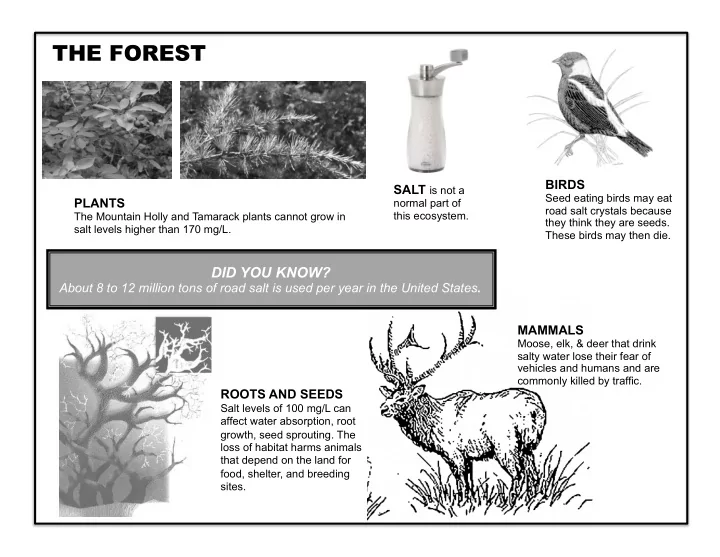
PLANTS
The Mountain Holly and Tamarack plants cannot grow in salt levels higher than 170 mg/L.
BIRDS
Seed eating birds may eat road salt crystals because they think they are seeds. These birds may then die.
SALT is not a
normal part of this ecosystem. ¡
DID YOU KNOW?
About 8 to 12 million tons of road salt is used per year in the United States. ROOTS AND SEEDS
Salt levels of 100 mg/L can affect water absorption, root growth, seed sprouting. The loss of habitat harms animals that depend on the land for food, shelter, and breeding sites.
MAMMALS
Moose, elk, & deer that drink salty water lose their fear of vehicles and humans and are commonly killed by traffic.
THE FOREST
SLIDE 2 FROGS
can die in salt levels
FISH
like rainbow trout will die if they swim in water of 1,000 mg/L of salt.
FRESHWATER
FRESHWATER
means that the water is
NOT SALTY. ¡ SMALL FRESHWATER PLANTS AND ANIMALS
that are the basis of the food web will begin to die at salt levels of 226 mg/L.
DID YOU OU KNO KNOW? W?
Most of the world’s water is off limits for drinking! Only 3% of Earth’s water is considered fresh, i.e. not salty. Most of it is locked up in ice as glaciers. Only 0.3% of Earth’s water is found in rivers or lakes and 0.9% is found underground.
BRACKISH WATER has 1,000 mg/L or more
- f salt and is considered to be too salty to drink.
BRINE WATER has 10,000 mg/L or more of
salt and is considered to be very salty.
PEOPLE
can only drink freshwater. The Environmental Protection Agency (EPA) does not allow people to drink water with salt levels greater than 250 mg/L. Also, water begins to taste bad at this level.
SLIDE 3
NEW JERSEY MEADOWLANDS: FROM SWAMP TO MARSH WHAT IS THE DIFFERENCE BETWEEN A SWAMP AND A MARSH? 1922 to Today—Reedy Marsh
In 1922, the Hackensack River was dammed, cutting off the flow of freshwater to the Meadowlands. The water became saltier, killing trees and leading to the growth of the salt tolerant reedy grasses that you can see today.
200 years ago — Cedar Tamarack Swamp
The New Jersey Meadowlands used to be filled with tall cedars and tamarack trees that grew in the wet swampy habitat. People cut them down, and they were also killed by SALT! A MARSH is a wetland with grasses, but no trees. It often grows in brackish (1000 mg/L) or even saltier water. A SWAMP is a wetland with woody plants like trees and often grows in freshwater.
WETLANDS
MARSHES
are SALTY.
SWAMPS are NOT SALTY. ¡
SLIDE 4 ESTUARY
DID YOU KNOW?
Organisms that live in estuaries are unique because they are able to live in huge ranges of salt, temperature, tides and sunlight. WHAT IS AN ESTUARY?
An estuary is a semi-enclosed area where fresh water meets and mixes with salty ocean water. It is often called “the cradle of the ocean” because it is filled with life.
RIVER OTTERS
can sometimes be seen swimming at the mouth of the Hudson River.
ATLANTIC STURGEON
can be 15 ft long and weigh over 800 lbs. They are part of an ancient 200 million year old fish lineage – older than dinosaurs!
SALT in estuaries
can range with the tide from 3,000 to 30,000 mg/L of salt. ¡ ¡
ALEWIFE
is a species of herring less than 1 foot long. Its name comes from its round body that people thought looked like an overweight wife of a bar
TEMPERATURES
in shallow estuaries can range from freezing to more than 100 °F in the course
SLIDE 5 OCEAN
DID YOU KNOW?
97% of the Earth’s water is salty and found in the oceans. NORTH ATLANTIC RIGHT WHALES
along with fin, humpback, minke, sperm, blue and sei whales, dolphins, pilot whales and porpoises can all be spotted off the coast of Long
- Island. Right whales were
given the name because they were the “right” whales to kill for their oil. Today less than 300 of the 50 foot, 70 ton animals remain.
GREAT WHITE SHARK
is found in all oceans, including off the coast of Long Island and
- NJ. It can be 20 ft long and weigh almost 5,000 lbs. Like other
sharks, Great Whites have rows and rows of teeth, one behind the next that move forward to replace broken and worn teeth.
LOGGERHEAD SEA TURTLES
along with Green Turtles, Hawksbill Turtles, Leatherback Turtles, and Atlantic Ridley Turtles still sometimes swim in the Atlantic off the New York / New Jersey coast.
SALT levels
are as high as 32,000 mg/L in the open ocean. ¡
HORSESHOE CRABS
climb onshore in the spring to lay their eggs–each female lays 80,000! These eggs feed migrating shorebirds, fish, and Atlantic loggerhead turtles.
SLIDE 6
A SALT CONCENTRATION GUIDE in mg/L:
67.5 Harms forest pine trees 100 Maximum allowed in NYC drinking water 226 Kills tiny freshwater plants and animals 250 Tastes salty. Maximum allowed in drinking water by the Environmental Protection Agency 400 Will kill some freshwater frogs 1,000 Will kill some freshwater fish like trout. Considered to be brackish or salty water 3,000 Lowest salt level found in the New York/New Jersey estuary 30,000 Highest level in the New York/New Jersey estuary 32,000 Average in ocean off of Long Island and New Jersey
SLIDE 7 Image ¡Credits ¡
- 1. Tamarack: ¡John ¡Lillis ¡
Mountain ¡Holly: ¡Champlain ¡Project ¡ Table ¡Salt: ¡Everything ¡Kitchens ¡ Bird: ¡US ¡Geological ¡Survey ¡ Mammal ¡(Deer): ¡Clker ¡
- 2. Rainbow ¡Trout: ¡US ¡Fish ¡& ¡Wildlife ¡Service ¡
Table ¡Salt: ¡Everything ¡Kitchens ¡ Frog: ¡USGS ¡ Algae: ¡US ¡Department ¡of ¡Health ¡& ¡Human ¡Services ¡ Tap ¡Water: ¡Food ¡& ¡Water ¡Watch ¡
- 3. Eastern ¡White ¡Cedar: ¡Forests ¡for ¡Maine's ¡Future ¡
Phragmites: ¡Rob ¡Bock/Sandbox ¡ Hackensack ¡River: ¡Karl ¡Musser/US ¡Geological ¡Survey ¡
- 4. Thermometer: ¡Florida ¡Center ¡for ¡InstrucXonal ¡Technology, ¡College ¡of ¡EducaXon/University ¡of ¡South ¡
Florida ¡ O[er: ¡WA ¡Department ¡of ¡Fish ¡& ¡Wildlife ¡ Alewife: ¡Department ¡of ¡Natural ¡Resources ¡-‑ ¡Cornell ¡University/NY ¡Department ¡of ¡Environmental ¡ ConservaXon ¡ AtlanXc ¡Sturgeon: ¡Department ¡of ¡Natural ¡Resources ¡-‑ ¡Cornell ¡University/NY ¡Department ¡of ¡ Environmental ¡ConservaXon ¡
- 5. Great ¡White ¡Shark: ¡Terry ¡Goss ¡
Sea ¡Turtle: ¡NOAA ¡ Horseshoe ¡Crab: ¡NOAA ¡ Right ¡Whale: ¡NOAA ¡ ¡