
SLIDE 1
European River Restoration: Past Trends and Future Ambitions
Dr Chris Baker Wetlands International
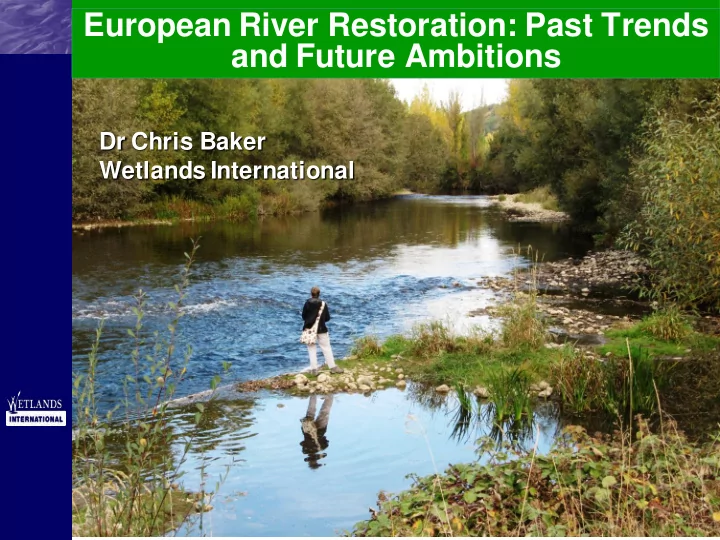
European River Restoration: Past Trends and Future Ambitions Dr - - PowerPoint PPT Presentation
European River Restoration: Past Trends and Future Ambitions Dr Chris Baker Wetlands International European Centre for River Restoration ECRR is connecting people and organizations (network / platform) ECRR supports development of
Dr Chris Baker Wetlands International
12-6-2012 3 ECCR National Networks Warsaw June 2012
RESTORE encourages the restoration of European rivers towards a more natural state. This delivers increased ecological quality, flood risk reduction, and social and economic benefits. RESTORE is implemented by 6 partners: Environment Agency for England and Wales (EA), UK River Restoration Centre (RRC), Finnish Environment Institute (SYKE), Italian River Restoration Centre (CIRF), Dutch Gov’t Service for Land and Water Management (DLG) Wetlands International (WI).
More than half of the surface water bodies in Europe are in less
than good ecological status or potential.
Rivers and transitional waters are reported to have worse
ecological status or potential and more pressures and impacts than water bodies in lakes and coastal waters.
driven
WFD Updated River Basin Management Plans in 2015 require an integrated approach across policy areas FRMD Flood risk management plans to be adopted in 2015 CAP Reform: Green Pillar I to support Natural Water Retention Measures through ecological focus areas. Habitats Directive, Birds Directive, Biodiversity Strategy
Europe
Change and disaster risk reduction
– develop technical guidance and a strategy – Establish research priorities – Improve access to finance (EIB)
Measures (NWRM) – Reduce vulnerability to floods and droughts
– Maintain and restore ecosystems and their service provision
– Develop natural water retention measures guidance by 2014 – Develop ecological flows guidance by 2014 – Promote implementation in RBMP planning cycle
discharge of 1000 m3/s
authorities
–Riverbed deepening
–Groin improvement –Creating side-channels –Removing obstacles –Strengthening of dikes (no room available at reasonable costs)
–Bypasses/ ‘green rivers’ –Widening of floodplain by replacement of dikes or de-poldering
underpin larger scale and higher impact river restoration initiatives and their monitoring
working at different scales
problems
river restoration
progress and quality to underpin policy and strategy implementation
integration of government, business and civil society interests and action.
underpin good practice in river restoration across the European region