SLIDE 1 Equilibrium conditions
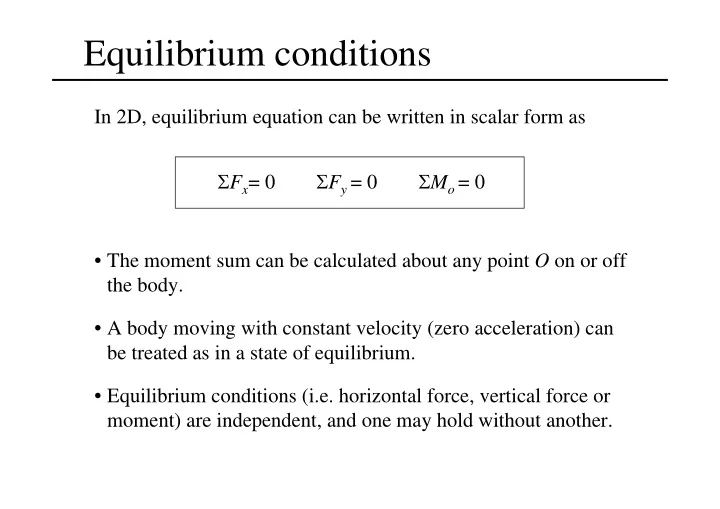
In 2D, equilibrium equation can be written in scalar form as ΣFx= 0 ΣFy = 0 ΣMo = 0
- The moment sum can be calculated about any point O on or off
the body.
- A body moving with constant velocity (zero acceleration) can
be treated as in a state of equilibrium.
- Equilibrium conditions (i.e. horizontal force, vertical force or
moment) are independent, and one may hold without another.
SLIDE 2 Categories of equilibrium(1)
1
F r
2
F r
3
F r
x
ΣFx = 0
x y ΣFx = 0 ΣFy = 0
1
F r
2
F r
3
F r
O
4
F r
SLIDE 3 Categories of equilibrium(2)
x y
1
F r
2
F r
3
F r
x y
1
F r M r
2
F r
3
F r
4
F r
ΣFx = 0 ΣMz = 0 ΣFx = 0 ΣFy = 0 ΣMz = 0
SLIDE 4 Two- and three-force members(1)
Two-force members
P r − P r
If there are only 2 forces acting on a body, and the body is in equilibrium, two forces must be equal, opposite, and collinear.
A B Fx Fy
A B P
Negligible weight 2 unknowns Only 1 unknown Two-force members
SLIDE 5 Two- and three-force members(2)
Three-force members
1
F r
2
F r
3
F r
O
1
F r
3
F r
2
F r
Three force must be concurrent.
=
∑
O
M
Exception: three forces are parallel
=
∑ F
r
Closed polygon satisfies can be drawn Sine and cosine law
SLIDE 6 Alternative equilibrium equations
In general, these three equilibrium equations are used
ΣFx= 0 ΣFy = 0 ΣMo = 0
Alternatively, the following sets of equilibrium equations can also be used
ΣMA = 0 ΣFx= 0 ΣMB = 0 ΣMA = 0 ΣMB = 0 ΣMc = 0
2-moments, 1-force 3-moments
SLIDE 7 Constraints
Constraint: the restriction of movement
- Constraint normal to the surface of
contact
- Tangential force cannot be supported
- Constraint in both vertical and
horizontal direction
- Moment cannot be supported
- Constraint in vertical and horizontal
direction and moment
SLIDE 8 Statical determinacy
P FAx FAy FBy A B FAy FBy FAx A B P FBx
Constraint : vertical Constraint: vertical, horizontal Constraint: vertical, horizontal
- 3 Unknowns
- 3 Equations (ΣFx= 0, ΣFy = 0, ΣMo = 0)
Statically determinate
Statically indeterminate
SLIDE 9
Adequacy of constraints (1)
Constraint: Fx, Fy, Moment Adequate constraints Constraint: Fx, Fy Moment about A cannot be supported Partial constraints Three constraints does not always guarantee a stable equilibrium configuration
SLIDE 10
Adequacy of constraints (2)
Constraint: Fx, Moment Fy cannot be supported Partial constraints Link 4 is unnecessary to maintain a fixed position Redundant constraints
SLIDE 11
Sample 1
Calculate the tension T in the cable which supports the 500-kg mass with the pulley arrangement shown. Each pulley is free to rotate about it bearing, and the weights of all parts are small compared with the load. Find the magnitude of the total force on the bearing of pulley C.
SLIDE 12
Sample 2
The man pushes the lawn mower at a steady speed with a force P that is parallel to the incline. The mass of the mower with attached grass bag is 50 kg with mass center at G. If θ = 15°, determine the normal forces NB and NC under each pair of wheels B and C. Neglect friction. Compare with the normal forces for the conditions of θ = 0 and P = 0
SLIDE 13
Sample 3
Find the angle of tilt θ with the horizontal so that the contact force at B will be one-half that at A for the smooth cylinder.
SLIDE 14
Sample 4
Determine the force P required to begin rolling the uniform cylinder of mass m over the obstruction of height h.
SLIDE 15 Sample 5
The exercise machine is designed with a lightweight cart which is mounted on small rollers so that it is free to move along the inclined ramp. Two cables are attached to the cart-one for each
- hand. If the hands are together so that the cables are parallel and if
each cable lies essentially in a vertical plane, determine the force P which each hand must exert on its cable in order to maintain an equilibrium position. The mass of the person is 70 kg, the ramp angle θ is 15°, and the angle β is 18°. In addition, calculate the force R which the ramp exerts on the cart.
SLIDE 16
Sample 6
The pin A, which connects the 200-kg steel beam with center of gravity at G to the vertical column, is welded both to the beam and to the column. To test the weld, the 80-kg man loads the beam by exerting a 300-N force on the rope which passes through a hole in the beam as shown. Calculate the torque (couple) M supported by the pin.
SLIDE 17
Sample 7
The 100-kg wheel rests on a rough surface and bears against the roller A when the couple M is applied. If M = 60 Nm and the wheel does not slip, compute the reaction on the roller A.
SLIDE 18
Sample 8
The indicated location of the center of mass of the 1600-kg pickup truck is for the unladen condition. If a load whose center of mass is x = 400 mm behind the rear axle is added to the truck, determine the mass mL of the load for which the normal forces under the front and rear wheels are equal.
SLIDE 19
Sample 9
The elements of a wall-mounted swing-away stool are shown in the figure. The hinge pin P fits loosely through the frame tube, and the frame tube has a slight clearance between the supports A and B. Determine the reactions on the frame tube at A and B associated with the weight L of an 80-kg person. Also, calculate the changes in the horizontal reactions at C and D due to the same load L. State any assumptions.
SLIDE 20 Sample 10
A portion of the shifter mechanism for a manual car transmission is shown in the figure. For the 8-N force exerted on the shift knob, determine the corresponding force P exerted by the shift link BC
- n the transmission (not shown). Neglect friction in the ball-and –
socket joint at O, in the joint B, and in the slip tube near support D. Note that a soft rubber bushing at D allows the slip tube to self- align with link BC.
SLIDE 21 Sample 11
The small crane is mounted on one side of the bed of a pickup
- truck. For the position θ = 40º, determine the magnitude of the
force supported by the pin at O and the oil pressure p against the 50-mm-diameter piston of the hydraulic cylinder BC.
SLIDE 22 Sample 12
Pulley A delivers a steady torque (moment) of 100 Nm to a pump through its shaft at C. The tension in the lower side of the belt is 600 N. The driving motor B has a mass of 100 kg and rotates
- clockwise. As a design consideration, determine the magnitude R
- f the force on the supporting pin at O..
SLIDE 23 Sample 13
The uniform 400-kg drum is mounted on a line of rollers at A and a line of rollers at B. An 80-kg man moves slowly a distance of 700 mm from the vertical centerline before the drum begins to
- rotate. All rollers are perfectly free to rotate, except one of them at
B which must overcome appreciable friction in its bearing. Calculate the friction force F exerted by that one roller tangent to the drum and find the magnitude R of the force exerted by all rollers at A on the drum for this condition.