Environmental Ethics: Anthropocentrism vs. Nonanthropocentrism - - PowerPoint PPT Presentation

environmental ethics anthropocentrism vs
SMART_READER_LITE
LIVE PREVIEW

Environmental Ethics: Anthropocentrism vs. Nonanthropocentrism - - PowerPoint PPT Presentation

Environmental Ethics: Anthropocentrism vs. Nonanthropocentrism Anthropocentric Worldview Adopts a human-centered ideology Asserts dominance over all other species Views humans as a unique and superior Constructs nature as


slide-1
SLIDE 1

1

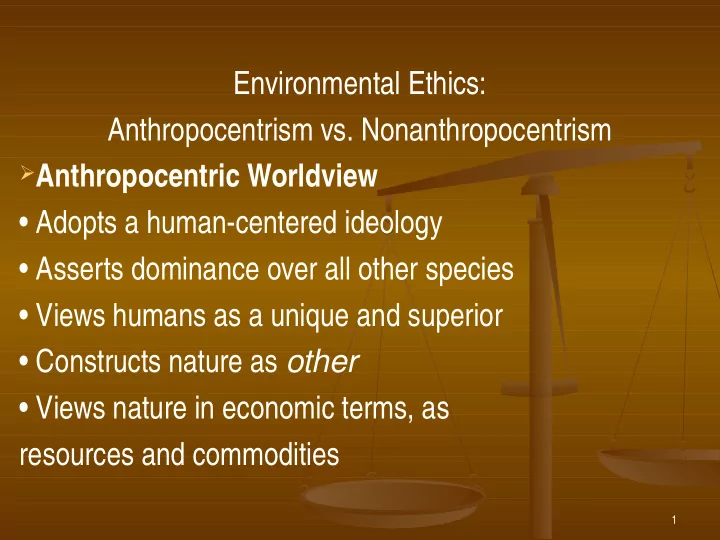
Environmental Ethics: Anthropocentrism vs. Nonanthropocentrism

  • Anthropocentric Worldview
  • Adopts a human-centered ideology
  • Asserts dominance over all other species
  • Views humans as a unique and superior
  • Constructs nature as other
  • Views nature in economic terms, as

resources and commodities

slide-2
SLIDE 2

2

 Unlike other applied ethicists, core idea is that we should

extend the sphere of moral obligation beyond humans. Who counts morally and why – endangered species, old growth forests, wilderness areas? May require a reexamination of the human-nature relationship. As much theoretical as applied, possibly more so.

 Most contributions to date are to metaethical debates

  • ver value theory, especially non-human centered

(nonanthropocentric) descriptions of the value of natureitself (intrinsic value).

slide-3
SLIDE 3

3

 anthropocentric value: Value that is human centered or

derived from human judgment.

 non-anthropocentric value: Value that is not human

centered, or independent of human judgment.

slide-4
SLIDE 4

4

 Intrinsic value: The worth objects have in their own

right, independent of their value to any other end.

 Instrumental value: The worth objects have in fulfilling

  • ther ends.
slide-5
SLIDE 5

5

  • Anthropocentrism:

Anthropocentrism: Humans are intrinsically valuable Humans are intrinsically valuable (members of (members of the moral community). Other the moral community). Other things in the things in the environment are valuable environment are valuable because they are important because they are important to humans. to humans.

  • Humans are intrinsically valuable. Other beings are

Humans are intrinsically valuable. Other beings are extrinsically valuable or valuable because of their value extrinsically valuable or valuable because of their value to humans. to humans.

slide-6
SLIDE 6

6

  • Some Anthropocentric Theories of Ethics

Some Anthropocentric Theories of Ethics

  • Natural Rights: Human beings have inherent rights.

Natural Rights: Human beings have inherent rights. Human rights must be protected (by law, etc.) Other Human rights must be protected (by law, etc.) Other things do not have “rights.” things do not have “rights.”

  • Kantianism: Human beings have inherent worth

Kantianism: Human beings have inherent worth (because they are rational). Other animals and plants (because they are rational). Other animals and plants do not have inherent worth, since they are not rational. do not have inherent worth, since they are not rational.

slide-7
SLIDE 7

7

  • (

(Anthropocentric Anthropocentric) Utilitarianism: The morally right ) Utilitarianism: The morally right policies maximize the amount of (human) happiness in policies maximize the amount of (human) happiness in the world. the world.

  • (

(Anthropocentric Anthropocentric) Religious ) Religious ethics ethics: God made humans : God made humans in his images, and everything else is made for humans. in his images, and everything else is made for humans. (That is, everything else is valuable if it is valuable to (That is, everything else is valuable if it is valuable to humans, otherwise not.) humans, otherwise not.)

  • Discussion: But why should humans have value, rights,

Discussion: But why should humans have value, rights, etc., that other things do not? What makes animals, etc., that other things do not? What makes animals, trees, and ecosystems valuable? trees, and ecosystems valuable?

slide-8
SLIDE 8

Singer argues that: Singer argues that:

 There is no logical reason to regard human life as more

There is no logical reason to regard human life as more valuable than any other form of sentient life. valuable than any other form of sentient life.

 He insists that animal life, the earth and the environment

He insists that animal life, the earth and the environment have intrinsic worth, and not just instrumental worth as have intrinsic worth, and not just instrumental worth as Kant assumes. Kant assumes.

 He calls the view that human life is intrinsically more

He calls the view that human life is intrinsically more valuable than everything else “speciesism”. valuable than everything else “speciesism”.

 He says that “speciesism” is simply prejudice and

He says that “speciesism” is simply prejudice and discrimination and is therefore unethical as a basis for discrimination and is therefore unethical as a basis for environmental ethics. environmental ethics.

8

slide-9
SLIDE 9
  • Animals surely deserve to live their lives free from suffering and

Animals surely deserve to live their lives free from suffering and exploitation. exploitation.

  • Animals are not ours to:

Animals are not ours to:

  • eat

eat

  • wear

wear

  • experiment on

experiment on

  • use for entertainment

use for entertainment

  • abuse

abuse

9

slide-10
SLIDE 10

Direct vs. Indirect duties towards Direct vs. Indirect duties towards animals animals

 Direct duties: duties owed to the animals

Direct duties: duties owed to the animals themselves (treating animals welfare as an themselves (treating animals welfare as an intrinsic good intrinsic good) )

 Indirect duties: duties to act in certain ways towards

Indirect duties: duties to act in certain ways towards animals for the sake of ourselves, others or society animals for the sake of ourselves, others or society (treating animal welfare as an (treating animal welfare as an instrumental instrumental good good) )

10

slide-11
SLIDE 11

Examples of indirect duties towards animals: Examples of indirect duties towards animals:

  • Duty to respect private property (animals that belong to someone)

Duty to respect private property (animals that belong to someone)

  • Duty to avoid cruelty because it encourages a cruel nature in us, which might then be

Duty to avoid cruelty because it encourages a cruel nature in us, which might then be expressed towards other people expressed towards other people

  • Duty not to hurt the feelings of people who love animals by abusing animals

Duty not to hurt the feelings of people who love animals by abusing animals

  • Duty to maintain the health of biosystems and nature in general, for our own good

Duty to maintain the health of biosystems and nature in general, for our own good

  • Duty to preserve beautiful creatures, for the enjoyment of others and future generations

Duty to preserve beautiful creatures, for the enjoyment of others and future generations

  • Duty to preserve species that may be sources of other instrumental goods, e.g. medicine

Duty to preserve species that may be sources of other instrumental goods, e.g. medicine

11

slide-12
SLIDE 12

Ethical status for animals Ethical status for animals

Animal welfare as an intrinsic good Animal welfare as an intrinsic good Kantian and utilitarian ethics traditionally extended to all Kantian and utilitarian ethics traditionally extended to all people, but only people people, but only people Kant: all rational beings are ends in themselves Kant: all rational beings are ends in themselves assumption assumption: only humans are rational (or maybe humans, angels and : only humans are rational (or maybe humans, angels and extraterrestrials) extraterrestrials) Utilitarianism: the pleasures and pains of all conscious beings are of equal Utilitarianism: the pleasures and pains of all conscious beings are of equal importance importance assumption assumption (?): only humans are conscious/have pleasure and pain (?): only humans are conscious/have pleasure and pain

12

slide-13
SLIDE 13

Singer sees ethics as evolving. Singer sees ethics as evolving. In the past, slaves, women and people of other races In the past, slaves, women and people of other races were often not treated as persons, and their were often not treated as persons, and their interests were not given consideration. interests were not given consideration. Now we recognize all people as persons and extend Now we recognize all people as persons and extend equal consideration to all people. equal consideration to all people. Now we should extend equal ethical consideration to Now we should extend equal ethical consideration to animals as well. animals as well.

13

slide-14
SLIDE 14

Borderline cases: babies, the severely mentally Borderline cases: babies, the severely mentally retarded, psychopaths retarded, psychopaths Argument from analogy: borderline cases are similar to (some) animals (in Argument from analogy: borderline cases are similar to (some) animals (in terms of abilities, sentience, capacity for pleasure and pain), so animals terms of abilities, sentience, capacity for pleasure and pain), so animals should be treated similarly should be treated similarly We routinely grant importance to the interests to human borderline cases – We routinely grant importance to the interests to human borderline cases – not full rights (e.g. the right to vote), but the right to have their preferences not full rights (e.g. the right to vote), but the right to have their preferences treated as morally important and the right not to be mistreated treated as morally important and the right not to be mistreated Animals are not equal to normal adults, and therefore cannot have truly equal Animals are not equal to normal adults, and therefore cannot have truly equal rights, but their preferences (e.g. the desire to avoid pain) should be given rights, but their preferences (e.g. the desire to avoid pain) should be given equal consideration equal consideration

14

slide-15
SLIDE 15

Equal consideration, not equal rights Equal consideration, not equal rights

  • We don’t discriminate between people on the basis of intelligence

We don’t discriminate between people on the basis of intelligence

  • r ability. So we should not discriminate against animals because
  • r ability. So we should not discriminate against animals because

they are less intelligent or lack certain abilities. they are less intelligent or lack certain abilities.

  • We treat babies and the severely brain damaged better than we

We treat babies and the severely brain damaged better than we treat animals, but we shouldn’t. Animals have just as much right to treat animals, but we shouldn’t. Animals have just as much right to consideration as babies (or more!) E.g. an adult ape is more consideration as babies (or more!) E.g. an adult ape is more aware, more self-directing and has at least as much capacity for aware, more self-directing and has at least as much capacity for suffering as a baby. suffering as a baby.

15

slide-16
SLIDE 16

16

  • Questioning the Anthropocentric Approach to Value in

Questioning the Anthropocentric Approach to Value in Nature Nature Key questions: Key questions:

  • Are humans the only things in the world that are valuable in

Are humans the only things in the world that are valuable in themselves? themselves?

  • Is everything else only valuable because it is valuable to

Is everything else only valuable because it is valuable to humans? humans?

  • Why should humans be placed inside the circle and other beings

Why should humans be placed inside the circle and other beings

  • n the outside?
  • n the outside?
  • What would we call it if we placed only people of one race inside

What would we call it if we placed only people of one race inside the circle just because of their race? the circle just because of their race?

  • Is it any different if we place only beings in one species inside

Is it any different if we place only beings in one species inside the circle just because of their species? the circle just because of their species?

  • Is there a relevant different between humans and nonhumans

Is there a relevant different between humans and nonhumans that makes the former intrinsically valuable and the latter not? that makes the former intrinsically valuable and the latter not?

slide-17
SLIDE 17

17

Non-Anthropocentric Approaches to Non-Anthropocentric Approaches to Ethics Ethics

  • Nature includes:

Nature includes:

  • Animals

Animals

  • Plants

Plants

  • Ecosystems

Ecosystems

  • Species

Species

  • Humans?

Humans? The Issue: Why are these things valuable? The Issue: Why are these things valuable? Why should we care about them? Why should we care about them?

slide-18
SLIDE 18

18

  • Non-Anthropocentric Approaches to Ethics

Non-Anthropocentric Approaches to Ethics

  • Sentientism:

Sentientism: All beings that have the capacity to feel All beings that have the capacity to feel pleasure and pain /the ability to experience life as a pleasure and pain /the ability to experience life as a subject are intrinsically valuable, and must be subject are intrinsically valuable, and must be considered for their own good, not just human good. considered for their own good, not just human good. Thus higher animals have moral considerability/ Thus higher animals have moral considerability/ inherent worth. inherent worth.

 Natural human affinity towards other animals.

Natural human affinity towards other animals.

slide-19
SLIDE 19

19

  • We have duties to all animals, and their interests are

We have duties to all animals, and their interests are (nearly) always equal to those of Humans (nearly) always equal to those of Humans

  • Biocentric egalitarianism: we have duties to all living

Biocentric egalitarianism: we have duties to all living things things

  • We ought to pursue

We ought to pursue environmental environmental justice because all justice because all species are equal species are equal

  • We have duties to at least some “

We have duties to at least some “environmental environmental

  • bjects”
  • bjects”
  • We have (largely unspecified) duties to “the land”

We have (largely unspecified) duties to “the land”

  • We have duties to inanimate objects

We have duties to inanimate objects

slide-20
SLIDE 20

20

  • Ecocentric Ethics

Ecocentric Ethics

 Any ethics or philosophy that places an emphasis on ecological

Any ethics or philosophy that places an emphasis on ecological wholes and moves away from individual plants and animals; wholes and moves away from individual plants and animals; value is placed on these ecological systems as wholes value is placed on these ecological systems as wholes

 Early version of ecocentric ethics is Aldo Leopold's "Land Ethic"

Early version of ecocentric ethics is Aldo Leopold's "Land Ethic"

 Ecocentric ethics and philosophies are

Ecocentric ethics and philosophies are holistic holistic ethics, rather ethics, rather than individualistic. The holism can be "metaphysical"-the whole than individualistic. The holism can be "metaphysical"-the whole exists, apart from or as really as its parts Or "epistemological"— exists, apart from or as really as its parts Or "epistemological"— the whole is the chief way to understand the parts. Then there is the whole is the chief way to understand the parts. Then there is moral holism—the system should be considered morally, moral holism—the system should be considered morally, independently of the individuals in that system. independently of the individuals in that system.

slide-21
SLIDE 21

21

 An ecocentric ethics appeals to

An ecocentric ethics appeals to ecology ecology in one way or another for help in in one way or another for help in explaining and defending its conclusions. Ecology is the study of the explaining and defending its conclusions. Ecology is the study of the interactions of living organisms with each other and with their non-living interactions of living organisms with each other and with their non-living

  • environments. An ecosystem is an area in which a variety of living
  • environments. An ecosystem is an area in which a variety of living
  • rganisms interact in mutually beneficial ways with their living and nonliving
  • rganisms interact in mutually beneficial ways with their living and nonliving

environment (forests, wetlands, lakes, grasslands, deserts). Ecologists, like environment (forests, wetlands, lakes, grasslands, deserts). Ecologists, like botanists and zoologists, focus more on interdependencies and botanists and zoologists, focus more on interdependencies and relationships than on individual organisms. Ecology emphasizes such relationships than on individual organisms. Ecology emphasizes such wholes as species, biotic diversity, ecological communities, ecosystems, wholes as species, biotic diversity, ecological communities, ecosystems, and biological, chemical, and geological cycles. and biological, chemical, and geological cycles.

 problems this appeal faces are (1) the lack of complete agreement among

problems this appeal faces are (1) the lack of complete agreement among ecologists about proper scientific methods, models, and conclusions; and ecologists about proper scientific methods, models, and conclusions; and (2) the difficulty of actually drawing any ethical conclusions from scientific (2) the difficulty of actually drawing any ethical conclusions from scientific

  • bservations
  • bservations
slide-22
SLIDE 22

22

 Environmental protection

Environmental protection, , as presently practiced, is a as presently practiced, is a potentially misleading and dangerous concept. Why? Because it potentially misleading and dangerous concept. Why? Because it seeks primarily to protect the environment of nature’s worst seeks primarily to protect the environment of nature’s worst

  • enemy. This results in
  • enemy. This results in

additional support for the already additional support for the already towering human dominance. We need a new concept of towering human dominance. We need a new concept of environmental protection. It must also strive to protect the environmental protection. It must also strive to protect the environments of our fellow creatures. They cannot speak out for environments of our fellow creatures. They cannot speak out for

  • themselves. We must act on their behalf according to the best of
  • themselves. We must act on their behalf according to the best of
  • ur knowledge. Our societies and educational systems have to
  • ur knowledge. Our societies and educational systems have to

take this into account. They must obtain and teach ecological take this into account. They must obtain and teach ecological knowledge and ecological thinking. And they must insist on knowledge and ecological thinking. And they must insist on accepting human responsibility for other ecosystem accepting human responsibility for other ecosystem components. components.

slide-23
SLIDE 23

23

 to develop and to enforce new values, such as self-

to develop and to enforce new values, such as self- restriction, modesty, responsibility, honesty; restriction, modesty, responsibility, honesty;

 to formulate aims, such as peace, freedom, dignity,

to formulate aims, such as peace, freedom, dignity, justice, human rights; justice, human rights;

 to further ideals, such as virtue, altruism, love.

to further ideals, such as virtue, altruism, love.

 Here extends ground common with moral theology and

Here extends ground common with moral theology and moral philosophy. moral philosophy.

slide-24
SLIDE 24

24

 We can survive only in an intact nature and must

We can survive only in an intact nature and must therefore protect such intactness from our one-sided therefore protect such intactness from our one-sided egoism. egoism.

 We can no longer accept ethical doctrines that

We can no longer accept ethical doctrines that continue to deny or neglect scientifically recognized continue to deny or neglect scientifically recognized realities. realities.

slide-25
SLIDE 25

25

  • What are the consequences for ecological ethics?

What are the consequences for ecological ethics?

  • Replace as much as possible linear resource degradation

Replace as much as possible linear resource degradation by cyclic resource re-utilization. by cyclic resource re-utilization.

  • Learn more about the working principles of ecosystems

Learn more about the working principles of ecosystems and use the insight gained for reconstructing our and use the insight gained for reconstructing our economies and societies. economies and societies.

  • Re-harmonize the human world with the world around us

Re-harmonize the human world with the world around us and reduce our detrimental impacts on nature. and reduce our detrimental impacts on nature.

  • Adjust the number of people on earth and their per capita

Adjust the number of people on earth and their per capita use of energy and matter in accordance with the carrying use of energy and matter in accordance with the carrying capacities of ecosystems. capacities of ecosystems.