Pipelining Introduction Consider a drink bottling plant Filling the - - PowerPoint PPT Presentation

pipelining introduction
SMART_READER_LITE
LIVE PREVIEW

Pipelining Introduction Consider a drink bottling plant Filling the - - PowerPoint PPT Presentation

6a.1 6a.2 Pipelining Introduction Consider a drink bottling plant Filling the bottle = 3 sec. Placing the cap = 3 sec. EE 457 Unit 6a Labeling = 3 sec. Would you want Machine 1 = Does all three (9 secs.), outputs the


slide-1
SLIDE 1

6a.1

EE 457 Unit 6a

Basic Pipelining Techniques

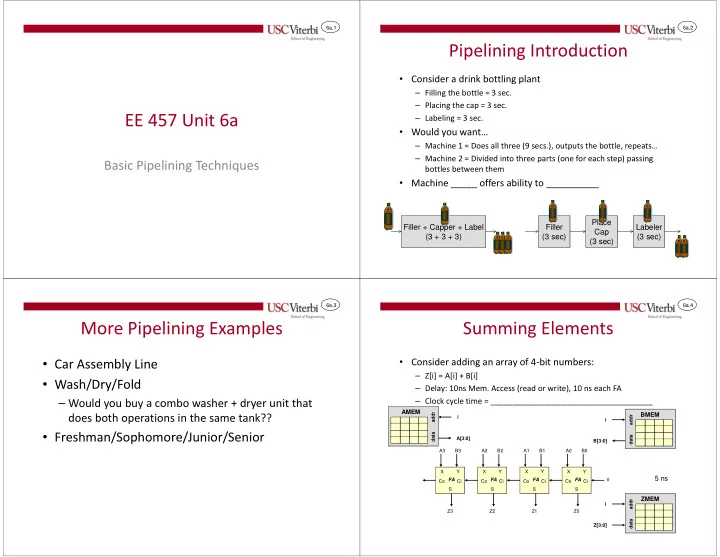
6a.2

Pipelining Introduction

  • Consider a drink bottling plant

– Filling the bottle = 3 sec. – Placing the cap = 3 sec. – Labeling = 3 sec.

  • Would you want…

– Machine 1 = Does all three (9 secs.), outputs the bottle, repeats… – Machine 2 = Divided into three parts (one for each step) passing bottles between them

  • Machine _____ offers ability to __________

Filler + Capper + Label (3 + 3 + 3) Filler (3 sec) Place Cap (3 sec) Labeler (3 sec)

6a.3

More Pipelining Examples

  • Car Assembly Line
  • Wash/Dry/Fold

– Would you buy a combo washer + dryer unit that does both operations in the same tank??

  • Freshman/Sophomore/Junior/Senior

6a.4

Summing Elements

  • Consider adding an array of 4-bit numbers:

– Z[i] = A[i] + B[i] – Delay: 10ns Mem. Access (read or write), 10 ns each FA – Clock cycle time = _____________________________________

X Y S Ci Co FA

5 ns

X Y S Ci Co FA X Y S Ci Co FA X Y S Ci Co FA

BMEM

addr data

AMEM

addr data i i A[3:0] B[3:0] A0 B0 A1 B1 A2 B2 A3 B3

ZMEM

addr data i Z[3:0] Z0 Z1 Z2 Z3

slide-2
SLIDE 2

6a.5

Pipelined Adder

If we assume that the pipeline registers are ideal (0ns additional delay) we can clock the pipe every __

  • ns. Speedup =

____

AMEM

addr data i A[3:0] B[3:0] Z[3:0] Z0 Z1 Z2 Z3

BMEM

addr data i

A3 B3 A2 B2 A1 B1 A0 B0

X Y S Ci FA

S0 C1

Co

C2 S1

X Y S Ci FA Co X Y S Ci FA Co

C3 S2

X Y S Ci FA Co

C4 S3 S2

ZMEM

addr data i

A3 B3 A2 B2 A1 B1 A0 B0 S1/S2 S2/S3 S3/S4 S4/S5 S5/S6 Pipeline Register (Stage Latch) 10ns 10ns

6a.6

Pipelining Effects on Clock Period

  • Rather than just try to balance

delay we could consider making more stages

– Divide long stage into multiple stages – In Example 3, clock period could be _________________ – Time through the pipeline (latency) is still 20 ns, but we’ve doubled our throughput (1 result every __ ns rather than every 10 or 15 ns) – Note: There is a small time overhead to adding a pipeline register/stage (i.e. can’t go crazy adding stages)

5 ns 15 ns 10 ns 10 ns 5 ns 5 ns 5 ns 5 ns

  • Ex. 3: Break long stage into multiple stages

Clock period = ___(___ speedup)

  • Ex. 1: Unbalanced stage delay

Clock Period = ___ns

  • Ex. 2: Balanced stage delay

Clock Period = __ns (____ speedup)

6a.7

To Register or Latch?

  • What should we use for pipeline stages

– Registers [edge-sensitive] …or… – Latches [level-sensitive]

  • Latches may allow data to _________________
  • Answer: __________________

S1

Register or Latch

S2 S3

Register or Latch

6a.8

But Can We Latch?

  • We can latch if we run the latches on opposite phases of the

clock or have a so-called _________________

– Because each latch runs on the opposite phase data can only move

  • ne step before being stopped by a latch that is in hold (off) mode
  • You may learn more about this in EE577a or EE560 (a

technique known as Slack Borrowing & Time Stealing)

S1b

Latch

S2a S2b

Latch Latch

S3a S3b

Latch Φ ~Φ

slide-3
SLIDE 3

6a.9

Pipelining Introduction

  • Implementation technique that _________execution of multiple instructions

at once

  • Improves ___________ rather an single-instruction execution latency
  • ______________ stage determines clock cycle time [e.g. a 30 min. wash cycle

but 1 hour dry time means _________ per load]

  • In the case of perfectly balanced stages:

– Speedup =

  • A 5-stage pipelined CPU may not realize this speedup 5x b/c…

– The stages may not be perfectly balanced – The overhead of filling up the pipe initially – The overhead (setup time and clock-to-Q) delay of the stage registers – Inability to keep the pipe full due to branches & data hazards

6a.10

Non-Pipelined Execution

Instruction Fetch (I-MEM) Reg. Read ALU Op. Data Mem Reg. Write Total Time

Load 10 ns 5 ns 10 ns 10 ns 5 ns 40 ns Store R-Type Branch Jump

Fetch Reg ALU Data Reg 40 ns Fetch Reg ALU Data Reg 40 ns LW $5,100($2) LW $7,40($6) time Fetch … 3 Instructions = 3*40 ns LW $8,24($6) 40 ns

6a.11

Pipelined Execution

  • Notice that even though the register access only takes 5 ns it is allocated a

10 ns slot in the pipeline

  • Total time for these 3 pipelined instructions =

– 70 ns = ___ ns for 1st instruc + _____ for the remaining instructions to complete

  • The speedup looks like it is only 120 ns / 70 ns = 1.7x
  • But consider 1003 instructions: ____________________________

– The overhead of filling the pipeline is ___________ over steady-state execution when the pipeline is full Fetch Reg ALU Data Reg

10 ns

Fetch Reg ALU Data Reg LW $5,100($2) LW $7,40($6) time Fetch Reg ALU Data Reg

20 ns 30 ns 40 ns 50 ns 60 ns 70 ns

… Fetch Reg ALU Data Reg LW $8,24($6)

80 ns 6a.12

Pipelined Timing

  • Execute n instructions using a k

stage datapath

– i.e. Multicycle CPU w/ k steps

  • r single cycle CPU w/ clock

cycle k times slower

  • w/o pipelining: ___________
  • w/ pipelining: ____________

– ___ cycles for 1st instruc. + ____ cycles for n-1 instrucs. – Assumes we keep the pipeline full

Fetch 10ns Decode 10ns Exec. 10ns Mem. 10ns WB 10ns C1 ADD C2 SUB ADD C3 LW SUB ADD C4 SW LW SUB ADD C5 AND SW LW SUB ADD C6 OR AND SW LW SUB C7 XOR OR AND SW LW C8 XOR OR AND SW C9 XOR OR AND C10 XOR OR C11 XOR

Pipeline Filling Pipeline Emptying Pipeline Full

7 Instrucs. = 11 clocks

slide-4
SLIDE 4

6a.13

Designing the Pipelined Datapath

  • To pipeline a datapath in five stages means five

instructions will be executing (“in-flight”) during any single clock cycle

  • Resources cannot be shared between stages because

there may always be an instruction wanting to use the resource

– Each stage needs its own resources – The single-cycle CPU datapath also matches this concept of no shared resources – We can simply divide the single-cycle CPU into stages

6a.14

Single-Cycle CPU Datapath

14

I-Cache

1

PC

+

Addr. Instruc.

Register File

Read

  • Reg. 1 #

Read

  • Reg. 2 #

Write

  • Reg. #

Write Data Read data 1 Read data 2 Sign Extend

ALU

Res. Zero 1 Sh. Left 2

+

D-Cache

Addr. Read Data Write Data A B 4 1 16 32 5 5 1

RegDst ALUSrc

5

MemtoReg MemWrite MemRead

ALU control

PCSrc

RegWrite Branch

INST[5:0] [25:21] [20:16] [15:11] [15:0]

ALUOp[1:0]

Fetch (IF) Decode (ID)

  • Exec. (EX)

Mem WB

6a.15

Information Flow in a Pipeline

  • Data or control information should flow only in the

forward direction in a linear pipeline

– Non-linear pipelines where information is fed back into a previous stage occurs in more complex pipelines such as floating point dividers

  • The CPU pipeline is like a buffet line or cafeteria

where people can not try to revisit a a previous serving station without disrupting the smooth flow of the line

Buffet Line

???

6a.16

Register File

  • Don’t we have a non-linear flow when we write a value back

to the register file?

– An instruction in WB is re-using the register file in the ID stage – Actually we are utilizing different ________of the register file

  • ID stage ___________ register values
  • WB stage __________ register value

– Like a buffet line with _________ at one station

IM Reg

ALU

IM Reg

Buffet Line

???

slide-5
SLIDE 5

6a.17

Register File

  • Only an issue if WB to same register as being read
  • Register file can be designed to do “internal forwarding”

where the data being written is immediately ______ out as the ___________________

IM

Reg

ALU

DM

Reg

IM

Reg

ALU

DM

Reg

IM

Reg

ALU

DM

Reg

IM

Reg

ALU

DM

Reg LW $5,100($2) ADD $3,$4,$5 Write $5 Read $5 CC1 CC2 CC3 CC4 CC5 CC6 CC7 CC8

6a.18

Pipelining the Fetch Phase

  • Note that to keep the pipeline full we

have to fetch a new instruction every clock cycle

  • Thus we have to perform

PC = PC + 4 every clock cycle

  • Thus there shall be no pipelining

registers in the datapath responsible for PC = PC +4

  • Support for branch/jump warrants a

lengthy discussion which we will perform later

Fetch

I-Cache

1

PC

+

Addr. Instruc.

Stage Register

A B 4

6a.19

Pipeline Packing List

  • Just as when you go on a trip you have to pack

everything you need _____________, so in pipelines you have to take all the control and data you will need with you down the pipeline

6a.20

Basic 5 Stage Pipeline

  • Compute the size of each pipeline register (find the max. info needed for any

instruction in each stage)

  • To simplify, just consider LW/SW (Ignore control signals)

Fetch Decode Exec. Mem WB

I-Cache

1

PC

+

Addr. Instruc.

Instruction Register Register File

Read

  • Reg. 1 #

Read

  • Reg. 2 #

Write

  • Reg. #

Write Data Read data 1 Read data 2 Sign Extend

Pipeline Stage Register

ALU

Res. Zero 1 Sh. Left 2

+

Pipeline Stage Register D-Cache

Addr. Read Data Write Data

Pipeline Stage Register

A B 4 1 16 32 5 5 5

rs rt rt/rd

Op = 35 rs=1 rt=10 immed.=40 LW $10,40($1) SW $15,100($2) Op = 43 rs=2 rt=15 immed.=100

Instruc = 32

slide-6
SLIDE 6

6a.21

Basic 5 Stage Pipeline

  • There is a bug in the load instruction implementation
  • Which register is written with the data read from memory?
  • We need to preserve the ______________ number by carrying it through the

pipeline with us

  • In general this is true for all signals needed later in the pipe

LW $10,40($1) SW $15,100($2) Fetch Decode Exec. Mem WB

I-Cache

1

PC

+

Addr. Instruc.

Instruction Register Register File

Read

  • Reg. 1 #

Read

  • Reg. 2 #

Write

  • Reg. #

Write Data Read data 1 Read data 2 Sign Extend

Pipeline Stage Register

ALU

Res. Zero 1 Sh. Left 2

+

Pipeline Stage Register D-Cache

Addr. Read Data Write Data

Pipeline Stage Register

A B 4 1 16 32 5 5 1

6a.22

PIPELINE CONTROL

6a.23

Pipeline Control Overview

  • We will just consider basic (simple) pipeline control and deal with problems

related to branch and data hazards later

  • It is assumed that the PC and pipeline register update on each clock cycle so no

separate write enable signals are needed for these registers

Fetch Decode Exec. Mem WB

I-Cache

1

PC

+

Addr. Instruc.

Instruction Register Register File

Read

  • Reg. 1 #

Read

  • Reg. 2 #

Write

  • Reg. #

Write Data Read data 1 Read data 2 Sign Extend

Pipeline Stage Register

ALU

Res. Zero 1 Sh. Left 2

+

Pipeline Stage Register D-Cache

Addr. Read Data Write Data

Pipeline Stage Register

A B 4 1 16 32 5 5 1

6a.24

Stage Control

  • Instruction Fetch: The control signals to read instruction memory and to write

the PC are always asserted, so there is nothing special to control in this pipeline stage

  • ID/RF: As in the previous stage the same thing happens at every clock cycle so

there are no optional control lines to set

  • Execution: The signals to be set are RegDst, ALUop/Func, and ALUSrc. The

signals determine whether the result of the instruction written into the register specified by bits 20-16 (for a load) or 15-11 for an R-format), specify the ALU

  • peration, and determine whether the second operand of the ALU will be a

register or a sign-extended immediate

  • Memory Stage: The control lines set in this stage are Branch, MemRead, and
  • MemWrite. These signals are set for the BEQ, LW, and SW instructions

respectively

  • WriteBack: the two control lines are RegWrite , which writes the chosen register,

and MemToReg, which decides between the ALU result or memory value as the write data

slide-7
SLIDE 7

6a.25

Control Signals per Stage

  • How many control signals are needed in each

stage

Instruction Reg Dst ALU Src ALU Op[1:0] Func[5:0] Branch Mem Read Mem Write Reg Write Memto- Reg

R-format 1 10 … 1 LW 1 00 X 1 1 1 SW X 1 00 X 1 X Beq X 01 X X

6a.26

Control Signal Generation

  • Recall from the Single-Cycle CPU

discussion that there is no state machine control, but a simple translator (combinational logic) to translate the 6- bit opcode into these 9 control signals

  • Since the datapaths of the single-cycle

and pipelined CPU are essentially the same, so is the control

  • The main difference is that the control

signals are generated in one clock cycle and used in a subsequent cycle (later pipeline stage)

  • We can produce all our signals in the

________ and use the pipeline registers to store and pass them to the _______________ stage

I-Cache PC

Addr. Instruc.

Register File

Read

  • Reg. 1 #

Read

  • Reg. 2 #

Write

  • Reg. #

Write Data Read data 1 Read data 2 Sign Extend 16 5 5 1

RegDst

5 RegWrite ALUSrc RegDst MemtoReg ALUOp[1:0]

[31:26] [25:21] [20:16] [15:11] [15:0] [25:0]

Control

6a.27

Basic 5 Stage Pipeline

  • Control is generated in the decode stage and passed along to consuming

stages through stage registers

Fetch Decode Exec. Mem WB

I-Cache

1

PC

+

Addr. Instruc.

Instruction Register Register File

Read

  • Reg. 1 #

Read

  • Reg. 2 #

Write

  • Reg. #

Write Data Read data 1 Read data 2 Sign Extend

Pipeline Stage Register

ALU

Res. Zero 1 Sh. Left 2

+

Pipeline Stage Register D-Cache

Addr. Read Data Write Data

Pipeline Stage Register

A B 4 1 16 32 5 5 1 Control

Ex

Mem WB Mem WB WB ALUSrc,RegDst, ALUOp, (Func) Branch, MemRead, MemWrite RegWrite, MemToReg

6a.28

Exercise:

  • On copies of this sheet, show this sequence executing on the pipeline:

– LW $10,40($1) => SUB $11,$2,$3 => AND $12,$4,$5 => OR $13,$6,$7 => ADD $14,$8,$9

Fetch Decode Exec. Mem WB

I-Cache

1

PC

+

Addr. Instruc.

Instruction Register Register File

Read

  • Reg. 1 #

Read

  • Reg. 2 #

Write

  • Reg. #

Write Data Read data 1 Read data 2 Sign Extend

Pipeline Stage Register

ALU

Res. Zero 1 Sh. Left 2

+

Pipeline Stage Register D-Cache

Addr. Read Data Write Data

Pipeline Stage Register

A B 4 1 16 32 5 5 1 Control

Ex

Mem WB Mem WB WB ALUSrc,RegDst, ALUOp, (Func) Branch, MemRead, MemWrite RegWrite, MemToReg

slide-8
SLIDE 8

6a.29

Review

  • Although an instruction can begin at each clock cycle, an individual

instruction still takes five clock cycles

  • Note that it takes four clock cycle before the five-stage pipeline is
  • perating at full efficiency
  • Register write-back is controlled by the WB stage even though the register

file is located in the ID stage; the correct write register ID is carried down the pipeline with the instruction data

  • When a stage is inactive, the values of the control lines are deasserted

(shown as 0's) to prevent anything harmful from occurring

  • No state machine is needed; sequencing of the control signals follows

simply from the pipeline itself (i.e. control signals are produced initially but delayed by the stage registers until the correct stage / clock cycle for application of that signal)

6a.30

ADDITIONAL REFERENCE

6a.31

LW $t1,4($s0): Fetch

Fetch LW and increment PC

Fetch Decode Exec. Mem WB

I-Cache

1

PC

+

Addr. Instruc.

Instruction Register Register File

Read

  • Reg. 1 #

Read

  • Reg. 2 #

Write

  • Reg. #

Write Data Read data 1 Read data 2 Sign Extend

Pipeline Stage Register

ALU

Res. Zero 1 Sh. Left 2

+

Pipeline Stage Register D-Cache

Addr. Read Data Write Data

Pipeline Stage Register

A B 4 1 16 32 5 5

6a.32

LW $t1,4($s0): Decode

Fetch Decode Exec. Mem WB

I-Cache

1

PC

+

Addr. Instruc.

LW $t1,4($s0) machine code Register File

Read

  • Reg. 1 #

Read

  • Reg. 2 #

Write

  • Reg. #

Write Data Read data 1 Read data 2 Sign Extend

Pipeline Stage Register

ALU

Res. Zero 1 Sh. Left 2

+

Pipeline Stage Register D-Cache

Addr. Read Data Write Data

Pipeline Stage Register

A B 4 1 16 32 5 5

Decode instruction and fetch operands

$s0 # $t1 #

slide-9
SLIDE 9

6a.33

LW $t1,4($s0): Execute

Fetch Decode Exec. Mem WB

I-Cache

1

PC

+

Addr. Instruc.

Instruction Register Register File

Read

  • Reg. 1 #

Read

  • Reg. 2 #

Write

  • Reg. #

Write Data Read data 1 Read data 2 Sign Extend

$t1 # / Offset=0x00000004 / $s0 value

ALU

Res. Zero 1 Sh. Left 2

+

Pipeline Stage Register D-Cache

Addr. Read Data Write Data

Pipeline Stage Register

A B 4 1 16 32 5 5

Add offset 4 to $s0 value

6a.34

LW $t1,4($s0): Memory

Fetch Decode Exec. Mem WB

I-Cache

1

PC

+

Addr. Instruc.

Instruction Register Register File

Read

  • Reg. 1 #

Read

  • Reg. 2 #

Write

  • Reg. #

Write Data Read data 1 Read data 2 Sign Extend

Pipeline Stage Register

ALU

Res. Zero 1 Sh. Left 2

+

$t1 # / Address D-Cache

Addr. Read Data Write Data

Pipeline Stage Register

A B 4 1 16 32 5 5

Read word from memory

6a.35

LW $t1,4($s0): Writeback

Fetch Decode Exec. Mem WB

I-Cache

1

PC

+

Addr. Instruc.

Instruction Register Register File

Read

  • Reg. 1 #

Read

  • Reg. 2 #

Write

  • Reg. #

Write Data Read data 1 Read data 2 Sign Extend

Pipeline Stage Register

ALU

Res. Zero 1 Sh. Left 2

+

Pipeline Stage Register D-Cache

Addr. Read Data Write Data

$t1 # / Data read from memory

A B 4 1 16 32 5 5

Write word to $t1

6a.36

LW $t1,4($s0)

Fetch LW

Fetch Decode Exec. Mem WB

I-Cache

1

PC

+

Addr. Instruc.

Instruction Register Register File

Read

  • Reg. 1 #

Read

  • Reg. 2 #

Write

  • Reg. #

Write Data Read data 1 Read data 2 Sign Extend

Pipeline Stage Register

ALU

Res. Zero 1 Sh. Left 2

+

Pipeline Stage Register D-Cache

Addr. Read Data Write Data

Pipeline Stage Register

A B 4 1 16 32 5 5

Decode instruction and fetch operands Add offset 4 to $s0 Read word from memory Write word to $t1

slide-10
SLIDE 10

6a.37

ADD $t4,$t5,$t6: Fetch

Fetch ADD and increment PC

Fetch Decode Exec. Mem WB

I-Cache

1

PC

+

Addr. Instruc.

Instruction Register Register File

Read

  • Reg. 1 #

Read

  • Reg. 2 #

Write

  • Reg. #

Write Data Read data 1 Read data 2 Sign Extend

Pipeline Stage Register

ALU

Res. Zero 1 Sh. Left 2

+

Pipeline Stage Register D-Cache

Addr. Read Data Write Data

Pipeline Stage Register

A B 4 1 16 32 5 5

6a.38

ADD $t4,$t5,$t6: Decode

Fetch Decode Exec. Mem WB

I-Cache

1

PC

+

Addr. Instruc.

ADD $t4,$t5,$t6 machine code Register File

Read

  • Reg. 1 #

Read

  • Reg. 2 #

Write

  • Reg. #

Write Data Read data 1 Read data 2 Sign Extend

Pipeline Stage Register

ALU

Res. Zero 1 Sh. Left 2

+

Pipeline Stage Register D-Cache

Addr. Read Data Write Data

Pipeline Stage Register

A B 4 1 16 32 5 5

Decode instruction and fetch operands

$t5 # $t4 # $t6 # 6a.39

ADD $t4,$t5,$t6: Execute

Fetch Decode Exec. Mem WB

I-Cache

1

PC

+

Addr. Instruc.

Instruction Register Register File

Read

  • Reg. 1 #

Read

  • Reg. 2 #

Write

  • Reg. #

Write Data Read data 1 Read data 2 Sign Extend

$t4 # / $t6 value / $t5 value

ALU

Res. Zero 1 Sh. Left 2

+

Pipeline Stage Register D-Cache

Addr. Read Data Write Data

Pipeline Stage Register

A B 4 1 16 32 5 5

Add $t5 + $t6

6a.40

ADD $t4,$t5,$t6: Memory

Fetch Decode Exec. Mem WB

I-Cache

1

PC

+

Addr. Instruc.

Instruction Register Register File

Read

  • Reg. 1 #

Read

  • Reg. 2 #

Write

  • Reg. #

Write Data Read data 1 Read data 2 Sign Extend

Pipeline Stage Register

ALU

Res. Zero 1 Sh. Left 2

+

$t4 # / Sum of $t5 + $t6 D-Cache

Addr. Read Data Write Data

Pipeline Stage Register

A B 4 1 16 32 5 5

Just pass sum through

slide-11
SLIDE 11

6a.41

ADD $t4,$t5,$t6: Writeback

Fetch Decode Exec. Mem WB

I-Cache

1

PC

+

Addr. Instruc.

Instruction Register Register File

Read

  • Reg. 1 #

Read

  • Reg. 2 #

Write

  • Reg. #

Write Data Read data 1 Read data 2 Sign Extend

Pipeline Stage Register

ALU

Res. Zero 1 Sh. Left 2

+

Pipeline Stage Register D-Cache

Addr. Read Data Write Data

$t4 # / Sum of $t5 + $t6

A B 4 1 16 32 5 5

Write sum to $t4

6a.42

ADD $t4,$t5,$t6

Fetch ADD

Fetch Decode Exec. Mem WB

I-Cache

1

PC

+

Addr. Instruc.

Instruction Register Register File

Read

  • Reg. 1 #

Read

  • Reg. 2 #

Write

  • Reg. #

Write Data Read data 1 Read data 2 Sign Extend

Pipeline Stage Register

ALU

Res. Zero 1 Sh. Left 2

+

Pipeline Stage Register D-Cache

Addr. Read Data Write Data

Pipeline Stage Register

A B 4 1 16 32 5 5

Decode instruction and fetch operands Add $t5 + $t6 Just pass sum through Write sum to $t4

6a.43

OLD PIPELINING

6a.44

Basic 5 Stage Pipeline

  • Control is generated in the decode stage and passed along to consuming

stages through stage registers

Fetch Decode Exec. Mem WB

I-Cache

1

PC

+

Addr. Instruc.

Instruction Register Register File

Read

  • Reg. 1 #

Read

  • Reg. 2 #

Write

  • Reg. #

Write Data Read data 1 Read data 2 Sign Extend

Pipeline Stage Register

ALU

Res. Zero 1 Sh. Left 2

+

Pipeline Stage Register D-Cache

Addr. Read Data Write Data

Pipeline Stage Register

A B 4 1 16 32 5 5 1

slide-12
SLIDE 12

6a.45

Basic 5 Stage Pipeline

  • Control is generated in the decode stage and passed along to consuming

stages through stage registers

Fetch Decode Exec. Mem WB

I-Cache

1

PC

+

Addr. Instruc.

Instruction Register Register File

Read

  • Reg. 1 #

Read

  • Reg. 2 #

Write

  • Reg. #

Write Data Read data 1 Read data 2 Sign Extend

Pipeline Stage Register

ALU

Res. Zero 1 Sh. Left 2

+

Pipeline Stage Register D-Cache

Addr. Read Data Write Data

Pipeline Stage Register

A B 4 1 16 32 5 5 1 Control

Ex

Mem WB Mem WB WB ALUSrc,RegDst, ALUOp, (Func) Branch, MemRead, MemWrite RegWrite, MemToReg