Environment and Natural Resources Trust Fund 2012-2013 Request for - - PDF document

environment and natural resources trust fund 2012 2013
SMART_READER_LITE
LIVE PREVIEW

Environment and Natural Resources Trust Fund 2012-2013 Request for - - PDF document

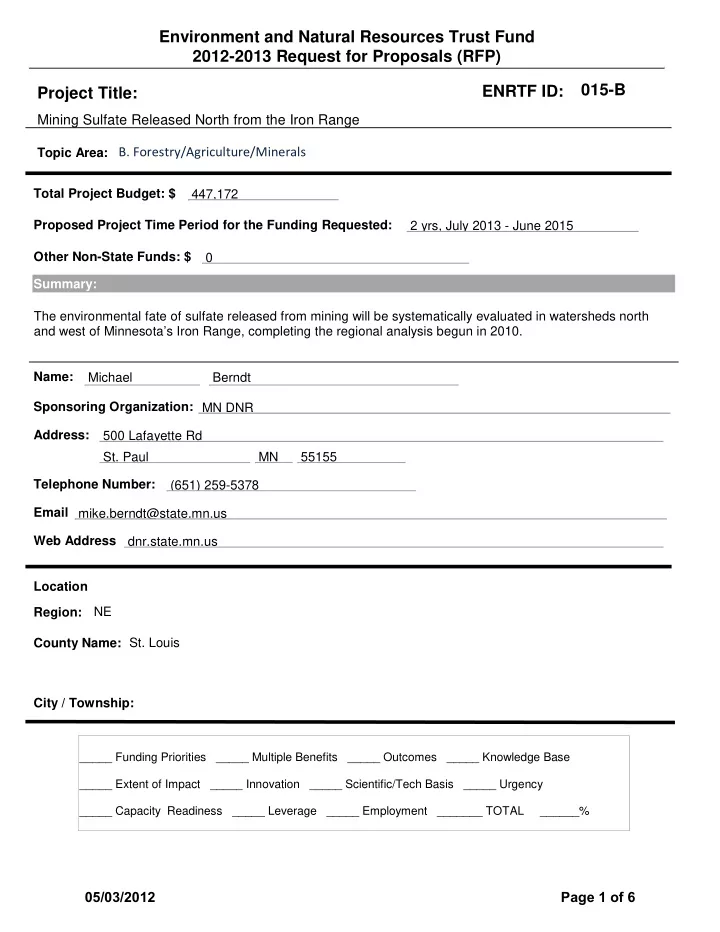
Environment and Natural Resources Trust Fund 2012-2013 Request for Proposals (RFP) 015-B ENRTF ID: Project Title: Mining Sulfate Released North from the Iron Range B. Forestry/Agriculture/Minerals Topic Area: Total Project Budget: $ 447,172


slide-1
SLIDE 1

Environment and Natural Resources Trust Fund 2012-2013 Request for Proposals (RFP) Project Title:

Total Project Budget: $ Proposed Project Time Period for the Funding Requested: Other Non-State Funds: $ Name: Sponsoring Organization: Address: Telephone Number: Email Web Address County Name: City / Township: Region: Summary: Location

Mining Sulfate Released North from the Iron Range

447,172 2 yrs, July 2013 - June 2015 The environmental fate of sulfate released from mining will be systematically evaluated in watersheds north and west of Minnesota’s Iron Range, completing the regional analysis begun in 2010. Michael MN DNR 500 Lafayette Rd

  • St. Paul

MN 55155 (651) 259-5378 mike.berndt@state.mn.us dnr.state.mn.us NE

  • St. Louis

Berndt

_____ Funding Priorities _____ Multiple Benefits _____ Outcomes _____ Knowledge Base _____ Extent of Impact _____ Innovation _____ Scientific/Tech Basis _____ Urgency _____ Capacity Readiness _____ Leverage _____ Employment _______ TOTAL ______%

  • B. Forestry/Agriculture/Minerals

ENRTF ID: 015-B

Topic Area:

05/03/2012 Page 1 of 6

slide-2
SLIDE 2

Environment and Natural Resources Trust Fund (ENRTF) 2012-2013 Main Proposal 1 PROJECT TITLE: Mining Sulfate Released North from the Iron Range

  • Dr. Michael E. Berndt (DNR) and Dr. Nathan Johnson (University of Minnesota Duluth)
  • I. PROJECT STATEMENT

Minnesota’s Mesabi Iron district provides most of the domestic iron ore supply used by the United States. The district also straddles the triple continental divide and serves, therefore, as a headwater region for waters flowing north towards Hudson Bay, south through the Mississippi River basin, and east, through the St. Louis River and Great Lakes waterway. An earlier study conducted by the Minnesota Department

  • f Natural Resources (DNR) and University of Minnesota Duluth (UMD), and funded by ENRTF,

evaluated the sources and fate of sulfate in waters draining through the St. Louis River basin. The DNR and UMD propose here to complete the range-wide survey, by evaluating sulfate release and fate in waters flowing from the mining district through the Mississippi, Little Fork, and Rainy River watersheds. Sulfate behaves as a relatively benign dissolved compound under the oxidizing conditions that typically prevail in streams and other openly flowing waterways. However, this compound can be reduced to hydrogen sulfide gas and other reduced sulfur compounds when exposed to organic rich substrates such as those encountered in wetland soils and lake sediments. Recent studies have pointed specifically to the conversion of sulfate to hydrogen sulfide gas as a primary mechanism involved in the transport of methyl mercury from sediment to open water. This reaction is also suspected in creating conditions toxic to wild rice stands. Thus, the proposed study will evaluate sulfate release from the mining region and characterize the downstream sulfate-reduction processes in the three remaining mine-impacted watersheds for the Mesabi district. The plan for this study will be similar to that used previously by this group in the St. Louis River

  • watershed. The DNR will collect water samples and determine flow characteristics at key sites located

downstream from the mining district to wetlands and lakes where sulfate reduction is expected to take

  • place. The samples will be analyzed for a range of parameters useful for distinguishing mining from non-

mining sulfate and which can also be used to quantify the amounts of sulfate reduction taking place upstream from the selected sampling stations. UMD will collect sediment cores from lakes in the

  • watershed. They will make measurements in the cores and conduct experiments designed to quantify

sulfate reduction in the sediments and effect on the overlying water column. Both studies will also evaluate methylmercury, total mercury, and dissolved organic carbon, owing to the importance of these species in effecting mercury transport and bioaccumulation. The result of this research will be a consistent and comprehensive series of recommendations and supporting documents that state agencies, decision makers, and other stake holders can rely on to manage sulfate releases to the areas north and west of Minnesota’s Iron Range as mining companies continue to bring forward plans for expansion and development.

  • II. DESCRIPTION OF PROJECT ACTIVITIES

Activity 1: Stream sulfate survey (Minnesota DNR) Budget $308,722 Outcome Completion Date

  • 1. Reconnaissance survey to identify sampling sites

December 31, 2013

  • 2. Watershed wide sampling programs

March 31, 2015

  • 3. Weekly to biweekly sampling at important watershed node points

March 31, 2015

05/03/2012 Page 2 of 6

slide-3
SLIDE 3

2

  • 4. Evaluation and final report

June 30, 2015 Activity 2: Lake Sediment Evaluation (University of Minnesota – Duluth) Budget $138,450 Outcome Completion Date

  • 1. Initial lake coring survey to select sampling sites

December 31, 2013

  • 2. Primary core collection, conduction of experiments to evaluate transport

March 31, 2015

  • 3. Evaluation and final report

June 30, 2015

  • III. PROJECT STRATEGY
  • A. Project Team/Partners
  • Dr. Michael Berndt is a Research Scientist 3 at the Minnesota Department of Natural Resources and is an

adjunct assistant professor in the Geology Department at the University of Minnesota. He will be a co- lead investigator for the project with the responsibility of conducting the DNR portion of the studies (Activity 1) and of fulfilling the project’s reporting and contracting requirements.

  • Dr. Nathan Johnson is an assistant professor in the Civil Engineering Department at the University of

Minnesota Duluth. He will be a co-lead investigator for the project, but will subcontract with the Minnesota DNR. He will have the primary responsibility for conducting UMD’s portion of the overall study (Activity 2).

  • B. Timeline Requirements

The project is designed to be completed in the state’s two year funding cycle, beginning in July 2013. The initial late summer and fall seasons will be dedicated to making careful site selections for sampling that will be conducted in the subsequent 12 to 15 months. The project will be completed within a two year period.

  • C. Long-Term Strategy and Future Funding Needs

The proposed work represents what is hoped to be the completion of a long term effort by the Minnesota Department of Natural Resources that began in 2007. The aim of this effort has been to characterize the sources and environmental impacts of sulfate released in Minnesota’s Iron Range district. In 2007 to 2009, the Minnesota DNR conducted a broad regional survey of relationships between mercury, dissolved sulfate, and dissolved organic carbon in the St. Louis River. This was followed by a geochemical study, conducted in 2010 and 2011, on five wetlands and a lake into which sulfate from mining was added. An important hypothesis that arose during this campaign was that methyl-mercury transport may be enhanced by formation of hydrogen sulfide gas. In 2012, the DNR launched an aggressive campaign to test this hypothesis that will end in 2013. The Minnesota Pollution Control Agency is also currently re-examining the wild rice sulfate standard for the state of Minnesota and establishing TMDL-based rules for mercury, methylmercury, and possibly sulfate release to the St. Louis River Basin. In 2010, in anticipation of a potential need to control sulfate released from mining operations, the DNR began working with ENRTF to evaluate source and fate of sulfate from the Mesabi mining district. The proposed study, to begin in July 2013, would provide a continuation of that effort and complete the geographical coverage needed to fully assess sulfate release and sulfate reduction processes associated with mining on the Iron Range.

05/03/2012 Page 3 of 6

slide-4
SLIDE 4

BUDGET ITEM Personnel: 1 FTE each year spread between 3 to 4 classified and unclassified staff paid almost exclusively through special project funds, including 15-20% fringe benefits as per state union contracts: RSIII .25 FTE x 2 yr (~$48K) RSII 0.5 FTE x 2 yr (~$55K) Chemist 1 0.25 FTE (~$25K) Contracts: Dissolved Cation and Aniond (~$14K) Stream Gaging (~$12K) Gaging Stations (~$52K) Mercury and Methylmercury (~$32.2K) Dissolved Organic Carbon (~$5880) Stable Isotope Measurements (~$37.8K) University of Minnesota Duluth - Dr. Nathan Johnson CO-PI Sediment Chemisrty ($130 K) Equipment/Tools/Supplies: Gloves, preservation chemicals, bottles, shipping, pipettes, filters, lab wipes, and other items necessary to collect and ship samples Acquisition (Fee Title or Permanent Easements): Travel: Travel to field sites, lodging, meals during field work. Additional Budget Items: DNR used a rate of 6.5% to calculate costs for direct support services, which are DNR’s direct and necessary business services required to support this proposal. TOTAL ENVIRONMENT AND NATURAL RESOURCES TRUST FUND $ REQUEST = SOURCE OF FUNDS AMOUNT Status Other Non-State $ NA N/A Other State $ Being Applied to Project During Project Period: NA N/A In-kind Services During Project Period: NA N/A Remaining $ from Current ENRTF Appropriation (if applicable): This project ends June 30, 2012, and is not expected to have significant funds remaining. $270,000 Spent or

  • bligated

Funding History: Includes an estimated $300,000 from previous DNR projects (Non-ENRTF) conducted between 2007 and 2011 on St. Louis River and nearby wetlands and lakes, funded by Minerals Coordinating Committee, Iron Ore Cooperative Research, and Environmental Cooperative Research funds. Also, $400,000 from DNR Cooperative Research funds (FY2012,2013) + $500,000 industry match (for six on going projects, ending between 6/30 to 12/31/2013) $1,200,000 Includes all funding for SO4 and MeHg projects to be completed in FY 2013 3,000 $ 27,292 $ 283,880 $

  • V. OTHER FUNDS

128,000 $ 447,172 $ 5,000 $ N/A

2012-2013 Detailed Project Budget

  • IV. TOTAL ENRTF REQUEST BUDGET 2 years

AMOUNT

C:\Users\dgriffit\Documents\proposals_recevied\berndt-michael_0412-2-068-Budget

05/03/2012 Page 4 of 6

slide-5
SLIDE 5

1 Figure (1 Minnesota watershed (not show 1): The Biwa

  • a. The propo

ds shown in d wn), were com abik Iron Form

  • sed study wil

dark gray. S mpleted previo mation (black ll evaluate im Sulfate impact

  • usly in a 201

k) hosts virtu mpacts of sulf ts to the St. L 10-2012 ENR ually all of the fate released f Louis River w RTF funded stu e iron curren from the mini watershed, so udy. ntly being min ing district in

  • uth of the d

ned in nto the district

05/03/2012 Page 5 of 6

slide-6
SLIDE 6

Project Manager Qualifications/Organization Project Manager:

  • Dr. Michael Berndt is a Research Scientist 3 at the Minnesota Department of Natural Resources and an

adjunct assistant professor in the Geology Department at the University of Minnesota. He will be a co‐ lead investigator for the project with the responsibility of conducting the DNR portion of the studies (Activity 1) and of fulfilling the project’s reporting and contracting requirements. Qualifications: Education: 1987―University of Minnesota, PhD Geology 1983―University of Wisconsin, MS Geology 1980―University of Minnesota, BS Geology, BS Geophysics Work Experience: 2001-Present Research Scientist III at Minnesota Department of Natural Resources, Division of Mineland Reclamation:

  • Leader for numerous environmental studies of Minnesota’s mineland regions
  • Regular participant in the review and permitting of proposed mining projects
  • Currently lead investigator for three studies funded though various state (DNR-

Iron Ore and Environmental Cooperative Research (IOCR, ECR)), federal (US- EPA, USGS), and industry-matching sources: (1) $2.0 million, mostly US-EPA: testing technologies to control mercury in taconite stack emissions (2010-2012) (2) $270,000 ENRTF: fate of mining generated sulfate in the St. Louis River watershed (2010-2012) (3) $900,000 IOCR, ECR and industry match- Mineland Water Research Advisory Panel (2011-2013). 1987-2001 Senior Research Associate: University of Minnesota Twin Cities Geology and Geophysics Department:

  • Conducted independent field and laboratory research studies in

geochemistry at the University of Minnesota.

  • Consulted to Minnesota Department of Health and Department of

Natural Resources on Environmental Projects.

  • Taught or co-taught advanced courses in geochemistry and economic

geology. Organizational Description: The Minnesota Department of Natural Resources, Lands and Minerals Division is responsible for ensuring that mineral development in the state is environmentally sound, and mined areas are reclaimed to be safe, free of pollution, and suitable for future use.

05/03/2012 Page 6 of 6