Environment and Natural Resources Trust Fund 2012-2013 Request for - - PDF document

environment and natural resources trust fund 2012 2013
SMART_READER_LITE
LIVE PREVIEW

Environment and Natural Resources Trust Fund 2012-2013 Request for - - PDF document

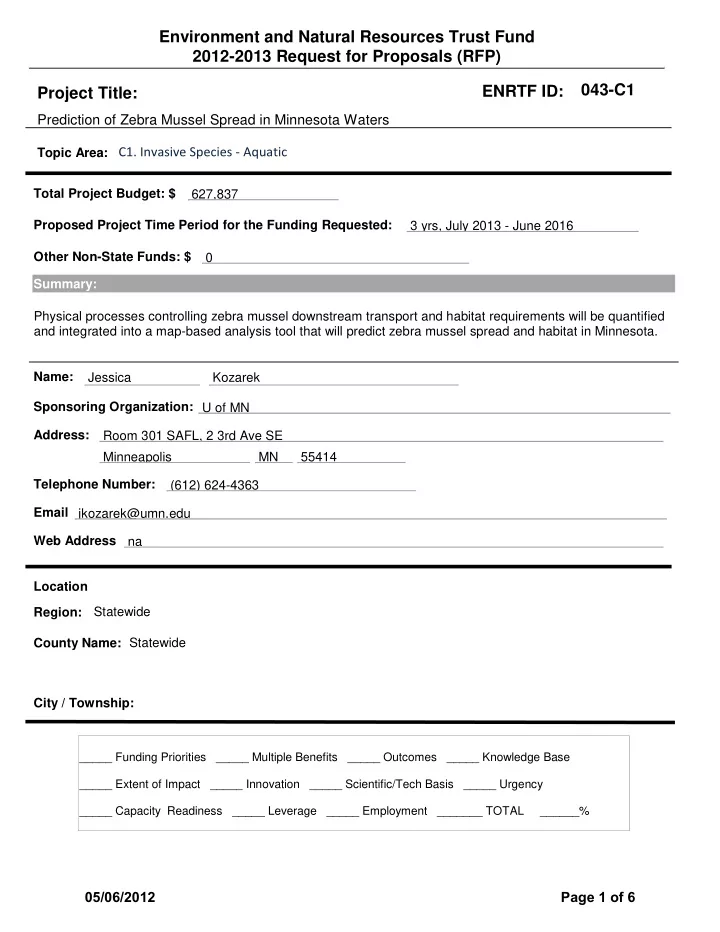
Environment and Natural Resources Trust Fund 2012-2013 Request for Proposals (RFP) 043-C1 ENRTF ID: Project Title: Prediction of Zebra Mussel Spread in Minnesota Waters C1. Invasive Species Aquatic Topic Area: Total Project Budget: $


slide-1
SLIDE 1

Environment and Natural Resources Trust Fund 2012-2013 Request for Proposals (RFP) Project Title:

Total Project Budget: $ Proposed Project Time Period for the Funding Requested: Other Non-State Funds: $ Name: Sponsoring Organization: Address: Telephone Number: Email Web Address County Name: City / Township: Region: Summary: Location

Prediction of Zebra Mussel Spread in Minnesota Waters

627,837 3 yrs, July 2013 - June 2016 Physical processes controlling zebra mussel downstream transport and habitat requirements will be quantified and integrated into a map-based analysis tool that will predict zebra mussel spread and habitat in Minnesota. Jessica U of MN Room 301 SAFL, 2 3rd Ave SE Minneapolis MN 55414 (612) 624-4363 jkozarek@umn.edu na Statewide Statewide Kozarek

_____ Funding Priorities _____ Multiple Benefits _____ Outcomes _____ Knowledge Base _____ Extent of Impact _____ Innovation _____ Scientific/Tech Basis _____ Urgency _____ Capacity Readiness _____ Leverage _____ Employment _______ TOTAL ______%

  • C1. Invasive Species ‐ Aquatic

ENRTF ID: 043-C1

Topic Area:

05/06/2012 Page 1 of 6

slide-2
SLIDE 2

Environment and Natural Resources Trust Fund (ENRTF) 2012‐2013 Main Proposal

1 PROJECT TITLE: Prediction of zebra mussel spread in Minnesota waters

  • I. PROJECT STATEMENT

Zebra mussels (Dreissena polymorpha) pose a serious threat to Minnesota lake and river ecosystems, lakeshore recreation, and water supply and power plant infrastructure. In addition to colonizing water infrastructure such as intake pipes, zebra mussels have been found to colonize native mussel beds, potentially out‐competing native mussel species for food. Zebra mussels can disperse either by overland transport (e.g. by commercial and recreational boaters) or by drift of the planktonic larvae (veligers) from colonized lakes or reservoirs following downstream currents. Spread of zebra mussels requires downstream transport of larvae to suitable colonization sites in streams, lakes, or reservoirs within a 2‐3 week viability period. While Minnesota state agencies are working actively to reduce the spread of zebra mussels via boat traffic, less is known about the potential for the spread of zebra mussels via natural downstream transport from an infested water body. The primary goal of this research is to determine which Minnesota lakes and reservoirs should be prioritized for protection against human transport of zebra mussels, by mapping out the potential for downstream zebra mussel transport from infested water bodies. The main products will be 1) information on the physical processes controlling the downstream transport of zebra mussel larvae, 2) information on habitat requirements of zebra mussels for colonization of rivers and streams, and 3) a map‐based analysis tool that will predict the spread and habitat of zebra mussels over space and time from an infested water body. This project will use a combination of controlled laboratory and outdoor experiments, field data collection, and computer modeling. Field data will be collected from the Rum River and the Zumbro River to determine favorable and unfavorable habitat conditions for zebra mussel colonization. A series

  • f laboratory experiments will examine zebra mussel transport and habitat limitations under controlled
  • conditions. Detailed models for the transport of zebra mussel larvae through rivers, streams, and

wetlands will be developed, coupled with zebra mussel population models, and verified using field data. These models will be integrated into a state‐wide geographic information system (GIS). This integrated tool will enable the user to 1) predict the spread of zebra mussels from source locations over time, and 2) map out the regional distribution of zebra mussel habitat classifications.

  • II. DESCRIPTION OF PROJECT ACTIVITIES

Activity 1: Zebra Mussel Field Survey Budget: $185,702 Field work will be conducted on the Rum River at the outlet to Lake Mille Lacs (colonized by 2005) and the Zumbro River downstream of Lake Zumbro (colonized by 2000). The goal is to document zebra mussel colonization, habitat (i.e. depth, velocity, turbulence, and substrate), and zebra mussel threats to native mussel species in riverine systems. Outcome Completion Date

  • 1. Survey zebra mussel habitat, colonization, and threat for Rum River

September 2014

  • 2. Survey zebra mussel habitat, colonization, and threat for Zumbro River

September 2015 Activity 2: Zebra Mussel Transport Experiments Budget: $153,845 Laboratory experiments will focus on 1) turbulence effects on transport and mortality of zebra mussel larvae, 2) emergent vegetation effects on zebra mussel larvae transport inhibition, and 3) zebra mussel attachment to various types of substrate. The experiments will provide relationships for modeling transport and colonization of zebra mussels. Outcome Completion Date

  • 1. Determine tolerable and fatal turbulence levels for zebra mussel larvae

November 2014

  • 2. Quantify substrate sizes and hydraulic characteristics for colonization

November 2014

  • 3. Quantify effect of emergent vegetation on zebra mussel larvae transport

November 2015

05/06/2012 Page 2 of 6

slide-3
SLIDE 3

2 Activity 3: Zebra Mussel Habitat Experiments Budget: $133,025 Laboratory experiments will focus on the feeding ability (pumping rates) of zebra mussels under a variety of habitat variables including substrate size, suspended sediment concentration, temperature, flow rate, turbulence characteristics, and attachment to native mussels. The goal is to quantify the effect of habitat conditions on zebra mussel physiology. Results will provide insight into the potential for zebra mussels to inhabit various water bodies. Outcome Completion Date

  • 1. Quantify effect of habitat variables on zebra mussel feeding rate

June 2014

  • 2. Quantify effect of native mussel beds on zebra mussel feeding rate

June 2015 Activity 4: Spatial Zebra Mussel Transport and Habitat Model Budget: $155,265 Process‐based zebra mussel transport and population models will be developed and verified that will predict the local spread and habitat of zebra mussels from an infested lake through connected rivers and streams. The models will be integrated with a state‐wide GIS interface to create a spatial analysis tool to map regional zebra mussel spread and habitat from infested water bodies. Outcome Completion Date

  • 1. Develop zebra mussel habitat model

December 2014

  • 2. Develop zebra mussel transport model

September 2015

  • 3. Integrate and verify transport/habitat model

December 2015

  • 4. Create regional spatial analysis tool

June 2016

  • III. PROJECT STRATEGY
  • A. Project Team/Partners

University of Minnesota, St. Anthony Falls Laboratory ‐ Dr. Jessica Kozarek (Research Associate): Project Manager, habitat and vegetation laboratory experiments; Dr. William Herb (Research Associate) and Danny Im (Applications Programmer): zebra mussel transport analysis tool;

  • Dr. Miki Hondzo (Professor): turbulence experimental setup; Craig Taylor (Associate Engineer):

transport laboratory experiments; Undergraduate and Graduate Students: laboratory and experiments Macalester College, Department of Biology ‐ Dr. Daniel Hornbach (Professor) and Mark Hove (Research Associate): field data collection and reporting; Department of Geology ‐ Dr. Kelly Macgregor (Associate Professor): habitat characterization; Undergraduate Research Team: Assist with field data collection

  • B. Timeline Requirements

This project relies on two full seasons of field data collect the summer of 2014 and 2015 following a preliminary reconnaissance in July 2013. Laboratory research involving zebra mussel larvae is planned summer 2014 and 2015 due to the timing of veliger release (May –Sep). Adult mussel habitat experiments are scheduled for early spring and late fall to avoid the coldest water temperatures. Spatial data analysis, mapping and modeling is planned in phases based on field data collection and experimental results to be completed within 36 months.

  • C. Long‐Term Strategy and Future Funding Needs

SAFL, in collaboration with state and federal agencies and Macalester College, are working to establish a mussel experimental research facility at SAFL. This proposal is the result of three interdisciplinary meetings hosted by SAFL to discuss mussel research attended by MN DNR, US FWS, NPS, US ACE, and Macalester College. SAFL is uniquely suited for mussel research because of flume facilities and the Outdoor StreamLab’s wetland vegetation basins. These facilities allow experiments under controlled flow environments fed by Mississippi River water. Funding is being sought for invasive mussel research, native mussel life‐cycle and habitat research, and mussel related educational initiatives.

05/06/2012 Page 3 of 6

slide-4
SLIDE 4

BUDGET ITEM Personnel: . Research Associate: Jessica Kozarek (36% benefits, 33% time yrs. 1-3) Research Associate: William Herb (36% benefits, 45% time yrs. 1-3) Professor: Miki Hondzo (36% benefits, 3% time yrs. 1-3) Research Engineer: Craig Taylor (36% benefits, 18% time yrs. 1-3) Graduate Research Assistant (43.4% fringe and tuition, 50% time yrs. 1-2, 25% yr 3) Undergraduate Students (8% benefits, 400 hrs for yrs, 1-2, 200 hrs yr. 3) Applications Programmer: Danny Im (36% benefits, 30% time yrs. 2-3) 2xTechnical Staff (benefits 41.3%, 2.5% time yrs 1-3) Instrumentation Specialist (benefits 36%, 5% time yrs. 1-3) Contracts: Macalester College (Activity 1: Field data collection): Dan Hornbach (Professor), Kelly Macgregor (Associate Professor), Mark Hove (Research Associate), Undergraduate Research Team Cost includes: Personnel (87%), Travel to field sites (12%), Supplies - SCUBA and field equipment maintenence (1%) Equipment/Tools/Supplies: Activity 2 flume experiments: supplies including pump, substrate, filters, decontaminants, tracers, and larvae stains Activity 2 vegetation experiments: supplies including supplies to modify vegetation basin, decontaminants, larvae stains, filters Activity 3 flume experiment: supplies including substrate, dye, and gape sensor instrumentation Travel: Travel to mileage to collect zebra mussel larvae for experiments (6 trips) Additional Budget Items: Activity 4 server space for web deployment of model TOTAL ENVIRONMENT AND NATURAL RESOURCES TRUST FUND $ REQUEST = SOURCE OF FUNDS AMOUNT Status Other Non-State $ Being Applied to Project During Project Period: n/a n/a Other State $ Being Applied to Project During Project Period: n/a n/a In-kind Services During Project Period: SAFL flume and instrimentation usage ($125 per day for 19 months of flume usage) 114,000 $ Remaining $ from Current ENRTF Appropriation (if applicable): n/a n/a Funding History: n/a n/a AMOUNT 109,620 $ 20,589 $ 39,360 $

2012-2013 Detailed Project Budget

  • IV. TOTAL ENRTF REQUEST BUDGET 3 years

100,057 $ 77,297 $ 627,837 $ 1,000 $ 21,184 $ 10,822 $ 5,000 $ 1,500 $ 4,500 $ 185,702 $

  • V. OTHER FUNDS

28,500 $ 19,706 $ 3,000 $

I:\ML2013\RFP\proposals_recevied\kozarek-jessica_0412-2-203-Budget

05/06/2012 Page 4 of 6

slide-5
SLIDE 5

Prediction of zebra mussel spread in Minnesota waters

05/06/2012 Page 5 of 6

slide-6
SLIDE 6

PROJECT MANAGER QUALIFICATIONS Jessica L. Kozarek, Research Associate and Outdoor StreamLab Research Program Coordinator, National Center for Earth Surface Dynamics, St. Anthony Falls Laboratory, University of Minnesota Current Responsibilities (May 2010‐present):  Manage Outdoor StreamLab research projects including undergraduate student research assistants and visiting researchers  Conduct and report on research on physical, chemical, and biological experiments in the OSL  Plan for future OSL research projects in key research areas including in‐stream habitat, channel/floodplain interactions, and stream restoration  Develop regional and national stream restoration and in‐stream habitat partnerships Education: The Pennsylvania State University Chemical Engineering B.S., 2002 Virginia Tech Biological Systems Engineering M.S., 2006 Virginia Tech Biological Systems Engineering Ph.D., 2011 Select Publications: Resop, J.P., J.L. Kozarek, and W.C. Hession. 2012. Terrestrial Laser Scanning for Delineating In‐stream Boulders and Quantifying Habitat Complexity Measures. Photogrammetric Engineering and Remote Sensing. 78(4): 363‐371. Kozarek, J.L., W.C. Hession, C.A. Dolloff, and P. Diplas. 2010. Hydraulic Complexity Metrics for Evaluating In‐Stream Brook Trout (Salvelinus fontinalis) Habitat. Journal of Hydraulic Engineering. 136(12): 1067‐1076. Select Presentations: Kozarek, J.L. C. Hill, S. Kang, A. Khosronejad, D. Baker, K. Guentzel, M. Hondzo, and F. Sotiropoulos.

  • 2012. Combining field and laboratory experiments with numerical simulation to inform stream

restoration design. Upper Midwest Stream Restoration Symposium, March 4‐March 7, 2012, Minneapolis, MN. Kozarek, J.L. 2010. Outdoor StreamLab: opportunities for research on ecohydrology and nutrient

  • cycling. NCED Summer Institute, August 23, 2010, SAFL, University of Minnesota, Minneapolis,

MN. Kozarek, J.L. and W.C. Hession. 2007. Linking fluvial morphology and aquatic ecosystems. Professional workshop: Introduction to Fluvial Geomorphology, VA/WVA Water Resources Conference, Blacksburg, VA. ORGANIZATION DESCRIPTION

  • St. Anthony Falls Laboratory (SAFL) is an interdisciplinary fluid mechanics research facility of the College
  • f Science and Engineering at the University of Minnesota. SAFL research focuses on environmental,

energy, and health challenges. Since 2002, SAFL has been the headquarters of the National Center for Earth‐surface Dynamics (NCED), a National Science Foundation‐sponsored Science and Technology

  • Center. Part of SAFL’s long term strategy is to become an academic leader in invasive species research

including zebra mussel habitat assessment, modeling, and management under various environmental conditions. Macalester College is a top‐ranked liberal arts college. The Environmental Studies program, chaired by Dan Hornbach, offers a number of opportunities for student‐faculty research including research to assist the Minnesota DNR and National Park Service in developing management plans for endangered freshwater mussels.

05/06/2012 Page 6 of 6