Environment and Natural Resources Trust Fund 2012-2013 Request for - - PDF document

environment and natural resources trust fund 2012 2013
SMART_READER_LITE
LIVE PREVIEW

Environment and Natural Resources Trust Fund 2012-2013 Request for - - PDF document

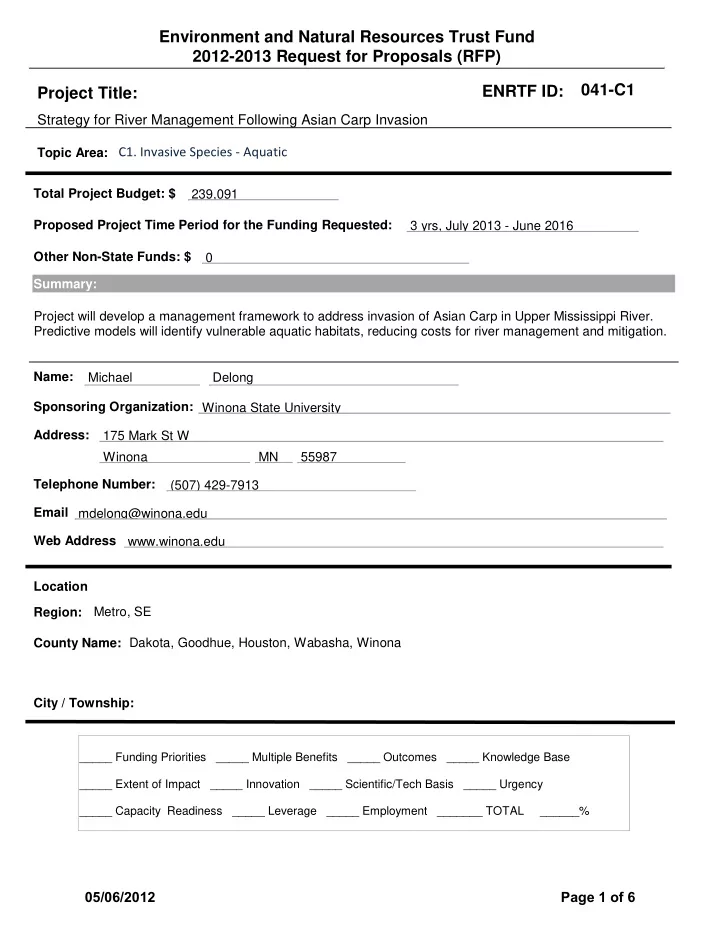
Environment and Natural Resources Trust Fund 2012-2013 Request for Proposals (RFP) 041-C1 ENRTF ID: Project Title: Strategy for River Management Following Asian Carp Invasion C1. Invasive Species Aquatic Topic Area: Total Project Budget:


slide-1
SLIDE 1

Environment and Natural Resources Trust Fund 2012-2013 Request for Proposals (RFP) Project Title:

Total Project Budget: $ Proposed Project Time Period for the Funding Requested: Other Non-State Funds: $ Name: Sponsoring Organization: Address: Telephone Number: Email Web Address County Name: City / Township: Region: Summary: Location

Strategy for River Management Following Asian Carp Invasion

239,091 3 yrs, July 2013 - June 2016 Project will develop a management framework to address invasion of Asian Carp in Upper Mississippi River. Predictive models will identify vulnerable aquatic habitats, reducing costs for river management and mitigation. Michael Winona State University 175 Mark St W Winona MN 55987 (507) 429-7913 mdelong@winona.edu www.winona.edu Metro, SE Dakota, Goodhue, Houston, Wabasha, Winona Delong

_____ Funding Priorities _____ Multiple Benefits _____ Outcomes _____ Knowledge Base _____ Extent of Impact _____ Innovation _____ Scientific/Tech Basis _____ Urgency _____ Capacity Readiness _____ Leverage _____ Employment _______ TOTAL ______%

  • C1. Invasive Species ‐ Aquatic

ENRTF ID: 041-C1

Topic Area:

05/06/2012 Page 1 of 6

slide-2
SLIDE 2

Environment and Natural Resources Trust Fund (ENRTF) 2012‐2013 Main Proposal

1 PROJECT TITLE: Strategy for River Management Following Asian Carp Invasion

  • I. PROJECT STATEMENT

Recent media reports have confirmed what environmental DNA has suggested – Asian carp are in Minnesota waters of the Upper Mississippi River. Their discovery has spurred action toward prevention of movement into some parts of the river. Those sections of the river that cannot be protected are very likely to be impacted by the invasion and subsequent increase in numbers of Asian carp, raising immediate questions on their impact on the river’s ecological integrity. As planktivores, consumers of microscopic animals and primary producers (phytoplankton) in the water column, their impact could be substantial because past research has demonstrated that phytoplankton are the major resource supporting the entire food web of the Upper Mississippi

  • River. This means Asian carp will be competing with native mussels, larval fish, and juvenile fish,

thereby putting larger fish, birds, and reptiles at risk by negatively impacting organisms they eat. Given the risks involved, it is essential we take an adaptive management approach to this threat. Goals of Project  Develop food web models reflecting the current condition of potentially vulnerable habitats within different sections of the Upper Mississippi River  Combine information on the feeding dynamics of Asian carp where they are already established in the Upper Mississippi to build models that predict their impact on vulnerable habitats  Provide models to state and federal agencies responsible for management of the river for development of management plans in advance of Asian Carp becoming established Project Outcomes  A knowledge base not previously available for management of the Upper Mississippi River  A tool for identifying habitats and regions of the Upper Mississippi, including major tributaries, where management may be required to mitigate negative impacts of Asian carp  Reduce costs for future monitoring and management by being able to predict, and later assess, impacts of Asian carp and other potential invasive species The Upper Mississippi River is well studied but information that is lacking for a sound understanding of the dynamics of resource use within its diversity of habitats – backwaters, sloughs, lakes, etc. This requires understanding the food web, where we have gained insights on functional dynamics of the main channel. The proposed modeling approach will address project goals because food webs integrate all aspects of the ecology of a river – from what species are present (and why) to what provides the energy for growth and reproduction of river-dependent

  • species. Two years of field work will allow for collection of all representatives of the food web

from different habitats, including major tributaries, within five locations (see figure). Samples will be used to determine natural stable isotope ratios which provide more accurate measures of what is going into actual animal growth than gut content analysis. They also allow for construction of food web models by linking resources supporting the food web to consumers. Information from a section of river where carp are established will make the models predictive by relating their impact in that area to what could happen in Minnesota rivers.

  • II. DESCRIPTION OF PROJECT ACTIVITIES

Activity 1: Collection and Analysis of 12,870 samples for Food Web Models Budget: $228599 Samples will be collected from all five locations from July – August 2013 and 2014. Multiple habitats (channels and different slackwaters – areas with no flow, major tributaries) will be sampled within all locations to capture the diversity of habitats. Fish will be collected by

05/06/2012 Page 2 of 6

slide-3
SLIDE 3

2 electrofishing and seine. Tissue samples will be removed and fish returned safely to the river. Invertebrates will be collected by hand and with bottom samplers. Scrapings will be taken from the

  • uter layer of mussel shells before returning them to the water. Items representing the base of the

food web will be collected using standard methods used in past food web studies. All samples will be dried, ground, and packaged in the lab for stable isotope analysis. Samples will be sent to a stable isotope laboratory for determination of carbon and nitrogen stable isotope ratios, which will be used in development of food web models. Stable isotopes when combined with mixing models will lead to the generation of food web models. Outcome Completion Date

  • 1. Completed field collection of samples 45 days/ year (Year 1 and Year 2)

Aug 2013; 2014

  • 2. Completion of processing and shipment to isotope lab

Dec 2013; 2014

  • 3. Receipt of isotopic data, allowing for start of model development

April 2014; 2015 Activity 2: Development of Predictive Model for Management of Asian Carp Budget: $10492 Model development will incorporate stable isotope mixing models, which identify links between fish and the base of the food web. This is a critical focal point because the direct impact of Asian carp will be at the bottom of the food web, from where their effect will cascade to higher consumers (i.e., fish-eating fish). Other calculations, such as determination of where fish and invertebrates are on the food chain and food web complexity, will be generated to aid in determining where changes by carp may occur. Iowa samples will take project to the next step by allowing for predictions of responses in Minnesota water. A mixing model that allows input of prior knowledge (SIAR) to predict ecosystem changes will be used to create predictive models using Iowa data. Models will be presented to agency partners for feedback with subsequent re- evaluation as required. Publications and presentations at meetings will provide dissemination beyond state and federal partners. In-kind contribution goes toward model development. Outcome Completion Date

  • 1. Food web models for first year data; second year

Oct 2014; 2015

  • 2. Completed food web models including potential impacts of Asian Carp

February 2016

  • 3. Modifications in response to state and federal partner input

May 2016

  • III. PROJECT STRATEGY
  • A. Project Team/Partners

Winona State’s Large River Studies Center will be the only team member receiving funding and will complete all activities described. Students participating in the project will receive an invaluable practical application of their education. The Minnesota Department of Natural Resources in Lake City and the U.S. Fish & Wildlife Service in Winona are interested in the

  • project. They will receive the models and input from M. Delong on the application and

implementation of the model.

  • B. Timeline Requirements

The project will be completed within 3 years. Two field seasons will provide a model that reflects differences in food web character created by annual differences in hydrological conditions. Processing of samples will begin after they are collected and will continue into the Fall of each

  • year. Analysis by the laboratory will take an additional 2–3 months. Development of food web

models will require data entry, model verification, and preparation for presentation to MDNR.

  • C. Long‐Term Strategy and Future Funding Needs

This project will ultimately lower costs for future assessment and management of Asian carp, with applications to other invasive species because it will allow for prior identification of vulnerable regions and habitats within these regions. No additional funding to Winona State for the project described is anticipated.

05/06/2012 Page 3 of 6

slide-4
SLIDE 4

BUDGET ITEM Personnel: Undergraduate Research Assistants (4 positions each for Yr 1 & 2 of project; 100% full-time; 16-week; 30-hr/wk; $10/hr). Salary=$4800/positions/yr; Benefits=7.625% of salary ($366/yr). Duties = field work and lab processing of samples as per QA/QC protocols. Total Yr 1 = $20664; Yr 2=$20664. Personnel: Michael Delong - project director. 1-month summer salary based on 22 duty days in calendar month @$421.5/duty day in Yr 1 & 2 Total/yr = $9273; Benefits for insurance, retirement, FICA/Medicare = 18% salary ($1669/yr). Total Yr 1=$10492; Yr 2=$10,492; Inclusion of Delong salary negotiable. Time commitment to 3-yr project; 80% summer; 25% academic year Equipment/Tools/Supplies: Vials for storing tissue samples 12,870 @ $0.44 each Equipment/Tools/Supplies: Capsules for ground samples 12,870 @ 0.14 each Equipment/Tools/Supplies: Colloidal silica for separating live and dead organic matter from water and bottom samples. 12 liter @ $78.8/liter Equipment/Tools/Supplies: Shipping samples to isotopic analysis lab Equipment/Tools/Supplies: Tubes processing for organic matter samples 500/case Equipment/Tools/Supplies: 750 vials@$0.44 =$429; 750 capsules@0.14 Travel: Total miles = 3140 miles@$0.29/mile plus 40 days@$23/day for university vehicle. All travel is to sample sites with return to Winona the same day. Travel: Iowa Travel - 4 nights*2 rooms*$70/night = $560; Meals = 5 days*3 people*$31/d =$465; University vehicle: 700 miles @ $0.29/mile, 5 day @ $23/day = $318. Additional Budget Items: Analysis of stable isotope 12870 samples @$12/sample Additional Budget Items: Iowa Analysis of stable isotope 750 samples @$12/sample Additional Budget Items: Boat use (gas, oil, maintenance) 90 d @ $18/day TOTAL ENVIRONMENT AND NATURAL RESOURCES TRUST FUND $ REQUEST = SOURCE OF FUNDS AMOUNT Status Other Non-State $ Being Applied to Project During Project Period: n/a Other State $ Being Applied to Project During Project Period: n/a In-kind Services During Project Period: College of Science and Engineering allows workload release during academic year for direction of undergraduate research. Estimated 17% assignment (3 years). Additional 8% comes from independent time 36,380 $ Pending Funding by ENRTF Remaining $ from Current ENRTF Appropriation (if applicable): n/a Funding History: n/a 9,000 $ 41,328 $ 5,663 $ 566 $ 77 $ 200 $ 237 $ 1,802 $

2012-2013 Detailed Project Budget

  • IV. TOTAL ENRTF REQUEST BUDGET (Three years)

AMOUNT 1,343 $ 1,620 $

  • V. OTHER FUNDS

20,984 $ 239,091 $ 1,831 $ 154,440 $

C:\Users\dgriffit\Documents\proposals_recevied\delong-michael_0412-2-196-Budget

05/06/2012 Page 4 of 6

slide-5
SLIDE 5

River above Lale Pepin Lale Pepin Between Wabasha and Rollingstone Between Winona and Brownsville Pool 18 - northernmost point where Asian carp known to reproduce

Location of areas to be sampled for establishing models for managing river in the face of carp invasion. Mulitple habitats , including major tributaries will be sampled over two-year period.

05/06/2012 Page 5 of 6

slide-6
SLIDE 6

Project Manager Qualifications Michael Delong, Ph.D., has 25 years experience in the study of large rivers, including systems throughout

  • ut the central U.S.: the Mississippi (Upper and Lower), Ohio, Missouri, and Tennessee rivers. This

includes 20 years of work in the Upper Mississippi River, including the Chippewa and St. Croix rivers, as professor of biology and director of the Large River Studies Center (LRSC). Delong’s expertise includes fish and invertebrate community structure, the ecological response to invasive species (zebra mussels), hydrology, geomorphology, and food web ecology. He has published 26 peer-reviewed papers on river science as author or co-author as well as two book chapters and a book. He has also contributed to 123 conference presentations. As director of the LRSC, he has managed $600,000 in grants from the National Science Foundation, US Environmental Protection Agency, Minnesota DNR, and Wisconsin DNR. Undergraduates have participated in all of these projects, including the collection and processing of 10,000 samples for the USEPA grant. Delong will direct the project, including training of undergraduate students participating in the project, data management, budget management (in conjunction with the WSU Business Office), model development, and submission of reports on findings. Delong will also serve as expert in the application of models with the MDNR and other interested agencies as needed for their independent application. Relevant Publications Delong, M. D., Thorp, J. H., M. C. Thoms and L. M. McIntosh. 2011. Trophic niche dimensions of fish communities as a function of historical hydrological conditions of a Plains river. Invited paper, River Systems 19:177-187. Delong, M. D. 2010. Food webs and the Upper Mississippi River: contributions to our understanding of ecosystem function in large rivers. Invited paper, Hydrobiologia 640:89-101. Delong, M. D. and J. H. Thorp. 2006. Significance of instream autotrophs in the trophic dynamics of the Upper Mississippi River. Oecologia 147:76-85. Delong, M.D. 2005. The Upper Mississippi River. Pages 327 – 373, In Benke, A.C. and C.E. Cushing (eds.), The Rivers of North America. Academic Press. Delong, M. D., J. H. Thorp, K. S. Greenwood, and M. C. Miller. 2001. Responses of consumers and food resources to a high magnitude, unpredicted flood in the upper Mississippi River Basin. Regulated Rivers: Research and Management 17:217-234. Thorp, J. H., M. D. Delong, and A. F. Casper. 1998. In situ experiments on predatory regulation of a bivalve mollusc (Dreissena polymorpha) in the Mississippi and Ohio Rivers. Freshwater Biology 39:649-661. Recent Relevant Grants as Principal Investigator/co‐PI Preliminary Research: Historical changes in ecosystem structure and function in Australian rivers. New South Wales Environmental Trust ($20,000; 2011-2012). Landscape legacies: retrospective analyses of changes in ecosystem function across two centuries. National Science Foundation, ($80,000; 2010-2011). Determination of ecological thresholds through an historical perspective of trophic dynamics in rivers. U.S. Environmental Protection Agency STAR program, ($297,489, 2005-2008). Large River Studies Center of Winona State University The mission of the LRSC is to provide educational opportunities for undergraduate students at WSU and to be a source of knowledge on river systems for the local, regional, and international communities. As director, Delong has directed 118 undergraduate research projects over the last 20 years. To meet these goals, the LRSC has developed collaborations with the US Geological Survey’s Upper Midwest Environmental Sciences Center and the Riverine Landscapes Laboratory, University of New England, Australia.

05/06/2012 Page 6 of 6