Environment and Natural Resources Trust Fund 2012-2013 Request for - - PDF document

environment and natural resources trust fund 2012 2013
SMART_READER_LITE
LIVE PREVIEW

Environment and Natural Resources Trust Fund 2012-2013 Request for - - PDF document

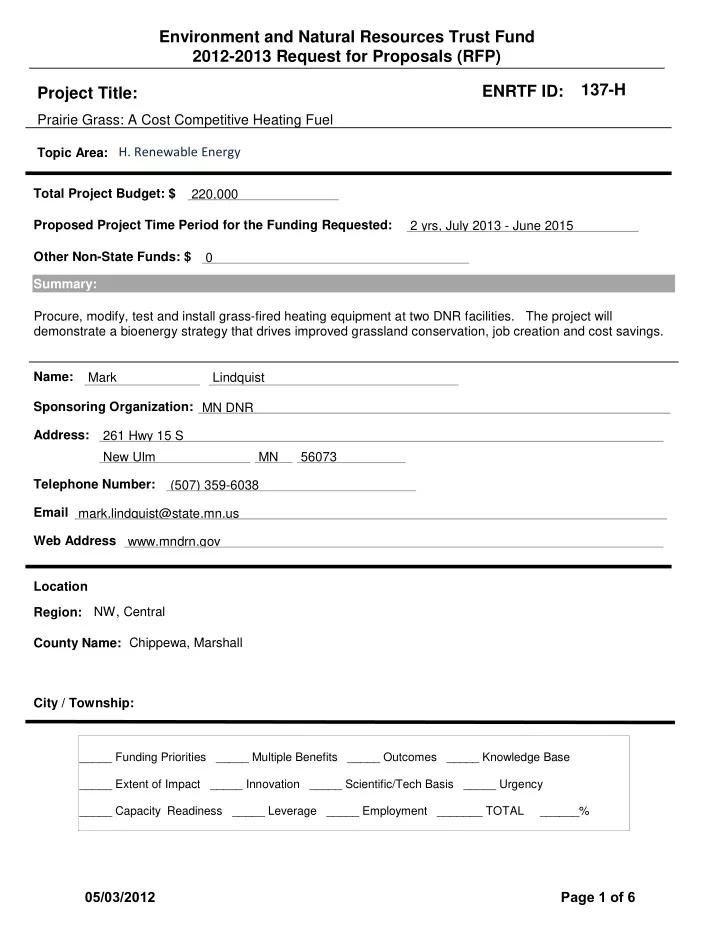
Environment and Natural Resources Trust Fund 2012-2013 Request for Proposals (RFP) 137-H ENRTF ID: Project Title: Prairie Grass: A Cost Competitive Heating Fuel H. Renewable Energy Topic Area: Total Project Budget: $ 220,000 Proposed


slide-1
SLIDE 1

Environment and Natural Resources Trust Fund 2012-2013 Request for Proposals (RFP) Project Title:

Total Project Budget: $ Proposed Project Time Period for the Funding Requested: Other Non-State Funds: $ Name: Sponsoring Organization: Address: Telephone Number: Email Web Address County Name: City / Township: Region: Summary: Location

Prairie Grass: A Cost Competitive Heating Fuel

220,000 2 yrs, July 2013 - June 2015 Procure, modify, test and install grass-fired heating equipment at two DNR facilities. The project will demonstrate a bioenergy strategy that drives improved grassland conservation, job creation and cost savings. Mark MN DNR 261 Hwy 15 S New Ulm MN 56073 (507) 359-6038 mark.lindquist@state.mn.us www.mndrn.gov NW, Central Chippewa, Marshall Lindquist

_____ Funding Priorities _____ Multiple Benefits _____ Outcomes _____ Knowledge Base _____ Extent of Impact _____ Innovation _____ Scientific/Tech Basis _____ Urgency _____ Capacity Readiness _____ Leverage _____ Employment _______ TOTAL ______%

  • H. Renewable Energy

ENRTF ID: 137-H

Topic Area:

05/03/2012 Page 1 of 6

slide-2
SLIDE 2

Environment and Natural Resources Trust Fund (ENRTF) 2012‐2013 Main Proposal

1 PROJECT TITLE: Prairie Grass: A Cost Competitive Heating Fuel I. PROJECT STATEMENT NEED: Minnesota grasslands are currently under significant pressure. High commodity prices and resultant land rents for farm land have induced significant acreage to shift from conservation to production land uses. Current Congressional debate on the reauthorization of federal bill programs points to substantial further cuts in the CRP and related programs. In this context, sustaining existing grassland habitats will be difficult. In addition, accelerated management of both public and private grasslands is needed. Managed haying has been demonstrated to be a reasonable substitute for fire in ensuring grassland health. At the same time, high energy costs for DNR facilities without access for natural gas compound agency budget pressures. Opportunities exist to reduce energy costs and increase the value of grasslands by using grass fuels to displace high cost propane and fuel oil. However, to take these strategies to scale, demonstrations are needed to validate the use of grass pellet fuel for heating. Overall Goals:  Demonstrate technical and economic viability of heating with grass pellet fuels.  Test and demonstrate that air quality standards can be achieved with grass fired heating systems.  Build model supply chains for grass pellets. METHODS: Install a modified grass fired boiler at DNR facilities in Southwest and Northwest Minnesota to demonstrate grass pellet fuel economic and technical viability. These projects will complement the

  • ne operational grass fired boiler in Southeast Minnesota. The project will use state of the art emissions

testing facilities to verify and ensure compliance with air quality standards.

  • II. DESCRIPTION OF PROJECT ACTIVITIES

Activity 1: Boiler Procurement and Modification Budget: $105,000 Select and procure two commercial biomass (likely wood pellet) fired boilers sized appropriately for demonstration site facilities and modify them to burn grass pellet fuel. Outcome Completion Date

  • 1. Selection and procurement of two biomass boilers

Sept 2013

  • 2. Engineering and redesign
  • Dec. 2013
  • 3. Complete Modifications (pollution control, burn pot, ash handling, air delivery)

March 2014 Activity 2: Fuel Testing Budget: $10,000 Prairie grasses will be collected through existing prescribed haying projects and pelleting will be accomplished through commercial companies. Outcome Completion Date

  • 1. Secure grass hay

Fall 2013

  • 2. Grass Chemical Analysis

December 2013

05/03/2012 Page 2 of 6

slide-3
SLIDE 3

2

  • 3. Grass pellet testing

December 2013

  • 4. Commercial bulk pellet production

March 2014

  • 5. Quality control Testing and verification of commercially produced fuel

May 2014 Activity 3: Boiler Test and Data Analysis Budget: $85,000 Conduct test burns in each boiler to verify compliance with EPA standards and boiler performance. Outcome Completion Date

  • 1. Test burns

May 2014

  • 2. Data analysis and reports

August 2014 Activity 4: Install boilers and Shakedown Budget: $20,000 Install equipment and test fire to verify performance and tune system as needed. Outcome Completion Date

  • 3. Install Equipment

August 2014

  • 4. Shakedown operation

October 2014

  • III. PROJECT STRATEGY
  • A. Project Team/Partners

Mark Lindquist, Project Manager: Minnesota Department of Natural Resource, Operations Support

  • Division. 116,000 ENTF

Minnesota State University, Mankato – International Renewable Energy Technology Institute. IRETI is a state funded enterprise with expertise in the design operation and testing of biomass fired heating

  • appliances. IRETI will lend expertise in selection of suitable heating equipment modification of heating

equipment to burn grass pellets (most commercial equipment is designed to burn wood). $104,000 ENTF Agricultural Utilization Research Institute. AURI is a public not‐for‐profit with leading expertise on pelletizing of agricultural products such as prairie grasses. AURI will provide their expertise and capacity to produce and test sufficient volumes of prairie grass fuels to test and commission the heating

  • equipment. $0 ENFT.
  • B. Timeline Requirements

The project time line is based upon bringing the new heating facilities on‐line for the 2014‐2015 heating

  • season. In order to meet this time line, the prairie grass harvest will need to occur during the fall of 2013

so that fuel can be tested and prepared in a timely fashion.

  • C. Long‐Term Strategy and Future Funding Needs

This project is a partnership that will leverage state investment in IRETI and AURI as well as state grassland resources and DNR resource management capacities. The project’s primary funding need is for the initial capital expenditure. Once operational, the project will be self‐sustained through existing

  • perating budgets. Each ton of prairie hay will have the heating value equal to about 130 gallons of

propane, worth $225. The cost of harvesting and pelleting grass will be less than the cost of propane.

05/03/2012 Page 3 of 6

slide-4
SLIDE 4

BUDGET ITEM Personnel: Project and Contract Management (Classified): DNR 200 hours@ $50 /hour salary and fringe Contracts: MSU,M, IRETI (project partner) - Boiler redesign and modification, testing and

  • versight of installation, 104,000; Boiler installation, 14,000; Grass fuel pelleting, 2,000.

Equipment/Tools/Supplies: Two biomass boilers plus supplies needed to convert to grass pellet fuels. Acquisition (Fee Title or Permanent Easements): In this column, indicate proposed number of acres and and name of organization or entity who will hold title. Travel: 2,000 miles @ 50 cents per mile. 4 trips to SW MN, 4 trips to NW MN, 6 trips to Mankato MN Additional Budget Items: Direct Support Services: DNR used a rate of 6.5% to calculate costs for direct support services, which are DNR’s direct and necessary business services required to support this proposal TOTAL ENVIRONMENT AND NATURAL RESOURCES TRUST FUND $ REQUEST = SOURCE OF FUNDS AMOUNT Status Other Non-State $ Being Applied to Project During Project Period:

  • $

Other State $ Being Applied to Project During Project Period:

  • $

In-kind Services During Project Period: 20 tons hay @ $100 value per ton. 2,000 $ Secured Remaining $ from Current ENRTF Appropriation (if applicable): NA Funding History: NA 1,000 $ 14,000 $ 120,000 $

  • V. OTHER FUNDS

10,000 $ 220,000 $ 75,000 $

2012-2013 Detailed Project Budget

Prairie Grass: A Cost Competitive Heating Fuel

  • IV. TOTAL ENRTF REQUEST BUDGET 2 years

AMOUNT

I:\ML2013\RFP\proposals_recevied\lindquist-mark_0412-2-050-Budget

05/03/2012 Page 4 of 6

slide-5
SLIDE 5

Prairie Grass as a Cost Effecve Heang Fuel: Preliminary Project Locaons

MN DNR: Prairie Grass as a Cost Effecve Heang Fuel

05/03/2012 Page 5 of 6

slide-6
SLIDE 6

MN DNR: Prairie Grass as a Cost Effective Heating Fuel Project Manager Qualifications Mark Lindquist, Biofuels Program Manager, Operations Support Minnesota Department of Natural Resources

  • Mr. Lindquist has eleven years of experience working with the Minnesota DNR and has led the Biofuels

Program since 2007. Prior to that, he was the Southern Regional Planner (1998 – 2004). He brings to bear a wide angle vision of the DNR’s work and mission. Currently housed within the Operations Support Division, Mr. Lindquist provides leadership on natural resource development, including bioenergy development and agricultural policy. Experience relevant to this project:  Contract Management

  • $385,000 contract with U of MN to complete: The Potential for Terrestrial Carbon

Sequestration in Minnesota and Terrestrial Carbon Sequestration Monitoring Networks and Demonstration Sites as requested by the Legislature in 2007.

  • $85,000 Environmental Initiative Ag Leadership Dialogue

 BioEnergy Development

  • Co‐Author: Prairie Vegetation & Energy Production Harvest Plan for WMA's., 2009
  • Next Generation Energy Board, Grants Technical Review Team
  • Co‐Chair, MN DNR Biofuels Team, 2010 – present.
  • Close partnership with commercial, industrial, and academic partners to evaluate and

advance sound bioenergy projects. Organization Description The Minnesota Department of Natural Resources’ overall mission is to work with citizens to conserve and manage the state's natural resources, to provide outdoor recreation opportunities, and to provide for commercial uses of natural resources in a way that creates a sustainable quality of life. “Conservation that Works” defines key strategies for the DNR. Development of cost effective prairie grass utilization strategies supports a number of these strategies including:  accelerated prairie conservation,  engage agriculture,  drive natural resource based economic development,  adapt programs to changing climate and emerging energy markets, and  improve the efficiency of DNR business practices.

05/03/2012 Page 6 of 6