Environment and Natural Resources Trust Fund 2012-2013 Request for - - PDF document

environment and natural resources trust fund 2012 2013
SMART_READER_LITE
LIVE PREVIEW

Environment and Natural Resources Trust Fund 2012-2013 Request for - - PDF document

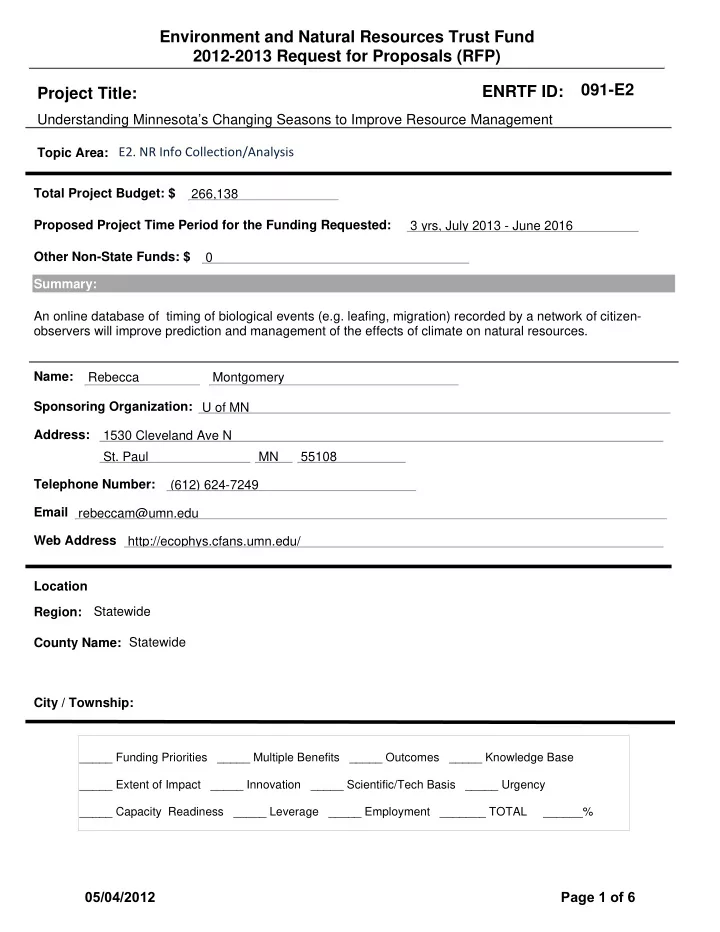
Environment and Natural Resources Trust Fund 2012-2013 Request for Proposals (RFP) 091-E2 ENRTF ID: Project Title: Understanding Minnesotas Changing Seasons to Improve Resource Management E2. NR Info Collection/Analysis Topic Area: Total


slide-1
SLIDE 1

Environment and Natural Resources Trust Fund 2012-2013 Request for Proposals (RFP) Project Title:

Total Project Budget: $ Proposed Project Time Period for the Funding Requested: Other Non-State Funds: $ Name: Sponsoring Organization: Address: Telephone Number: Email Web Address County Name: City / Township: Region: Summary: Location

Understanding Minnesota’s Changing Seasons to Improve Resource Management

266,138 3 yrs, July 2013 - June 2016 An online database of timing of biological events (e.g. leafing, migration) recorded by a network of citizen-

  • bservers will improve prediction and management of the effects of climate on natural resources.

Rebecca U of MN 1530 Cleveland Ave N

  • St. Paul

MN 55108 (612) 624-7249 rebeccam@umn.edu http://ecophys.cfans.umn.edu/ Statewide Statewide Montgomery

_____ Funding Priorities _____ Multiple Benefits _____ Outcomes _____ Knowledge Base _____ Extent of Impact _____ Innovation _____ Scientific/Tech Basis _____ Urgency _____ Capacity Readiness _____ Leverage _____ Employment _______ TOTAL ______%

  • E2. NR Info Collection/Analysis

ENRTF ID: 091-E2

Topic Area:

05/04/2012 Page 1 of 6

slide-2
SLIDE 2

PROJECT

  • I. PROJEC

To everyt fertilizer t everything insect eme pollinator pollen, tic that ensur What hap anyone m understan provide a

  • future. Fo

shown to unprecede phenology economic  H  H  W To answe  E w  C Current ef When form approache monitorin  Id pr pe  D  P  D

  • II. DESCRI

Activity 1 Following centers an 100 years scattered, document current ob average a May 20, 1 know of a

  • bservatio

datasets a

Environ 2012‐20

TITLE: Under T STATEMEN thing there is to deciding w

  • g. Phenology

ergence or fis r, predator-pre ck, mosquito s res the health, pens if the tim making decisio nd the timing o critical scien

  • r example, fo

lengthen thei ented change y could jeopa c gains realize How has the ti How might ph What are the c r these questi Examine histor whether the ph Create a netwo fforts to track mal data is co es hinder the ng and a stand dentification o roductivity; p est outbreaks Dramatic incre

  • tential to do

Direct engagem IPTION OF PR : Rescue hist g the changing nd state parks

  • f data. Thes

piece-meal a ted and stored

  • bservations. F

spen leafing d 1950 (latest). at least ten loc

  • ns on >50 sp

awaiting disco

nment and 013 Main

rstanding Min NT a season. Fro where to go to y, the timing o sh spawning, ey); determin season). The , productivity ming of our se

  • ns related to
  • f seasonal bi

ntific foundati

  • rest manager

ir growing sea in both plant ardize not only ed from activi ming of seaso enology chan

  • nsequences

ions we will e rical records henology of M

  • rk of trained

k phenology a

  • llected, the s

accessibility dardized, acce

  • f key areas l

pollination ser and ecosyste ease in amoun

  • cument other

ment of citize ROJECT ACTIV toric phenolog g of the seaso have journal se records are across the stat d in a perman For example, a date of April This year (20 calities with d pecies for a to

  • very in MN n

d Natural Proposal

nnesota’s chan

  • m deciding w

fish for trout

  • f seasonal bi

is critical to u es growing se timing of sea y and integrity easons chang Minnesota’s iological activ

  • n for manag

rs seeking to i ason in warm and animal p y the health a ities as divers

  • nal biologica

nge in the futu for natural re engage in the

  • f events suc

Minnesota’s p citizen-obser are often made species and th and usefulnes essible databa ikely to be im rvices to fruit em health nt and quality r phenomena ens with the la VITIES

  • gy records an
  • ns has alway

s that go back e a valuable an te and at risk. ent database. a record from 30 with a 1.5 012) leaves em datasets longe

  • tal of >500,0

number in the

Resource

1 nging season when to spray t, see spring w iological even understanding eason length f asonal biologi y of our natura ges? This ques natural resou vity and its re gement of Min increase timb m years. There phenology lik and productivi e as visiting a al events (i.e. ure? esource manag following act h as leafing, f lant and anim rvers to monit e in personal he events reco ss of the data ase will result mpacted by ph t and row crop y of data colle such as invas and that foste nd make publ ys been a part k decades: the nd endangere Historical da Existing reco m St. Paul, MN month range merged on asp er than 25 yea 000 individua e 100s. We w

es Trust Fu

ns to improve mosquitoes, wildflowers or nts like leafin g interactions for plants; an ical events is al resources. stion is becom

  • urces. Our ove

elation to clim nnesota’s natu ber productivi is growing w kely related to ity of our natu a park, harves . phenology) c gement? tivities: flowering and mal species ha tor and record written journ

  • rded vary gre

for science a t in the follow henological ch ps; plant, wild ected sive species u rs good stewa licly availabl

  • f Minnesota

e Eloise Butle ed Minnesota ata could be lo

  • rds provide i

N (AC Hodso e in leafing fro pens in St. Pa

  • ars. These rep

al observation will locate, dig

und (ENRT

resource man trim trees, pla r fall colors – ng, blossom d s among speci nd affects hum a critical ecol ming increasin erarching goa

  • mate. This new

ural resource ity may favor worldwide evi

  • changing cli

ural resource sting a tree or changed in M d bird migrati as changed in d phenology o nals or on pap eatly among o and managem wing positive o hange includi dlife and hum using network ardship le Budget: a’s heritage. er Wildflower resource, yet

  • st if it is not

important his

  • n 1941-1991
  • m April 9, 1

aul on March present daily t

  • ns. We expect

gitize and ana

TF)

nagement ant corn or ap – timing is dates, migratio ies (e.g. plant man health (e. logical proces ngly relevant al is to better w knowledge s now and in tree species idence of rece

  • imate. Change

s but also the r fishing. We Minnesota? ion to ascerta the recent pa

  • f key specie

per calendars.

  • bservers. Th
  • ent. Statewid
  • utcomes:

ing timber man disease ri k observers $ 98,845 Many nature r Garden has t they are digitized, storical contex ) shows an 1987 (earliest)

  • 19. At presen

to weekly t that phenolo lyze handwrit pply

  • n,

t- g. ss to will the ent es in e ask: ain ast es hese de sk; ~ xt for ) to nt we

  • gy

tten

05/04/2012 Page 2 of 6

slide-3
SLIDE 3

Understanding Minnesota’s changing seasons to improve resource management

2 historical records to examine whether and how phenology has changed in recent years. We will use these data to model the relationship between climate and phenology. As a result, hundreds of thousands of

  • bservation hours spanning decades and a range of ecosystems will become publicly accessible.

Outcome Completion Date

  • 1. Online searchable database of historical phenological observations

December 2015

  • 2. Report “Trends in timing of biological events in MN during the last century”

June 2016 Activity 2: Create a statewide observer network to monitor phenology Budget: $ 167, 293 A new statewide citizen-science network will focus on monitoring easy to identify, iconic species (e.g. sugar maple, loon) of ecological and/or economic importance that occur across the state’s major

  • ecoregions. We will develop simple data collection guidelines delivered via a web site with online

training materials and data entry systems. The USA-National Phenology Network will host this web portal and provide QA/QC. Data will be accessible for review and visualization using tools already developed by USA-NPN and local software designers. New tools will be developed that depict the changing of the seasons across the state in real time. For example, viewers could ‘watch’ the green wave

  • f spring spread from south to north. A statewide outreach campaign and training workshops will create a

core set of observers. Our goal is to have a minimum of one observer per county with more in large counties like St. Louis. The resultant database could be used in real-time to make seasonal decisions. For example, a forest manager in northern MN might use the database to track leafing of buckthorn in southern MN to plan when to apply an early season foliar herbicide treatment. As a result of this effort, it will be possible to implement more effective and efficient timing of resource management actions. Outcome Completion Date

  • 1. Key species lists, training manuals, on-line training materials

October 2014

  • 2. Web portal for data entry and visualization of phenological observations

January 2015

  • 3. Statewide training workshops on monitoring and recording phenology

Feb 2015-Jun 2016

  • 4. Online database of current phenological observations

Feb 2015-ongoing

  • III. PROJECT STRATEGY
  • A. Project Team/Partners
  • Team. Rebecca Montgomery (Department of Forest Resources, FR-UMN, in-kind) is the overall Project
  • Manager. Chris Buyarski (FR-UMN, 50% time) will lead development of key species lists and

monitoring protocols. A graduate student (FR-UMN, 25% time) will coordinate work on historical phenological records. Barbara Coffin (Bell Museum of Natural History, in-kind) and a Partnership Coordinator (50%) will work with partners statewide, develop and coordinate training workshops and recruit observers with input from Bell Museum communication and marketing staff. Coordinating Partners include long-term phenology observers: John Latimer (rural mail carrier, host of KAXE Phenology show, Grand Rapids, MN), Jim Gilbert (retired Gustavus Adolphus professor, St. Peter, MN); David Palmquist (retired naturalist, Whitewater State Park, Winona, MN) and Larry Weber (retired teacher, Carlton, MN) as well as MN Naturalists Association, Belwin Outdoor Science (Josh Leonard, Director), Wolf Ridge Environmental Learning Center (Peter Harris, science coordinator), Freshwater Society, Will Steger Foundation, Trout Unlimited and the USA-National Phenology Network.

  • B. Timeline Requirements

This project will require 36 months of funding, from July 1, 2013-June 30, 2016. This is conceived as a 3- year project since year one begins in the middle of the growing season. Moreover, including a full year for citizen observations will allow evaluation and revision of online systems during the project period.

  • C. Long‐Term Strategy and Future Funding Needs

Our goal is to develop the resulting observer network into a registered non-profit organization providing

  • n-going data on timing of biological events to resource managers, scientists, businesses and individuals.

05/04/2012 Page 3 of 6

slide-4
SLIDE 4

Understanding Minnesota's changing seasons to improve resource management

BUDGET ITEM Personnel: Project coordinator (50% time), 71% salary 29% benefits, 3 yrs, Chris Buyarski 87,349 $ Partnership coordinator (50% time), 73% salary 27% benefits, 2 yrs, 1 person 49,694 $ Graduate student (25% time), 54% salary 46% benefits, 3 yrs, 1 person 55,170 $ Contracts: Web developer to build website, web blog and new visualization tools (estimate 500 h * 50$/h) 25,000 $ Graphic designer to support design of website, brochures and training materials (estimate 250 h * 50$/h) 12,500 $ Equipment/Tools/Supplies: Printing brochures 350 $ Printing training manuals 6,000 $ Workshop materials (large paper/post its, markers, printed handouts) 150 $ Acquisition (Fee Title or Permanent Easements): Travel: Project team meetings: mileage. 3 years * 2/year * 10 persons * ~250mi/person * 0.51cents/mile 7,650 $ Project team meetings: per diem. 3 years * 2/year * 10 persons *2 d * ($77/lodging + $46 Meal&Incidentals [based on standard MN GSA rate]) 14,760 $ Travel to conduct training workshops: 1 year * 5 workshops * 3 persons * 2 d * (mileage [250 mi/person*0.51 cents/mile] + per diem [$77 lodging + $46 M&I]) 7,515 $ Additional Budget Items: TOTAL ENVIRONMENT AND NATURAL RESOURCES TRUST FUND $ REQUEST = SOURCE OF FUNDS AMOUNT Status Other Non-State $ Being Applied to Project During Project Period: US National Science Foundation Preproposal "Understanding cues for budbreak in trees at the temperate-boreal forest ecotone: community phenology in an era of climate change" 500,000 $ Pending University of Minnesota Institute on Environment Resident Fellow Program "Minnesota Phenology Network (MnPN): an observer network to measure the pulse of the state and connect people to the land" 10,000 $ Pending Other State $ Being Applied to Project During Project Period: N/A In-kind Services During Project Period: Rebecca Montgomery, 2 week salary + benefits 16,703 $ Barbara Coffin, 2 week salary + benefits 14,381 $ USA-National Phenology Network web portal development & data hosting 30,000 $ Remaining $ from Current ENRTF Appropriation (if applicable): N/A Funding History: University of Minnesota Institute on the Environment Mini-Grant "Phenology: the Pulse of the Planet – developing science and engagement initiatives that explore plant and animal response to climate change" 2,500 $

2012-2013 Detailed Project Budget

  • IV. TOTAL ENRTF REQUEST BUDGET 3 years

AMOUNT N/A

  • V. OTHER FUNDS

266,138 $ N/A

05/04/2012 Page 4 of 6

slide-5
SLIDE 5

1‐Apr
 6‐Apr
 11‐Apr
 16‐Apr
 21‐Apr
 26‐Apr
 1‐May
 6‐May
 11‐May
 16‐May
 21‐May
 1940
 1950
 1960
 1970
 1980
 1990
 2000
 2010


Year
of
observa9on
 Date
that
aspen

 leaves
emerged


Historic
dataset

(A
Hodson;
St.
Paul)
 Current
data

 (C
Buyarski;

 E.
Bethel)
 Growing
season
length
 Forest
produc9vity


What
are
the
poten+al
ecological
 and
economic
consequences?
 Has
the
+ming
of
seasonal
biological
events
changed
in
Minnesota?

 Where
do
we
know
of
 data
and/or
observers?

 What
kinds
of
events
could
be
monitored
by
 a
trained
ci+zen‐observer
network?


UNDERSTANDING
MINNESOTA’S
CHANGING
SEASONS
TO
IMPROVE
RESOURCE
MANAGEMENT


tree
budburst
and
leafing
 insect
emergence
 allergens
 (ragweed)

 bird
migra9on


slide-6
SLIDE 6

Understanding Minnesota’s changing seasons to improve resource management

Project Manager Qualifications and Organization Description Project Manager: Rebecca A. Montgomery Associate Professor, Dept. of Forest Resources, University of Minnesota, St. Paul, MN 55108. Professional Appointments and Preparation Associate Professor, Forest Resources, University of Minnesota, 2011-present Assistant Professor, Forest Resources, University of Minnesota, 2004-2011 Research Associate, Forest Resources, University of Minnesota, 2003-2004 Instructor, Forest Resources, University of Minnesota, 2003-2004 Ph.D., Ecology and Evolutionary Biology, University Connecticut, 1999. B.A., Biology, magna cu laude, Occidental College, 1994. Honors, Professional Recognition and Service (Selected) Invited speaker at regional, national and international symposia, seminars, and workshops, e.g. MN Sustainable Forest Education Cooperative, Michigan State, UW-Madison, University of Toronto, US- Japan Workshop on Photosynthetic Plasticity and Global Change. Received Richard C. Newman Art of Teaching award (2010) and College of Food, Agricultural and Natural Resources Sciences Distinguished Teaching Award (2010). I serve as chair of the Physiology Working Group of the Society of American Foresters and subject editor of Forest Science. I serve on the Science Team for the Minnesota Climate Change Vulnerability Assessment and on the Falcon Heights Environment Commission. Areas of Expertise Plant ecophysiology, forest ecology, forest regeneration and dynamics, herbivory, competition, invasive species, rare and endangered species biology. Research spans temperate and tropical forests, managed and unmanaged ecosystems. Project Management Experience Principal investigator or co-principal investigator on >15 research grants from National Science Foundation, Minnesota Department of Natural Resources, US Department of Energy, US National Park Service and USDA Forest Service projects. Principal investigator on a seed grant from the University of Minnesota’s Institute on Environment related to creating a phenology network in Minnesota. Supervise research staff, post-doctoral scholars, graduate students and undergraduate students. Peer-reviewed publications Twenty-four publications, including articles, book chapters, and reports. Twenty-two publications in the peer-reviewed literature, and 8 in preparation. Project Management Qualifications and Responsibilities for this Project Ten years of research experience in oak savanna, deciduous and boreal forest of Minnesota; organized of the highly successful workshop “Phenology the Pulse of the State” (Bell Museum of Natural History, February 2012); co-organized annual Minnesota Phenologist meetings (2010-2012); manage a Facebook page aimed at bringing together researchers and citizens interested in phenology in Minnesota. Montgomery will provide scientific leadership, supervise funded staff, mentor the graduate student and both oversee and participate in all project activities. Organization Description The University of Minnesota has a strong tradition of education and public service through it role as both the state land-grant university, and the state's primary research university. The Department of Forest Resources is the leading research and educational institution on forest related issues in Minnesota. For

  • ver 100 years the department has played a key role in discovering and fostering sustainable forest

resource management activities in Minnesota.