Enhancing Creative Thinking through Designing Electronic Slides - - PDF document

enhancing creative thinking through designing electronic
SMART_READER_LITE
LIVE PREVIEW

Enhancing Creative Thinking through Designing Electronic Slides - - PDF document

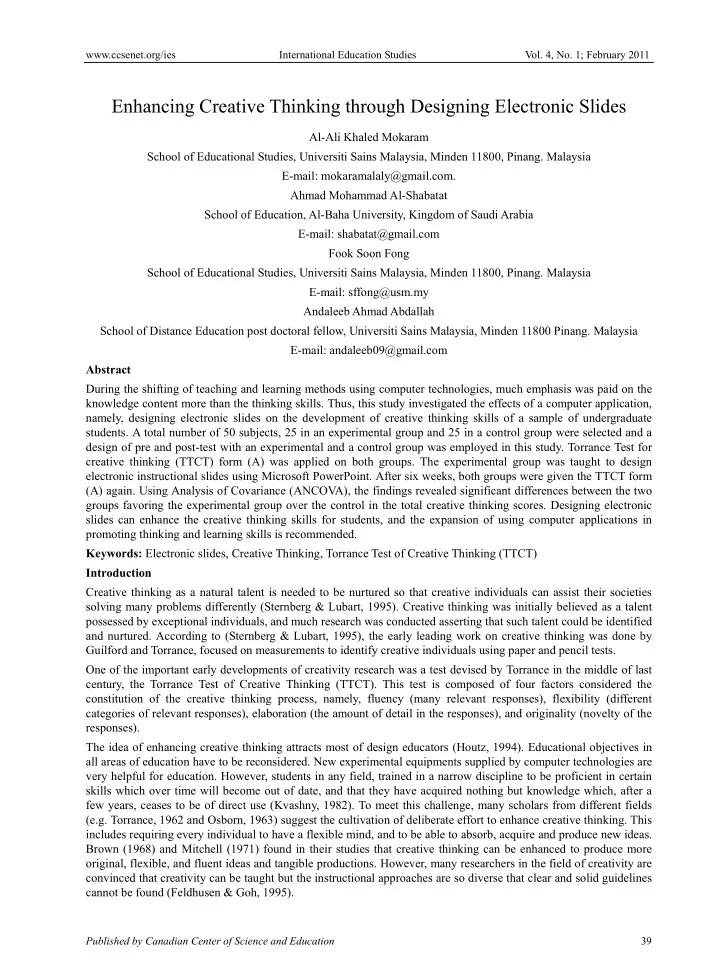
www.ccsenet.org/ies International Education Studies Vol. 4, No. 1; February 2011 Enhancing Creative Thinking through Designing Electronic Slides Al-Ali Khaled Mokaram School of Educational Studies, Universiti


slide-1
SLIDE 1

www.ccsenet.org/ies International Education Studies Vol. 4, No. 1; February 2011 Published by Canadian Center of Science and Education 39

Enhancing Creative Thinking through Designing Electronic Slides

Al-Ali Khaled Mokaram School of Educational Studies, Universiti Sains Malaysia, Minden 11800, Pinang. Malaysia E-mail: mokaramalaly@gmail.com. Ahmad Mohammad Al-Shabatat School of Education, Al-Baha University, Kingdom of Saudi Arabia E-mail: shabatat@gmail.com Fook Soon Fong School of Educational Studies, Universiti Sains Malaysia, Minden 11800, Pinang. Malaysia E-mail: sffong@usm.my Andaleeb Ahmad Abdallah School of Distance Education post doctoral fellow, Universiti Sains Malaysia, Minden 11800 Pinang. Malaysia E-mail: andaleeb09@gmail.com Abstract During the shifting of teaching and learning methods using computer technologies, much emphasis was paid on the knowledge content more than the thinking skills. Thus, this study investigated the effects of a computer application, namely, designing electronic slides on the development of creative thinking skills of a sample of undergraduate

  • students. A total number of 50 subjects, 25 in an experimental group and 25 in a control group were selected and a

design of pre and post-test with an experimental and a control group was employed in this study. Torrance Test for creative thinking (TTCT) form (A) was applied on both groups. The experimental group was taught to design electronic instructional slides using Microsoft PowerPoint. After six weeks, both groups were given the TTCT form (A) again. Using Analysis of Covariance (ANCOVA), the findings revealed significant differences between the two groups favoring the experimental group over the control in the total creative thinking scores. Designing electronic slides can enhance the creative thinking skills for students, and the expansion of using computer applications in promoting thinking and learning skills is recommended. Keywords: Electronic slides, Creative Thinking, Torrance Test of Creative Thinking (TTCT) Introduction Creative thinking as a natural talent is needed to be nurtured so that creative individuals can assist their societies solving many problems differently (Sternberg & Lubart, 1995). Creative thinking was initially believed as a talent possessed by exceptional individuals, and much research was conducted asserting that such talent could be identified and nurtured. According to (Sternberg & Lubart, 1995), the early leading work on creative thinking was done by Guilford and Torrance, focused on measurements to identify creative individuals using paper and pencil tests. One of the important early developments of creativity research was a test devised by Torrance in the middle of last century, the Torrance Test of Creative Thinking (TTCT). This test is composed of four factors considered the constitution of the creative thinking process, namely, fluency (many relevant responses), flexibility (different categories of relevant responses), elaboration (the amount of detail in the responses), and originality (novelty of the responses). The idea of enhancing creative thinking attracts most of design educators (Houtz, 1994). Educational objectives in all areas of education have to be reconsidered. New experimental equipments supplied by computer technologies are very helpful for education. However, students in any field, trained in a narrow discipline to be proficient in certain skills which over time will become out of date, and that they have acquired nothing but knowledge which, after a few years, ceases to be of direct use (Kvashny, 1982). To meet this challenge, many scholars from different fields (e.g. Torrance, 1962 and Osborn, 1963) suggest the cultivation of deliberate effort to enhance creative thinking. This includes requiring every individual to have a flexible mind, and to be able to absorb, acquire and produce new ideas. Brown (1968) and Mitchell (1971) found in their studies that creative thinking can be enhanced to produce more

  • riginal, flexible, and fluent ideas and tangible productions. However, many researchers in the field of creativity are

convinced that creativity can be taught but the instructional approaches are so diverse that clear and solid guidelines cannot be found (Feldhusen & Goh, 1995).

slide-2
SLIDE 2

www.ccsenet.org/ies International Education Studies Vol. 4, No. 1; February 2011 ISSN 1913-9020 E-ISSN 1913-9039 40

Enhancing the creative thinking using the computer is considered one of the most important features of the third millennium 21st century (Hussein, 2002). Heaston and Bedell (1999) demonstrate that technology will play a key role in helping students to develop their abilities to think and act creatively through the rich computer environment. Studying the impact of computer use in the development of creative thinking was included within two phenomena emerged in the late twentieth century. The first is the scientific and technological revolution, and the second is represented by the importance of creativity in a rapidly changing world (Shehab, 1999). Computer as an advanced technology can help producing creative techniques and the user to go beyond the traditional methods and provides information in different ways prompting individuals to come up with creative ideas which helps them to master thinking skills since the creative thinking requires several cognitive processes that might not be mastered by traditional methods (Lubart, 2005). The strength of the computer and its associated modern technologies influence creativity, and it is predicted to become highly increasing and it is very hard to keep the technological development without the use of the computer, as people are now becoming aware of the importance of computers and its applications. Lubart (2005) proposes that computers can be involved in creative work examining four categories of human–computer interaction to promote creativity, namely, computer as nanny, pen-pal, coach, and colleague. He emphasizes that computers may facilitate managing creative tasks, communicating between individuals, collaborating on creative projects, enhancing creativity, and producing the creative act through integrated human–computer cooperation. Alomari (2006) conducted a study to identify the effects of computerized training program to enhance the creative thinking for seventh grade students. He reported significant differences favoring the experimental group stating that the training programs using computers increases students’ creative thinking skills. Barton (2005) reported that using information and communication technology would help teachers to design creative activities in Physics classes which in turn enhance their students’ thinking skills. Further, Hyun (2005) conducted a study to explore the development of thinking skills for kindergarten students by providing a rich environment of information and communication (ICT) tools. His results showed that the students’ learning activities and expertise were increased significantly through using such tools. Babbit and Miller (2002) studied the effects of using computers to enhance solving problems in mathematics for the disable students, interesting findings were reported that using computer technologies would increase disable students high-order thinking skills and attract them to deal with complex mathematics problems. The study of Wheelers et al. (2002) explored the possibility of developing creative thinking among students through information and communication technology (ICT), their study showed positive results on creative thinking through a number of composition tasks of creativity model which was used in three associated activities, namely, problem solving, creative integration, and social interaction. This study represents some new results about the nature of creativity associated with the computer and educational technology practiced in the learning environment and the use of computer-enhanced study methods in the development of creative thinking. Hopson (1998) investigated the effects of students’ attitudes towards the use of a computer on promoting their creative thinking through high-order thinking skills. His results revealed that the learning environment enhanced by computer technology was important and had positive impact on students, in terms of developing creative thinking and advanced thinking skills to students, the study showed that using computers affects positively students’ creativity and their attitudes towards computers. Gorman and Bourne (1983) conducted a study to investigate the use of Logo application to enhance creative

  • thinking. They trained 160 students on using Logo language for 10 weeks and applied the Torrance test for creative

thinking (verbal form). Their results showed significant differences between pre and post test, the researchers attributed this result to the impact of Logo in the development of creative thinking among the members of the

  • sample. In another study, (Silvern, 1988) utilized Logo language to promote creative problem solving for 109
  • students. She reported that Logo assess the students to solve problems creatively and stated that Logo language
  • ffers a wider opportunity for students to draw lines, develop drawings, and produce forms that develop their ability

to create. Similar results were reported by (Clements, 1991). Cousins and Ross (1993) conducted a study to determine the impact of computer use as a development tool on students’ capabilities of creative thinking. Students were divided into four experimental groups; the first group learned special computer tasks, the second studied geography in a collaborative learning method, and the third learned comprehensive teaching tasks using the computer, and a control group taught the computer literacy in

  • general. The results were significantly favoring the group that learned special computer tasks and for the group that

learned comprehensive teaching skills of the computer compared to the other groups, also significant differences were found in favor of the group that learned special computer skills in contrast with the group which learned

slide-3
SLIDE 3

www.ccsenet.org/ies International Education Studies Vol. 4, No. 1; February 2011 Published by Canadian Center of Science and Education 41

comprehensive skills. The researchers explained these results as the complicity of the special skills used with the students thinking that require more mental effort which is reflected on the creative thinking skills. The goal of the practice of using the computer to make the students learn how to be creative if they decide what to do and how to do it on the basis that the learners are using their experiences to build mental models, and it is important for the students to think while interacting with the computer how to solve the problem correctly, or to improve and amend it. This demands the students to develop their understanding by using skills to do something new. The problem of the current study stems from the urgent need for the minds that can encounter the challenges of the future and identify the skills that students should master and the possibility of employing technology to develop the creative thinking skills they have, while the use of computers in the educational fields takes only the form of appearance in comparison to the great ability and high cost of involving computers in the process of learning and

  • education. This study explores the effect of designing electronic slides using Microsoft PowerPoint software to

make presentations allowing students to employ their creative thinking skills since this software affords the usability

  • f images, sounds, drawings and animations. Therefore using this software by the students might affect their creative

thinking skills. Specifically this study investigated the possible effects of designing electronic slides on enhancing the creative thinking skills for undergraduate students. Methods Participants The study was conducted on 50 undergraduate students, 25 students of computer and educational technology course as an experimental group, those students were chosen due to the nature of this course which requires designing electronic slides using Microsoft PowerPoint. And 25 students of early childhood course were chosen as a control group, the members of the sample were students from the undergraduate level of the first and second year of age level between (18-20) years. Instrument TTCT is the widely used test of measuring creativity (Torrance, 1974). The test includes figural and verbal subtests. The TTCT-Verbal has two parallel forms, A and B, including asking questions and making guesses (subtests 1, 2 and 3), where respondents write out questions and make guesses about possible consequences of situations based on a drawing of a scene; improvement of a product (subtest 4), where the participants list ways to change a toy elephant so that they will have more fun playing with it; unusual uses (subtest 5), where the examinees list interesting and unusual uses of a cardboard box; and supposing (subtest 6), where the examinees are asked to list all the consequences should an improbable situation come true (Torrance, 1962; 1974). The TTCT-Figural consists of two parallel forms A and B, with three subtests, namely, compose a drawing, finish a drawing, and compose a different drawing parting from parallel lines (Torrance, 1974). The TTCT-Figural form A was used in this study to measure students’ creative thinking. Procedures Students of the control and experimental groups were given TTCT-Figural form (A). The experimental group designed electronic slides, while the control group did not engage in any computer programmed work under the supervision of the lecturers. After 6 weeks of the pre-test, the two groups took the same test as post. Designing electronic slides refers to a set of procedures and processes that deal with the planning and implementation of educational tasks and its evaluation in the form of electronic presentation using Microsoft PowerPoint employing sounds, images, colors, texts, and animations. In this study, creative thinking was measured through the students’ total grades in TTCT-Figural form (A) testing the ability of the individual production to be fluent, flexible, and

  • riginal. The fluent presentations were identified through the capacity of producing a large number of creative ideas

about a certain subject at a specific time. The flexible presentations were identified through the ability of individuals to generate ideas that are relevant to the situation, and whenever there are new ideas that are diverse. The original presentations were identified through the ability to produce unusual and distinctive idea or solving a problem in a non-traditional manner. Results Table 1 presents overall means, standard deviations, and adjusted means of the pre and post test for the control and the experimental groups. This shows that there is a difference in the means of the two groups. Insert Table Here For the control group an adjusted mean of (M= 65.44) with standard deviation of (SD= 16.90) while the

slide-4
SLIDE 4

www.ccsenet.org/ies International Education Studies Vol. 4, No. 1; February 2011 ISSN 1913-9020 E-ISSN 1913-9039 42

experimental group an adjusted mean of (M= 112.41) with standard deviation of (SD= 24.16). In order to examine any significant differences at p <.05 between the control and the experimental groups on the post-test, the analysis of covariance (ANCOVA) was conducted. Table 2 illustrates the results of analysis of covariance (ANCOVA) technique between the adjusted mean scores on the post test. Insert Table 2 Here An analysis of covariance (ANCOVA) was carried out to investigate the differences between the two groups on the test as shown in Table 2. The result shows that there were statistically significant differences between the adjusted mean scores of the control and the experimental groups on the post test in favor of the experimental group which can be attributed to the designing of the electronic slides as indicated by F (1, 49) = 35.877, at p = 0.000 (p< 0.05). The results showed that there was a positive and significant impact of designing electronic slides on the development of creative thinking in the sample of study. Discussion and Conclusion The result is attributable to several reasons. The rich interactive designing environment facilitated by computers, enable users to do-undo-redo their drawings and designing steps, adding different colors, images, animations, sounds, geometric objects, and many other elements which can be provided only by computers. This also would allow students to preview the designed work moving forward and backward during the designing process which gives them more opportunities to add, remove, or modify their designs to be more creative which is consistent with Cousins and Ross (1993). Further, various and different contexts can be used to design electronic slides in languages, geography, physics, or any preferred content as computers support manipulating various and different inputs such as texts, visions, sounds, and motions. Moreover, students employ large mental abilities through the designing by computers as a platform to pursue the creative design. This would demand them to have long attention span, synthesize the elements of the design, establish connections between these elements, build comparisons, consider and try other ways of design, and generate large number of ideas during the electronic designing as demonstrated by Hopson (1998). Such process will trigger students’ creative thinking and enhance them to come out with original, flexible, and fluent productions. The findings are consistent with Alomari (2006) and Hyun (2005) in which the rich environment of information and communication (ICT) tools will increase students’ learning activities and expertise. Eventually, using computer technologies in education and learning opens wide horizons of interaction among the learners, learning materials, and learning process and strategies which enhances their creative thinking skills and makes learning and thinking enjoyable. Most of the computer applications were designed creatively, Microsoft PowerPoint one of these applications that contains rich and numerous features which allow the users to create original work, do a specific work in different ways, and modify existed work to fit specific purposes. Several studies in the literature investigated the roles of computers in enhancing the creative thinking skills. However, only this study investigated the effects of designing electronic slides as a specific application for computers to enhance creative thinking. Significant findings were reported adding to the literature of information and communication technology (ICT) and teaching thinking the importance of using computers technologies in training, learning, and teaching which maximizes the students thinking and learning skills and minimizes time, effort, and cost in acquiring and developing new skills and

  • expertise. However, more studies are recommended to investigate other computer technologies and applications

impacts on enhancing thinking skills and creativity among students. References Alomari, O. (2006). The effects of a computerized module in Islamic education in Jordanian schools. Unpublished doctoral dissertation. University of Jordan. Amman, Jordan. Babbit, C., & Miller, S. (2002). Using hypermedia to improve the mathematics problem solving skills of students learning disabilities. Journal of learning disablities, 29 (1), 372 391. Barton, R. (2005) Supporting teachers in making innovative changes in the use of computer-aided practical work to support concept development in physics education. International Journal of Science Education, 27 (3), 345-365. Brown, I. G. (1968). Operation Creativity: A Strategy for Teacher Change. Journal of Creative Behavior, 2 (4), 263-270. Clements, J. (1991). Enhances to creative thinking in computer environment, American Education Journal, 28,173-187.

slide-5
SLIDE 5

www.ccsenet.org/ies International Education Studies Vol. 4, No. 1; February 2011 Published by Canadian Center of Science and Education 43

Cousins, J. B. & Ross, J. A. (1993). Improving Higher Order Thinking Skills by teaching with computer: A comparative Study. Journal of Research on Computing in Education, 26 (1), 94-115. Feldhusen, J. F. & Goh, B. E. (1995). Assessing and accessing creativity: An integrative review of theory, research, and development. Creativity Research Journal, 8 (3), 231-247. Gorman, M., & Bourne, G. (1983). Learning to think by learning logo, Bulletin of the Psychonomic Society, 21 (3), 165-67. Heaston, A., & Bedell, J. (1999). Technology, Creativity and The Young Child. In J. Price et al. (Eds.), Proceedings of Society for Information Technology and Teacher Education International Conference. Hopson, M. H. (1998). Effects of a Technology Enriched Learning Environment on Student Development of Higher Order Thinking Skills. Journal of assisted learning, vol. 2,70-82. Houtz, J. C. (1994). Creative Problem Solving in the Classroom: Contributions of Four Psychological Approaches. Runco, M. A. (Ed.)., Problem Finding, Problem Solving, Creativity, pp 153-170. Norwood, NJ: Ablex. Hussein, M. (2002). Computer use in the development of innovative thinking. Amman: Dar Al-Fajer publishing and printing and distribution. Hyun, E. (2005). A study of 5- to 6-year old children's peer dynamics and dialectical learning in a computer-based technology-rich environment. Compu-ter & Education, vol. 44 (2). pp. 69-91. Kvashny, A. (1982). Enhancing creativity in landscape architectural education. Landscape Journal, vol. 1, pp.104-110. Lubart, T. (2005). How can computers be partners in the creative process: Classification and commentary on the Special Issue. Int. J. Human-Computer Studies, vol. 63, pp. 365–369 Mitchel, B. (1971). The Classroom Pursuit of Creativity: One Strategy That Worked. Journal of Research and Development in Education, vol. 4 (3), pp.57-61. Osborn, A. (1963). Applied Imagination. NewYork: Charles Scribner’s and Sons. Shehab, M. O. (1999). Newness and growth, the use of a computer Water in the development of creative thinking among students in Jordan. Unpublished Doctoral dessertation, University of Tunis: Tunisia. Silvern, S. (1988). Creativity Play With Logo. Childhood Education, vol. 64 (4), pp. 220-224. Sternberg, R. J., & Lubart T. I. (1995). Defying the Crowd: Cultivating Creativity in a Culture of Conformity. Free Press, New York. Torrance, E. P. (1962). Thinking Creatively With Pictures. Figural booklets A and B. Cholastic Testing Service, Inc., Bensenville, Illinois. Torrance, E. P. (1974). Torrance tests of creative thinking. Lexington, MA: Personnel Press. Wheelers, S., Waite, S. J. & Bromfield, C. (2002). Promoting creative thinking throught the use Of ICT. Journal of computer Assisted Learning, vol. 18 (3), pp. 367,12. Table 1. Descriptive Statistics of the Control and Experimental Groups

Groups N Pre-test M SD Post-test M SD

  • Adj. Means

Control 25 62.24 11.90 72.32 16.90 65.44 ª Experimental 25 81.60 22.50 118.64 24.16 112.41 ª

Table 2. Results summary of the analysis of covariance (ANCOVA)

Source Type III Sum of Squares df Mean Square F Sig. Pre-test 4282.73 1 4282.73 12.159 0.000 Group 12636.62 1 12636.62 *35.877 *0.000 Error 16554.46 47 352.22 Total 47656.48 49