enhancing teaching effectiveness and student learning the

Enhancing Teaching Effectiveness and Student Learning: The Teaching - PowerPoint PPT Presentation

Enhancing Teaching Effectiveness and Student Learning: The Teaching Resource Centers Course Design Institute Marva Barnett, TRC Founding Director Michael Palmer, TRC Associate Director and CDI Director Course Design Institute During the


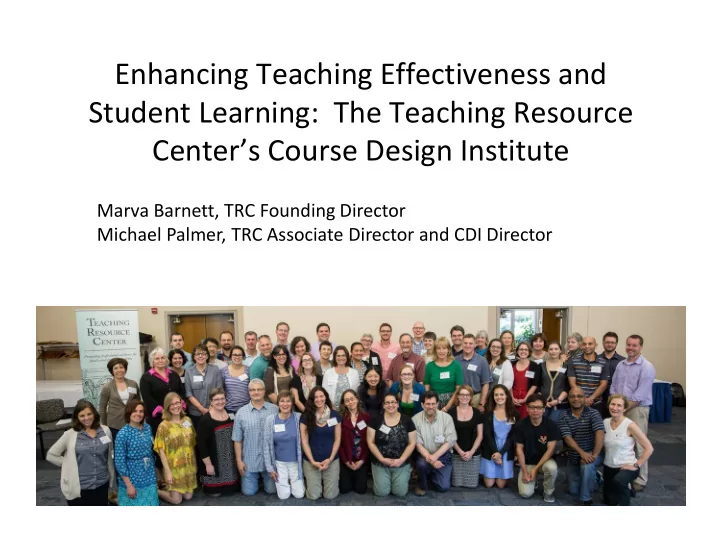
  1. Enhancing Teaching Effectiveness and Student Learning: The Teaching Resource Center’s Course Design Institute Marva Barnett, TRC Founding Director Michael Palmer, TRC Associate Director and CDI Director

  2. Course Design Institute During the Institute, participants… design or redesign a course built • on learner-centered design principles Backward Design develop a final or near-final • syllabus 2 learn how to apply research- • 1 based teaching and learning principles to design other courses. 3 Integrated Design

  3. Annual participation N=215

  4. Participant profile N=215

  5. Assessing impact Students’ learning Students’ teaching observation perceptions about the Participants’ participants’ teaching teaching performance performance Participants’ beliefs, knowledge, and practices 1. self-efficacy about teaching Participants’ & learning perceptions 2. syllabus toolbox and perception survey satisfaction 3. syllabus rubric with the seminar Kreber, C., & Brook, P. (2001). Impact evaluation of educational development programmes. International Journal for Academic Development , 6(2), 96-108.

  6. Participants’ perceptions & satisfaction Overwhelmingly positive participant feedback:  Overall, 215 participants rated the 2008-2014 Institutes 4.76/5.00.  100% of participants said they would recommend CDI to a colleague. Representative comments:  This is by far the best teaching workshop I have ever attended . The content was interesting and the instructors really practiced what they preached with respect to learning techniques.  The institute gave me life! And it totally changed my approach to course design and teaching .  In two words: [the CDI experience was] life-altering . This may seem overblown, but it is 100% true. I came in thinking I had a handle on my course, but realized very soon I needed to go back to the drawing board. The result is exponentially improved.

  7. Participants’ practices Rubric quantitatively scores syllabi using criteria typical of learning- centered environments: 1. learning goals and objectives 2. assessment activities 3. learning activities 4. schedule 5. overall learning environment

  8. Pre-CDI learning-focused: 2 (6.1%) transitional: 7 (21.2%) * 2 nd CDI content-focused: 24 (72.7%)

  9. Post-CDI learning-focused: 21 (63.6%) transitional: 10 (30.3%) content-focused: 2 (6.1%)

  10. high-gain: 13 (39.4%) moderate-gain: 14 (42.4%) low-gain: 5 (15.2%) no-gain: 1 (3.0%) % <gain> avg = 60.0

  11. Statistics Criterion t(32) p Overall 10.41 < .001 Learning Goals & 7.53 < .001 Objectives Assessment Activities 8.05 < .001 Schedule 2.65 .006 Overall Learning 10.62 < .001 Environment H 0 : post-CDI syllabi scores are not greater than pre-CDI syllabi scores

  12. Adapting and scaling CDI Demographic-specific CDIs (e.g. Nucleus, Hybrid Challenge) • Condensed-format CDIs • Online CDI: c 3 Design •

  13. post- assessment; syllabus analysis c 3 Design learner- create course centered objectives class/course create tutorials, /curriculum determine header info resources, situational worksheets, Store data; identify factors templates similar courses from database knowledge check Determine scope (e.g. class, course, or tutorials, curriculum) & resources, develop create delivery mode (e.g. worksheets, learning goals description self-guided, blended, templates add to social media) integration map map; analyze convert to create objectives knowledge learning objectives onto Fink’s check optional: draw from objectives Taxonomy database for suggestions knowledge check add to integration tutorials, map; analyze create macro resources, develop macro assessments worksheets, assessments optional: draw from templates User-controlled database for interaction suggestions knowledge Computer-controlled check interaction add to integration Computer-generated, tutorials, develop map; analyze user-modifiable resources, create activity learning output worksheets, plan optional: draw from activities templates database for Integration map suggestions processing and analysis knowledge schedule check Database storage, retrieval Syllabus component

  14. Enhancing Teaching Effectiveness and Student Learning: The Teaching Resource Center’s Course Design Institute Marva Barnett, TRC Founding Director Michael Palmer, TRC Associate Director and CDI Director

Recommend


More recommend