Energy Informatics - Computer Science for Power and Energy Systems - - PowerPoint PPT Presentation

energy informatics computer science for power and energy
SMART_READER_LITE
LIVE PREVIEW

Energy Informatics - Computer Science for Power and Energy Systems - - PowerPoint PPT Presentation

Technische Universitt Technische Universitt Mnchen Mnchen Energy Informatics - Computer Science for Power and Energy Systems of the Future Martin Sachenbacher and Martin Leucker ECSS-09, Paris, France October 8, 2009 Martin Leucker


slide-1
SLIDE 1

Technische Universität München

Martin Leucker

Technische Universität München
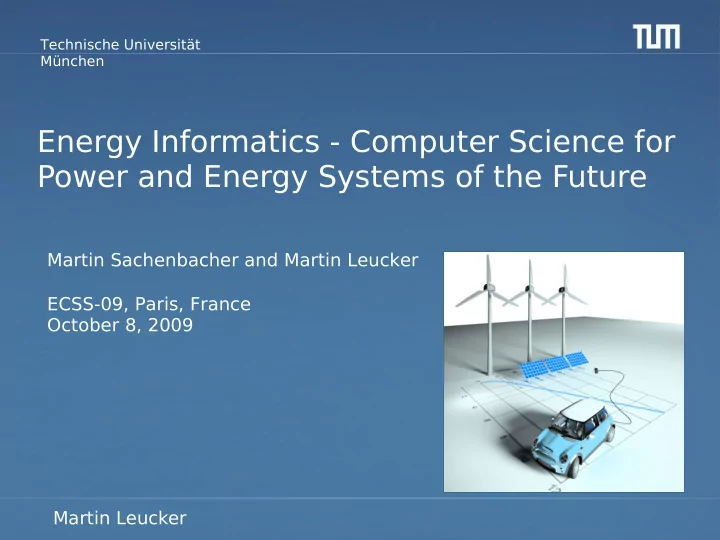
Energy Informatics - Computer Science for Power and Energy Systems of the Future

Martin Sachenbacher and Martin Leucker ECSS-09, Paris, France October 8, 2009

slide-2
SLIDE 2

Technische Universität München

Martin Leucker

Energy Informatics?

The application and adaption of the large body of achievements in Informatics for addressing the challenges in the Energy Domain.

slide-3
SLIDE 3

Technische Universität München

Martin Leucker

Reducing energy consumption

Of buildings - SmartHouses Of computer systems – Green IT Of (Embedded) Systems

slide-4
SLIDE 4

Technische Universität München

Martin Leucker

How to reduce energy consumption?

Analyse and Optimize energy consumption of

Buildings, Computers, All kind of systems

using modeling, analysis, and optimization techniques meanwhile standard in computer science Optimize energy consumption using ICT by

Monitoring, Diagnosis, and Planning

Again – with techniques from computer science actually deployed in the final system

slide-5
SLIDE 5

Technische Universität München

Martin Leucker

Expansion of Renewable Energy: DESERTEC

slide-6
SLIDE 6

Technische Universität München

Martin Leucker

Expansion of Renewable Energy: Small Producers

Farmer transforms into an Energy Farmer managing an Energy Farm

slide-7
SLIDE 7

Technische Universität München

Martin Leucker

Challenge: Renewable Energy Buffering

  • Energy supply becomes increasingly fluctuating/uncertain

due to weather-dependent energy sources (wind and solar power) Goal: shift peak demands by integrating storage devices in grid to store energy in an optimal manner.

slide-8
SLIDE 8

Technische Universität München

Martin Leucker

Challenge: Risk Analysis - T rust?

How to model and analyze the reliability of producers?

slide-9
SLIDE 9

Technische Universität München

Martin Leucker

Germany‘s National Electrical Mobility Plan

  • Bring one million electrical vehicles (EVs) to the streets by

2020

  • Reduce carbon emissions and dependency on fossil

resources

  • Information & communication technology (ICT) plays major

role

Demand-oriented power production

Supply-oriented power consumption

„Prosumers“ buy and sell energy

Martin Leucker

slide-10
SLIDE 10

Technische Universität München

Martin Leucker

E-T

  • ur Allgäu Project
  • Show how sustainable electrical transportation using local

and renewable energy can be realized in a rural, touristic region

  • Diverse fleet of 30 EVs, operated and monitored under

typical modes of usage (e.g., commuting to nearby Munich)

  • Funding: 5,8 MEuros, duration: 2009-2011
slide-11
SLIDE 11

Technische Universität München

Martin Leucker

Allgäu Model Region

slide-12
SLIDE 12

Technische Universität München

Martin Leucker

Challenge: Cruising Range Prediction and Energetic Route Optimization

  • Limited battery capacity (100-150 km), recharging takes hours
  • Goal: accurately predict energy consumption for specific route

segments, perform energy-based route optimization

Depends on distance and elevation profile, traffic conditions, weather, battery state, vehicle dynamics, driver behavior, etc.

Reason from mixed discrete-continuous and stochastic models

slide-13
SLIDE 13

Technische Universität München

Martin Leucker

Reasoning with Hybrid Constraint Models

(Maier Sachenbacher CPAIOR 2008, PHM 2009)

  • Model discrete-continuous systems with HyPHCA (Hybrid

Probabilistic Hierarchical Constraint Automata)

  • Discretize continuous part using PHAVer (Polyhedral

Hybrid Automaton Verifier)

  • Find solutions using constraint solver (T
  • ulbar2, GeCode,

…)

slide-14
SLIDE 14

Technische Universität München

Martin Leucker

Challenge: Renewable Energy Buffering

  • Goal: shift peak demands by integrating Electric Vehicles

in the power grid to store energy

slide-15
SLIDE 15

Technische Universität München

Martin Leucker

Optimal Energy Buffering under Constraints

  • n Probability of Failure
  • Goal: Maximize storage effectiveness, while minimizing mobility risk

– Given model of physical battery behavior and stochastic model of human car

usage (when will the car be driven)

– Compute control strategy that maximizes effectiveness of energy buffering,

but keeps mobility risk (possibility that user cannot drive car because of insufficient charge) below a certain threshold

  • Promising approach: Iterative risk allocation for model-predictive control with a

joint chance constraint (Ono Williams AAAI 2008)

– Finds control strategy that maximizes expected performance in dynamic

system with uncertainty, while constraining that probability of failure is below an upper bound (pfail < 0.01)

slide-16
SLIDE 16

Technische Universität München

Martin Leucker

Iterative Risk Allocation (Ono Williams AAAI 2008)

  • Dynamic system x(t+1) = Ax(t) + But with uncertainty

(disturbance, …)

  • Find u1 … ut with probabilistic guarantee pfail < 0.01 (chance

constraint)

  • Iterative algorithm:

compute best control strategy using current risk allocation

decrease/increase risk where constraint is inactive/active

slide-17
SLIDE 17

Technische Universität München

Martin Leucker

Challenge: Fully automatic markets

The Electric Vehicle has to sell and buy energy automatically – on a dynamically changing market place

slide-18
SLIDE 18

Technische Universität München

Martin Leucker

Conclusions

Some challenges of the energy domain Reducing energy consumption Energy Production

Volatile renewable energy production Large number semi-trustable energy producers

Shift towards Electro mobile vehicles ICT can help to address these challenges by using

Modeling Analysis, and Optimization