
SLIDE 1
Emergency Telecommunications in Bangladesh
29 March 2006 Prepared by: Fazlur Raman
Emergency Telecommunications in Bangladesh Prepared by: 29 March - - PowerPoint PPT Presentation
Emergency Telecommunications in Bangladesh Prepared by: 29 March 2006 Fazlur Raman Bangladesh One the most Disaster Prone Countries of the World At least 34 cyclones ravaged the coastline over last four decades, claiming more
29 March 2006 Prepared by: Fazlur Raman
Bangladesh
One the most Disaster Prone Countries of the World
⇑ ↑
Cyclone / Storm Surges are part of life in Bangladesh & people live in coastal areas for survival. Access to basic telecommunication for these courageous people be considered as fundamental human right. Provide disaster proof Emergency Telecommunications services for Coastal Belt of Bangladesh Cyclone shelters be provided with Telephone services & used for Public Call Office (PCO); Tele-Medicine & Tele-Education purposes.
Many Chars have neither Coastal Dikes nor Cyclone
Cyclone Shelters for a population of 13 million. Number
1500, but it is still quite inadequate. The most disaster prone areas of Bangladesh are off-shore islands in Bay of Bengal and the river banks. Little or no telecommunication facilities are available there.
Improve forecasting and communication facilities to enhance national capabilities to respond effectively to disaster reduce impacts of adversity. Reliable communications are an essential requirement for effective disaster management.
Telecommunications are indispensable tool for disaster mitigation and for co-ordination of international and national responses to disasters. .
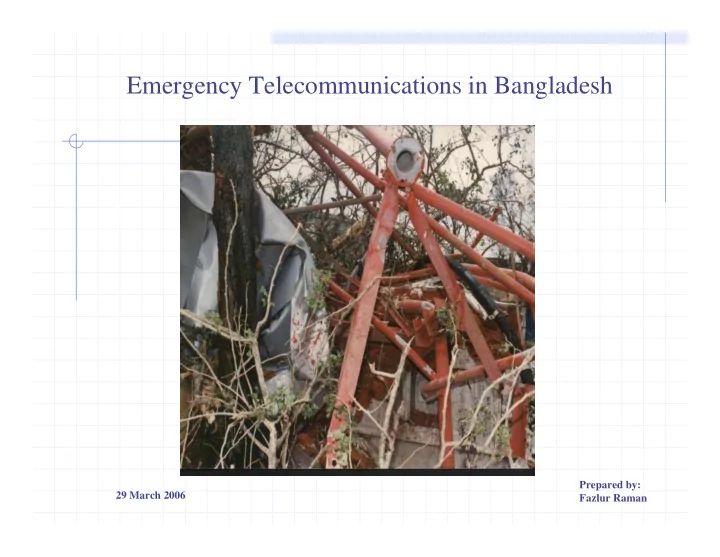
Following April 1991 cyclone, national and international telecommunications were interrupted due to the collapse of vital microwave tower at Chittagong. Bangladesh was cut off from the rest of the world for several days before the services could be partially restored.
BTTB / Private Operators had little or no telecommunication network in most disaster prone coastal areas of Bangladesh till a few years back. Adaptation of wireless technologies like Cellular; WLL; Radio Trunking; VSAT, Internet etc. by BTTB as well as by Private Operators are changing the scenario fast.
National Backbone Network of BTTB
Phulbaria Sripur Talibabad Shajibazar Zorarganj Chiringa Betbunia Mahalchhari MunshiganjExisting Transmission Lines Fiber Optic Cable under installation Digital MW Link under installation
Faridpur Madaripur Shariatpur Narshindi www.aktel.com
CLEARLY AHEAD CLEARLY AHEAD
www.aktel.com
Coverage end 2005 (Network Capacity 3.1 M)
Note: Predicted site radius is 5 Km
radio network area covered 51.7% Aktel radio network covers 6 divisions 61 districts 351 upazilla / Thana
BRAC CENTER MASCOT PLAZA FARUK CHAMBER
Nobinagar Delduar Nawabganj Shibchar Baniarchar Rupsha Gopalganj Goiripur Falgunkara Lemua Wahidpur Faudzarhat Alekharchor
UDOY
AKTEL SDH Backbone Network Capacity Plan Yr 2005-2006
Sylhet Bogra MW: 2xSTM-1 OF: STM-16
Budhanti Saistaganj Debpara Kurua Narayanpur Ghorashal
Khulna
ADM-16/TX HUB
16
Fiber Optic BKB /Spur/ADM-1 Nimgachi Enayetpur
SILVER
Kanchpur
AZAD
Anwara Jaldi Dulhazra Pekua Baitush Sharaf Madarganj Nandina Ghonoshyampur Ishwarganj Atpara Khaliajuri Diraj Sunamganj HW Mushulli Manikkhali Roghunathpuri Pirganj Gobindaganji Bagerhat Pirozpur Jhalokhati Barishal Bhola Karunanagar Char Clarke Sandwip Chapai Bypass Uttara Ganobhaban Ronobhanga Bazar Sariakandi Pubail Munshirhat Nawabpur Khajuria Neptune Tea Estate Pairabandh Bhobanipur Dalua Apil Gate Bashundia Bazar Barobazar Hatgopal Kulbaria Mirpur Pakshi Dhanaydda Balirtek Jhtka Goalanda Kamarkhali Sirajband Ranirbandar
2XSTM-1 2XSTM-1 2XSTM-1
Spur Towers Backbone Towers Border Sea Shore District Borber Spur Links Backbone Links
SDH Backbone Network
Tower District
Backbone (75m)/Spur (55m) 44 BTS Green Field (42m) 17 CTG Hill Tracts 3 Total 64
Mobile Operator – Market Share
2005
AKTEL 30% GP 53%
9% CityCell 5% TeleTalk 3%
2003
AKTEL 22% GP 64%
3% CityCell 11% TeleTalk 0%
2004
AKTEL 29% GP 62%
1% CityCell 8% TeleTalk 0%
Should provide Telecommunication facilities for (a) Administrative Organs and Public Institutions dealing with Disaster Management (b) Disaster / Cyclone / Flood Relief Shelters (c)Actual areas where the disaster strikes.
The administrative organs and public institutions designated by Disaster Management Bureau are to be linked together by BTTB network as well as Private Operators network to provide redundancies. It should enable the headquarters to broadcast urgent information to all the organs / bodies at once.
Telecommunication for Cyclone / Flood Relief Shelters
Disaster Relief Shelters are the focal areas where people in distress take shelters. These are normally located in remote areas, where generally no telecommunication facilities are available. Telecommunications in Cyclone Shelters must be used regularly to ensure its operation during emergencies.
Cyclone / Flood Relief Shelter are to be used for Multi Purpose activities like Public Call Office (PCO); Hospitals (Tele-Medicine) and Schools (Tele- Education) purposes and that will ensure operation of Telecommunication Links during a disaster.
Emergency Operation Centre / Control Room With HF Radio Communication
Telecommunication Network of Cyclone Preparedness Programme in the Coastal Belt of Bangladesh
HF Radio provide Amateur Radio Services & Economic Telecommunications particularly suiting NGOs, international and national aid responses to disasters. .
Eternal Vigilance with Emergency Telecommunication is the Price to be paid for Disaster Management in Bangladesh
fazlur@aktel.com