
SLIDE 1
1 SKA-EMBRACE, Steve Torchinsky, 21cm Paris Intensity Mapping Workshop, 4 June 2014
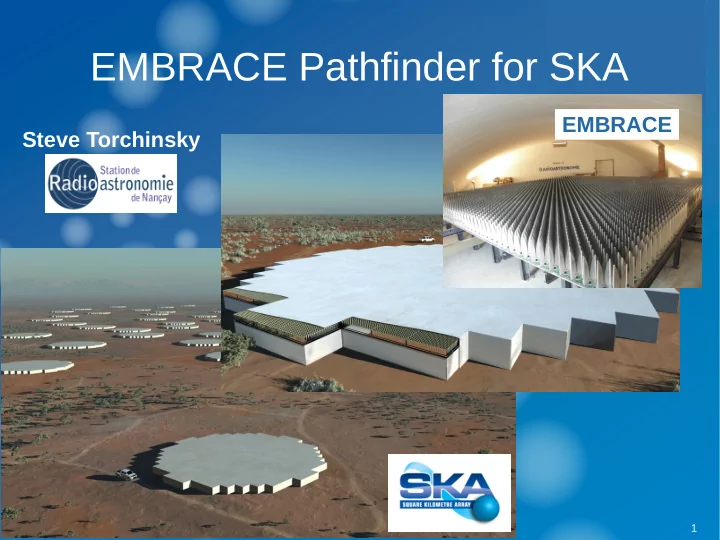
EMBRACE Pathfinder for SKA EMBRACE Steve Torchinsky 1 - - PowerPoint PPT Presentation
EMBRACE Pathfinder for SKA EMBRACE Steve Torchinsky 1 SKA-EMBRACE, Steve Torchinsky, 21cm Paris Intensity Mapping Workshop, 4 June 2014 Dense Aperture Plane Array Fully sampled, unblocked aperture Large field of view (~100 sq. deg) `
1 SKA-EMBRACE, Steve Torchinsky, 21cm Paris Intensity Mapping Workshop, 4 June 2014
SKA-EMBRACE, Steve Torchinsky, 21cm Paris Intensity Mapping Workshop, 4 June 2014 2
`
4 SKA-EMBRACE, Steve Torchinsky, 21cm Paris Intensity Mapping Workshop, 4 June 2014
SKA-EMBRACE, Steve Torchinsky, 21cm Paris Intensity Mapping Workshop, 4 June 2014 5
EMBRACE is an AAmid Pathfinder for SKA
Largely funded within EC FP6 Project SKADS (2005-09) For EMBRACE: ASTRON: Project Leader, overall architecture, antennas,
Nançay: Beamformer Chip, Monitoring and Control Software MPI Bonn and INAF Medicina: design of multiplexing circuits for
Two demonstrators built. One at Westerbork (132 tiles) and one at
SKA-EMBRACE, Steve Torchinsky, 21cm Paris Intensity Mapping Workshop, 4 June 2014 6
SKA-EMBRACE, Steve Torchinsky, 21cm Paris Intensity Mapping Workshop, 4 June 2014 7
Nançay: 4608 Vivaldi antenna elements Westerbork: 9504 Vivaldi antenna elements Single polarization (second polarization antennas are in place, but only one
polarization has a complete signal chain)
4 level hierarchical analog beamforming/signal summing
Beamformer chip:
−
4 inputs, 2 outputs (2 independent beams)
−
45º phase steps
Analog summing output from 3 beamformer chips
Analog summing of 6 inputs = 1 tile (72 elements)
15m cable → Analog summing of 4 inputs = 1 tileset
Down conversion
(16 A-beam, and 16 B-beam)
(132 A-beam, and 33 B-beam)
SKA-EMBRACE, Steve Torchinsky, 21cm Paris Intensity Mapping Workshop, 4 June 2014 8
500 – 1500 MHz
– But high pass filter at 900 MHz to avoid digital television
Nançay: 70 m2 (8.5m X 8.5m) Westerbork: 148 m2 (12.7m X 11.6m) Instantaneous RF band: 100 MHz Maximum instantaneous beam formed:
– Can trade off band width vs. number of beams – Nançay
– Westerbork
4 elements phased Together in the Beamformer microchip
11 SKA-EMBRACE, Steve Torchinsky, 21cm Paris Intensity Mapping Workshop, 4 June 2014
4 elements phased Together in the Beamformer microchip
3 beamchips on a Hexboard (12 elements)
6 hexboards in a tile (72 elements)
6 hexboards in a tile (72 elements)
4 tiles in a tileset (288 elements)
SKA-EMBRACE, Steve Torchinsky, 21cm Paris Intensity Mapping Workshop, 4 June 2014 18
SKA-EMBRACE, Steve Torchinsky, 21cm Paris Intensity Mapping Workshop, 4 June 2014 19
SKA-EMBRACE, Steve Torchinsky, 21cm Paris Intensity Mapping Workshop, 4 June 2014 20
SKA-EMBRACE, Steve Torchinsky, 21cm Paris Intensity Mapping Workshop, 4 June 2014 21
SKA-EMBRACE, Steve Torchinsky, 21cm Paris Intensity Mapping Workshop, 4 June 2014 22
Pulsar acquisition system provided by
Aris Karastergiou
LOFAR Remote Station Processing Boards for digital beamforming
SKA-EMBRACE, Steve Torchinsky, 21cm Paris Intensity Mapping Workshop, 4 June 2014 23
SKA-EMBRACE, Steve Torchinsky, 21cm Paris Intensity Mapping Workshop, 4 June 2014 24
SKA-EMBRACE, Steve Torchinsky, 21cm Paris Intensity Mapping Workshop, 4 June 2014 25
Pulsar B0329+54 1175.6MHz 6 November 2012 >9 hours tracking EMBRACE@Nançay connected to ARTEMIS backend (courtesy U. Oxford)
SKA-EMBRACE, Steve Torchinsky, 21cm Paris Intensity Mapping Workshop, 4 June 2014 26
SKA-EMBRACE, Steve Torchinsky, 21cm Paris Intensity Mapping Workshop, 4 June 2014 27
SKA-EMBRACE, Steve Torchinsky, 21cm Paris Intensity Mapping Workshop, 4 June 2014 28
SKA-EMBRACE, Steve Torchinsky, 21cm Paris Intensity Mapping Workshop, 4 June 2014 29
SKA-EMBRACE, Steve Torchinsky, 21cm Paris Intensity Mapping Workshop, 4 June 2014 30
be done simultaneously with EMBRACE (multibeams)
SKA-EMBRACE, Steve Torchinsky, 21cm Paris Intensity Mapping Workshop, 4 June 2014 31
Cygnus A Same data! (before/after fix)
GPS satellite (strong source) No change
Stable background “image” due to correlator offset
SKA-EMBRACE, Steve Torchinsky, 21cm Paris Intensity Mapping Workshop, 4 June 2014 32
SKA-EMBRACE, Steve Torchinsky, 21cm Paris Intensity Mapping Workshop, 4 June 2014 33
Image by deepskycolors.com
SKA-EMBRACE, Steve Torchinsky, 21cm Paris Intensity Mapping Workshop, 4 June 2014 34
OFF timeline shifted to align with ON (i.e. same Az-El pointing, earlier time) (ON – OFF)/OFF Baseline fit and interpolate past RFI channels Spectrum of M33
SKA-EMBRACE, Steve Torchinsky, 21cm Paris Intensity Mapping Workshop, 4 June 2014 35
SKA-EMBRACE, Steve Torchinsky, 21cm Paris Intensity Mapping Workshop, 4 June 2014 36
(nearly) daily monitoring of pulsar B0329+54 at 970MHz and 1176MHz simultaneously
accretion events in the long term (see e.g. Brook et al. ArXiv:1311.3541v1)
82 observations at 970MHz to date
SKA-EMBRACE, Steve Torchinsky, 21cm Paris Intensity Mapping Workshop, 4 June 2014 37
between 18 Nov 2013 and 1 June 2014
system
SKA-EMBRACE, Steve Torchinsky, 21cm Paris Intensity Mapping Workshop, 4 June 2014 38
between 18 Nov 2013 and 1 June 2014
system
SKA-EMBRACE, Steve Torchinsky, 21cm Paris Intensity Mapping Workshop, 4 June 2014 39
SKA-EMBRACE, Steve Torchinsky, 21cm Paris Intensity Mapping Workshop, 4 June 2014 40
SKA-EMBRACE, Steve Torchinsky, 21cm Paris Intensity Mapping Workshop, 4 June 2014 41
– daily pulsar B0329+54 at two frequencies: 970MHz 1176MHz
– repeat M33: spectroscopic detection of a galaxy – mapping M31 with multibeams (M31 is the Andromeda Galaxy) – M42 Radio Recombination Lines (M42 is the Orion Nebula)
– Intensity mapping together with PAON-4
– implement improved calibration for tilesets
– use full bandwidth: i.e. 186 beamlets
– 3-lane data acquisition from the RSPs – acquisition on UNIBOARD with integrated real-time RFI flagging – simultaneous data acquisition of the same beam on different acquisition systems
(ARTEMIS and UNIBOARD)
SKA-EMBRACE, Steve Torchinsky, 21cm Paris Intensity Mapping Workshop, 4 June 2014 42