The Australian SKA Pathfinder Tobias Westmeier CSIRO Astronomy and - - PowerPoint PPT Presentation

the australian ska pathfinder
SMART_READER_LITE
LIVE PREVIEW

The Australian SKA Pathfinder Tobias Westmeier CSIRO Astronomy and - - PowerPoint PPT Presentation

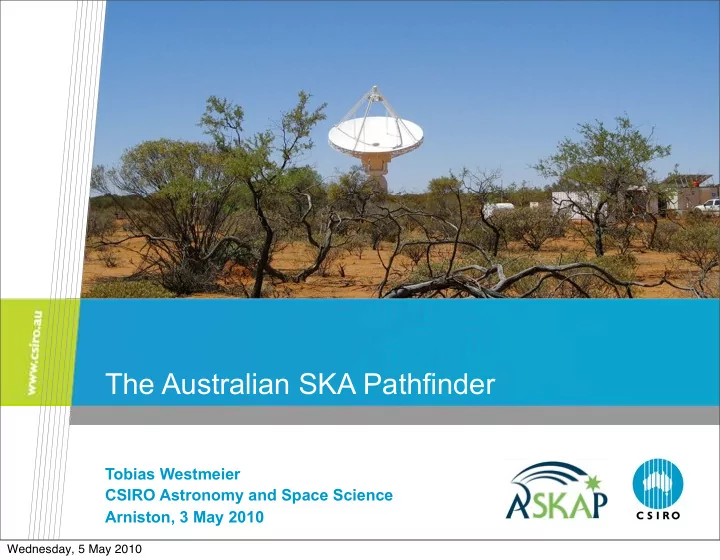
The Australian SKA Pathfinder Tobias Westmeier CSIRO Astronomy and Space Science Arniston, 3 May 2010 Wednesday, 5 May 2010 What is ASKAP? Australian Square Kilometre Array Pathfinder Located near Boolardy, Western Australia

slide-1
SLIDE 1

The Australian SKA Pathfinder

Tobias Westmeier CSIRO Astronomy and Space Science Arniston, 3 May 2010

Wednesday, 5 May 2010

slide-2
SLIDE 2
  • CSIRO. ASKAP Simulations

What is ASKAP?

  • Australian Square Kilometre Array Pathfinder
  • Located near Boolardy, Western Australia
  • Precursor telescope of the Square Kilometre Array (SKA)
  • Demonstrator for new receiver technologies

Wednesday, 5 May 2010

slide-3
SLIDE 3
  • CSIRO. ASKAP Simulations

Where will ASKAP be located?

Perth Sydney Brisbane Melbourne Adelaide Darwin Alice Springs WESTERN AUSTRALIA NORTHERN TERRITORY SOUTH AUSTRALIA QUEENSLAND NEW SOUTH WALES VICTORIA TASMANIA Hobart ACT Canberra Murchison Radio Astronomy Observatory Wednesday, 5 May 2010

slide-4
SLIDE 4
  • CSIRO. ASKAP Simulations

MRO Support Facility – Geraldton

Perth WESTERN AUSTRALIA Geraldton Murchison

  • Maintenance
  • Operations
  • Outreach

420 km Wednesday, 5 May 2010

slide-5
SLIDE 5
  • CSIRO. ASKAP Simulations

Shire of Murchison

Geraldton Murchison Boolardy Monkey Mia Carnarvon Lake Macleod WESTERN AUSTRALIA 3 5 k m

Shire of Murchison:

  • 50,000 km²
  • 0 gazetted towns
  • 29 sheep/cattle stations
  • 160 population
  • 41,500 km²
  • 431 municipalities
  • 16,493,156 pop.

The Netherlands:

Wednesday, 5 May 2010

slide-6
SLIDE 6
  • CSIRO. ASKAP Simulations

Murchison Radio Astronomy Observatory

Wednesday, 5 May 2010

slide-7
SLIDE 7
  • CSIRO. ASKAP Simulations

Murchison Radio Astronomy Observatory

Wednesday, 5 May 2010

slide-8
SLIDE 8
  • CSIRO. ASKAP Simulations

Radio Frequency Interference

Light Pollution 131 MHz (FORTE)

Wednesday, 5 May 2010

slide-9
SLIDE 9
  • CSIRO. ASKAP Simulations

Radio Frequency Interference

Wednesday, 5 May 2010

slide-10
SLIDE 10
  • CSIRO. ASKAP Simulations

Radio Frequency Interference

Wednesday, 5 May 2010

slide-11
SLIDE 11
  • CSIRO. ASKAP Simulations

Radio Frequency Interference

Sydney

Population: 4 × 10⁶

Narrabri

Population: 9 × 10³

Boolardy

Population: a few

Wednesday, 5 May 2010

slide-12
SLIDE 12
  • CSIRO. ASKAP Simulations

Proposed Location for the SKA

  • Australia ideal for the SKA
  • Low RFI environment
  • Plenty of space
  • Good infrastructure
  • Commitment of OZ and

NZ governments

Wednesday, 5 May 2010

slide-13
SLIDE 13
  • CSIRO. ASKAP Simulations

Proposed Location for the SKA

5 5 k m

Wednesday, 5 May 2010

slide-14
SLIDE 14
  • CSIRO. ASKAP Simulations

ASKAP Timeline

Dec 2009 Antenna 1 deployed Nov 2010 Fibre link installed Nov/Dec 2010 Delivery of antennas 2 – 6 Feb – Sep 2011 BETA installation and commissioning tests May 2011 Mid-term review of Survey Science Projects June 2011 BETA early science Dec 2011 All 36 antennas delivered Mid 2012 Final review of Survey Science Projects Q4 2012 ASKAP complete Early 2013 Beginning of science operations 2010 2011 2012 2013

SSP mid-term review SSP final review first antenna deployed today ASKAP complete beginning

  • f science
  • perations

delivery antennas 2 – 6 all 36 antennas delivered BETA early science

Wednesday, 5 May 2010

slide-15
SLIDE 15
  • CSIRO. ASKAP Simulations

ASKAP Design Goals

  • High dynamic range, wide-field imaging
  • Number of antennas

36 (630 baselines)

  • Antenna diameter

12 m

  • Maximum baseline

6 km (30 antennas inside 2 km)

  • Angular resolution

10 arcsec

  • Sensitivity

65 m²/K

  • Frequency range

700 – 1800 MHz

  • Focal plane phased array

192 elements

  • Field of view

30 deg²

  • Processed bandwidth

300 MHz

  • Number of channels

16 384

  • Integration time

5 s

Wednesday, 5 May 2010

slide-16
SLIDE 16
  • CSIRO. ASKAP Simulations

ASKAP Design Goals

  • High dynamic range, wide-field imaging
  • Number of antennas

36 (630 baselines)

  • Antenna diameter

12 m

  • Maximum baseline

6 km (30 antennas inside 2 km)

  • Angular resolution

10 arcsec

  • Sensitivity

65 m²/K

  • Frequency range

700 – 1800 MHz

  • Focal plane phased array

192 elements

  • Field of view

30 deg²

  • Processed bandwidth

300 MHz

  • Number of channels

16 384

  • Integration time

5 s

Wednesday, 5 May 2010

slide-17
SLIDE 17
  • CSIRO. ASKAP Simulations

First ASKAP Antenna Deployed

  • First ASKAP antenna shipped to Australia and installed on site

in December 2009.

Wednesday, 5 May 2010

slide-18
SLIDE 18
  • CSIRO. ASKAP Simulations

First ASKAP Antenna Deployed

Wednesday, 5 May 2010

slide-19
SLIDE 19
  • CSIRO. ASKAP Simulations
  • Antennas built by 54th Research

Institute of China Electronics Technology Group Corporation (CETC54).

  • Azimuth / elevation mount with

elevation range of +15° to +89°.

  • Third (polarisation) axis: dish can

rotate by ±180° to keep orientation fixed w.r.t. the sky.

  • Slender support legs to minimise

aperture obstruction.

Antenna Design

Wednesday, 5 May 2010

slide-20
SLIDE 20
  • CSIRO. ASKAP Simulations

Antenna Design

◄ The polarisation axis in action ▲ Installation of the receiver housing

Wednesday, 5 May 2010

slide-21
SLIDE 21
  • CSIRO. ASKAP Simulations

First VLBI Fringes

  • First VLBI fringes on 22 April between ASKAP and Mopra!
  • First trans-Tasman fringes (ASKAP–Warkworth) on 23 April!

More to come soon!

Wednesday, 5 May 2010

slide-22
SLIDE 22
  • CSIRO. ASKAP Simulations

ASKAP Design Goals

  • High dynamic range, wide-field imaging
  • Number of antennas

36 (630 baselines)

  • Antenna diameter

12 m

  • Maximum baseline

6 km (30 antennas inside 2 km)

  • Angular resolution

10 arcsec

  • Sensitivity

65 m²/K

  • Frequency range

700 – 1800 MHz

  • Focal plane phased array

192 elements

  • Field of view

30 deg²

  • Processed bandwidth

300 MHz

  • Number of channels

16 384

  • Integration time

5 s

Wednesday, 5 May 2010

slide-23
SLIDE 23
  • CSIRO. ASKAP Simulations

ASKAP Array Configuration

  • Initial array configuration
  • Spectral line:
  • Inner 30 antennas only,
  • max. baseline 2 km.
  • Resolution: 30 arcsec at

1.4 GHz.

  • Continuum:
  • 36 antennas in 6 km array.
  • Resolution: 10 arcsec at

1.4 GHz.

Gupta, Johnston, Feain & Cornwell (2008) Wednesday, 5 May 2010

slide-24
SLIDE 24
  • CSIRO. ASKAP Simulations

uv Coverage and Beam Size

Beam size of full array at natural weighting.

−50° −10° 0°

Wednesday, 5 May 2010

slide-25
SLIDE 25
  • CSIRO. ASKAP Simulations

Synthesised Beam at 1.4 GHz and δ = −30°

Uniform weighting FWHM: 18.9 arcsec Sidelobes: −5.5%…+3.1% Natural weighting FWHM: 27.5 arcsec Sidelobes: −2.4%…+4.9%

Wednesday, 5 May 2010

slide-26
SLIDE 26
  • CSIRO. ASKAP Simulations

ASKAP Design Goals

  • High dynamic range, wide-field imaging
  • Number of antennas

36 (630 baselines)

  • Antenna diameter

12 m

  • Maximum baseline

6 km (30 antennas inside 2 km)

  • Angular resolution

10 arcsec

  • Sensitivity

65 m²/K

  • Frequency range

700 – 1800 MHz

  • Focal plane phased array

192 elements

  • Field of view

30 deg²

  • Processed bandwidth

300 MHz

  • Number of channels

16 384

  • Integration time

5 s

Wednesday, 5 May 2010

slide-27
SLIDE 27
  • CSIRO. ASKAP Simulations

Phased Array Feed

PAF prototype installed on the 12-m Parkes testbed antenna ► John O’Sullivan with the PAF prototype ◄

Wednesday, 5 May 2010

slide-28
SLIDE 28
  • CSIRO. ASKAP Simulations

Phased Array Feed

Final FoV and sensitivity will depend on details of beam-forming.

Moon

Wednesday, 5 May 2010

slide-29
SLIDE 29
  • CSIRO. ASKAP Simulations

30 deg² Field of View

1° M87 M86 M84 M90 M89 M58 M59 M60

Virgo Cluster

Wednesday, 5 May 2010

slide-30
SLIDE 30
  • CSIRO. ASKAP Simulations

30 deg² Field of View

1° M87 M86 M84 M90 M89 M58 M59 M60

Virgo Cluster

Wednesday, 5 May 2010

slide-31
SLIDE 31
  • CSIRO. ASKAP Simulations

30 deg² Field of View

1° M87 M86 M84 M90 M89 M58 M59 M60

Virgo Cluster

VLA 1.4 GHz

Wednesday, 5 May 2010

slide-32
SLIDE 32
  • CSIRO. ASKAP Simulations

Survey Science Projects

  • 30 deg² field of view → ASKAP will be a survey machine.
  • Over the first 5 years of operation
  • 75% will be devoted to large survey science projects (SSPs).
  • 25% will be given to smaller guest science proposals.
  • Survey science projects are large projects with > 1500 h.
  • Open, international, competitive process set up for submission
  • f expressions of interest and proposals.
  • SSP proposals were evaluated by committee of international

experts with a broad range of proficiencies.

  • A total of 10 SSPs were invited to work with ATNF through the

design study phase.

  • Origin of SSP team members:
  • 30% Australia, 30% Europe, 30% North America, 10% other.

Wednesday, 5 May 2010

slide-33
SLIDE 33
  • CSIRO. ASKAP Simulations

SSPs “A Group”

  • WALLABY (PIs: B. Koribalski, L. Staveley-Smith)
  • Widefield ASKAP L-band Legacy All-sky Blind Survey
  • Extragalactic neutral hydrogen survey
  • 75% of the entire sky
  • Up to 500,000 galaxies out to a redshift of 0.26
  • Aims: H I properties and large-scale distribution of galaxies, galaxy formation, missing satellites

problem, evolution and star formation, mergers and galaxy interactions, H I mass function, distribution and evolution of cool gas, cosmological parameters, nature of the cosmic web

  • EMU (PI: R. Norris)
  • Evolutionary Map of the Universe
  • Deep radio continuum survey (10 µJy/beam rms)
  • 75% of the entire sky
  • Aims: probing star forming galaxies to redshift 1, powerful starbursts to even greater redshifts,

AGN to the edge of the universe, discovering new classes of rare objects, trace the evolution of star forming galaxies and massive black holes throughout the history of the universe, explore large-scale structure Wednesday, 5 May 2010

slide-34
SLIDE 34
  • CSIRO. ASKAP Simulations

SSPs “A− Group”

  • GASKAP (PIs: J. Dickey, N. McClure-Griffiths)
  • Galactic ASKAP Spectral Line Survey
  • H I and OH in Milky Way and Magellanic System
  • 10 × improvement in brightness sensitivity and

angular resolution

  • Aims: OH masers from evolved stars and star formation regions, diffuse emission from molecular

and atomic clouds, H I absorption towards background continuum sources and the structures in the gas that trace the effects of stellar winds and supernova explosions, stunning images of the ISM

  • DINGO (PI: M. Meyer)
  • Deep Investigation of Neutral Gas Origins
  • Evolution of H I from the current epoch to z ≈ 0.5
  • Legacy dataset spanning cosmologically repre-

sentative volumes

  • Aims: key cosmological distributions, including ΩH I, H I mass function and halo occupation

distribution function, combined with optical data to enable study of co-evolution of stellar, baryonic and dark matter content of galaxies Wednesday, 5 May 2010

slide-35
SLIDE 35
  • CSIRO. ASKAP Simulations

SSPs “A− Group”

  • FLASH (PI: E. Sadler)
  • The First Large Absorption Survey in H I
  • Blind H I absorption-line survey of background

radio continuum sources

  • Aims: neutral gas content of galaxies, cosmic H I mass density in the redshift range 0.5 < z < 1.0,

100 × increase in total number of absorption line systems

  • POSSUM (PIs: B. Gaenser, T. Landecker, R. Taylor)
  • Polarisation Sky Survey of the Universe’s

Magnetism

  • Radio source polarisation, RM synthesis
  • Wide-field survey for RM grid across the sky
  • Aims: ordered components of the Milky Way’s magnetic field, test dynamo and other models of

magnetic field generation in galaxies and clusters, carry out comprehensive census of magnetic fields as a function of redshift in galaxies, AGN, galaxy clusters and the IGM Wednesday, 5 May 2010

slide-36
SLIDE 36
  • CSIRO. ASKAP Simulations

SSPs “A− Group”

  • VAST (PIs: T. Murphy, S. Chatterjee)
  • ASKAP Survey for Variables and Slow Transients
  • Search for transients with timescales > 5 s
  • Aims: study of flare stars, intermittent pulsars, X-ray binaries, magnetars,

extreme scattering events, intra-day variables, radio supernovae and orphan afterglows of γ-ray bursts

  • CRAFT (PI: P. Hall)
  • Commensal Real-time ASKAP Fast Transients

Survey

  • Survey for transient sources with timescales < 5 s
  • Aims: study the most energetic and brightest single events in the uni-

verse, high brightness temperature objects, extreme states of matter, physics of strong gravitational fields, sensitive probe on the huge reservoir

  • f baryons in the IGM

Wednesday, 5 May 2010

slide-37
SLIDE 37
  • CSIRO. ASKAP Simulations

SSPs “Strategic Priorities Group”

  • VLBI (PI: S. Tingay)
  • The High-resolution Components of ASKAP:

Meeting the Long Baseline Specifications for the SKA

  • ASKAP + Australian Long Baseline Array, high-

speed data recording equipment, software correlation facilities and high speed data transport networks

  • Aims: proper motion and parallax of pulsars, high-resolution imaging of AGN, follow-up of

transient radio sources, distances and proper motions of OH masers

  • COAST (PI: I. Stairs)
  • Compact Objects with ASKAP: Surveys and Timing
  • Pulsar timing aimed at high-profile issues in astro-

physics

  • Aims: gravitational waves, tests of General Relativity and other theories of strong gravity, studies
  • f binary stellar evolution, blind searches for pulsars, Galactic neutron star population, pulsar

emission mechanism, structure and magnetic field of the Galaxy Wednesday, 5 May 2010

slide-38
SLIDE 38
  • CSIRO. ASKAP Simulations

Survey Science Project Management

  • Interaction between SSPs and ASKAP through
  • 5 technical working groups
  • Coordination and Management group

ASKAP Project Scientist Ilana Feain ASKAP Project Scientist Simon Johnston Coordination & Manage- ment Simulations & Imaging Pipeline Source Finding Survey Strategy Commis- sioning & Hardware Data Format & Access

  • Coordination and Management group
  • SSP PIs meet with ASKAP staff on a bi-monthly basis
  • Technical working groups
  • Meetings between SSP WG chairs and ASKAP staff as needed

Wednesday, 5 May 2010

slide-39
SLIDE 39
  • CSIRO. ASKAP Simulations

ASKAP Simulations

  • Sky simulation based on
  • SKADS S3-SAX sky (Obreschkow et al. 2009) for spectral line
  • SKADS S3-SEX sky (Wilman et al. 2008) for continuum
  • 30 antennas in the 2 km core configuration
  • 32 idealised beams on a 1° grid
  • Total integration time of 8 h
  • Continuum simulations have been deconvolved using multi-

scale CLEAN

Sky Simulation Telescope Simulation Imaging Image Analysis Source Finding Cataloguing

WG 1 WG 2

Wednesday, 5 May 2010

slide-40
SLIDE 40
  • CSIRO. ASKAP Simulations

ASKAP Continuum Simulations

Wednesday, 5 May 2010

slide-41
SLIDE 41
  • CSIRO. ASKAP Simulations

ASKAP Spectral Line Simulations

Wednesday, 5 May 2010

slide-42
SLIDE 42
  • CSIRO. ASKAP Simulations

ASKAP Simulations

  • New simulations released on 16 April.
  • Fully-sampled beams for homo-

geneous noise levels.

  • Correction of flux error in previous

continuum simulations.

  • Spectral cube with lower noise for

source finding tests.

  • Next release due end of May,

focussing on

  • Transient sources
  • Polarisation
  • ASKAP simulations are publicly available:
  • http://www.atnf.csiro.au/people/Matthew.Whiting/ASKAPsimulations.php

Wednesday, 5 May 2010

slide-43
SLIDE 43
  • CSIRO. ASKAP Simulations

Committment of Australian Government

  • Super Science Initiative of the Australian Government

Wednesday, 5 May 2010

slide-44
SLIDE 44
  • CSIRO. ASKAP Simulations

Committment of Australian Government

  • Outcome
  • Announced by the Minister for Innovation, Industry, Science and

Research, Senator Kim Carr, during a ceremony held at ATNF on 8 April 2010.

  • 1st round commencing in 2010
  • 2nd round commencing in 2011

Wednesday, 5 May 2010

slide-45
SLIDE 45
  • CSIRO. ASKAP Simulations

Job Opportunities

  • Total of 33 Super Science Fellowships in Astronomy and Space

Science all across Australia over the next 4 years.

  • About 10 of these will be directly related to ASKAP.
  • Positions will be advertised in May for commencement in mid/

late 2010.

  • Great opportunity for early-

career researchers within 3 years of a PhD.

Wilsons Promontory Kata Tjuta Canberra Wednesday, 5 May 2010

slide-46
SLIDE 46
  • CSIRO. ASKAP Simulations

For more Information...

  • Public ASKAP website:
  • http://www.atnf.csiro.au/projects/askap/
  • ASKAP Science/Technical Updates:
  • http://www.atnf.csiro.au/projects/askap/science_update_newsletter.html
  • http://www.atnf.csiro.au/projects/askap/technical_update_newsletter.html
  • ASKAP Project Scientists:
  • Simon Johnston
  • Ilana Feain

(acting: Tobias Westmeier)

  • atnf-askap-ps@csiro.au
  • anzSKA websites:
  • http://www.ska.gov.au/
  • http://www.ska.edu.au/

Wednesday, 5 May 2010

slide-47
SLIDE 47

Contact Us Phone: 1300 363 400 or +61 3 9545 2176 Email: enquiries@csiro.au Web: www.csiro.au

Thank you

CSIRO Astronomy and Space Science Tobias Westmeier Phone: +61 (0)2 9372 4622 Email: tobias.westmeier@csiro.au Web: http://www.atnf.csiro.au/

Wednesday, 5 May 2010