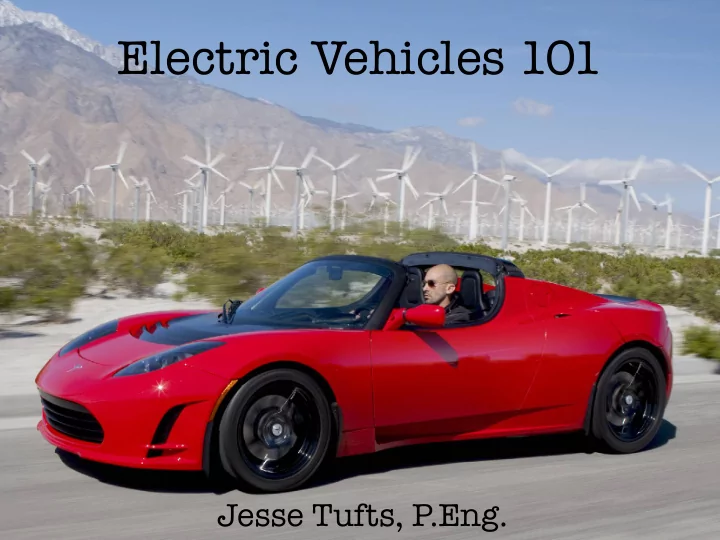
Electric Vehicles 101 Jesse Tufts, P.Eng. EV 101 Overview - - PowerPoint PPT Presentation

electric vehicles 101
SMART_READER_LITE
LIVE PREVIEW

Electric Vehicles 101 Jesse Tufts, P.Eng. EV 101 Overview - - PowerPoint PPT Presentation

Electric Vehicles 101 Jesse Tufts, P.Eng. EV 101 Overview Introductions Safety Glossary Why EVs? Why Not? Factory Offerings DIY Evs, Why? Why Not? DIY EV Expectations EV Components Range and Performance


slide-1
SLIDE 1

Electric Vehicles 101

Jesse Tufts, P.Eng.

slide-2
SLIDE 2

EV 101 Overview

  • Introductions
  • Safety
  • Glossary
  • Why EVs? Why Not?
  • Factory Offerings
  • DIY Evs, Why? Why Not?
  • DIY EV Expectations
  • EV Components
  • Range and Performance Estimation
  • Economics
  • Example builds
  • Resources
slide-3
SLIDE 3

Introductions

  • Jesse Tufts
  • Mechanical Engineer - U of S

2006

  • Formula SAE alumni
  • Grew up on a farm, started off

with classic cars

  • Started a Japanese Mini Truck

EV conversion in 2010

  • It's now my daily driver!
slide-4
SLIDE 4

The Electric Japanese Mini Truck

  • 1992 Daihatsu Hijet Jumbo Cab
  • Joint project with John Storey Bishoff
slide-5
SLIDE 5

The Electric Japanese Mini Truck

  • Then
  • 660cc 3 cylinder gas motor, about 45hp
  • 4wd, 5 speed transmission
  • 7 L/100km fuel economy (42mpg)
  • Now
  • 45hp three phase AC motor
  • 7.6kWh lithium battery pack
  • 60 km max city range
  • 85 km/hr top speed
slide-6
SLIDE 6

The Electric Japanese Mini Truck

  • Joint project, shared use truck
  • Started February 2010
  • Licensed in Spring 2012
  • 1000 + hours and counting!
  • $14,000 total cost including the truck
  • $0.01/km electricity cost to drive
  • Very fun to drive! Great for hauling stuff
slide-7
SLIDE 7

The Electric Japanese Mini Truck

slide-8
SLIDE 8

Introductions

  • Who?
  • Where?
  • What?
  • Why EVs?
  • Plans?
slide-9
SLIDE 9

Safety Disclaimer!

  • DIY EVs can be dangerous
  • Fire
  • Electrocution
  • Crush injuries, you name it!
  • 0.2A across your heart can kill you
  • EV batteries can often provide >1000A!
  • High voltage increases shock potential
  • Wear gloves when doing any wiring and don't become

part of a circuit!

  • Keep yourself and others around you safe
slide-10
SLIDE 10

Glossary

  • Kwh
  • unit of energy commonly used to measure

electricity consumption and capacity.

  • Equivalent to 1000 W of power (1 kW)

running for 1 hr, or 3,600,000 J.

  • Electric Current (I)
  • measured in amperes, the fow rate of

electric charge, 1A = 1 coulomb/sec or 6.24 x 10

18 electrons/sec.

  • Analogous to water fow rate ex. L/min
slide-11
SLIDE 11

Glossary

  • Voltage (V)
  • The electrical potential difference between two points.
  • Analogous to water pressure, ex. psi.
  • Power (P)
  • measured in Watts, 1W = 1J/sec
  • P=IV, electric power = electric current x voltage
  • Rate at which energy is used or work is performed
  • Shaft power = Torque x angular velocity
  • Angular velocity radians/sec
  • 2π radians/revolution
  • Torque in Nm
  • Power(W)=(Nm x rpm)/2π
  • Power(Hp) = (ftlbs x rpm)/5252
  • 1 Hp = 746W
slide-12
SLIDE 12

Why Electric Vehicles?

  • Personal Transportation is part of our way of life
  • Current gas and diesel vehicles are very

ineffjcient

  • Ex. 3rd gen Prius = 38.5% thermally effjcient
  • 61.5% energy wasted as heat!
  • Typical modern car – 25% to 30% thermally

effjcient in ideal conditions

  • Narrow RPM range necessitates complicated

transmissions

  • Inherently noisy with lots of vibration
slide-13
SLIDE 13

Why Electric Vehicles?

slide-14
SLIDE 14

Why Electric Vehicles?

  • Burning fossil fuels = emissions
  • CO2, N2O, SO2, unburned hydrocarbons,

particulate matter

  • Source of environmental and health problems.
  • Extraction and refjning create Social, Health and

Environmental problems

  • Fossil fuels are undeniably needed but why are

we wasting them?

  • What happens when we run out?
  • Can we afford to burn them until they run out?
slide-15
SLIDE 15

Why Electric Vehicles?

  • Bio-fuels can offer a partial solution if done

properly

  • Diffjcult to change fuel sources on existing vehicles
  • Food vs. Fuel?
  • Still almost impossible to be energy independent
  • Nearly impossible to brew your own gasoline
  • Home brew bio diesel and SVO is possible but

require a large land base to grow oil crops

  • Current waste oil sources could only provide a

small % of needed transport fuels

slide-16
SLIDE 16

Why Electric Vehicles?

slide-17
SLIDE 17

Why Electric Vehicles?

  • Electric vehicles offer very high energy effjciency –

80%-95%

  • Zero tailpipe emissions, potentially 100% pollution free
  • Very quiet operation with almost no vibration
  • Very wide effjcient RPM range and full torque at 0 rpm

means no transmission is needed

  • Electric motors have one moving part, almost no

maintenance

  • ~1/10th the cost to operate compared to a gas car
  • Electric motors will happily accept power from any

source

slide-18
SLIDE 18

Why Electric Vehicles?

  • Electricity is a universal source of energy that can be

generated many different ways

  • Solar, Wind, Hydro, Geothermal offer pollution free

power generation and almost unlimited capacity!

  • Natural Gas power plants can operate at >2X the

effjciency of a gas engine at peak conditions

  • 4X the effjciency at typical conditions!
  • Large stationary power plants are better able to deal

with emissions than cars.

  • Power is already delivered right to your garage

http://shrinkthatfootprint.com/wp-content/uploads/2013/02/Shades-of-Green-Full-Report.pdf

slide-19
SLIDE 19

Why Electric Vehicles?

  • It is entirely possible and practical to generate

enough electricity to cover household and transportation needs on the land area of a single family home. Personal Energy Independence is Possible

slide-20
SLIDE 20

Why Not Electric Vehicles?

  • Current battery technology means range is somewhat

limited for now

  • Charging infrastructure is not yet widespread
  • Current charging technology is slow when compared to a

gas fjll-up

  • Not all electricity sources are “green”
  • Still uncertain long term reliability
  • Currently not practical for large, long range, heavy haul

vehicles

slide-21
SLIDE 21

Why or Why Not Electric Vehicles?

  • What do you think?
slide-22
SLIDE 22

Factory Electric Vehicles

  • If you're going to buy a

new car anyways....

  • Currently Available

– Nissan Leaf – Mitsubishi IMiEV – Ford Focus Electric – Smart Fortwo EV – Tesla Model S – Fiat 500e – Honda Fit EV – Toyota Rav4 EV

– Chevrolet Spark EV – Chevrolet Volt

slide-23
SLIDE 23

Nissan Leaf

– Type: Battery Electric – 4 door hatchback, 5

Passenger

– Range: 120km (EPA) – 200km (NEDC) – Effjciency 193Wh/km city – 230Wh/km hiway – 107Hp, 187 lbft torque – ~10 sec 0-100km/hr – 3.6kW or 6.6kW Chargers – CHaDEMO fast charging

equipped, 80% in 30 min.

– 24 kWh battery pack

– Available in Edmonton – Best selling EV

worldwide, 83,000 total sales as of Sept 30th, 2013

– Starting price $31,698 – Video

slide-24
SLIDE 24

Mitsubishi iMIEV

– Type: Battery Electric – 4 door hatchback, 4

Passenger

– Range: 100km (EPA) – 150km (NEDC) – Effjciency 168Wh/km city – 211Wh/km hiway – 66Hp, 145 lbft torque – ~13 sec 0-100km/hr – 3.6kW on board charger – CHaDEMO fast charging

equipped, 80% in 15 min.

– 16 kWh battery pack – Available in Edmonton – Starting Price $32,998 – Video

slide-25
SLIDE 25

Ford Focus Electric

– Type: Battery Electric – 4 door hatchback, 5

Passenger

– Range: 122km (EPA) – 162km (NEDC) – Effjciency 193Wh/km

city

– 215Wh/km hiway – 143Hp, 184 lbft torque – ~9.5 sec 0-100km/hr – 6.6kW on board charger – No Fast Charging – 23 kWh battery pack – Available in Edmonton – Starting Price $41,199 – Video

slide-26
SLIDE 26

Smart fortwo EV

– Type: Battery Electric – 2 door hatchback, 2

Passenger

– Range: 109km (EPA) – 135km (NEDC) – Effjciency 173Wh/km

city

– 226Wh/km hiway – 74Hp, 96 lbft torque – 11.5 sec 0-100km/hr – 3.3kW on board charger – No Fast Charging – 17.6 kWh battery pack – Available in Edmonton – Starting Price $26,990 – Video

slide-27
SLIDE 27

Tesla Model S

– Type: Battery Electric – 4 door hatchback, 7

Passenger

– Range: 335/426km (EPA) – 390/502km (NEDC) – Effjciency 222Wh/km city – 217Wh/km hiway – 302/362/416Hp, 325/443

lbft torque

– 6.2/5.6/4.4 sec 0-

100km/hr

– 10/20kW on board charger – 120kW Supercharging

– 60/85 kWh battery pack – Available in Edmonton – Starting Price $77,800 – Video

slide-28
SLIDE 28

Fiat 500e

– Type: Battery Electric – 2 door hatchback, 4

Passenger

– Range: 139 km (EPA) – Effjciency 173Wh/km

city

– 195Wh/km hiway – 111 Hp, 147 lbft torque – 9 sec 0-100km/hr – 6.6kW on board charger

– 24 kWh battery pack – Only available in

California...

– Starting Price $32,500

US

– Video

slide-29
SLIDE 29

Honda Fit EV

– Type: Battery Electric – 4 door hatchback, 5

Passenger

– Range: 131 km (EPA) – Effjciency 160Wh/km

city

– 201Wh/km hiway – 134 Hp, 189 lbft torque – ~9 sec 0-100km/hr – 6.6kW on board charger – 20 kWh battery pack – Lease Only in select US

markets

– Video

slide-30
SLIDE 30

Toyota Rav4 EV

– Type: Battery Electric – 4 door SUV, 5 Passenger – Range: 165 km (EPA) – Effjciency 270Wh/km

city

– 285Wh/km hiway – 154 Hp, 270 lbft torque – ~7 sec 0-100km/hr – 10kW on board charger – 41.8 kWh battery pack – $49,800 US, for sale in

California only

– Video

slide-31
SLIDE 31

Chevrolet Spark EV

– Type: Battery Electric – 4 door hatchback, 4

Passenger

– Range: 132 km (EPA) – Effjciency 165Wh/km

city

– 193Wh/km hiway – 140 Hp, 400 lbft torque – 7.5 sec 0-100km/hr – 3.6kW on board charger – SAE Combo Fast

Charging 80% in 20 min.

– 21.3 kWh battery pack – $26,685 US, for sale in

California and Oregon,

– Available for feet sales

  • nly in Canada

– Video

slide-32
SLIDE 32

BMW i3

– Type: Battery Electric +

  • ptional range extender

– 4 door hatchback, 4

Passenger

– Range: 128-160km est – Effjciency 165Wh/km

city

– 193Wh/km hiway – 170 Hp, 184 lbft torque – 6.9 sec 0-100km/hr – 7.4kW on board charger – SAE Combo Fast

Charging 80% in 20 min.

– 22 kWh battery pack – $44,950 available

summer 2014 in Canada

– Video

slide-33
SLIDE 33

Chevrolet Volt

– Type: Extended Range

EV

– 4 door hatchback, 4

Passenger

– Range: 61 km (EPA) – Effjciency 214 Wh/km

combined

– 149 Hp, 272 lbft torque – 9 sec 0-100km/hr – 3.3kW on board charger. – 1.4L, 80hp gas motor – 16.5 kWh (10.8 kWh

usable) battery pack

– $36,895 – Video

slide-34
SLIDE 34

Up and Coming

  • Tesla Model X
  • Tesla SUV, 4wd, seats 7
  • Cadillac ELR
  • Sporty and luxurious Volt?
  • VW Golf Electric, BMW i3,
  • Also worth mentioning are the Ford C-Max

Energi and the Ford Fusion Energi.

slide-35
SLIDE 35

Up and Coming

  • What have you heard of?
slide-36
SLIDE 36

Other Options?

  • There are occasionally EV conversions and, more

frequently now, factory EVs on the used market.

  • DIY Conversion is possible
  • Parts are available to convert an existing vehicle

into a battery EV

  • Almost any vehicle can be converted
slide-37
SLIDE 37

Why DIY Conversion?

  • Potentially cheaper than Production EVs
  • More vehicle selection
  • Vehicle confjguration is only limited by your

imagination (and your wallet)

  • High performance potential
  • Satisfying hobby, with a conscience!
  • The more people who see EVs as viable the more

they will grow

slide-38
SLIDE 38

Why Not DIY Conversion?

  • Potentially more expensive than Production EVs
  • Can be time consuming to convert
  • Will you actually fjnish this project?
  • Vehicle reliability is limited by your skill
  • Low performance potential
  • Can be technically diffjcult
  • Like any DIY project there is potential for safety

hazards!

slide-39
SLIDE 39

Great Expectations

  • Vehicle Type
  • Range
  • Performance
  • Budget
  • Tools, Facilities and

Skills

slide-40
SLIDE 40

Vehicle Type

  • 1. How many passengers?
  • Any kids on the way?
  • 2. How much cargo?
  • Do you need to haul more than groceries?
  • 3. What type of driving?
  • City vs. Highway
  • 4. Has it been done before?
  • 5. What do you want to drive?
  • Do you want to invest $20,000 in a beater?
slide-41
SLIDE 41

Range Expectations

  • 1. How far do you really need to drive in a day?
  • EVs are great for commuting!
  • 50km = easy, lower cost
  • 100km = reasonably attainable
  • 200km = possible but getting quite expensive
  • 2. Could you charge at work?
  • 3. Longest daily drive has to be less than 80% of

your maximum range!

slide-42
SLIDE 42

Performance

  • 1. Top speed
  • Aerodynamics
  • Gearing
  • Max motor RPM
  • Power
  • 2. Acceleration
  • Weight
  • Gearing
  • Torque
  • You want 0.5G min off the line!
slide-43
SLIDE 43

Budget

  • What's the maximum you're comfortable spending on this

project?

  • Donor cost vs. parts cost; is the vehicle worth spending a

lot of money on?

  • Can you meet your range and performance expectations

with your selected donor vehicle and budget?

  • Can you sell parts removed from the donor?
  • Could you share the project with a friend?
slide-44
SLIDE 44

Tools, Facilities and Skills

  • Tools you'll need
  • Full set of typical mechanics and fabrication tools
  • Voltmeter, Electrical crimpers and wire stripper
  • Tools that will be good to have or borrow
  • Welder, drill press, band saw
  • Engine hoist
  • You'll need an enclosed garage with good lighting and a

heater

  • Skills
  • Can you do basic car maintenance?
  • Do you have a basic knowledge of electricity and wiring?
  • Do you have access to a friend who can lend a hand?
slide-45
SLIDE 45

EV Components

  • Motors
  • Adapters and drivetrain
  • Controllers
  • Batteries
  • Battery Management Systems
  • Chargers
  • Auxiliaries
  • DC-DC converter
  • Vacuum Pump
  • Power Steering
  • Heater
slide-46
SLIDE 46

AC Motors

  • Smooth power and control, easy reversing
  • No maintenance, high effjciency
  • Full torque regenerative braking
  • Somewhat limited options, DIY versions are less powerful

and more expensive than DC motors

  • One main brand for DIY, HPEVS motors with Curtis AC

controllers

slide-47
SLIDE 47

DC Motors

  • Very high torque and power potential!
  • Lots of size and brand options, less expensive than AC for a given

power output

  • Most types can not provide regenerative braking
  • Brushes require some regular maintenance
  • Brands include NetGain Motors, Advanced DC, D&D Motors, Kostov
slide-48
SLIDE 48

Adapters and Drivetrain

  • Adapters
  • Attach the motor to the

transmission input shaft

  • Can be purchased or

custom machined

  • But, alignment is critical!
  • Drivetrain
  • Standard transmission vs.

direct drive

  • 4wd can work, but expect

less range

slide-49
SLIDE 49

Motor Controllers

  • Higher Amps = Higher Torque
  • AC
  • Curtis 650A, 60 - 130V max
  • 75kw max power
  • Curtis 500A 60-170V max
  • 85kW max power
  • All PC programable
slide-50
SLIDE 50

Motor Controllers

  • DC
  • Evnetics Soliton Jr. - 600A, 9-

340V max

  • Soliton 1 – 1000A, 9-340V

max

  • Soliton Shiva – 3000A, 425v,

1.2MW!

  • PC programable, liquid cooled
  • Other brands include Curtis,

Netgain Controls, Zilla

slide-51
SLIDE 51

Batteries

  • Typical Pack Voltage 96V-144V
  • Lead Acid
  • Heavy
  • Low effjciency (60%)
  • Low usable capacity
  • Wear out quickly (500 charge cycles)
  • Some types need maintenance
  • Cheap, easy to implement
  • Work well for lawn tractor or quad

conversions

slide-52
SLIDE 52

Batteries

Lithium Iron Phosphate

  • Best chemistry for DIY

conversions

  • 1/3 the weight for double the

usable capacity of lead!

  • Effjciency from 88%-95%
  • >1500 charge cycles if you

typically discharge to 80% DOD.

  • 3.2V/cell
  • Popular brands; CALB, Winston,

Sinopoly, Headway

  • Rated in Ah, common 60-400Ah
slide-53
SLIDE 53

Batteries

  • Lithium Iron Phosphate
  • Don't Overcharge! <3.6V
  • Don't Over Discharge! >2.5V
  • Don't charge below freezing
  • Max 3C continuous discharge, for a

100Ah cell that's 300A

  • Capable of >10C short discharges
  • Safe to use at -30 but performance is

poor!

  • Highly recommended to use a BMS

(Battery Management System)

slide-54
SLIDE 54

Batteries

  • Sinopoly 100Ah Cell
  • Calb Cell Curves, charge, discharge

etc.

slide-55
SLIDE 55

Battery Management Systems

  • Monitor individual cell voltages to

prevent overcharging

  • Bleed energy off high cells to balance

the pack, commonly use a power resistor

  • Provide low voltage warnings to

prevent over discharging

  • Helps diagnose a weak or defective

cell

slide-56
SLIDE 56

Battery Management Systems

  • Commonly used include

Mini BMS

  • Elithion
  • Also check out the BMS Directory
slide-57
SLIDE 57

Battery Chargers

  • Start under $500 for a simple 1.5

kW charger

  • Up to 12 kW chargers available
  • Small packs can charge off 12 V

but larger packs need a 240 V charger

  • Popular brands include Elcon,

Manzanita Micro, Zivan, DeltaQ

slide-58
SLIDE 58

Battery Chargers and Accessories

  • 12kW open source charger
  • 15kW open source home

charging station

  • Android Based EV Dashboard
  • Cycle Analyst e-guage
slide-59
SLIDE 59

Auxiliary Components

  • Large vehicles need power brakes and power steering
  • Electric vacuum pump for power brakes
  • Electric hydraulic pump for power steering
  • DC-DC converter provides 12 V to power your vehicle's

systems

  • Electric Heat
  • Use a ceramic heater core, 3000 W minimum
  • Heated seats only draw 60 W each! Add on kits

are available

  • Potential to preheat your vehicle while it's

plugged in

slide-60
SLIDE 60

Fitting it All Together

slide-61
SLIDE 61

Fitting it All Together

slide-62
SLIDE 62

Performance Estimation

  • You want 0.5G acceleration off the line!
  • If you could maintain 0.5G acceleration up to

100km/hr you would get there in 5.7 sec!

  • Motor torque x gear ratio = wheel torque
  • Wheel torque ÷ tire radius = forward thrust
  • Forward thrust ÷ vehicle weight = acceleration in Gs
  • At what speed does the motor torque decrease?
  • Use this to size your motor and controller
slide-63
SLIDE 63

Estimating Range and Sizing the Pack

  • Gas Car Effjciency:
  • Only 14-16% in the city!
  • 20-26% on the highway
  • Gasoline energy content = 9.63 kWh/L
  • Electric car effjciency: 80-90% !
  • Use this to estimate the electrical energy

needed to drive an EV a given distance

  • Size the pack or estimate range with this

value

slide-64
SLIDE 64

Example Build: Toyota Echo Hatchback

  • Pro's
  • Lightweight – 2080 lbs
  • Aerodynamic – 0.29 drag

coeffjcient

  • 4 doors
  • Inexpensive to buy used
  • Reasonably modern
  • Simple reliable car
  • Cons
  • Not terribly exciting!

Yet....

slide-65
SLIDE 65

Vehicle Type

  • 1. How many passengers? (4)
  • Any (more) kids on the way? (Not Yet)
  • 2. How much cargo? (Just Groceries)
  • I can use the mini truck for larger cargo
  • 3. What type of driving? (City)
  • 4. Has it been done before? (Yes!)
  • 5. What do you want to drive?
  • A Tesla Model S.....
slide-66
SLIDE 66

Range Expectations

  • 1. How far do you really need to drive in a day?
  • Spruce Grove and back safely = 60 km highway
  • 2. Could you charge at work? (Potentially)
  • 3. Longest daily drive has to be less than 80% of

your maximum range!

  • No problem, typical day <40 km
slide-67
SLIDE 67

Performance

  • 1. Top speed (120 km/hr)
  • Aerodynamics (good)
  • Gearing (5 spd manual)
  • Max motor RPM (6500)
  • Power (105 hp original)
  • 2. Acceleration
  • Weight (2080 lbs original)
  • Gearing (5 spd manual)
  • Torque (electric will have more than stock!)
  • 0.5G off the line acceleration? We'll see...
slide-68
SLIDE 68

Budget

  • What's the maximum you're comfortable spending on this

project? ($20,000 including the car)

  • Donor cost vs. parts cost; is the vehicle worth spending a lot
  • f money on? (Yes)
  • Can you meet your range and performance expectations

with your selected donor vehicle and budget? (We'll See!)

  • Can you sell parts removed from the donor? (Yes)
  • Could you share the project with a friend? (Possibly)
slide-69
SLIDE 69

EV Components

  • Motors – AC51
  • Adapters and drivetrain

– From CanEV, standard trans FWD

  • Controller – Curtis 500A
  • Batteries – 48 x 100 Ah Sinopoly
  • Battery Management System

– Mini BMS

  • Chargers – 1.5 kW Elcon
  • Auxiliaries
  • DC-DC converter – 30 A
  • Vacuum Pump - yes
  • Power Steering – manual steering available
  • Heater – 3 kW min + add on heated seats!
slide-70
SLIDE 70

Performance Estimation

  • AC 51 Motor torque = 100 ft lbs from 0-4500 rpm
  • 100 ft lbs x 12.5:1 gear ratio in 1st = 1250 ft lbs wheel

torque

  • 1250 ft lbs x 12”/11.5” tire radius = 1304 lbs thrust
  • 2200 lb estimated car weight
  • 1st gear = 0.59G up to 40 km/hr (4500 rpm) in <2 sec!
  • 2nd gear = 0.32G up to 73 km/hr (4500 rpm) in 6.5 sec

with no shift. ~5 sec with a shift.

  • Motor revs to 8000 rpm (with reduced torque) so you

should be able to drive in just 2nd gear and still hit 100+km/hr.

  • Zippy performance in the city: Check!
slide-71
SLIDE 71

Range Estimation

  • Pack Size = 48 x 100 Ah Sinopoly = 154V nominal
  • 154V x 100 Ah = 15.36 kWh pack size
  • City fuel economy = 6.7 L/100 km city
  • 6.7 L/100 km x 9.63 kWh/L = 0.645 kWh/km = Energy burned
  • 0.645 Wh/km x 15% (city effjciency) = 0.097 kWh/km

= Mechanical energy needed

  • 0.097 kWh/km ÷ 80% (EV effjciency) = 0.121 kWh/km

= Electrical energy needed in the city

  • 0.164 kWh/km on the highway
  • 15.36 kWh ÷ 0.121 kWh/km = 127 km max city range
  • 100 km safe city range, 75 km safe highway range
slide-72
SLIDE 72

Cost Estimate

  • AC 51 Motor / Curtis 1239 Controller
  • $4,425
  • Motor Adapter
  • $850
  • 48 x 100Ah Sinopoly Cells
  • $6,480
  • Battery Management System
  • $700
  • 1.5 kW Charger
  • $400
  • Accessories (DC-DC, Vacuum Pump, Instrumentation, Wiring,

Metal work, etc.)

  • $1,500
  • Total = $14,355, Typical used Echo - $5,000
slide-73
SLIDE 73
  • Value of the EV grin you'll have after your fjrst drive?

Priceless!

Cost Estimate

slide-74
SLIDE 74
  • Cost to drive
  • Assuming 50% city/50% highway
  • Energy consumption from the pack =0.143

kWh/km

  • Charger effjciency 87%
  • From the wall consumption = 0.164 kWh/km
  • Electricity cost $0.08/kWh
  • 1.3 cents/km!
  • With heater use and all that available torque....
  • Add 30% = 1.7 cents/km for electricity
  • No oil changes, minimal brake use due to regen

Economics

slide-75
SLIDE 75
  • Cost to drive the original gas car
  • Assuming 50% city/50% highway
  • 6.7L/100km city, 5.6L/100km highway
  • 6.2L/100km average
  • Average fuel price $1.12/L
  • 7 cents/km + ~30% winter driving and

increasing fuel prices over time

  • 9 cents/km typical
  • Oil changes $50/5000km = 1 cent/km
  • Brakes/engine maintenance ~$500/50,000km? =

1 cent/km

  • Total $0.11/km

Economics

slide-76
SLIDE 76
  • Savings
  • 11-1.7 = 9.3 cents/km
  • $14,355/$0.093/km = 154,355 km till payback
  • This gets a lot better if you switch from something like

a truck!

  • How much better?
  • Battery lifespan and cost/km?

Economics

slide-77
SLIDE 77
  • Check out my blog
  • Links to useful EV websites
  • This presentation in PDF format.

www.jessetufts.wordpress.com

Resources

slide-78
SLIDE 78

Questions?