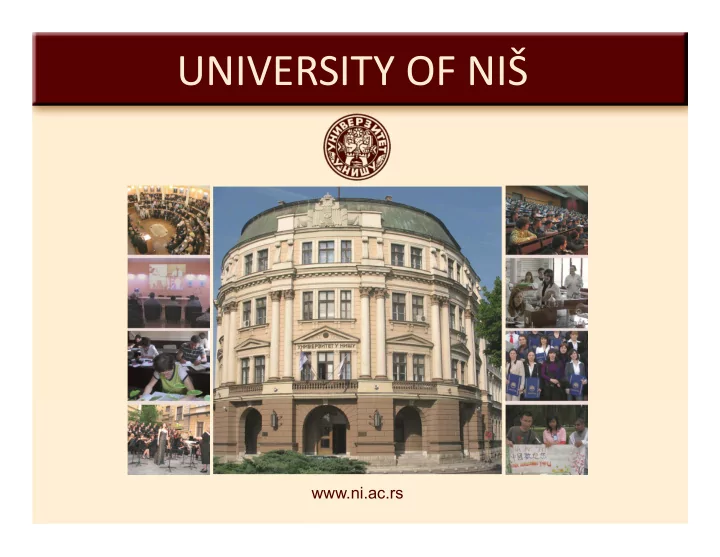
SLIDE 1 UNIVERSITY OF NIŠ
www.ni.аc.rs
SLIDE 2 Founded on June 15th, 1965 Originally consisted of:
- Faculty of Law&Economics,
- Faculty of Medicine
- Faculty of Engineering
With abt 10500 students and 234 teaching staff.
UNIVERSITY OF NIŠ
SLIDE 3
The Headquarters of the University of Niš is today located at one of the most representative buildings in Niš – which was built in 1887 and is now part of the national heritage, protected by the state.
UNIVERSITY OF NIŠ TODAY
SLIDE 4
- The only university in the south-east
- f Serbia with the population of about
two million people.
- One of the most important institutions
in Niš, the city of about 300,000 inhabitants, a significant economic, social, educational, cultural, sport and tourist centre of Serbia.
UNIVERSITY OF NIŠ TODAY
SLIDE 5
Often referred to as a “Gateway Between the East and the West”, Niš has a long history ever since the prehistoric times. It is also known as an Imperial City because Constantine the Great was born there.
EAST‐WEST GATE
SLIDE 6 Training visit, Dortmund – Bremen, Germany, 01st-05th May
HISTORIC HERITAGE
SLIDE 7 It has 29.064 students at all levels
UNIVERSITY OF NIŠ TODAY
- Basic academic level,
- Master level,
- PhD level,
- Specialist and
professional level
level
SLIDE 8 It comprises 13 faculties:
UNIVERSITY OF NIŠ TODAY
- Faculty of Civil Engineering and Architecture
- Faculty of Technology in Leskovac
- Faculty of Economy
- Teacher-Training Faculty in Vranje
- Faculty of Electronic Engineering
- Faculty of Occupational Safety
- Faculty of Mechanical Engineering
- Faculty of Fine Arts
- Faculty of Medicine
- Faculty of Law
- Faculty of Sport and Physical Education
- Faculty of Sciences and Mathematics
- Faculty of Philosophy
SLIDE 9 The procedure is underway for establishing new faculties:
UNIVERSITY OF NIŠ TODAY
- Faculty of Agriculture,
- Faculty of Theology
- Faculty of Political Sciences.
SLIDE 10 The teaching process is carried out by 1558 professors and their assistants
UNIVERSITY OF NIŠ TODAY
- 970 teaching staff
- 394 full professors
- 273 associate
professors
professors
and 12 lecturers
assistants
SLIDE 11 From its foundation until now
UNIVERSITY OF NIŠ TODAY
49,216 students (48.,189 Serbian citizens and 1323 foreign citizens)
2,254 post-graduates (2,210 Serbian citizens and 44 foreign citizens ) and
1,275 doctoral students (1,260 of Serbian and 15 of foreign citizenship).
SLIDE 12 UNIVERSITY OF NIŠ TODAY
- In 2010, the University of Niš celebrates a significant
anniversary – 45 years of development.
- In these 45 years it has developed into a well-
established and functional academic community with considerable reputation in the country and abroad .
SLIDE 13 Internationalization and cooperation – two key processes in joining the European higher education area.
UNIVERSITY OF NIŠ FUTURE
- Harmonization of Serbian study programs with
EU programs of study,
- Application of credit system (ECTS),
- Student and teaching staff mobility,
- European collaboration in quality assurance,
- Lifelong learning,
- Student participation in education,
- Promotion of European HE area.
Final result should yield - internationally valid diplomas
SLIDE 14 INTERNATIONAL COOPERATION
INTERNATIONAL ACADEMIC ASSOCIATIONS (EUA, IUC, IIE…)
INTERNATIONAL PROGRAMS AND PROJECTS (TEMPUS, FP7, CEEPUS, WUS, ERASMUS MUNDUS)
COOPERATION WITH FOREIGN UNIVERSITIES
SLIDE 15 FACULTY OF ELECTRONIC ENGINEERING
www.elfak.ni.ac.rs
SLIDE 16 Faculty chronicle – Faculty of Engineering is founded (with the department of Electrical Engineering) on the 18th of May 1960 in Niš – Faculty of Electronic Engineering is founded on the 23rd of November 1968 in Niš – First generation of the students 1968./69. (269 regular and 27 part-time students were registered) – Until the present day:
- B. S. 5509,
- M. S. 516,
- Ph. D. 187
– Faculty working space 22.970 м2 (two buildings)
FACULTY OF ELECTRONIC ENGINEERING
SLIDE 17 FACULTY OF ELECTRONIC ENGINEERING
Educational and scientific institution
– Educational activities
- B. S. studies
- M. S. studies
- Ph. D. studies
– Scientific and research activities – Commercial activities
SLIDE 18 Organizational structure – Management body – Faculty council – Executive body – Dean, three vice-deans – Student parliament– Student vice-dean – Technical bodies
- Council for teaching and science
- Electorate council
- Council for department program
- Department council
- Financial council
- Scientific faculty council
FACULTY OF ELECTRONIC ENGINEERING
SLIDE 19 – Organizational units for educational and scientific activities:
- Departments (Control Systems, Electronics, Power Engineering,
Mathematics, Measurements, Microelectronics, General Education, Computer Science and Informatics, Telecommunications and Theoretical Engineering),
- Center for scientific and research work and development,
- Center for innovation activity,
- Center for permanent education,
- Center for quality assurance,
- Computer Center,
- Library
- Publishing unit.
FACULTY OF ELECTRONIC ENGINEERING
SLIDE 20 Faculty of Electronic Engineering realizes all levels of studies: – Undergraduate professional studies (title: Bachelor of engineering in electrical engineering and computing) – Undergraduate academic studies (title: Bachelor of science in electrical engineering and computing) – Graduate academic studies (title: Master of science in electronic engineering and computer science) – Postgraduate studies (title: Doctor of science – electrical engineering and computing)
FACULTY OF ELECTRONIC ENGINEERING
SLIDE 21 FACULTY OF ELECTRONIC ENGINEERING
Study programs: Undergraduate academic studies
Electrical engineering and computing
Undergraduate professional studies
Electrical engineering and information technologies
Graduate academic studies
Computing Telecommunications Control Systems Electronics and microprocessor technique Electrical power engineering
Electrical engineering and computing
SLIDE 22 Employment possibilities: – National department for employment – Lack of experts in IT sector – Permanent need for programmers in the regional IT companies – Possibility of scientific work at the faculty
FACULTY OF ELECTRONIC ENGINEERING
SLIDE 23 FACULTY OF ELECTRONIC ENGINEERING
Freshmen Students Undergraduate professional studies:
120 students
Undergraduate academic studies:
420 students
Graduate academic studies:
320 students
Doctoral studies:
100 students
SLIDE 24 FACULTY OF ELECTRONIC ENGINEERING
Projects:
Basic, applied and development research Projects are financed by: Ministry of Science International foundations (WUS, FP7, TEMPUS, DAAD) Commercial projects: International companies Domestic companies Organization of international conferences and meetings: TELSIKS, MIEL, PES, ICEST, SAUM, SSSS
- Program for scientific and research work
- Program for development of scientific and research
youth
SLIDE 25 FACULTY OF ELECTRONIC ENGINEERING
Student competitions
Student organizations
Student clubs
- 3D archeology
- GNU club
- ELEFnet
- MediArt
Student parliament
- Student vice-dean
- Studentska unija
- Savez studenata
SLIDE 26 FACULTY OF ELECTRONIC ENGINEERING
Student scholarships
– Troxo – WUS – Tempus – ESSO – Sintronis – Specialized students practice in the country and aboard – Philip Moriss, EKO – oil industry
PECD Program - Philip Morris int.
- 5 most talented students get 2,000€ award
- over 100,000€ for students projects yearly
SLIDE 27
FACULTY OF ELECTRONIC ENGINEERING
Specialized courses and summer schools:
– Microsoft academy – CISCO academy – International summer school “Computer intelligence and information technologies” – (Microsoft) "Live@edu“ – free mail accounts for all students and employees.
SLIDE 28 FACULTY OF ELECTRONIC ENGINEERING
Teaching facilities:
– 4 amphitheatres – 40 classrooms – 30 laboratories – Innovation center – Library with over 25.000 library units (books, magazines and publications) – Information center – Cabinet for the foreign languages – Student club – Wireless and modern measurement and computer equipment for teaching and science
SLIDE 29 FACULTY OF ELECTRONIC ENGINEERING
Evaluation of the working quality is provided through: Center for quality insurance – Quality commission – Faculty self evaluation report – Comparison with the institutions of higher education in the other countries
- Quality insurance policy
- Textbooks regulation
SLIDE 30 FACULTY OF ELECTRONIC ENGINEERING
Availability of information:
– Publicity in faculty activities – Student magazine ELEF
- Electronic version
- Printed version
– Faculty Website – Student information portal Faculty organizes: – Education fairs – Schools visitation with providing information about faculty – Open day for a faculty visiting
SLIDE 31 FACULTY OF ELECTRONIC ENGINEERING
DEPARTMENT OF CONTROL SYSTEMS
Department of Control Systems
- Dr. Dragan Antić, full professor
- Dr. Goran S. Đorđević, full professor
- Dr. Bratislav Danković, full professor
- Dr. Milica Naumovic, full professor
- Dr. Zoran Jovanović, associate professor
- Dr. Darko Mitić, assistant professor
- Dr. Boban Veselić, teaching assistant
MSc Marko Milojković, teaching assistant MSc Saša Nikolić, teaching assistant MSc Staniša Perić, teaching associate MSc Darko Todorović, teaching associate
SLIDE 32 FACULTY OF ELECTRONIC ENGINEERING
DEPARTMENT OF CONTROL SYSTEMS
Department of Control Systems has the following study programs:
Control Systems at graduate academic studies Control Systems at the program Electrical Engineering and Computer Science at doctoral studies Industrial Control Systems within Electrical Engineering and Information Technologies on professional studies Academic study program Control Systems
Automatic Control Systems Computer Control Systems and Measurement Engineering
SLIDE 33 FACULTY OF ELECTRONIC ENGINEERING
DEPARTMENT OF CONTROL SYSTEMS
Subjects on undergraduate and master academic studies:
Control Systems, Modeling and Simulation of Dynamic Systems, Linear Control Systems, Process Control, Digital Control Systems, Mechatronics, Introduction to Robotics, Programmable Logic Controllers, Control Systems Design, Nonlinear Control Systems, Dynamics of Mechanisms and Machines, Optimal Control, Scada Systems, System Identification, Computer Controlled Systems, Intelligent Control, Intelligent Machines, Complex systems Control, Hydraulic and Pneumatic Control Systems, Sensors, Transducers and Actuators, Intelligent Systems, Service Robotics, etc.
SLIDE 34 FACULTY OF ELECTRONIC ENGINEERING
DEPARTMENT OF CONTROL SYSTEMS
On doctoral studies in the area of Control Systems the following subjects are taught:
System Theory, System Identification, Dynamic Systems Modeling, Computer Controlled Systems, Robotics and Automatization and Intelligent Control Systems.
SLIDE 35 FACULTY OF ELECTRONIC ENGINEERING
DEPARTMENT OF CONTROL SYSTEMS
Department of Control Systems have published
2 monographs 14 textbooks 16 supplementary textbooks 188 journal papers 726 papers at conferences 112 technical solutions current projects are 6
SLIDE 36 FACULTY OF ELECTRONIC ENGINEERING
DEPARTMENT OF CONTROL SYSTEMS
The Department of Control Systems has three scientific and two educational laboratories. Educational laboratories are: Laboratory for Analog Systems and Electric Drive Control Laboratory for Digital Systems and Process Control
SLIDE 37 FACULTY OF ELECTRONIC ENGINEERING
DEPARTMENT OF CONTROL SYSTEMS
Three scientific and research laboratories are: Laboratory for Control Systems Laboratory for Robotics and Automatization Laboratory for Modeling, Simulation and Control Systems
SLIDE 38 FACULTY OF ELECTRONIC ENGINEERING
DEPARTMENT OF CONTROL SYSTEMS
Digital Control Systems Sliding Mode Control Systems Robotics Modeling and Simulation Fuzzy Control Systems Genetic Algorithms Theory of Chaos Process Control
Research Interests
SLIDE 39 FACULTY OF ELECTRONIC ENGINEERING
DEPARTMENT OF CONTROL SYSTEMS
More than 300 published papers in last five years Citation Index: more than 150 Membership in Editorial Boards of Journals Reviewers in IEEE Publications (Transaction
- n IE, AC, R&A,…), IASTED …
Practical implementations
Research Results
SLIDE 40
The Department members issued: * >2000 papers (>200 papers published in SCI journals) * 11 monographs * 3 chapters in monographs * 7 texbooks * 8 supplementary texbooks * 27 technical solutions The Department professors supervised: * 33 PhD theses * 63 MSEE theses
Department for Telecommunications
SLIDE 41
Projects: * COST, WUS, TEMPUS * Many scientific projects in the field of Telecommunications supported by the Ministry of Science and Technological Development of Serbia Organization of conferences: * International Conference on Telecommunications in Modern Satellite, Cable and Broadcasting Services – TELSIKS (biennial conference, ieeexplore) * International Scientific Conference on Information, Communication and Energy Systems and Technologies – ICEST (every third year)
Department for Telecommunications
SLIDE 42
Department consists of three laboratories: Laboratory for Telecommunications Laboratory for Acoustics Laboratory for Microwave Techniques and Satellite Television.
Department for Telecommunications
SLIDE 43
Staff of the Lab for Telecommunications 4 Professors 3 Associate Professors 1 Assistant Professor 6 Assistants 1 Researcher 2 PhD Students Staff of the Lab for Acoustics 1 Assistant Professor
Laboratory for Telecommunications
SLIDE 44 Laboratory for Telecommunications
Former members of Lab:
- 1. Dr. Bane Vasic, Professor, University of Arizona,
USA (Affiliate Professor at ELFAK)
- 2. Dr. Ivan Djordjevic, Assistant Professor, University
- f Arozona, USA
- 3. Dr. Olgica Milenkovic, Associate Professor,
University of Illionis at Urbana, USA
- 4. Dr. Dragoljub Pokrajac, Associate Professor,
Delaware State University, USA
SLIDE 45
Studies in the field of Telecommunications are organized in three levels (4+1+3 years): academic, master and PhD. Academic and Master levels: Telecommunicatins Basics, Digital Telecommunications, Telecommunications Networks, Switching Systems, Telecommunications Systems, Statistical Telecommunications Theory, Information Theory, Mobile Telecommunications, Optical Telecommunications, Satellite Telecommuniations, Criptology, Error Control Coding, Signal Processing, Technical Acoustic, Audio Signal Processing
Laboratory for Telecommunications
SLIDE 46
Academic and master studies
SLIDE 47
Academic and master studies
SLIDE 48
Academic and master studies
SLIDE 49 PhD studies: duration of three years First year: Student chooses 3 courses among 8 possible
- 1. Telecommunications Theory
- 2. 3G and 4G Mobile Communications
- 3. Digital Telecommunications
Second year: Student chooses 3 courses among many possibl
- 1. Statistical Signal Processing
- 2. Digital Communications over Fading Channels
- 3. Coherent Optical Communication Systems
Laboratory for Telecommunications
SLIDE 50 Laboratory for Telecommunications
Research interests:
- 1. Communications over Fading Channels
1.1. Performance of micro and macro diversity receivers 1.2. Effects of different receiver imperfections on BER performance
- f uncoded and coded signal diversity reception
1.2. Performance analysis of cooperative relaying systems
- 2. Wireless communication systems
- 3. Performance Analysis of Optical Soliton Long-haul Transmission
Link under the impact of dispersion and nonlinearity
- 4. Design of low-density parity-check (LDPC) codes and their
application in wireless communication systems
- 5. Quantization
- 6. Influence of different disturbances in measurements of room
acoustic characteristics
SLIDE 51 PhD Student (four main activities):
- 1. Programming skills
- 2. Basics of Digital Communications
- 3. Wireless Communications
- 4. Error Control Coding
Laboratory for Telecommunications
SLIDE 52 FACULTY OF ELECTRONIC ENGINEERING
DEPARTMENT OF CONTROL SYSTEMS
Faculty of Electronic Engineering
Aleksandra Medvedeva 14 18000 Niš Secretary: 018/529-105 Student service: Dean office: 018/529-105 018/529-623 Fax: 018/588-399 018/588-414 http://www.elfak.ni.ac.yu http://en.elfak.ni.ac.yu
SLIDE 53
FACULTY OF ELECTRONIC ENGINEERING
DEPARTMENT OF CONTROL SYSTEMS
Thank you for attention !