Electric Potential A Concentrated at the center of the sphere - - PDF document

electric potential
SMART_READER_LITE
LIVE PREVIEW

Electric Potential A Concentrated at the center of the sphere - - PDF document

Slide 1 / 71 Slide 2 / 71 1 A negative charge is placed on a conducting sphere. Which statement is true about the charge distribution Electric Potential A Concentrated at the center of the sphere Charge density increases from the center to


slide-1
SLIDE 1

Slide 1 / 71

Electric Potential Multiple Choice Problems

Slide 2 / 71

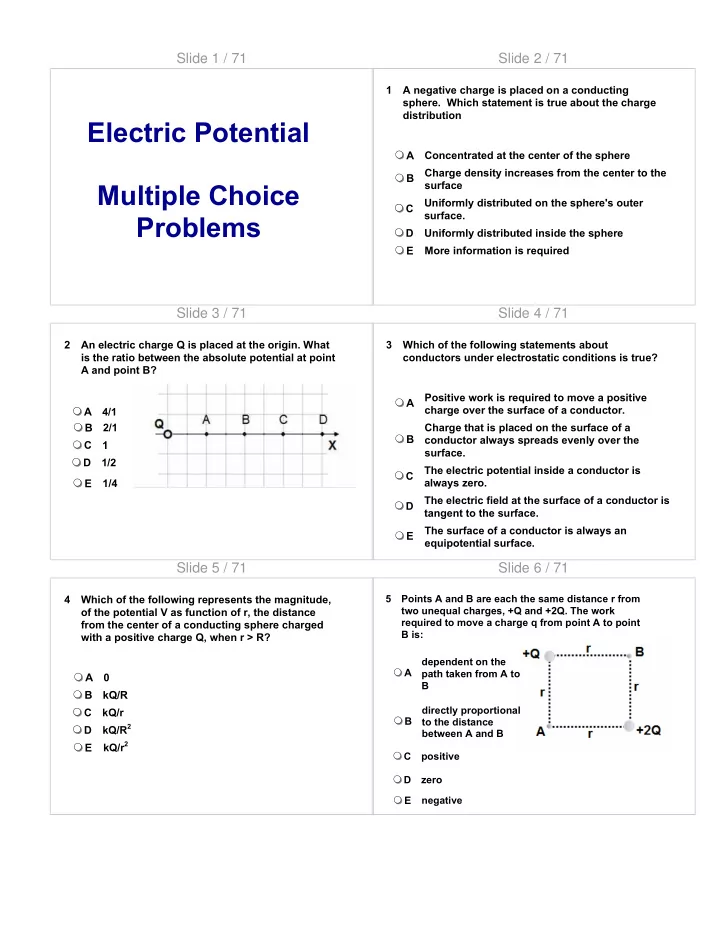
1 A negative charge is placed on a conducting

  • sphere. Which statement is true about the charge

distribution A Concentrated at the center of the sphere B Charge density increases from the center to the surface C Uniformly distributed on the sphere's outer surface. D Uniformly distributed inside the sphere E More information is required

Slide 3 / 71

2 An electric charge Q is placed at the origin. What is the ratio between the absolute potential at point A and point B? A 4/1 B 2/1 C 1 D 1/2 E 1/4

Slide 4 / 71

3 Which of the following statements about conductors under electrostatic conditions is true? A Positive work is required to move a positive charge over the surface of a conductor. B Charge that is placed on the surface of a conductor always spreads evenly over the surface. C The electric potential inside a conductor is always zero. D The electric field at the surface of a conductor is tangent to the surface. E The surface of a conductor is always an equipotential surface.

Slide 5 / 71

4 Which of the following represents the magnitude,

  • f the potential V as function of r, the distance

from the center of a conducting sphere charged with a positive charge Q, when r > R? A B kQ/R C kQ/r D kQ/R2 E kQ/r2

Slide 6 / 71

5 Points A and B are each the same distance r from two unequal charges, +Q and +2Q. The work required to move a charge q from point A to point B is: A dependent on the path taken from A to B B directly proportional to the distance between A and B C positive D zero E negative

slide-2
SLIDE 2

Slide 7 / 71

6 An electric field is created by a positive charge. The distribution of the electric field lines and equipotential lines is presented on the diagram. Which statement about electric potential is true? A VA > VB > VC > VD > VE B VA < VB < VC < VD < VE C VA = VD > VB > VC = VE D VA > VB = VC > VD = VE E VA > VB > VC = VD = VE

Slide 8 / 71

7 An electric field is created by a positive charge. The distribution of the electric field lines and equipotential lines is presented on the diagram. A test charge +q is moved from point to point in the electric field. Which statement about work done by the electric field on charge +q is true? A WA→B>WA→C B WA→D>WA→E C WD→C<WA→E D WA→D=WC→E =0 E WA→B=WA→E

Slide 9 / 71

8 Two parallel conducting plates are charged with an equal and opposite charges. Which statement is true about the magnitude of the electric potential? A Greater at point A B Greater at point B C Greater at point C D Greater at point D E The same at points B, C, D and zero at point A

Slide 10 / 71

9 A point charge q is released from rest at point A and accelerates is a uniform electric field E. What is the ratio between the work done by the field on the charge: WA→B/WB→C? A 1/2 B 1/4 C 1 D 2/1 E 4/1

Slide 11 / 71

10 A point charge q is released from rest at point A and accelerates is a uniform electric field E. What is the ratio between velocities of the charge VB/VC? A 1/(√2 ) B (√2)/3 C 1 D (√2)/1 E (√3)/2

Slide 12 / 71

11 A point charge Q1 = +4.0 µC is placed at point -2 m. A second charge Q2 is placed at point +3 m. The net electric potential at the origin is zero. What is charge Q2? A 9.0 µC Positive B 6.0 µC Positive C 3.0 µC Positive D 6.0 µC Negative E 9.0 µC Negative Magnitude Sign

slide-3
SLIDE 3

Slide 13 / 71

12 A conducting sphere is charged with a positive charge +Q. Which of the following is the correct relationship for the electric potential at the points A, B, and C? A VA < VB < VC B VA > VB < VC C VA < VB > VC D VA = VB < VC E VA = VB > VC

Slide 14 / 71

13 An electric field is presented by a series of equipotential lines. At which location the electric field strength is the greatest? A B C D E

Slide 15 / 71

14

A uniform conducting sphere of radius R is charged with a positive charge +Q. Which of the following is correct relationship between the potential and distance from the center of the sphere?

A B C D E

Slide 16 / 71

15 A uniform conducting sphere of radius R is charged with a positive charge +Q. Which of the following is correct relationship between the electric field and distance from the center of the sphere? A B C D E

Slide 17 / 71

16 Two positive charges A and B are placed at the corners of equilateral triangle with a side r. What is the net electric potential at point C? A (√2)kQ/r B (√3)kQ/r C kQ/r D (√5)kQ/r E 2kQ/r

Slide 18 / 71

17 Two charges +Q and –Q are placed at the corners

  • f equilateral triangle with a side r. What is the net

electric potential at point C? A B (√3)kQ/r C kQ/r D (√5)kQ/r E 2kQ/r

slide-4
SLIDE 4

Slide 19 / 71

18 Four positive Q charges are arranged in the corner

  • f a square as shown on the diagram. What is the

net electric potential at the center of the square? A B 8kQ (√2)r C 4kQ (√2)r D 16kQ (√2)r E 2kQ (√2)r

Slide 20 / 71

19 Two conducting spheres of different radii are charged with the same charge -

  • Q. What will happen to the charge if the spheres are connected with a

conducting wire? A Negative charge flows from the large sphere to the smaller sphere until the electric field at the surface of each sphere is the same B Negative charge flows from the smaller sphere to the larger sphere until the electric field at the surface of each sphere is the same C Negative charge flows from the large sphere to the smaller sphere until the electric potential at the surface of each sphere is the same D Negative charge flows from the smaller sphere to the larger sphere the electric potential at the surface of each sphere is the same E There is no charge flow between the spheres

Slide 21 / 71

20 A charged particle is projected with its initial velocity perpendicular to a uniform electric field. The resulting path of the particle is: A spiral B parabolic arc C circular arc D straight line parallel to the field E straight line perpendicular to the field

Slide 22 / 71

21 A positive charge of +3 µC is moved from point A to point B in a uniform electric field. How much work is done by the electric field on the charge? A 100 µJ B 120 µJ C 140 µJ D 160 µJ E 180 µJ

Slide 23 / 71

22 Two positive charges with a magnitude of Q are located at points (+1,0) and (-1,0). At which of the following points is the electric potential the greatest in magnitude? A (+2,0) B (0,-1) C (0,0) D (+3,0) E (0,+1)

Slide 24 / 71

23 An electron with energy of 200 eV enters a uniform electric field parallel to the plates. The electron is deflected by the electric field. What is the kinetic energy of the electron just before it strikes the upper plate? A 50 eV B 100 eV C 200 eV D 300 eV E 400 eV

slide-5
SLIDE 5

Slide 25 / 71

24 A parallel-plate capacitor has a capacitance C0. What is the capacitance of the capacitor if the area is doubled and separation between the plates is doubled? A 4 C0 B 2 C0 C C0 D 1/2 C0 E 1/4 C0

Slide 26 / 71

25 A parallel-plate capacitor is charged by a battery and then disconnected. What will happen to the charge on the capacitor and voltage across it if the separation between the plates is decreased and the area is increased? A Both increase B Both decrease C Both remain the same D The charge remains the same and voltage increases E The charge remains the same and voltage decreases

Slide 27 / 71

26 A parallel-plate capacitor is charged by connection to a battery and remains connected. What will happen to the charge on the capacitor and voltage across it if the separation between the plates is decreased and the area is increased? A Both increase B Both decrease C Both remain the same D The voltage remains the same and charge increases E The voltage remains the same and charge decreases

Slide 28 / 71

27 A parallel-plate capacitor is connected to a battery with a constant voltage. What happens to capacitance, charge, and voltage if a dielectric material is placed between the plates?

A B C D E

Capacitance Charge Voltage Increases Increases Decreases Decreases Increases Remains the same Remains the same Decreases Increases Increases Increases Remains the same Decreases Remains the same Increases

Slide 29 / 71

28 A parallel-plate capacitor is connected to a battery and becomes fully charged. The capacitor is then disconnected, and the separation between the plates is increased in such a way that no charge leaks off. What happens to the energy stored in the capacitor? A Remains the same B Increased C Decreased D Zero E More information is required

Slide 30 / 71

29 A parallel-plate capacitor is connected to a battery with a constant voltage. The capacitor becomes fully charged and stays connected. What happens to the energy stored in the capacitor if the separation is decreased? A Remains the same B Increased C Decreased D Zero E More information is required

slide-6
SLIDE 6

Slide 31 / 71

30 A parallel-plate capacitor is connected to a battery. The capacitor is fully charged before the battery is

  • disconnected. A uniform dielectric with a constant

K is inserted between the plates. What is the ratio between the energy stored in the capacitor with the inserted dielectric Uk to the energy without dielectric U0? A 1/K B 1/K2 C K/1 D K2/1 E 1

Slide 32 / 71

31 Two parallel conducting plates are connected to a battery with a constant voltage. The magnitude of the electric field between the plates is 1200 N/C. If the voltage is halved and the distance between the plates is tripled from the original distance. The magnitude of the new electric field is: A 800 N/C B 600 N/C C 400 N/C D 500 N/C E 200 N/C

Slide 33 / 71

Answers: 1. C 2. B 3. E 4. C 5. D 6. C 7. D 8. B 9. C

  • 10. A
  • 11. D
  • 12. E
  • 13. B
  • 14. D
  • 15. A
  • 16. E
  • 17. A
  • 18. B
  • 19. B
  • 20. B
  • 21. B
  • 22. C
  • 23. D
  • 24. C
  • 25. E
  • 26. D
  • 27. D
  • 28. B
  • 29. B
  • 30. A
  • 31. E

Slide 34 / 71

General Problems

Slide 35 / 71

  • 1. A charged sphere A has a charge
  • f +9 µC and is placed at the origin.
  • a. What is the electric potential at

point P located 0.6 m from the

  • rigin?

A point charge with a charge of +3 µC and mass of 5 g is brought from infinity to point P.

  • b. How much work is done to bring

the point charge from infinity to point P?

  • c. What is the electric force

between two charges?

  • d. What is the net electric field at

point 0.3 m from the origin? The sphere stays fixed and point charge is released from rest.

  • e. What is the speed of the point charge when it is far away from the origin?

Slide 36 / 71

  • 1. A charged sphere A has a charge
  • f +9 µC and is placed at the origin.
  • a. What is the electric potential at

point P located 0.6 m from the

  • rigin?

V = KQ/r V = (9x10⁹ Nm2/C2)(9x10-6C)/0.6m V = 1.35x10⁵V

slide-7
SLIDE 7

Slide 37 / 71

1. A point charge with a charge of +3 µC and mass of 5 g is brought from infinity to point P.

  • b. How much work is done to bring

the point charge from infinity to point P? E0 + W = Ef 0 + W = UE W = UE = qV UE = (3x10⁻⁶ C)(1.35x10⁵ V) UE = 0.405 J

Slide 38 / 71

  • 1. A point charge with a charge of +3 µC

and mass of 5 g is brought from infinity to point P.

  • c. What is the electric force

between two charges? FE = kq1q2/r2 FE = (9x10⁹ Nm2/C2)(9x10-6 C)(3x10⁻⁶ C)/(0.6m)2 FE = 0.675N (repulsive)

Slide 39 / 71

1. A point charge with a charge of +3 µC and mass of 5 g is brought from infinity to point P.

  • d. What is the net electric field at

point 0.3 m from the origin? E1 = kq1/r1

2

E1 = (9x10⁹ Nm2/C2)(9x10-6 C)/(0.3m)2 E1 = 9x10⁵ V/m E2 = kq2/r2

2

E2 = (9x10⁹ Nm2/C2)(3x10-6 C)/(0.3m)2 E2 = 3x10⁵ V/m Enet = E1 - E2 = 6x10⁵ V/m

E1 E2

Slide 40 / 71

1. The sphere stays fixed and point charge is released from rest.

  • e. What is the speed of the point

charge when it is far away from the origin? E0 + W = Ef UE + 0 = KE UE =½mv2 v = (2UE/m)1/2 v = 12.7 m/s

Slide 41 / 71

  • a. What is the magnitude and

sign of charge Q2?

  • b. What is the magnitude and

direction of the electric force between the charges?

  • c. What is the electric

energy of the system of two charges?

  • 2. Two charges are separated

by a distance of 0.5 m. Charge Q1 = -9 µC. The electric field at the origin is zero.

  • d. What is the net electric

potential at the origin?

  • e. How much work is required

to bring a negative charge of - 1nc from infinity to the origin?

Slide 42 / 71

  • a. What is the magnitude and

sign of charge Q2?

  • 2. Two charges are separated

by a distance of 0.5 m. Charge Q1 = -9 µC. The electric field at the origin is zero. E1 = E2 kQ1/r1

2 = kQ2/r2 2

Q1/r1

2 = Q2/r2 2

Q2 = Q1r2

2/r1 2

Q2 = (-9x10⁻⁶C)(0.3m)2/(0.2m)2 Q2 = -2x10⁻⁵ C or -20μC

slide-8
SLIDE 8

Slide 43 / 71

  • b. What is the magnitude and

direction of the electric force between the charges?

  • 2. Two charges are separated

by a distance of 0.5 m. Charge Q1 = -9 µC. The electric field at the origin is zero. F = kQ1Q2/r2 F = (9x10⁹ Nm2/C2)(9x10-6C)(20x10-6C)/(0.5m)2 F = 6.48N, away from each other

Slide 44 / 71

  • c. What is the electric

energy of the system of two charges?

  • 2. Two charges are separated

by a distance of 0.5 m. Charge Q1 = -9 µC. The electric field at the origin is zero. UE = kQ1Q2/r UE = (9x10⁹ Nm2/C2)(9x10-6C)(20x10-6C)/(0.5m) UE = 3.24 J

Slide 45 / 71

  • 2. Two charges are separated

by a distance of 0.5 m. Charge Q1 = -9 µC. The electric field at the origin is zero.

  • d. What is the net electric

potential at the origin? V1 = kQ1/r1 V1 = (9x10⁹ Nm2/C2)(-9x10-6 C)/0.2m = -4.1x10⁵ V V1 = kQ1/r1 V1 = (9x10⁹ Nm2/C2)(-20x10-6 C)/0.3m = -6.0x10⁵ V Vnet = -10.1x10⁵ V

Slide 46 / 71

  • 2. Two charges are separated by

a distance of 0.5 m. Charge Q1 = - 9 µC. The electric field at the

  • rigin is zero.
  • e. How much work is required

to bring a negative charge of - 1nc from infinity to the origin? E0 + W = Ef 0 + W = UE W = UE = qV W = (-1x10⁻⁹ C)(-10.1x10⁵ V) W = 1x10⁻³ J

Slide 47 / 71

  • 3. A charge Q1 = +9 µC is placed on the y-axis at -3 m,

and charge Q2 = -16 µC is placed at the x-axis at +4 m.

  • a. What is the magnitude of the electric force

between the charges?

  • b. On the diagram below show the direction of the

net electric field at the origin.

  • c. What is the magnitude of the net electric field at the
  • rigin?
  • d. What is the electric energy of the system of two

charges?

  • e. What is the net potential at the origin?
  • f. How much work is required to bring a small charge

+1 nC from infinity to the origin?

Slide 48 / 71

  • 3. A charge Q1 = +9 µC is placed on the y-axis at -3 m,

and charge Q2 = -16 µC is placed at the x-axis at +4 m.

  • a. What is the magnitude of the electric force

between the charges? FE = kQ1Q2/r2 FE = (9x10⁹ Nm2/C2)(9x10-6C)(16x10-6C)/(5m)2 FE = 0.052 N 3 m 5 m 4 m

slide-9
SLIDE 9

Slide 49 / 71

  • 3. A charge Q1 = +9 µC is placed on the y-axis at -3 m,

and charge Q2 = -16 µC is placed at the x-axis at +4 m.

  • b. On the diagram below show the direction of the

net electric field at the origin.

Enet

Slide 50 / 71

  • 3. A charge Q1 = +9 µC is placed on the y-axis at -3 m,

and charge Q2 = -16 µC is placed at the x-axis at +4 m.

  • c. What is the magnitude of the net electric field at

the origin? E1 = kQ1/r1

2

E1 = (9x10⁹ Nm2/C2)(9x10-6C)/(3m)2 E1 = 9000 N/C E2 = kQ2/r2

2

E2 = (9x10⁹ Nm2/C2)(16x10-6C)/(4m)2 E2 = 9000 N/C Enet = (E1

2 + E2 2)1/2

Enet = 13,000 N/C

Slide 51 / 71

  • 3. A charge Q1 = +9 µC is placed on the y-axis at -3 m,

and charge Q2 = -16 µC is placed at the x-axis at +4 m.

  • d. What is the electric energy of the system of two

charges?

UE = kQ1Q2/r UE = (9x10⁹ Nm2/C2)(9x10-6C)(16x10-6C)/(5m) UE = -0.26 J

Slide 52 / 71

  • 3. A charge Q1 = +9 µC is placed on the y-axis at -3 m,

and charge Q2 = -16 µC is placed at the x-axis at +4 m.

  • e. What is the net potential at the origin?

V1 = kQ1/r1 V1 = (9x10⁹ Nm2/C2)(9x10-6C)/(3m) V1 = 27000 V V2 = kQ2/r2 V2 = (9x10⁹ Nm2/C2)(16x10-6C)/(4m) V2 = -36000 V Vnet = V1 + V2 Vnet = -9000V

Slide 53 / 71

  • 3. A charge Q1 = +9 µC is placed on the y-axis at -3 m,

and charge Q2 = -16 µC is placed at the x-axis at +4 m.

  • f. How much work is required to bring a small charge

+1 nC from infinity to the origin? E0 + W = Ef W = UE W = qV W = (1x10⁻⁹ C)(-9000 V) W = -9 x 10⁻⁶ J

Slide 54 / 71

  • 4. Four equal and positive charges +q are

arranged as shown on figure 1.

  • a. Calculate the net electric field at the

center of square?

  • b. Calculate the net electric potential at the

center of square?

  • c. How much work is required to bring a

charge q0 from infinity to the center of square? Two positive charges are replaced with equal negative charges, figure 2.

  • d. Calculate the net electric field at the center
  • f square.
  • e. Calculate the net electric potential at the

center of square.

  • f. How much work is required to bring a

charge q0 from infinity to the center of square?

slide-10
SLIDE 10

Slide 55 / 71

  • 4. Four equal and positive charges +q are

arranged as shown on figure 1.

  • a. Calculate the net electric field at the

center of square?

E E E E

Enet = 0

Slide 56 / 71

  • 4. Four equal and positive charges +q are

arranged as shown on figure 1.

  • b. Calculate the net electric potential at the

center of square? V1 = V2 = V3 = V4 = Vd Vd = kq/r Vd = kq/(d#(2)/2) Vd = 2kq/(d#(2)) = #(2)kq/d Vnet = V1 + V2 + V3 + V4 = 4Vd Vnet = 4#(2)kq/d

Slide 57 / 71

  • 4. Four equal and positive charges +q are

arranged as shown on figure 1.

  • c. How much work is required to bring a

charge q0 from infinity to the center of square?

E0 + W = Ef 0 + W = UE W = qV W = q04#(2)kq/d W = 4#(2)kqq0/d

Slide 58 / 71

  • 4. Two positive charges are replaced with equal

negative charges, figure 2.

  • d. Calculate the net electric field at the center
  • f square.

E E E E

E = kq/r2 E = kq/(d#(2)/2)2 E = 4kq/(d22) = 2kq/d2 2E = 4kq/d2 Enet = #(2)4kq/d2

Slide 59 / 71

  • 4. Two positive charges are replaced with equal

negative charges, figure 2.

  • e. Calculate the net electric potential at the

center of square. V2 = V4 = #(2)kq/d V1 = V3 = -#(2)kq/d Vnet = V1 + V2 + V3 + V4 Vnet = 0

Slide 60 / 71

  • 4. Two positive charges are replaced with equal

negative charges, figure 2.

  • f. How much work is required to bring a

charge q0 from infinity to the center of square? E0 + W = Ef W = UE W = qV W = 0

slide-11
SLIDE 11

Slide 61 / 71

+

  • 5. In an oil-drop experiment, two

parallel conducting plates are connected to a power supply with a constant voltage of 100 V. The separation between the plates is 0.01

  • m. A 4.8x10⁻¹⁶ kg oil drop is

suspended in the region between the

  • plates. Use g = 10 m/s2.
  • a. What is the direction of the electric field between the plates?
  • b. What is the magnitude of the electric field between the plates?
  • c. What is the sign and magnitude of the electric charge on the oil

drop when it stays stationary? The mass of the drop is reduced to 3.2x10⁻¹⁶ kg because of vaporization.

  • d. What is the acceleration of the drop?

Slide 62 / 71

+

  • 5. In an oil-drop experiment, two

parallel conducting plates are connected to a power supply with a constant voltage of 100 V. The separation between the plates is 0.01

  • m. A 4.8x10⁻¹⁶ kg oil drop is

suspended in the region between the

  • plates. Use g = 10 m/s2.
  • a. What is the direction of the electric field between the plates?

down

Slide 63 / 71

+

  • 5. In an oil-drop experiment, two

parallel conducting plates are connected to a power supply with a constant voltage of 100 V. The separation between the plates is 0.01

  • m. A 4.8x10⁻¹⁶ kg oil drop is

suspended in the region between the

  • plates. Use g = 10 m/s2.
  • b. What is the magnitude of the electric field between the plates?

E = -#V/#x E = 100V/0.01m E = 10,000 V/m

Slide 64 / 71

+

  • 5. In an oil-drop experiment, two

parallel conducting plates are connected to a power supply with a constant voltage of 100 V. The separation between the plates is 0.01

  • m. A 4.8x10⁻¹⁶ kg oil drop is

suspended in the region between the

  • plates. Use g = 10 m/s2.
  • c. What is the sign and

magnitude of the electric charge on the oil drop when it stays stationary? FE - mg = 0 FE = mg qE = mg q = mg/E q = (4.8x10⁻¹⁶ kg)(10m/s2)/(104 V/m) q = 4.8x10⁻¹⁹C, must be negative FE mg

Slide 65 / 71

+

  • 5. In an oil-drop experiment, two

parallel conducting plates are connected to a power supply with a constant voltage of 100 V. The separation between the plates is 0.01

  • m. A 4.8x10⁻¹⁶ kg oil drop is

suspended in the region between the

  • plates. Use g = 10 m/s2.

The mass of the drop is reduced to 3.2x10⁻¹⁶ kg because of vaporization.

  • d. What is the acceleration of the drop?

FE - mg = ma qE - mg = ma a = (qE - mg)/m a = qE/m - g a = (4.8x10⁻¹⁹ C)(104 V/m)/(2.3x10-16 kg) - (10 m/s2) = 5 m/s2

Slide 66 / 71

+

  • 6. A parallel-plate capacitor is connected

to a battery with a constant voltage of 120

  • V. Each plate has a length of 0.1 m and

they are separated by a distance of 0.05 m. An electron with an initial velocity of 2.9x10⁷ m/s is moving horizontally and enters the space between the plates. Ignore gravitation.

  • a. What is the direction of the electric field between the plates?
  • b. Calculate the magnitude of the electric field between the plates.
  • c. Describe the electron’s path when it moves between the plates.
  • d. What is the direction and magnitude of its acceleration?
  • e. Will the electron leave the space between the plates?
slide-12
SLIDE 12

Slide 67 / 71

+

  • 6. A parallel-plate capacitor is connected

to a battery with a constant voltage of 120

  • V. Each plate has a length of 0.1 m and

they are separated by a distance of 0.05 m. An electron with an initial velocity of 2.9x10⁷ m/s is moving horizontally and enters the space between the plates. Ignore gravitation.

  • a. What is the direction of the electric field between the plates?

up

Slide 68 / 71

+

  • 6. A parallel-plate capacitor is connected

to a battery with a constant voltage of 120

  • V. Each plate has a length of 0.1 m and

they are separated by a distance of 0.05 m. An electron with an initial velocity of 2.9x10⁷ m/s is moving horizontally and enters the space between the plates. Ignore gravitation.

  • b. Calculate the magnitude of the electric field between the plates.

E = -#V/#x E = 120V/0.05m E = 2400 V/m

Slide 69 / 71

+

  • 6. A parallel-plate capacitor is connected

to a battery with a constant voltage of 120

  • V. Each plate has a length of 0.1 m and

they are separated by a distance of 0.05 m. An electron with an initial velocity of 2.9x10⁷ m/s is moving horizontally and enters the space between the plates. Ignore gravitation.

  • c. Describe the electron’s path when it moves between the plates.

parabolic, downward

Slide 70 / 71

+

  • 6. A parallel-plate capacitor is connected

to a battery with a constant voltage of 120

  • V. Each plate has a length of 0.1 m and

they are separated by a distance of 0.05 m. An electron with an initial velocity of 2.9x10⁷ m/s is moving horizontally and enters the space between the plates. Ignore gravitation.

  • d. What is the direction and magnitude of its acceleration?

ΣF = ma FE = ma qE = ma a = qE/m a = (1.6x10⁻¹⁹ C)(2400 V/m)/(9.11x10-31 kg) = 4.2x10¹⁴ m/s2

Slide 71 / 71

+

  • 6. A parallel-plate capacitor is connected

to a battery with a constant voltage of 120

  • V. Each plate has a length of 0.1 m and

they are separated by a distance of 0.05 m. An electron with an initial velocity of 2.9x10⁷ m/s is moving horizontally and enters the space between the plates. Ignore gravitation.

  • e. Will the electron leave the space between the plates?

y = ½at2 t = #(2y/a) t = #(2(0.025 m)/4.2x10-8s) = 3.5x10⁻⁸s x = vt = (2.9x10⁷m/s)(3.5x10-8s) = 1.0m It will leave the plates.