givg Ya a contradiction vectors This will With - you . Value of - - PDF document

givg
SMART_READER_LITE
LIVE PREVIEW

givg Ya a contradiction vectors This will With - you . Value of - - PDF document

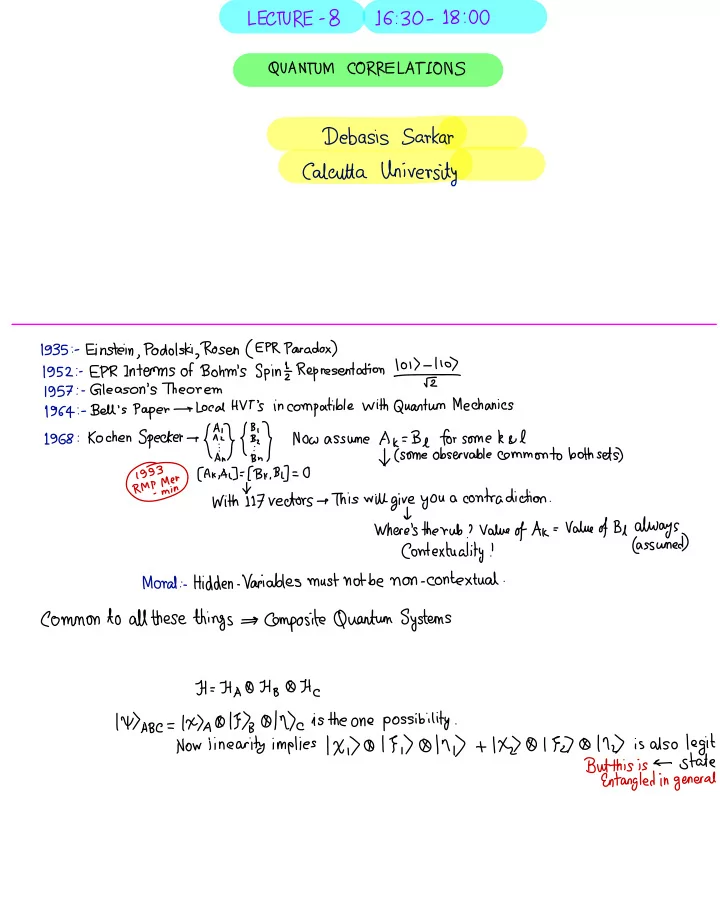
- 8 16 : 30 18 : 00 LECTURE - QUANTUM CORRELATIONS Sarkar De basis Calcutta University , Rosen ( EPR Paradox ) 1935 Einstein , Podolsk : - In terms of Bohm 's Spin te Representation 101714 1952 : EPR - Gleason 's


slide-1
SLIDE 1

LECTURE

  • 8

16:30

  • 18:00
QUANTUM CORRELATIONS

De basis

Sarkar

Calcutta

University

1935 :
  • Einstein
, Podolsk , Rosen ( EPR Paradox ) 1952 :
  • EPR
In terms
  • f
Bohm 's Spin te Representation 1017¥14 1957 :
  • Gleason
's Theorem 1964 :
  • Bell
's Paper
  • Local
HVT 's incompatible With Quantum Mechanics 1968 : Kochen Stecker
  • {
¥3} { Begin) Now assume

Ak= Be for

some k&l An

f, ( some

  • bservable
common to both sets

) [ Ak ,AD=[By ,BD= 0

€¥%

With

Ya

vectors
  • This will

givg

you

a contradiction .

away ,

Where's the rub ? value
  • f Ak
= Value of Be

Contextual

ity !

(

assumed) Moral :
  • Hidden
. Variables must not be non . contextual .

common to all these things

Gmposite Quantum Systems

FKHAOHBQ He

NDABE

=

1×7/+01923 QK)c is the

  • ne

possibility

. Now linearity implies

IXDQ 19

, ) QKD

+1×27019<7 QHD

is also

legit

Butthis is

  • state
Entangled in general
slide-2
SLIDE 2

ENTANGLEMENT

=

If PABE

= §w ; QPOPPQPF
  • Then Separable ;

Otherwise Entangled

(

OEW

:-< 1

& F Wi =D

Physical Realization

Separable States can be prepared locally FOR BIPARTITE PURE STATES

that

=

?¥n

;; li)aQ IDB
  • from Singular Value Decomposition Theorem
  • ne
can always Write this As = ,

¥

, 1 kayaked in some
  • ther basis
  • ( Schmidt Decomposition)
t

Iff

N=1
  • Separable

But for multipartite states

  • no

unique

Schmidt Decomposition

  • Can't be done

Bipartite Systems :

  • Q )
Is it Entangled ?

a)

If yes

  • How much

Entanglement ? Entanglement Quantification in terms of Teleportation Protocol Compare states in terms of their Entanglement

. . . Take

singlet (Original Benett Proto d)

  • 100% Exact Teleportation
; But take some
  • ther initial

states inexact teleportation

x

ttrms of fidelity wrt target

Suppose

we have a

state like

a 100)

tbli

D. . . . . .

allowed

  • peration
=

LOCC Under

LOccep0n_oQmf.mcrDent@tm-nCsCsx.D

  • Benett
concentration et al . . .

Xp

huffy entangled

Entangled Schumacher

Noiseless Data Compression Theorem

  • Allows the
reverse

process

'S (Pa) =

Entanglement of a pure bipartite state

  • Easily
Calculable What about mixed Bipartite

States ? Two Defy

  • 4
Distillable Entanglement 2) Entanglement
  • f formation} # for mixed

states

slide-3
SLIDE 3 EOF HAD =

inf

E P ; E ( IYDAB) Overall pure state decompositions

p⇒=§P ; lyiapxynitl

Distillable

Entanglement = nljmannt

But these

  • ptimizations
are hard to

do o# PROPERTIES

A GOOD MEASURE OF ENTANGLEMENT MUST

SATISFY @ Vanishes for Separable

State

@ LU
  • invariant

Monotone decreasing under

LOCC @ Additivity , Convexity , Continuity
  • NOT

Necessary but desirable

( like Six pack abs @ )

Hastings

  • EOF is not

additive

(Recent

Result )

One good candidate with all those properties
  • Squashed

Entanglement ( Winter)

t

But notoriously hard to calculate ( Winter if )

LOG . NEGATIVITY

/

CONCURRENCE

(2×2)

  • Easy to Calculate

÷

a¥x to Calculate

$

EoF= Simple te of Concurrence ~

log

I NI

N

= Negativity

(under

Partial Transpose)

Additive

but not

convex

Cplenio)

Squashed

Entanglement

  • Depends
  • n Quantum

Mutual Information

. . . So Good for Ckegyn
  • DETECTION
OF ENTANGLEMENT
  • Prob
: .

Given PAB is it entangled / separable ?

slide-4
SLIDE 4

Initially people thought

  • Bdlviolalim
  • = Entanglement
.

But for Werner States plate

.lt#)IeifpzHrEntang1edPossibletohavenoBdlViolationevenwithEntamnfpe)ButP707o..7-BellViolation

k#¥¥O¥iI¥

'

penetrate

Ifyouhaveanoperatorwhichistvebutnotcrewdlserveasa

detector

t

(e.g. Transpose

Operator)

(Hahn

. Banach )

FA=(

PABTBI

Partial

Transpose

  • n
B

Faare

20

  • PPT

states

EHAB

't

Parliairansposeona

}FE

ieeiaffninoemnredeigenraeue

.

mutates

t

Entangled for

sure

ButdoesPPT⇒

Separable ? 2×2,2×3

  • true

forhigher dimensional states

  • False
  • 7

Bound Entangled State

(Entangled but

not distillable) Example OFAPPT Entangled State in 3×3

systems

Walks

l°k±'IaH

i⇒oe¥±

" ' • "

} mnextpmodiauheapsasi

,

¥610 >

H

Implies

Existence of Bound Here

  • Entangled
states

EOF >0 But Distillable

  • g=(
  • 1. ¥

,lqXql )

. .
  • Bound

Entangl

Entanglement -0

ement

Reduction Criteria Violation

  • Distillable
  • Either Separable) Distillable
uau '* invariant states -=±+BP+[

Isotropic

states] where

!¥g±

,

lv

Definite form of

rd UQU

invariant states -=1+BV[ Werner states]

Entanglement available

hesatisfies Reduction

Criteria

  • canbe Bound
Entangled
slide-5
SLIDE 5 T pABnifyoutind1UDofrank-2and@1paEWfOeDistillab1et7O-0necepyundislillebleHarlialTransposDamilarlyn.cepyundistillabilityTomorrowi-MuHiparliteEntang1ement.N
  • ndassial

Correlations Beyond

Entanglement