Electric Current The amount of charge that flows by per unit time. - - PowerPoint PPT Presentation

electric current
SMART_READER_LITE
LIVE PREVIEW

Electric Current The amount of charge that flows by per unit time. - - PowerPoint PPT Presentation

Electric Current The amount of charge that flows by per unit time. Q I t Steady state A system (e.g. circuit) is in the steady state when the current at each point in the circuit is constant (does not change with


slide-1
SLIDE 1

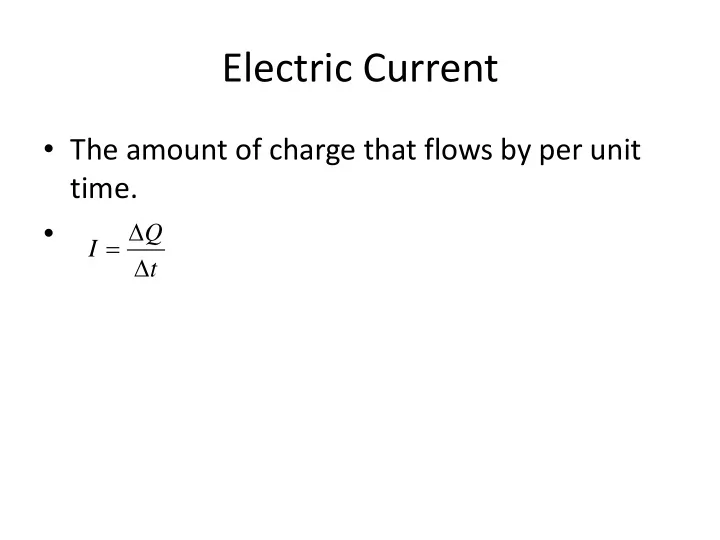
Electric Current

  • The amount of charge that flows by per unit

time.

  • Q

I t   

slide-2
SLIDE 2

Steady state

  • A system (e.g. circuit) is in the steady state

when the current at each point in the circuit is constant (does not change with time).

– In many practical circuits, the steady state is achieved in a short time.

  • In the steady state, the charge (or current)

flowing into any point in the circuit has to equal the charge (or current) flowing out.

– Kirchhoff’s Node (or Current) Rule.

slide-3
SLIDE 3

Figure 25.26

n = number of charges per unit volume = “charge-number density” (n > 1027 m-3 for a good metal) Typically vd ~ 10-5 m/s ~1 m/day

slide-4
SLIDE 4

Why do the electrons have a drift velocity?

  • They feel a force due to an electric field.
  • But then they should accelerate!: F = ma
  • Each electron does accelerate for some time

but then it collides with something (a nucleus, another electron, etc.).

  • After the collision, the electron goes off in

some random direction, giving it momentarily a zero average velocity.

  • The drift velocity is the average velocity in the

time between collisions:

2 2 2

d

a F qE v m m      

slide-5
SLIDE 5

Which of the following statements is false?

1) An electric field is needed to produce an electric current. 2) A potential difference between two points is needed to produce an electric current. 3) For a steady current to flow in a wire, the wire must be part of a closed circuit. 4) The electric field is constant along all parts of the circuit when a steady current is flowing. 5) The electric current in a wire is proportional to the drift velocity of the charges.

slide-6
SLIDE 6

Ohm’s Law

  • Current through a resistor (ohmic device) is

proportional to the potential difference across it.

V IR  

2

d

qE v m  

d

I qnAv 

2

2 q nAE I m  

2

2 q nA V I m l   

slide-7
SLIDE 7

Resistance and Resistivity

  • Resistance depends on the geometry of the

resistor – its length and cross-sectional area

– R is proportional to length – R is inversely proportional to area.

  • Resistivity r depends on material properties

like how often charges scatter.

l R A r 

slide-8
SLIDE 8

Wire A, which is of the same length and material as wire B, has twice the diameter of wire B. If the resistance of wire B is R, what is the resistance of wire A? 1) R 2) 2R 3) R/2 4) 4R 5) R/4

slide-9
SLIDE 9

Emf

  • Emf (Electromotive “force”) – the voltage

provided by some voltage source (e.g. a battery).

  • A source of emf converts non-electrical energy

to electrical energy.

  • E.g. electrical generator (turns mechanical energy

into electrical)

slide-10
SLIDE 10

Which of the relations among the quantities in the figure is generally correct?

1) I1R1 = I2R2 2) I3R3 = I4R4 3) I1R1 = I4R4 4) I3R4 = I4R3 5) I1R1 + I2R2 = e

slide-11
SLIDE 11

Power in a circuit

  • Power:
  • In time t, a charge Q enters on the left and

Q exits on the right.

E P t   

Vb Va