EFFECTIVE 9 . Documentation of Expenses FINANCIAL 8. Matching 4. - - PowerPoint PPT Presentation

effective
SMART_READER_LITE
LIVE PREVIEW

EFFECTIVE 9 . Documentation of Expenses FINANCIAL 8. Matching 4. - - PowerPoint PPT Presentation

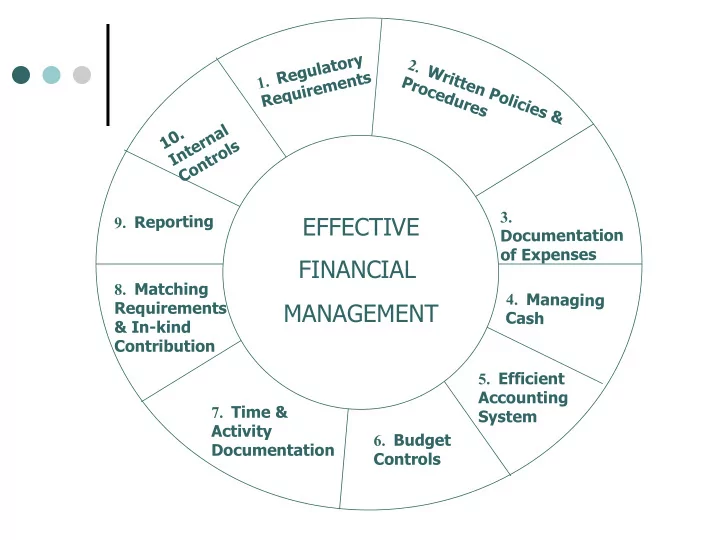
1. Regulatory Requirements 3. g R e p o r t i n EFFECTIVE 9 . Documentation of Expenses FINANCIAL 8. Matching 4. Managing Requirements MANAGEMENT Cash & In-kind Contribution 5. Efficient Accounting 7. Time & System


slide-1
SLIDE 1
  • 1. Regulatory

Requirements 3. Documentation

  • f Expenses
  • 4. Managing

Cash

  • 5. Efficient

Accounting System

  • 6. Budget

Controls

  • 7. Time &

Activity Documentation

  • 8. Matching

Requirements & In-kind Contribution 9 . R e p

  • r

t i n g

EFFECTIVE FINANCIAL MANAGEMENT

slide-2
SLIDE 2

What is the OMB?

 Executive Branch agency that assists in

preparation of the federal budget

 Responsible for coordination of

financial management information.

 Helps to improve administrative

management and develop government wide policies

 Assures grants are managed properly

and funds are spent in accordance with applicable laws and regulations.

slide-3
SLIDE 3

Authority

 The OMB Circulars do not work by

themselves

 They are binding when published by

Federal Agencies.

 Publishing a final rule in the Federal

Register officially adds it to the Code

  • f Federal Regulations therefore

making it mandatory.

slide-4
SLIDE 4

Federal Register & CFR

 The Federal Register is the official

daily publications for Rules, Proposed Rules and Notices of Federal agencies.

 The Code of Federal Regulations

(CFR) is the codification of the general and permanent rules published in the Federal Register. It is divided into 50 titles that represent broad areas subject to Federal regulation.

slide-5
SLIDE 5

Administrative Requirements and the CFR

 On March 12, 1987, the President directed

the Federal grantmaking agencies to issue a grants management common rule to adopt governmentwide terms and conditions for grants

 The attachments to the Administrative

Requirement Circulars were replaced by the grants management common rule

 It is important for a grantee to review the

regulations of their Federal awarding agency

slide-6
SLIDE 6

Administrative Requirements

 Provides consistency and uniformity

among Federal agencies in the management of grants and cooperative agreements

 Specific grantmaking requirements for

CNCS can be found in the Code of Federal Regulations (CFR).

 The CFR required all Federal agencies to

issue a grants management common rule to adopt government wide terms and conditions.

slide-7
SLIDE 7

How & when do I use the OMB Circulars?

 Cost Principles  Administrative

Requirements

 Audits

The Circulars provide information relevant to the grant in the following areas:

slide-8
SLIDE 8

Cost Principles

 Established principles to determine the

allowable costs incurred by

  • rganizations under grants or

contracts;

 Principles are designed so that Federal

awards bear their fair share of cost recognized under these principles

slide-9
SLIDE 9

Cost Principles

 Provides guidance about

reimbursement requirements

 Provides uniform standards of

allowability and allocation

 Encourages consistency of treatment

  • f costs
slide-10
SLIDE 10

Factors affecting allowability

  • f costs

To be allowable under an award, costs must meet the following general criteria:

 Be reasonable for the performance of the award

and be allocable under OMB principles.

 Conform to any limitations set forth in OMB

principles or in the award as to types or amount of cost items.

 Be consistent with policies and procedures that

apply uniformly to both federally-financed and

  • ther activities of the organization.
slide-11
SLIDE 11

Factors affecting allowability

  • f costs (con’t)

To be allowable under an award, costs must meet the following general criteria:

 Be accorded consistent treatment.  Be determined in accordance with generally

accepted accounting principles (GAAP).

 Not be included as a cost or used to meet cost

sharing or matching requirements of any other federally-financed program in either the current or a prior period.

 Be adequately documented.  Be ordinary and necessary for the operation of the

  • rganization or the performance of the award.
slide-12
SLIDE 12

Reasonable Costs

 A cost is reasonable if it does

not exceed that which would be incurred by a prudent person under the circumstances prevailing at the time the decision was made to incur the

  • costs. The question of the

reasonableness of specific costs must be scrutinized with particular care in connection with organizations or divisions which receive the preponderance

  • f their support from awards

made by Federal agencies.

slide-13
SLIDE 13

A-133 Audits

 Standards for obtaining

consistency and uniformity among Federal agencies for the audit of organizations expending Federal funds

 Applicable to organizations

that expend $500,000 or more of federal funds in a year

slide-14
SLIDE 14

Which Circular do I Follow?

 Although there are six grant circulars,

you are only covered by three of them, depending on type of entity:

 States, local governments, and Indian

Tribes

 Educational Institutions (even if part of a State

  • r local government)

 Non-Profit Organizations  Subgrantees should follow the

circulars for their organization type regardless of the grantors.

slide-15
SLIDE 15

Summary of Relevant OMB Circulars

Each of the specific circulars can be downloaded from the internet at the following address: Http://www.whitehouse. gov/OMB/circulars/index.html

Educational Institutions Non- Profit Organizations State & Local Governments Uniform Administrative Requirements

45 CFR 2543 & Circular No. A- 110 45 CFR 2543 & Circular No. A- 110 45 CFR 2541 & Circular No. A-102

Cost Principles

Circular No. A -21 Circular No. A-122 Circular No. A-87

Audits

Circular No. A-133 Circular No. A-133 Circular No. A-133