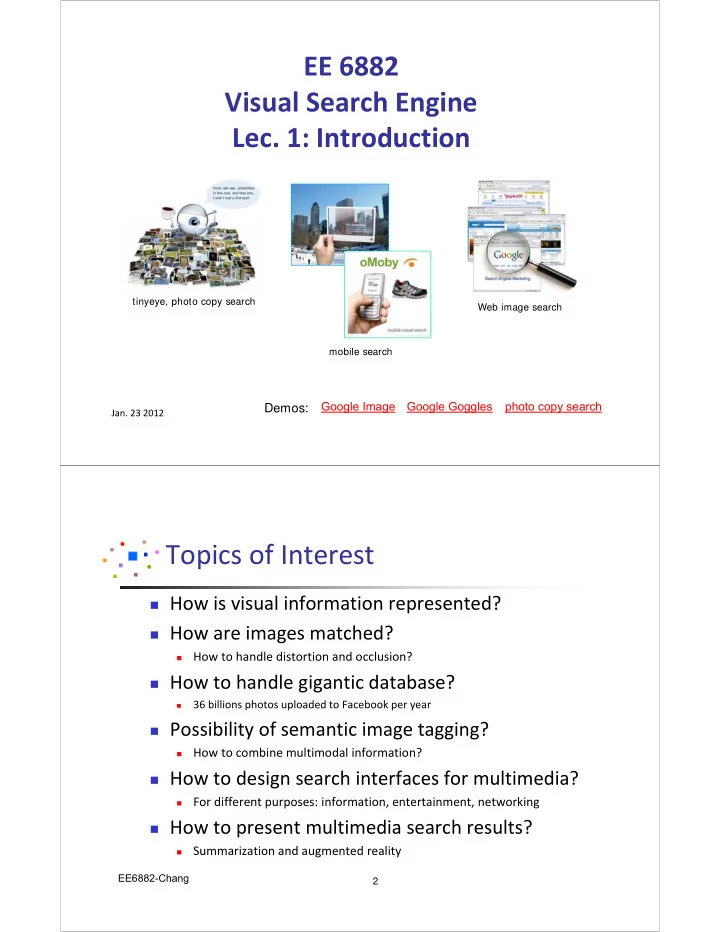
EE 6882 Visual Search Engine Lec. 1: Introduction tinyeye, photo - - PDF document

ee 6882 visual search engine lec 1 introduction
SMART_READER_LITE
LIVE PREVIEW

EE 6882 Visual Search Engine Lec. 1: Introduction tinyeye, photo - - PDF document

EE 6882 Visual Search Engine Lec. 1: Introduction tinyeye, photo copy search Web image search mobile search Google Image Google Goggles photo copy search Demos: Jan. 23 2012 Topics of Interest How is visual information represented?


slide-1
SLIDE 1

EE 6882 Visual Search Engine

  • Lec. 1: Introduction

tinyeye, photo copy search mobile search

Google Goggles Google Image photo copy search

Web image search

  • Jan. 23 2012

Demos:

Topics of Interest

 How is visual information represented?  How are images matched?

How to handle distortion and occlusion?

 How to handle gigantic database?

36 billions photos uploaded to Facebook per year  Possibility of semantic image tagging?

How to combine multimodal information?

 How to design search interfaces for multimedia?

For different purposes: information, entertainment, networking

 How to present multimedia search results?

Summarization and augmented reality

2 EE6882-Chang

slide-2
SLIDE 2

3

Visual Information Generation

illumination scene Sensing device image

4 S.-F . Chang, Columbia U.

Visual Representation and Features

R G R G R G B G B G R G R G R G B G B G R G R G R

Lens CCD Sensor

Demosaicking Filter

Camera Response Function

Additive Noise DSP (White Balance, Contrast Enhancement … etc)

irradiance Image intensity

slide-3
SLIDE 3

digital video | multimedia lab

Image quality not always perfect

 Image quality variations

 Exposure  Shadow  Distance  Obstruction  Blur  Weather  Day/Night Navteq NYC Data

Visual Representation: Global Features

Texture

20 40 60 80 100 0.2 0.4 0.6 0.8 1

energy in filter banks Shape

http://www.cs.princeton.edu/gfx/proj/shape/

Color

slide-4
SLIDE 4

Local Features: Keypoint Localization

  • Keypoint properties:

– Interesting content – Precise localization – Repeatable detection under variations of scale, rotation, etc

(Slide of K. Grauman) S.-F. Chang, Columbia U. 7

Example: Hessian Detector [Beaudet78]

  • Hessian determinant

Ixx Iyy Ixy

2

)) ( det(

xy yy xx

I I I I Hessian  

2 )^ ( .

xy yy xx

I I I   In Matlab:       

yy xy xy xx

I I I I I Hessian ) (

(Slide of K. Grauman) 8 S.-F. Chang, Columbia U.

slide-5
SLIDE 5

Local Appearance Descriptor (SIFT)

[Lowe, ICCV 1999]

Histogram of oriented gradients over local grids

  • e.g., 2x4, or 4x4 grids and 8 directions

‐> 4x4x8=128 dimensions

  • Scale invariant

S.-F. Chang, Columbia U. 9

Compute gradient in a local patch

10

  • K. Grauman, B. Leibe

Image representation

  • Image content is transformed into local features that are

invariant to geometric and photometric transformations

Local Features, e.g. SIFT

S lide: David Lowe

slide-6
SLIDE 6

Example

Initial matches Spatial consistency required

Slide credit: J. Sivic

Match regions between frames using SIFT descriptors and spatial consistency

Shape adapted regions Maximally stable regions

Multiple regions overcome problem of partial occlusion

Slide credit: J. Sivic

slide-7
SLIDE 7

Sivic and Zisserman, “Video Google”, 2006

Clustering of Image Patch Patterns

Corners Blobs eyes letters

From local features to Visual Words

clustering 128‐D feature space visual word vocabulary

slide-8
SLIDE 8

Represent Image as Bag of Words

clustering keypoint features visual words

… …

BoW histogram

Content Based Image Search

 Demo: Object Retrieval  Demo 2: Flickr Image Search

16 S.-F. Chang, Columbia U. Demos of Junfeng He

slide-9
SLIDE 9

Application of Image matching: search result summary

Issue a text query Find duplicate images, merge into clusters Explore history/trend Get top 1000 results from web search engine Rank clusters (size?, original rank?)

Slide of Lyndon Kennedy digital video | multimedia lab

Matching Reveals Image Provenance

Biggest Clusters Contain Iconic Images Smallest Clusters Contain Marginal Images

slide-10
SLIDE 10

Scale Up: Find similar images over Internet

 Billions of images online as dense sampling of the world  For every image taken, likely to find images that look alike

80 Million Tiny Images, Torralba, Fergus & Freeman, PAMI 2008

IM2GPS: where is this photo taken? (Hays & Efros, 2008)

Similar images Most likely locations

slide-11
SLIDE 11

digital video | multimedia lab

IM2GPS: where is this photo taken? (Hays & Efros, 2008)

Similar images Most likely locations

digital video | multimedia lab

IM2GPS: where is this photo taken? (Hays & Efros, 2008)

Similar images Most likely locations

slide-12
SLIDE 12

Images on Social Networks

 Understanding social behaviors by media mining

 Crandall et al, WWW 2009, 35 million Flickr photos,

300,000 users, photographer movement paths

Indexing Gigantic Dataset

  • Exhaustive matching of every image is infeasible
  • Use hierarchical clustering to speedup

– Reduce clustering complexity from O(dk2) to O(d*log(k)) d: feature dimension, k: clusters

  • Each local feature mapped to a path in the tree
  • Each image represented as a sub‐tree plus
  • ccurrence frequency of nodes
  • Each node linked with an inverted file of images
  • Similarity between query and database images

= similarity between two sub‐trees

Nister and Stewenius ‘06

slide-13
SLIDE 13

Search over Billions: Scalability is a Big Issue

 Similarity Search: traditional tree‐based methods (e.g., kd‐tree) not

suitable in high dimension, because of back tracing

 Need accurate, sublinear solutions (o(N), O(log(N)), O(1) )  Recent trends:

Hashing based index

 Random projection:

Locality Sensitive Hash (LSH)

[Indyk & Motwani 98, Charikar 02]  Principal projection:

Spectral Hashing [Weiss et al 08]

 Restricted boltzman machines [Hinton et al. 06, Torralba et al. 08]  Kernel LSH [Kulis et al. 09 & Mu et al. 10]

h

  • 1

+1 x1 x2 P(h(x1) = h(x2)) = 1- cos-1(x1·x2)/π = Sim(x1, x2) random projection h with N(0,1)

Beyond Tree Indexing: Locality Sensitive Hashing (LSH)

Choose a random projection

Project points

Points close in the original space remain close under the projection

Unfortunately, converse not true

 Answer: use multiple quantized projections which define a

high-dimensional “grid”

Slide credit: J. Sivic

slide-14
SLIDE 14

Slide of Sanjiv Kumar

Probabilistic guarantee of finding true targets within ε distance range

[Indyk & Motwani 98]

digital video | multimedia lab

Going to Higher Level: Text-based Search

Current system still flawed, e.g., keyword: Manhattan Cruise

slide-15
SLIDE 15

Auto Image Tagging May Help Fill the Gap

Audio-visual features

User social features

Camera/location info

. . .

Rich semantic description based on content recognition Statistical models

+

  • Anchor

Snow Soccer Building Outdoor

29

S.-F. Chang, Columbia U.

to maximize margin

wTx + b = 0

Airplane

Machine Learning: Build Classifier

wTxi + b > 0 if label yi= +1 wTxi + b < 0 if label yi= ‐1 Find separating hyperplane: w Decision function: f(x) = sign(wTx + b)

slide-16
SLIDE 16

TRECVID: Detection Examples

Classroom Demonstration Or Protest Cityscape Airplane flying Singing

  • Top five classification results

Object Localization

(PASCAL VOC)

bird cat cow dog horse sheep aeroplane bicycle boat bus car motorbike train bottle chair dining table potted plant sofa tv/monitor Person

slide-17
SLIDE 17

Assembling a shelter Batting a run‐in Making a cake

Need fusion of multimodal analysis: visual, audio, text, temporal

Example 1 Example 2 Example 3 Example 4

High‐Level Multimedia Event Detection

TRECVID 2010 MED Events:

Batting a run in

Grass Baseball Field Cheering Sky Running

Scene Concepts Audio Concepts

Walking

Action Concepts

Understanding contexts is critical for event modeling.

Clapping Speech

Model Event Context

slide-18
SLIDE 18
  • Offline concept detection
  • Online search

Find “people talking”

Classifiers Enable Concept‐Level Search

Visual Concept Classifiers

Anchor person Person, Meeting, … Military action, Vehicle, Road, Building…

Anchor person Person Meeting Military action Vehicle Road Building

35

Classifier Pool

Explore Concept Correlation: Semantic Diffusion via Graph

correlation matrix Classifier cj score

Individual Classifiers: Desert: 0.68; Sky: 0.60; Weapon: 0.38; Car: 0.43; Vehicle: 0.35 …

Concept correlation graph

slide-19
SLIDE 19

Iteration: 0 Iteration: 4 Iteration: 16

Adapting Graph Weights to New Domain

Broadcast News Documentary

Iteration: 20 Iteration: 8 Iteration: 12

Need to adapt to correlation new test domain on the fly

(Jiang, Ngo, and Chang, ICCV09)

The correlation model does not fit the new domain

Graph optimization

Columbia CuZero: 400+ classifiers

airplane airplane_takeoff airport_or_airfieldarmed_personbuildingcar cityscapecrowd desert dirt_gravel_road entertainmentexplosion_fire foresthighway hospital insurgents

landscape mapsmilitary military_basemilitary_personnelmountain nighttime people- marching person powerplants riot riverroad rpg shootingsmoke tanksurban vegetation vehicle waterscape_waterfrontweaponsweather

concept detection models:

  • bjects, people, location, scenes,

events, etc

Evaluation of 20 concepts at TRECVID 2008

Columbia Runs

slide-20
SLIDE 20

Demos: classifier‐based search

  • Find lake front buildings in the park
  • Find person walking around building
  • Find a car on a road in a snowy condition

39

When User in the Loop: Interactive Query Refinement

Query Formulation

Online Update/ Rerank

Query Processing

1 2

  • Query Examples
  • Classifiers
  • Key Words
  • Feature Selection
  • Distance Metric
  • Ranking Model

New Classifiers

  • Relevance Feedback

(shot, track, track interval)

  • Feature/Attributes
  • Interaction Log

Handle novel data

3

Results Updated results

slide-21
SLIDE 21

Columbia TAG Interactive Image Search System

 Demo:

Rapid Image Annotation with User Interaction

41 S.-F. Chang, Columbia U.

Person: 79% Clinton: 75% US Flag: 80% Podium: 70% Give speech: 75% Press conference: 65%

Tags:

Instead of Automatic Tagging 100% of Concepts

What if we can ask users to help 1-2 labels?

Partial Active Tagging

User labels: park, picnic

  • Auto. generated labels:

people, tree, mountain, etc

(Jiang, Chang, Loui, ICIP 06)

slide-22
SLIDE 22

Examples of Best Questions

Active Tagging

Best Questions to Ask User?

Airplane, animal, boat, building, bus, car, chart, court , crowd, desert, entertainment, explosion_fire, face, flag_us, government_leader, map, meeting, military, mountain, natural_disaster, office, outdoor, people_marching, person, road, sky, snow, sports, urban, waterscape, etc

User in the Loop - Relevance Feedback

  • Human‐machine collaboration

– Humans/machines do what they are best at [Branson et al, ECCV, 2010]

20-Question Game

slide-23
SLIDE 23

Mobile Visual Search

Image Database

  • 1. Take a picture
20 40 60 80 100 120 140 0.1 0.2 0.3 0.4 0.5
  • 2. Image

feature extraction

  • 3. Send to

server via MMS

  • 4. Feature

matching with database images

20 40 60 80 100 120 140 0.1 0.2 0.3 0.4 0.5 20 40 60 80 100 120 140 0.1 0.2 0.3 0.4 0.5 20 40 60 80 100 120 140 0.1 0.2 0.3 0.4 0.5
  • 5. Send most

similar images back

System level issues

 Speed

 Feature extraction  Transmitting features or images (up and down)  Searching large databases

 Storage

 Features and codebooks

 User interface

 Quality of captured images  Visualization of search results

46 EE6882-Chang

slide-24
SLIDE 24

digital video | multimedia lab

Mobile Challenge: Speed and Bandwidth

 Speed still limited by bandwidth and power

Mobile Visual Search, Girod, et al, SPM, 2011

Server:

  • 400,000 product images crawled

from Amazon, eBay and Zappos

  • Hundreds of categories; shoes,

clothes, electrical devices, groceries, kitchen supplies, movies, etc.

Speed

  • Feature extraction: ~1s
  • Transmission: 80 bits/feature
  • Serer Search: ~0.4s
  • Download/display: 1-2s

Columbia Mobile Product Search System based on Hashing

video demo Mobile App Demo He, Lin, Feng, and Chang, ACM MM 2011

slide-25
SLIDE 25

digital video | multimedia lab

Add Interactive Tools on Mobile Devices

 Interactive Segmentation

 User helps machine identify point of interest

1:01

Mobile Location Search

  • 300,000 images of 50,000 locations in Manhattan
  • Collected by the NAVTEQ street view imaging system

Geographical distribution

50

slide-26
SLIDE 26

How to guide the user to take a successful mobile query?

– Which view will be the best query?

  • For example, in mobile location search:
  • Or in mobile product search:

51

Challenge

Solution: Active Query Sensing

 Guide User to a More Successful Search Angle

 Active Query Sensing [Yu, Ji, Zhang, and Chang, ACMMM ’01]

Video demo Mobile App Demo

slide-27
SLIDE 27

Mobile Augmented Reality

 MIT Sixth Sense Project (Pranav Mistry and Pattie Maes, MIT)

 Mobile wearable computer  Camera and projector  Gesture interaction  Visual recognition

EE 6882, Spring 2011

 Course web site:

 http://www.ee.columbia.edu/~sfchang/course/vse

 Instructor: Prof. Shih‐Fu Chang

 Office hour: Monday 11‐12, CEPSR 709

 Asst. Instructor: Dr. Rong‐Rong Ji

Office Hour: Friday 2‐4pm, CEPSR 707

Staff Assistants: Tongtao Zhang, and Jinyuan Feng  Prerequisites:

 Image processing or computer vision, pattern

recognition, probability (a 15 mins quiz)

54 EE6882-Chang

slide-28
SLIDE 28

55

Course Format

Required background: familiarity with image processing, pattern

  • recognition. There will be a quiz.

Lectures + two hands‐on homeworks (due 2/13, 2/27)

Mid‐term project

Review and experiment topics of interest, 2 students each team

Proposal due 3/5, narrated slides due 3/26

Selected projects presented and discussed in class (3/26‐4/9)

Final project

Extension of mid‐term projects encouraged, 2 students each team

Proposal due 4/2, narrated slides due 4/30

Selected projects presented and discussed in class (4/30‐5/7)

Grading:

class participation (20%), homework (20%), mid‐term (20%), final (40%)

Everyone has a total “budget” of 4 days for late submissions. No other delayed submission accepted.

56 EE6882-Chang

Examples of Final Projects

 Mobile visual search: feature extraction, quality

enhancement, real‐time systems

 Mobile augmented reality  Image search for specific domains: product, patent

trademark, roadside objects, landmarks, 3D objects

 Hashing for search over million scale datasets  Gesture recognition with depth sensors  Fast video copy detection  Search by sketch drawings  Multimedia summarization

slide-29
SLIDE 29

Reading List

Many papers available at http://www.ee.columbia.edu/ln/dvmm/newPublication.htm/

Rui, Y., T.S. Huang, and S.‐F. Chang, Image retrieval: current techniques, promising directions and open

  • issues. Journal of Visual Communication and Image Representation, 1999. 10(4): p. 39‐62.

Smeulders, A.W.M., et al., Content‐Based Image Retrieval at the End of the Early Years. IEEE Trans. Pattern

  • Anal. Mach. Intell., 2000. 22(12): p. 1349‐1380.

Sivic, J. and A. Zisserman, Video Google: A text retrieval approach to object matching in videos, in ICCV. 2003.

Mikolajczyk, K. and C. Schmid, A performance evaluation of local descriptors. IEEE Transactions on Pattern Analysis and Machine Intelligence, 2005: p. 1615‐1630.

Nister, D. and H. Stewenius. Scalable recognition with a vocabulary tree. in CVPR. 2006.

Jiang, Y.‐G., et al. Consumer Video Understanding: A Benchmark Database and An Evaluation of Human and Machine Performance. ACM International Conference on Multimedia Retrieval (ICMR), 2011.

Zavesky, E. and S. Chang. CuZero: embracing the frontier of interactive visual search for informed users. in ACM Multimedia Information Retrieval (MIR). 2008.

Kennedy, L. and M. Naaman. Generating diverse and representative image search results for landmarks. in ACM WWW. 2008.

Yu, F., R. Ji, S.‐F. Chang. Active Query Sensing for mobile location search. In Proceeding of ACM International Conference on Multimedia (ACM MM), 2011. 57 EE6882-Chang